
DNA Replication: Steps, Mechanism, and Diagram (Prokaryotic)
DNA replication copies one DNA molecule into two before a cell divides. Learn the semi-conservative mechanism, the step-by-step process at the replication fork, and how leading and lagging strands are built.

On this page
Every time a cell divides, it must first make a complete copy of its DNA, so that each daughter cell receives the full set of instructions. A human cell copies about 3 billion base pairs, and it does so with remarkably few mistakes. This copying is called DNA replication, and it is one of the most important processes in all of biology. It is the reason a single fertilized egg can become a whole organism in which every cell carries the same genetic information, and it is the reason parents pass traits to their children.
The central question replication has to answer is simple to ask and hard to solve: how do you copy a molecule and be sure the copy is correct? The answer, worked out by experiment, is that DNA copies itself in a semi-conservative way. Each of the two old strands is kept and used as a pattern for a new strand. This article explains what that means, why it matters, and how a team of proteins carries it out step by step.
Why a cell must copy its DNA
DNA carries the instructions a cell needs to build proteins and to function. Before a cell divides into two, it must give each new cell a complete and correct copy of these instructions. If the copy were incomplete or full of errors, the new cell could malfunction or die. So replication is not just copying; it is copying with very high accuracy. This is true in every living organism, from bacteria to humans, which is why replication is a foundation topic across all of biology and health science.
The three proposed models of replication
When scientists first asked how DNA copies itself, three models were possible.
In the semi-conservative model, the two strands of the parent DNA separate, and each old strand serves as a template for building one new strand. Each daughter molecule therefore contains one old strand and one new strand.
In the conservative model, the parent molecule would stay fully intact, and an entirely new double-stranded copy would be made separately. The daughter would be made of two brand-new strands.
In the dispersive model, the parent DNA would be broken into pieces, copied, and reassembled, so that each strand of each daughter molecule would be a mixture of old and new segments.
The semi-conservative model is the correct one. This was shown by the classic Meselson and Stahl experiment, which followed heavy and light nitrogen through successive generations of DNA and found exactly the pattern the semi-conservative model predicts: after one round of replication, every molecule was a hybrid of one old and one new strand. Understanding that replication is semi-conservative is the single most important idea on this page, because everything that follows depends on each old strand acting as a template.
 Figure: Semiconservative model of replication, Source: BROCK Biology of Microorganism
How a template works
A template is a single strand of DNA whose base sequence decides the sequence of the new strand. The rule is base pairing: adenine pairs with thymine, and guanine pairs with cytosine. So if the template reads A, the new strand gets T opposite it; if the template reads G, the new strand gets C. Because both old strands are used as templates, and because base pairing is exact, the two daughter molecules end up identical to the original. This is how copying and accuracy are achieved at the same time.
The direction problem: why the two new strands are not built the same way
There is one complication that shapes the whole process, and it is worth understanding before the steps. The two strands of DNA run in opposite directions (they are antiparallel). The enzyme that builds new DNA can add building blocks in only one direction, always adding to the 3′ end so that the new strand grows 5′ to 3′. Because the two templates point in opposite directions, only one new strand can be built smoothly and continuously toward the opening point. The other has to be built in short pieces, in the opposite direction. This single fact explains the leading strand, the lagging strand, and the Okazaki fragments described below. Keep it in mind and the rest follows logically.
Steps of DNA replication in prokaryotes
Replication is usually described in three stages: initiation, elongation, and termination. The description below uses the bacterium Escherichia coli, the best-studied example. The enzymes are named here as the actors in each step; the full mechanism of each enzyme is covered in detail in the companion article on the enzymes involved in DNA replication.
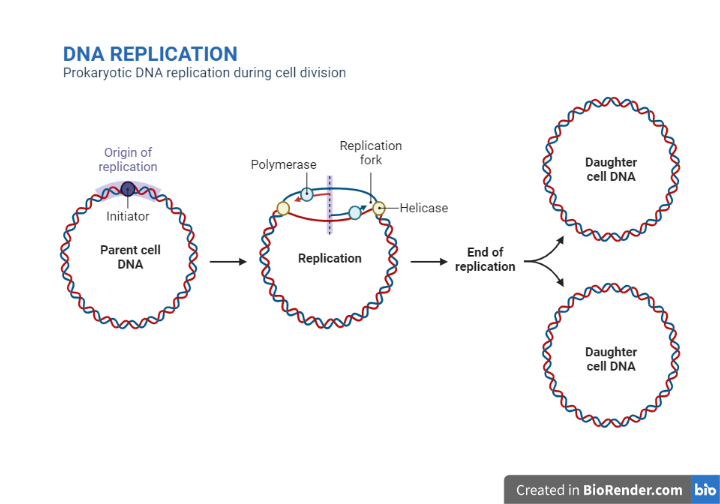 Figure: DNA replication in prokaryotes
Initiation
Replication does not start just anywhere. It begins at a specific site called the origin of replication. In E. coli this origin is named oriC and is about 245 base pairs long. It contains a cluster of short repeated sequences: a set of 9-mer repeats that act as binding sites for the initiator protein, and next to them a stretch of three AT-rich 13-mer repeats. AT-rich DNA is easier to pull apart because A-T pairs are held by only two hydrogen bonds, while G-C pairs have three. The initiator protein binds the 9-mer sites and then opens up the AT-rich 13-mer region, creating a small opened area called the replication bubble.
Once the DNA is opened, helicase is loaded onto the strands and begins unwinding the double helix, moving in both directions and creating two Y-shaped replication forks that travel away from the origin. As the strands separate, single-stranded binding proteins coat them to keep them apart and protect them, and topoisomerase relieves the twisting strain that builds up ahead of each fork. Each of these jobs is done by a specific enzyme, described on the enzymes page.
Elongation
New DNA cannot be started from nothing. Synthesis must begin from a short primer, a small piece of RNA laid down on the template by the enzyme primase. Once a primer is in place, DNA polymerase III extends it, reading the template and adding matching DNA nucleotides to build the new strand in the 5′ to 3′ direction.
Because of the direction problem described earlier, the two new strands are built differently.
The leading strand is built continuously. Its template allows DNA polymerase to follow the fork as it opens, so one primer is enough and synthesis runs smoothly in one long piece.
The lagging strand is built discontinuously, in short pieces called Okazaki fragments. Here the template runs the opposite way, so the polymerase can only work in short stretches away from the fork. Each Okazaki fragment needs its own new primer. Afterward, the RNA primers are removed and replaced with DNA by DNA polymerase I, and DNA ligase seals the gaps between fragments into one continuous strand. This is why the lagging strand needs more steps and more enzymes than the leading strand to copy the same length of DNA.
Accuracy is built into this stage. DNA polymerase III checks each base it adds and can remove a wrong one before moving on. This proofreading is a major reason replication makes so few errors.
Termination
In the circular E. coli chromosome, the two forks travel in opposite directions around the circle and eventually meet on the far side, in a region containing specific termination (Ter) sequences. A protein called Tus binds these Ter sites and acts like a one-way trap: a fork can enter but cannot pass through, so replication stops there. After the two new circular chromosomes are finished, they are often linked together like two rings of a chain, and a topoisomerase separates them so that each daughter cell receives one complete chromosome during cell division.
Prokaryotic versus eukaryotic replication
The basic mechanism, semi-conservative copying built on templates and primers, is the same in all organisms. The main differences are in scale and setting.
| Feature | Prokaryotes (e.g. E. coli) | Eukaryotes |
|---|---|---|
| Location | Cytoplasm (no nucleus) | Nucleus (and mitochondria) |
| Chromosome shape | Usually one circular chromosome | Several linear chromosomes |
| Origins of replication | One per chromosome | Many per chromosome |
| Replication forks | Two, from the single origin | Many, from many origins |
| Okazaki fragment length | Longer (about 1,000 to 2,000 nucleotides) | Shorter (about 100 to 200 nucleotides) |
| Main synthesis enzyme | DNA polymerase III | DNA polymerase δ and ε |
| DNA packaging | Not wrapped around histones | Wrapped around histones |
| Speed | Fast; a few thousand bases per second | Slower per fork, but many forks at once |
Eukaryotes use many origins because their chromosomes are far longer. Copying a human chromosome from a single origin would take far too long, so replication starts at many points at once and the sections are later joined.
(The enzyme names differ between the two groups and do not match one-to-one. Bacterial DNA polymerase III is the main replicase, while in eukaryotes that role is split. The details are on the enzymes page; do not try to pair them by number.)
Why DNA replication matters
Replication is more than a textbook process. It is the point at which genetic information is passed on, and it connects to several things a health-science student will meet again.
Accuracy and mutation: replication is highly accurate, but not perfect. The rare uncorrected error is one source of mutation, which underlies both evolution and disease.
Speed and infection: bacteria such as E. coli can copy their entire genome quickly, which is part of why bacterial infections can grow so fast.
Drug targets: because replication is essential, several enzymes that carry it out are targets for drugs. The bacterial enzyme DNA gyrase, for example, is blocked by the fluoroquinolone antibiotics. Some anticancer drugs work by interfering with DNA replication in rapidly dividing cells. These connections are developed further on the enzymes page.
How to Remember
Semi-conservative in three words: "keep one, copy one." Each daughter molecule keeps one old strand and copies one new strand. If you remember only one thing about replication, remember this, because every step exists to serve it.
Why AT opens first. The origin is AT-rich because A-T pairs have only two hydrogen bonds, while G-C pairs have three. Fewer bonds means easier to pull apart. Think "AT = two bonds = the easy zipper," which is why the machinery opens the DNA there.
Leading versus lagging, using your hands. DNA is only built 5′ to 3′. Point the fingers of both hands toward an opening point in the middle: one hand points "with" the opening (leading, one smooth piece), the other points "against" it (lagging, built backward in short Okazaki fragments). The direction problem is the whole reason one strand is broken into pieces.
Okazaki = lagging. The name to attach to the short pieces is Okazaki, and they are only on the lagging strand. A quick self-check: "Which strand is discontinuous?" If your answer names Okazaki fragments, you have the right one.
Key exam facts in one table
| Fact | Detail |
|---|---|
| What replication does | Copies one DNA molecule into two before cell division |
| Mechanism | Semi-conservative (each daughter = one old + one new strand) |
| Proven by | Meselson and Stahl experiment |
| Base pairing rule | A with T, G with C |
| Direction of synthesis | 5′ to 3′ only (adds to the 3′ end) |
| Start site | Origin of replication (oriC in E. coli, ~245 bp) |
| Primer | Short RNA piece; needed to start synthesis |
| Leading strand | Continuous, one primer |
| Lagging strand | Discontinuous, built in Okazaki fragments, one primer each |
| Termination (E. coli) | Forks meet at Ter sites; Tus protein traps the fork |
| Prokaryotic origins | One per chromosome |
| Eukaryotic origins | Many per chromosome |
Where Students Get Confused
Semi-conservative does not mean half of each strand is new. It means each double-stranded daughter molecule has one whole old strand and one whole new strand. The "half" is per double helix, not per single strand. Mixing this up is the most common replication error on exams.
The primer is RNA, not DNA. Synthesis cannot start on bare template. A short RNA primer is laid down first, and it is later removed and replaced with DNA. Students often assume DNA polymerase starts from nothing; it cannot.
Leading and lagging are not two different molecules. They are the two new strands being made at the same fork, at the same time. One is continuous and one is in pieces because of the antiparallel direction rule, not because they are separate events.
Replication is not transcription. Replication copies DNA into DNA to prepare for cell division. Transcription copies DNA into RNA to make a working message for protein synthesis. Different purpose, different product. If the product is a full second copy of the DNA, it is replication.
Okazaki fragments are only on the lagging strand. The leading strand is one continuous piece. Only the lagging strand is built in fragments.
References
- Madigan MT, Bender KS, Buckley DH, Sattley WM, Stahl DA. Brock Biology of Microorganisms. 16th ed. Pearson; 2021.
- Watson JD, Baker TA, Bell SP, Gann A, Levine M, Losick R. Molecular Biology of the Gene. 7th ed. Pearson; 2013.
- Nelson DL, Cox MM. Lehninger Principles of Biochemistry. 8th ed. W.H. Freeman; 2021.
Frequently Asked Questions
What is DNA replication in simple terms?
What is DNA replication in simple terms?
DNA replication is the process by which a cell copies its DNA, turning one double-stranded molecule into two identical ones. It happens before a cell divides, so that each new cell gets a complete copy of the genetic instructions.
Why is DNA replication called semi-conservative?
Why is DNA replication called semi-conservative?
Because each new double helix keeps one strand from the original DNA and pairs it with one newly made strand. Half of each daughter molecule is old and half is new, which is what "semi-conservative" means. This was proven by the Meselson and Stahl experiment.
What is the difference between the leading and lagging strands?
What is the difference between the leading and lagging strands?
The leading strand is built continuously in one long piece as the DNA opens. The lagging strand is built in short pieces called Okazaki fragments, because its template runs in the opposite direction and DNA can only be built in the 5′ to 3′ direction. The lagging strand therefore needs more primers and more steps.
What are Okazaki fragments?
What are Okazaki fragments?
They are the short pieces of new DNA made on the lagging strand. Each one is started with its own RNA primer, then the primers are removed and the fragments are joined into a continuous strand by DNA ligase.
Why does DNA replication need a primer?
Why does DNA replication need a primer?
The enzyme that builds new DNA cannot start a strand from nothing. It can only add to an existing 3′ end. A short RNA primer provides that starting point, and it is later replaced with DNA.
Where does DNA replication take place?
Where does DNA replication take place?
In prokaryotes such as bacteria, it happens in the cytoplasm, since they have no nucleus. In eukaryotes, it happens in the nucleus, and also in the mitochondria for the small amount of DNA found there.
How is DNA replication different from transcription?
How is DNA replication different from transcription?
Replication copies DNA into DNA to prepare for cell division, producing a second full copy of the genome. Transcription copies a gene from DNA into RNA to carry instructions for making a protein. The product tells them apart: a full DNA copy means replication, an RNA message means transcription.
Is DNA replication the same in prokaryotes and eukaryotes?
Is DNA replication the same in prokaryotes and eukaryotes?
The core mechanism is the same: semi-conservative copying using templates, primers, and 5′ to 3′ synthesis. The main differences are that eukaryotes use many origins of replication on long linear chromosomes, while bacteria usually use a single origin on one circular chromosome.

Tankeshwar Acharya, MSc (Medical Microbiology)
Tankeshwar Acharya is an Assistant Professor in the Department of Microbiology at Patan Academy of Health Sciences (PAHS), Nepal, where he has been teaching and practicing clinical microbiology for over 14 years. He is the founder of Microbe Online, one of the leading free microbiology education resources on the web, covering bacteriology, mycology, parasitology, immunology, and clinical laboratory diagnostics written from direct experience in both the classroom and the diagnostic laboratory.
Comments
No comments yet. Be the first to share your thoughts.
Leave a comment
All comments are reviewed before they appear.