
Disinfection Methods: Levels, Selection, and the Mistake That Lets Spores Survive
Why the disinfectant that works perfectly well on ordinary bacteria can leave a ward full of live Clostridioides difficile spores behind, and how to choose the right method, level, and chemical class every time.

On this page
The cleaning that wasn't
Picture a hospital ward doing everything it's supposed to. Every discharged bed is wiped down thoroughly, every surface visibly clean, using a quaternary ammonium disinfectant, the same one that works perfectly well against the ordinary bacteria the ward deals with day to day. And yet, over a period of weeks, new cases of Clostridioides difficile infection keep appearing on the same ward, in patients who had no contact with each other except the room itself.
The cleaning wasn't the problem. The choice of disinfectant was. Quaternary ammonium compounds, effective as they are against a wide range of everyday bacteria, have essentially no activity against bacterial endospores. C. difficile forms spores that survive on hard surfaces for months, and a "thoroughly cleaned," visibly spotless room can still be covered in them. The ward wasn't disinfecting adequately; it was reliably missing the one organism that mattered most in that setting.
The fix wasn't more scrubbing. It was switching to a sporicidal agent, a diluted sodium hypochlorite (bleach) solution, for terminal cleaning wherever C. difficile transmission was a concern. This is the core skill this article is really about: not memorizing a list of chemicals, but learning to ask which organism, realistically, is the hardest one I need to kill here before choosing a method.
Disinfection is a process whereby pathogenic organisms, but not necessarily all microorganisms or spores, are destroyed. Disinfection may be accomplished by physical or chemical means. A disinfectant is a chemical used to kill microorganisms on inanimate objects; the same chemical used on living tissue (skin) is called an antiseptic; and when a chemical is used to destroy all life forms, including spores, it is functioning as a chemical sterilant (biocide).
Factors That Influence Disinfectant Activity
- Type of organism present. Bacterial spores, such as Bacillus spp. and Clostridioides spp., are the most resistant organisms disinfectants encounter, followed by mycobacteria (acid-fast bacilli). Younger, actively growing cells are generally destroyed more readily than mature ones.
- Number of organisms present (microbial load). The time needed to kill microorganisms increases directly with microbial load, which is why instruments contaminated with blood, pus, or mucus take longer to disinfect adequately.
- Concentration of disinfectant. Higher concentration generally means higher killing power, but not always in a straight line, and sometimes not at all. A classic exception: 70% ethyl alcohol is more effective than 95% ethyl alcohol. Pure, high-concentration alcohol denatures the outer surface proteins of a cell almost instantly, forming a protective coagulated layer that blocks further alcohol penetration into the cell. The water in a 70% solution slows that surface reaction just enough to let the alcohol denature proteins throughout the cell, not just at the surface.
- Amount of organic material present (blood, mucus, pus). Organic material should be mechanically removed before disinfection to lower the microbial load, the same reason food residue is scraped off dishes before a dishwasher cycle. This matters for cold sterilization of instruments such as bronchoscopes in particular.
- Length of contact time. Longer exposure to a disinfectant improves efficacy.
- Type of water available (hard vs. soft). Hard water can reduce killing rates.
- Temperature and pH. Higher temperature generally enhances chemical activity, meaning a lower disinfectant concentration can sometimes be used at a higher temperature. Heat also kills more readily in acidic conditions.
- Nature of the surface being disinfected (corrosion risk, porous vs. nonporous).
Hierarchy of Microbial Resistance
Not all organisms are equally hard to kill, and this hierarchy is exactly why choosing a disinfectant by the toughest organism realistically present, not the average one, is the single most important decision in this topic:
| Resistance (highest to lowest) | Example organisms |
|---|---|
| Bacterial spores | Bacillus spp., Clostridioides difficile |
| Mycobacteria | Mycobacterium tuberculosis |
| Non-lipid (non-enveloped) viruses | Poliovirus, coxsackievirus |
| Fungi | Aspergillus, Candida |
| Vegetative bacteria | Staphylococcus aureus, Pseudomonas aeruginosa |
| Lipid (enveloped) viruses | HIV, hepatitis B virus, influenza virus |
Counterintuitively, lipid-enveloped viruses, despite causing some of the most serious diseases in medicine, are among the easiest organisms to inactivate with a disinfectant. Their lipid envelope is a structural weak point: alcohols and detergents dissolve it easily, destroying the virus's ability to infect a cell.
Physical Methods of Disinfection
- Boiling at 100°C for 15 minutes kills vegetative bacteria.
- Pasteurizing at 63°C for 30 minutes or 72°C for 15 seconds kills food pathogens.
- Nonionizing radiation, such as ultraviolet (UV) light. UV rays have a long wavelength and low energy, and do not penetrate well, so organisms must have direct surface exposure for this method to work, such as on the working surfaces of a biological safety cabinet (BSC).
Chemical Methods of Disinfection and Levels of Disinfection
Chemical disinfectants are classified into four categories based on the range of organisms they can kill:
- Low-level disinfectants kill most vegetative bacteria, some fungi, and some viruses, but not mycobacteria or bacterial spores.
- Intermediate-level disinfectants kill mycobacteria, vegetative bacteria, most viruses, and most fungi, but not necessarily bacterial spores.
- High-level disinfectants kill all microorganisms except high numbers of bacterial spores.
- Chemical sterilants, used at the same concentration but for a longer contact time, kill everything, including bacterial spores, achieving true sterilization.
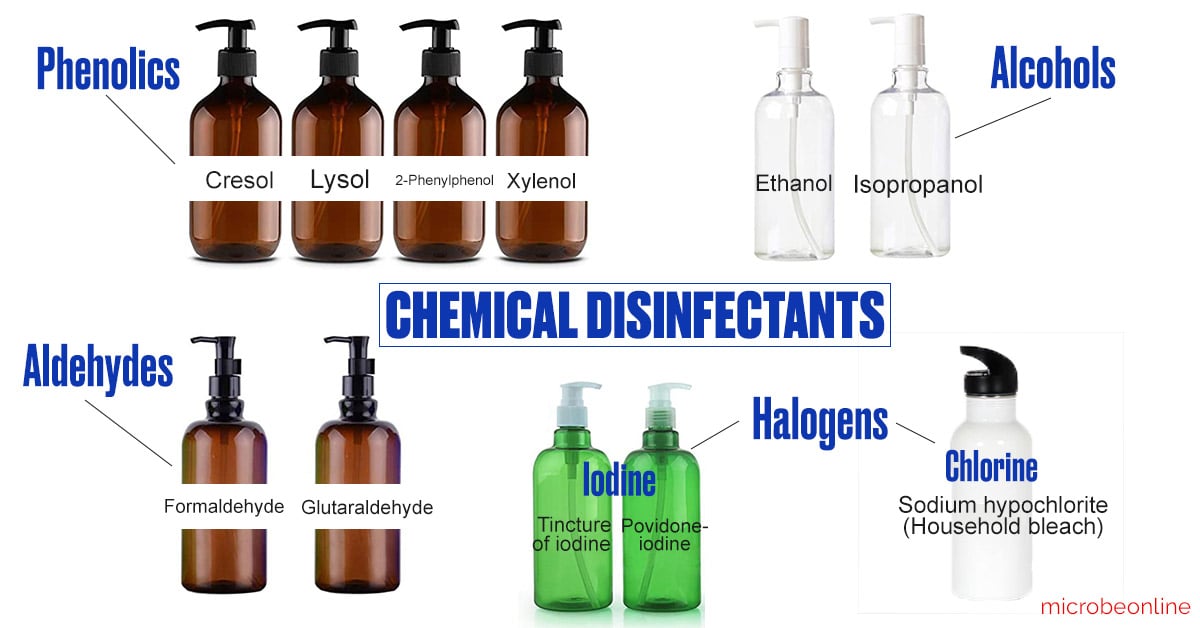 Figure: Chemical disinfectants
Activity Level of Selected Chemical Disinfectants
| Class | Use Concentration of Active Ingredient | Activity Level |
|---|---|---|
| Ethylene oxide (gas) | 450–500 mg/liter | High |
| Glutaraldehyde, aqueous | 2% | High to intermediate |
| Formaldehyde + alcohol | 8% + 70% | High |
| Stabilized hydrogen peroxide | 6–30% | High to intermediate |
| Formaldehyde, aqueous | 6–8% | High to intermediate |
| Iodophors | 750–5,000 mg/liter | High to intermediate |
| Iodophors | 75–150 mg/liter | Intermediate to low |
| Iodine + alcohol | 0.5% + 70% | Intermediate |
| Chlorine compounds | 0.1–0.5% | Intermediate |
| Phenolic compounds, aqueous | 0.5–3% | Intermediate to low |
| Iodine, aqueous | 1% | Intermediate |
| Alcohols (ethyl, isopropyl) | 70% | Intermediate |
| Quaternary ammonium compounds | 0.1–0.2% | Low |
| Chlorhexidine | 0.75–4% | Low |
| Hexachlorophene | 1–3% | Low |
| Mercurial compounds | 0.1–0.2% | Low |
Disinfectant Classes
- Alcohols. Among the most widely used disinfectants and antiseptics. Ethyl and isopropyl alcohol are non-sporicidal and evaporate quickly. Best used on skin as an antiseptic (surgical spirit); clinical thermometers and small instruments can be disinfected by soaking in isopropyl alcohol for 10–15 minutes.
- Aldehydes. Formaldehyde, glutaraldehyde, and ortho-phthalaldehyde are sporicidal and can function as chemical sterilants. Formaldehyde (formalin) is used to preserve anatomical specimens and to fumigate closed areas such as operating theaters. Aldehydes are generally not used as routine surface disinfectants because of their irritating fumes.
- Halogens. Chlorine and iodine are the most widely used halogen disinfectants.
- Chlorine, most commonly used as sodium hypochlorite (NaOCl), household bleach, is the most commonly available disinfectant and the sporicidal agent of choice for surfaces contaminated with C. difficile. The CDC recommends a 1:10 dilution of bleach for cleaning tabletops after blood spills. Chlorine is also used in municipal water supplies, swimming pools, and the dairy and food industries.
- Iodine compounds are widely used as antiseptics, either as a tincture with alcohol or as an iodophor bound to a neutral polymer, such as povidone-iodine. A combination of 70% ethyl alcohol followed by an iodophor is one of the most common approaches to skin disinfection before drawing blood cultures or performing surgery.
- Heavy metals. Salts of mercury, silver, zinc, and copper were widely used as germicides in the past, but have largely been replaced by less toxic chemicals. A notable historical exception: 1% silver nitrate eye drops were long used to prevent ophthalmia neonatorum (Neisseria gonorrhoeae conjunctivitis) in newborns; many settings have since shifted to erythromycin ointment instead, since silver nitrate can cause chemical conjunctivitis and has limited activity against Chlamydia trachomatis, a common co-cause of neonatal conjunctivitis. Mercury-containing compounds are no longer recommended due to environmental toxicity.
- Quaternary ammonium compounds (Quats). Compounds such as benzalkonium chloride are used to disinfect benchtops and other laboratory surfaces. Quats are not sporicidal, this is exactly why they cannot be relied on for terminal cleaning wherever C. difficile transmission is a concern; a sporicidal agent like diluted bleach is required instead. Organic material such as blood can also inactivate quats (and heavy metals), further limiting their reliability.
- Phenolics. Derivatives of carbolic acid (phenol), such as the common laboratory disinfectant amphyl. Adding a detergent produces a combined cleaning-and-disinfecting product, typically used at 2–5% concentration for benchtop cleaning.
How to Remember?
The "dial" analogy for disinfection levels. Picture a disinfection dial with three settings, low, intermediate, and high, each one killing a wider range of organisms than the last. Turning the dial all the way up to "high" still stops just short of one thing: bacterial spores. To go further and kill spores too, you need a completely different setting on the dial, a chemical sterilant, or a physical sterilization method entirely. The ward in the hook above was using a low-setting disinfectant (a quat) in a situation that needed the sterilant setting (bleach).
Mnemonic for the hierarchy of resistance, toughest to easiest "Some Microbes Never Fear Vodka, Luckily":
- Spores (toughest)
- Mycobacteria
- Non-lipid viruses
- Fungi
- Vegetative bacteria
- Lipid viruses (easiest) — "luckily," since this category includes HIV, hepatitis B, and influenza, some of the most feared pathogens in medicine turn out to be among the easiest to disinfect against, because their lipid envelope is a structural weak point.
Anchor for the 70% vs. 95% alcohol fact: think of 95% alcohol as moving so fast it "shrink-wraps" the outside of a cell before it can get inside, while 70% alcohol, slowed down just enough by its water content, has time to fully soak in and denature everything.
Key exam facts
| Fact | Detail |
|---|---|
| Disinfectant vs. antiseptic vs. sterilant | Disinfectant = inanimate objects; antiseptic = living tissue; chemical sterilant = kills everything including spores |
| Hierarchy of resistance (toughest to easiest) | Spores → Mycobacteria → Non-lipid viruses → Fungi → Vegetative bacteria → Lipid viruses |
| Low-level disinfectant | Kills most vegetative bacteria, some fungi, some viruses; not mycobacteria or spores |
| Intermediate-level disinfectant | Kills mycobacteria, vegetative bacteria, most viruses and fungi; not necessarily spores |
| High-level disinfectant | Kills everything except high numbers of bacterial spores |
| Classic concentration exception | 70% ethyl alcohol is more effective than 95%, because some water is needed for full protein denaturation |
| Sporicidal agent for C. difficile | Sodium hypochlorite (bleach), typically 1:10 dilution; quats and alcohol are not sporicidal |
| CDC blood-spill recommendation | 1:10 dilution of household bleach |
| Silver nitrate historical use | Ophthalmia neonatorum prophylaxis; largely superseded by erythromycin ointment in many settings |
| Weak point of enveloped viruses | Lipid envelope is easily disrupted by alcohols and detergents, making them relatively easy to inactivate |
Where Students and Practitioners Get Confused
- Disinfectant, antiseptic, and chemical sterilant are not interchangeable terms. The same chemical can be any of the three depending on concentration, contact time, and what surface it's applied to.
- "Visibly clean" does not mean disinfected, and definitely doesn't mean sterile. Organic material can physically shield organisms from a disinfectant even when a surface looks spotless, exactly what happened in the C. difficile scenario above.
- Higher concentration is not always more effective. The 70% vs. 95% alcohol exception is the classic example, and it's a common exam trap.
- Assuming enveloped (lipid) viruses are the hardest to kill because they cause serious disease. The opposite is true: their lipid envelope is a structural weak point that makes them relatively easy to inactivate. Non-enveloped viruses, lacking that fragile membrane, are actually tougher.
- Assuming any "hospital-grade" disinfectant is adequate for any surface. Low-level disinfectants like quats and alcohol are appropriate for routine, non-spore-forming organisms, but are specifically inadequate wherever C. difficile or similar spore-forming pathogens are a concern.
References and further readings
- Madigan, M. T., Bender, K. S., Buckley, D. H., Sattley, W. M., & Stahl, D. A. (2018). Brock Biology of Microorganisms (15th ed.). Pearson.
- Procop, G. W., & Koneman, E. W. (2016). Koneman's Color Atlas and Textbook of Diagnostic Microbiology (7th, International ed.). Lippincott Williams and Wilkins.
- Tille, P. (2017). Bailey & Scott's Diagnostic Microbiology (14th ed.). Mosby.
- Willey, J. M., Sherwood, L. M., & Woolverton, C. J. (2016). Prescott's Microbiology (10th ed.). McGraw-Hill Education.
- Centers for Disease Control and Prevention. (2008). Guideline for Disinfection and Sterilization in Healthcare Facilities. https://www.cdc.gov/hicpac/pdf/guidelines/Disinfection_Nov_2008.pdf
Frequently Asked Questions
What is the difference between disinfection and sterilization?
What is the difference between a disinfectant and an antiseptic?
Why is 70% alcohol more effective than 95% alcohol as a disinfectant?
What are the levels of chemical disinfection?
Why can't quaternary ammonium compounds be used to control Clostridioides difficile?
What is the hierarchy of microbial resistance to disinfectants?
Why are enveloped viruses like HIV and influenza relatively easy to disinfect against?
What dilution of bleach does the CDC recommend for cleaning blood spills?

Tankeshwar Acharya, MSc (Medical Microbiology)
Tankeshwar Acharya is an Assistant Professor in the Department of Microbiology at Patan Academy of Health Sciences (PAHS), Nepal, where he has been teaching and practicing clinical microbiology for over 14 years. He is the founder of Microbe Online, one of the leading free microbiology education resources on the web, covering bacteriology, mycology, parasitology, immunology, and clinical laboratory diagnostics written from direct experience in both the classroom and the diagnostic laboratory.
Comments
No comments yet. Be the first to share your thoughts.
Leave a comment
All comments are reviewed before they appear.