
Czapek Dox Agar: Composition, Principle, and Colony Characteristics of Aspergillus and Penicillium

On this page
Two Aspergillus isolates grow on Sabouraud agar with identical blue-green colony appearance. On Czapek Dox agar — where sucrose is the only carbon source and sodium nitrate the only nitrogen — colony texture, growth rate, and pigmentation differ between the two. The nutritional restriction of Czapek Dox agar reveals phenotypic differences that richer media suppress. One is A. fumigatus; the other is A. flavus. The distinction matters: A. flavus produces aflatoxins in food, and antifungal susceptibility profiles between the two species differ.
Czapek medium is also called Czapek’s agar (CZA) or Czapek-Dox medium. Czapek agar is named after the Friedrich Johann Franz Czapek. He invented this medium and was later modified by Arthur Wayland Dox. Thus the name Czapek-Dox medium is derived. It is used for the general cultivation of fungi from the water sample and the cultivation of saprophytic fungi and soil bacteria. Sucrose and nitrate are the sources of carbon and nitrogen, respectively.
The modified form of the Czapek Dox Agar is the Oxoid Czapek Dox Agar. This modified form prevents the precipitation of magnesium phosphate. The medium has good buffering action due to the presence of different salts. It highly supports Candida albicans for chlamydospore production.
Principle of Czapek Dox Agar
Czapek Dox Agar is the semisynthetic medium used to cultivate fungi (yeasts, molds, filamentous species). Sodium nitrate is the sole nitrogen source, while sucrose is the sole carbon source. Czapek Dox Agar is used to isolate the Aspergillus, Penicillium, Paecilomyces, and other fungi having the same requirement. Dipotassium phosphate buffers the medium. The essential ions required for the medium is provided by magnesium sulphate, potassium chloride, and ferrous sulphate. Agar present in the medium is the solidifying agent. In the modified form of the Czapek Dox Agar, the magnesium glycerophosphate and potassium sulfate have replaced the magnesium sulfate and potassium phosphate of the media. This modification helps to prevent the precipitation of magnesium phosphate.
Composition ofCzapek Dox Agar
| Ingredients | Gms/ Litre |
|---|---|
| Sucrose | 30.000 |
| Sodium nitrate | 2.000 |
| Dipotassium phosphate | 1.000 |
| Magnesium sulphate | 0.500 |
| Potassium chloride | 0.500 |
| Ferrous sulphate | 0.010 |
| Agar | 15.000 |
| Final pH (at 25°C) | 7.3 ± 0.2 |
Preparation of Czapek Dox Agar
- Take 1000 ml distilled water and suspend 49.01 grams.
- To dissolve properly, heat the mixture till it boils gently.
- Then sterilize it in the autoclave at 15 lbs pressure (121°C) for 15 minutes.
- After the sterilization, cool it to 45-50°C.
- Before pouring in the sterile plates, mix them properly. If it is not mixed well, agar may sediment at the bottom, due to which the media plates do not set well due to the improper aliquot of the agar.
Colony Characteristics in Czapek Dox Agar
Candida albicans: cream-colored colonies
Aspergillus niger: White/yellow mycelium, black spores
Aspergillus flavus: granular, flat, often with radial grooves and yellow
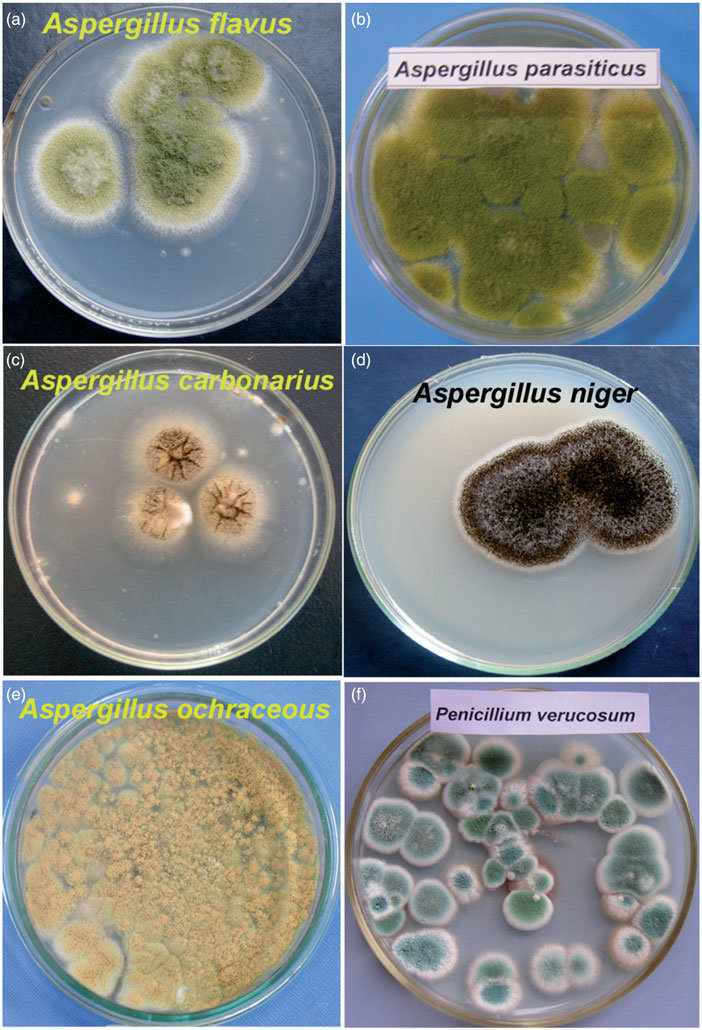 Figure: Source: M.K. Saleemi et al. DOI:10.1080/15569543.2016.1233890
Figure: Colonies of different fungal species on Czapek dox solution agar media after incubation at 27°C for 4-5 days. (a)A. flavus, (b) A. parasiticus, (c) A. carbonarius, (d) A. niger, (e) A. ochraceous, and (f) P. verucosum.
Uses
- Czapek Dox Agar is used for the isolation of Aspergillus, Penicillium, Paecilomyces, and other fungi.
- It is used for testing water and wastewater samples to isolate the Aspergillus, Penicillium, and other fungi.
- Czapek medium is also used for the taxonomic studies of Penicillium.
- Acidophilic organisms like yeast can be cultivated in the Czapek Agar by increasing the acidity of the medium.
Key Fungi on Czapek Dox Agar
| Organism | Colony Colour | Growth Rate | Key Feature |
|---|---|---|---|
| Aspergillus fumigatus | Blue-grey to grey-green | Rapid (3–5 days) | Distinctive on Czapek — preferred sporulation medium |
| Aspergillus flavus | Yellow-green to olive-green | Rapid | Granular surface; large irregular vesicle |
| Aspergillus niger | Black/dark brown | Rapid | Dense black conidial head; distinctive on CDA |
| Aspergillus terreus | Cinnamon-brown | Moderate | Flat, granular; velvety surface |
| Penicillium spp. | Blue-green, powdery | Moderate | Brush-like conidiophore on microscopy |
| Paecilomyces spp. | Tan to olive | Moderate | Similar to Penicillium; phialides tapering to long tubes |
Important limitation: Czapek Dox agar does not support the growth of fastidious organisms — it is a synthetic minimal medium. It is used for taxonomic characterisation of saprophytic fungi, not for primary isolation from clinical specimens.
Limitation
It does not support the growth of fastidious organisms.
Key Exam Facts in One Table
| Feature | Detail |
|---|---|
| Type | Synthetic (defined composition) fungal medium |
| Carbon source | Sucrose only |
| Nitrogen source | Sodium nitrate only |
| pH | ~7.3 (near neutral — unlike SDA which is acidic) |
| Named after | Friedrich Czapek (developed) + Arthur Wayland Dox (modified) |
| Primary use | Identification and taxonomic characterisation of Aspergillus, Penicillium, saprophytic moulds |
| Does NOT support | Fastidious organisms; primary isolation from clinical specimens |
| Advantage | Standardised composition → reproducible colony morphology for identification |
| Modified Czapek Dox | Magnesium glycerophosphate replaces magnesium sulfate (prevents phosphate precipitation) |
References
- Chander J. Textbook of Medical Mycology. 4th ed. Jaypee Brothers Medical Publishers; 2018.
- Larone DH. Larone's Medically Important Fungi: A Guide to Identification. 6th ed. ASM Press; 2018.
- Pitt JI. The Genus Penicillium and its Teleomorphic States Eupenicillium and Talaromyces. Academic Press; 1979.
- Murray PR, Rosenthal KS, Pfaller MA. Medical Microbiology. 9th ed. Elsevier; 2020.
Frequently Asked Questions
What makes Czapek Dox agar different from Sabouraud dextrose agar for fungal identification?
Which fungi are best identified on Czapek Dox agar?

Tankeshwar Acharya, MSc (Medical Microbiology)
Tankeshwar Acharya is an Assistant Professor in the Department of Microbiology at Patan Academy of Health Sciences (PAHS), Nepal, where he has been teaching and practicing clinical microbiology for over 14 years. He is the founder of Microbe Online, one of the leading free microbiology education resources on the web, covering bacteriology, mycology, parasitology, immunology, and clinical laboratory diagnostics written from direct experience in both the classroom and the diagnostic laboratory.
Comments
No comments yet. Be the first to share your thoughts.
Leave a comment
All comments are reviewed before they appear.