
Clostridium botulinum: Botulinum Toxin, Botulism, Diagnosis, Prevention
How botulinum toxin blocks acetylcholine to cause flaccid paralysis, the three types of botulism, why infants must not eat honey, and how botulism is diagnosed and prevented.

On this page
A woman comes to the emergency department with double vision and drooping eyelids that started a few hours ago. Now she is having trouble swallowing and her speech is slurred. She is fully alert and feels no numbness anywhere.
A day earlier she had eaten home-canned vegetables. The weakness is spreading downward, from her eyes and face toward her arms. This pattern, a wide-awake patient with descending paralysis and no sensory loss, points to a toxin that is switching off her nerves one signal at a time. The organism never left the food. Only its toxin is in her body. This is botulism, caused by Clostridium botulinum.
Introduction
Clostridium botulinum is a gram-positive, spore-forming rod. Its subterminal, bulging spore gives the cell a tennis racket appearance. One idea organizes this whole topic, and it is the mirror image of tetanus: C. botulinum stays outside the body or in the gut or wound and never invades, but its toxin blocks acetylcholine release at nerve endings, so muscles cannot contract. The result is flaccid paralysis. The toxin is the disease.
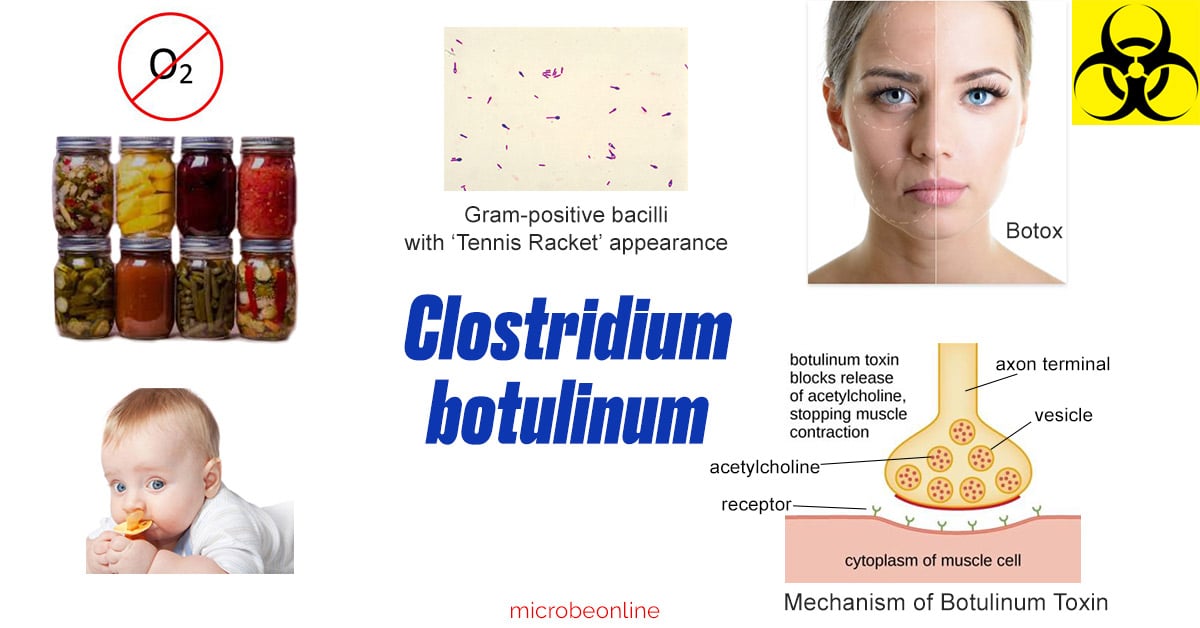 Figure: Clostridium botulinum cover image
It produces botulinum toxin, one of the most lethal substances known, and causes botulism, a rare but life-threatening paralytic disease. Botulism appears as three main forms: foodborne botulism, wound botulism, and infant botulism.
The name comes from the Latin botulus, meaning sausage, because poorly preserved sausages were an early recognized source. Botulinum toxin is also made by a few other clostridia, including C. butyricum, C. baratti, and C. argentinense.
The lethal dose for a human is extremely small, on the order of micrograms, which is why C. botulinum is treated as a potential biological weapon. The CDC lists it as a Category A bioterrorism agent, along with Bacillus anthracis and Yersinia pestis.
 Figure: Homemade canned food source of botulism
Pathogenesis
Transmission
C. botulinum is found widely in nature as a saprophyte in soil, animal manure, vegetables, and sea mud. Home-canned foods, condiments, and fish products are the most common sources of foodborne botulism. Honey is the classic source of spores in infant botulism.
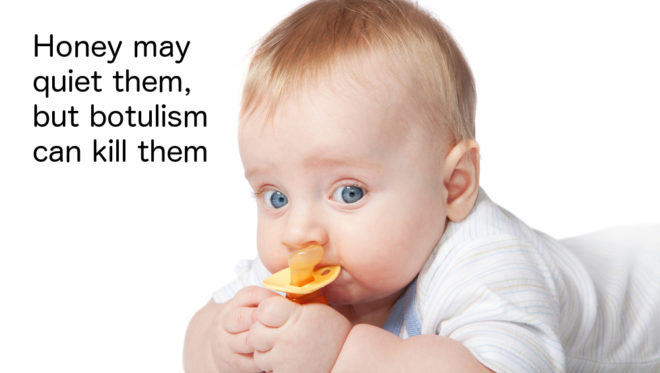 Figure: Honey as source of infant botulism
The danger with home-canned food comes from two facts. The spores are heat-resistant and survive inadequate cooking, and the sealed container provides the anaerobic conditions the organism needs. The surviving spores then germinate and produce toxin inside the sealed food. This is why improperly processed home canning, not commercial canning, is the usual culprit.
Mechanism of action of Botulinum toxin (BoNT)
C. botulinum is non-invasive. All of its harm comes from botulinum toxin (BoNT), one of the most toxic substances known. There are seven serological types, labeled A to G. Human botulism is caused mainly by types A, B, and E, and rarely F.
After the toxin enters the body (swallowed as preformed toxin, produced in a wound, or produced in the infant gut), it travels through the blood to peripheral cholinergic nerve endings. It acts at three main sites: the neuromuscular junction, postganglionic parasympathetic nerve endings, and peripheral ganglia. It does not enter the central nervous system, which is why patients stay fully alert and have no sensory loss.
In normal condition: Upon stimulation of peripheral and cranial nerves, acetylcholine is normally released from vesicles at the neural side of the motor endplate. Acetylcholine then binds to specific receptors on the muscle, inducing contraction.
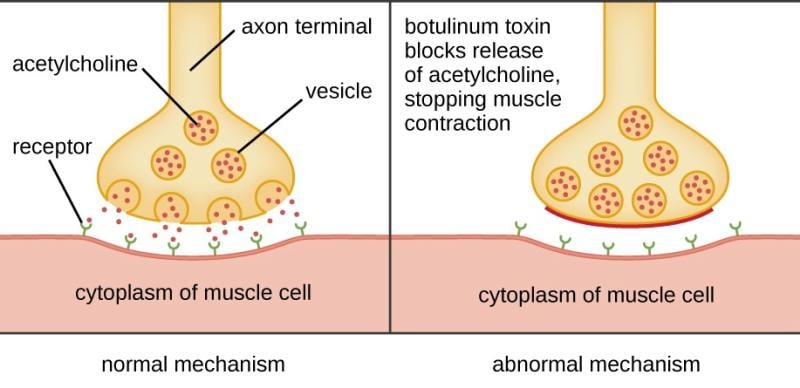 Figure: Mechanism of Botulinum toxin (Image source: lumenlearning.com)
Botulinum toxin is a protease. It cleaves SNARE proteins that the nerve terminal needs to release its neurotransmitter, so acetylcholine cannot be released at the nerve ending. Without acetylcholine, the muscle receives no signal to contract, and the result is flaccid paralysis. The block lasts a long time, weeks to months, but it is not permanent. Nerve terminals slowly sprout and recover, which is why botulism patients can fully recover with supportive care and why cosmetic Botox wears off.
Because botulinum toxin relaxes muscle, tiny controlled doses are used therapeutically for conditions of excess muscle contraction, such as strabismus (misaligned eyes), blepharospasm (uncontrollable eyelid closure), dystonias, and muscle spasticity, as well as for cosmetic wrinkle reduction.
It is worth comparing this directly with tetanus, because students confuse the two. Both C. botulinum and C. tetani make neurotoxins that cleave SNARE proteins and block neurotransmitter release. The difference is location and target. Botulinum toxin acts at the neuromuscular junction and blocks acetylcholine, so muscles cannot contract, giving flaccid paralysis. Tetanus toxin acts in the spinal cord and blocks inhibitory neurotransmitters, so muscles cannot relax, giving spastic paralysis. Same molecular action, opposite site, opposite clinical picture. For the other side of this comparison, see the article on Clostridium tetani and tetanus.
Clinical manifestations
The features of botulism follow directly from blocked acetylcholine at cranial nerve, motor, and parasympathetic nerve endings. The cranial nerves are affected first, so the earliest signs are in the eyes, face, and throat, and the weakness then spreads downward. Common features include:
- Diplopia (double vision) or blurred vision
- Ptosis (drooping eyelids)
- Dysphagia (difficulty swallowing)
- Dysarthria (slurred speech)
- Descending, symmetric flaccid paralysis of voluntary muscles
- Decreased deep tendon reflexes
- Dry mouth, constipation, and other signs of blocked parasympathetic (cholinergic) function
- Respiratory muscle paralysis, which is the usual cause of death
Two features are diagnostically important. The patient stays fully conscious and alert throughout, because the toxin does not reach the brain. And there is no sensory loss, because the toxin affects only motor and autonomic nerve endings. A wide-awake patient with descending paralysis and normal sensation is the classic picture of botulism.
Types of Botulism
There are three major types of human botulism based how they are acquired:
Foodborne botulism: results from eating food that already contains preformed toxin, classically improperly processed home-canned food. Because the toxin is preformed, symptoms can begin within hours to a couple of days. This is an intoxication, not an infection.
Wound botulism: results when C. botulinum grows and produces toxin inside a wound, then the toxin spreads through the body. It presents like foodborne botulism but without the gastrointestinal features, because nothing toxic was swallowed.
Infant botulism: occurs in infants aged one year or under. The infant swallows spores (classically in honey), and because the infant gut lacks the protective normal flora and stable environment of an adult gut, the spores germinate there, and the growing bacteria produce toxin inside the intestine. Features include poor sucking and feeding, a weak cry, ptosis, a floppy neck, and generalized weakness, giving the "floppy baby" picture. With good supportive care and assisted feeding the outlook is excellent.
The key difference from adults: in a healthy adult, the established gut flora prevents C. botulinum spores from germinating, so swallowing spores is not usually dangerous. In an infant under one year, that protection is not yet in place, which is why honey is unsafe for this age group only.
Laboratory diagnosis
Diagnosis of botulism includes isolation and identification of the bacilli by conventional cultural biochemical procedures and demonstration of the presence of botulinum neurotoxin in a patient sample or in the food (for outbreak investigation) with the toxin neutralization test
Demonstration of botulinum toxin (mouse neutralization test) in serum or feces confirms the clinical diagnosis of botulism.
Sample
Serum, feces, gastric contents, vomitus, wound swab, exudate, or tissues depending on the type of botulism.
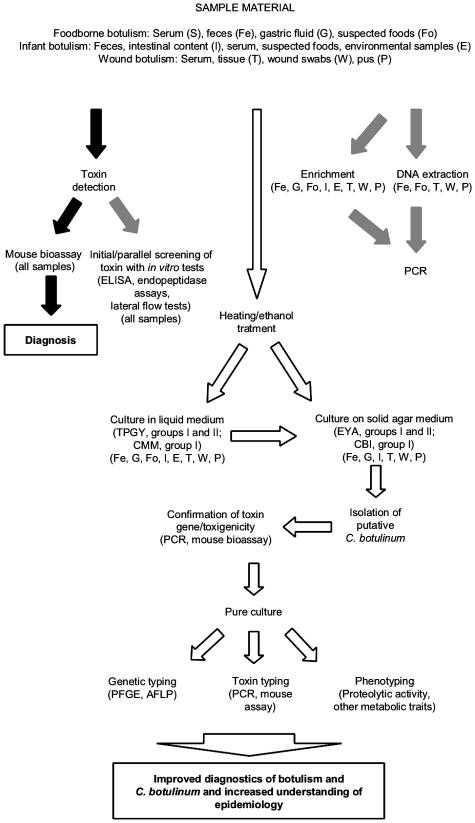 Figure: Diagnosis of Botulism (Image source- Lindström & Korkeala, 2006)
Direct microscopy
Gram staining of smears made from suspected food or feces-reveals gram-positive, non-capsulated bacilli with subterminal, oval, bulging spores.
Culture
Isolation- culture is done on blood agar or Robertson’s cooked meat (RCM) broth.
In RCM broth: growth turns the broth turbid, and the meat particles change in a way that reflects the strain's metabolism. Proteolytic strains (types A, B, F) digest the meat, turning it black with a foul odor. Saccharolytic strains (types C, D, E) ferment sugars instead and turn the meat pink without the foul odor.
In blood agar: Colonies are large, irregular, semi-transparent, hemolytic, and fimbriated border.
Growth on culture media may be confirmed by Gram staining, biochemical tests, or molecular assays. Serotyping is done with type-specific antisera.
Identifying features of Clostridium botulinum
- Motile by peritrichate flagella.
- Exhibit lipase activity on egg yolk agar.
Toxin Neutralization Test (Mouse Bioassay)
The in vivo mouse bioassay is the gold standard test for detecting active botulinum toxin. A sample (serum, feces, or an extract of the suspect food) is injected intraperitoneally into mice, which are then observed for signs of botulism and death, usually within about four days.
If that lethal activity can be neutralized (in another set of mice) by injecting antibodies against one of the botulinum toxin serotypes, it confirms the presence of botulinum neurotoxin.
Molecular Diagnosis
Molecular techniques such as polymerase chain reaction (PCR) targeted to the neurotoxin genes are ideal for the detection and identification of C. botulinum. Further typing (for example, toxin typing or gene typing) can be done using pulse-field gel electrophoresis (PFGE) and amplified fragment length polymorphism (AFLP).
Treatment of botulism
Treatment follows from the mechanism.
Neutralize circulating toxin early. Give botulinum antitoxin as soon as botulism is suspected, without waiting for laboratory confirmation. Antitoxin only neutralizes toxin that is still free in the blood. It cannot reverse toxin already bound to nerve endings, so giving it early limits how much paralysis develops. For infant botulism, a human-derived botulinum immunoglobulin is used rather than the equine antitoxin used in adults.
Support breathing. The most important supportive measure is airway and ventilatory support, because death in botulism is usually from paralysis of the respiratory muscles. Patients may need mechanical ventilation for a prolonged period while the nerve terminals recover.
Wound botulism additionally needs wound debridement to remove the source of toxin production, plus an antibiotic. Note that antibiotics have no role in foodborne or infant botulism, where the problem is toxin, not tissue infection. Aminoglycosides are avoided in botulism because they can worsen the neuromuscular block.
Recovery is possible because the toxin's effect is reversible: new nerve terminals sprout over weeks to months. Supportive care keeps the patient alive during that time.
Prevention of botulism
Safe food handling. Proper home canning and heat processing prevent foodborne botulism. Botulinum toxin itself is heat-labile and is destroyed by thorough cooking (boiling for several minutes), so heating suspect food can inactivate preformed toxin. The spores, however, are heat-resistant, so prevention depends on correct canning conditions, not cooking alone. Bulging or damaged cans should be discarded.
No honey under one year of age. Infants aged one year or younger should never be given honey, because it can carry C. botulinum spores that germinate in the immature infant gut. This single rule prevents a large share of infant botulism.
Wound care. Prompt cleaning and debridement of contaminated wounds reduces the risk of wound botulism.
How to Remember
| Device | The memory hook |
|---|---|
| Tennis racket spore | The subterminal bulging spore makes the cell look like a tennis racket. (Compare: C. tetani has a terminal spore, the drumstick.) |
| The 4 D's of botulism | Diplopia, Dysphagia, Dysarthria, Descending paralysis. Cranial nerves first, then downward. |
| Botulism = Bfloppy, Tetanus = Tight | Botulism blocks acetylcholine at the muscle, so muscles go floppy (flaccid). Tetanus blocks inhibition in the cord, so muscles go tight (spastic). |
| No ACh, no contraction | Botulinum toxin stops acetylcholine release. No acetylcholine means no muscle signal, so the muscle relaxes and stays relaxed. Flaccid paralysis. |
| Alert and no numbness | The toxin never reaches the brain or sensory nerves. So the patient stays wide awake with normal sensation. This separates botulism from a stroke or a sensory neuropathy. |
| Honey and the infant gut | Adults have gut flora that block spores. Infants under one do not, so spores germinate in them. That is why honey is unsafe only for babies. |
| Toxin is heat-labile, spores are not | You can destroy the toxin by boiling the food, but you cannot destroy the spores that way. Prevention needs proper canning, not just cooking. |
Key exam facts
| Feature | Clostridium botulinum |
|---|---|
| Morphology | Gram-positive rod with subterminal bulging spore, tennis racket appearance |
| Oxygen | Obligate anaerobe |
| Motility | Motile (peritrichous flagella) |
| Egg yolk agar | Lipase positive |
| Toxin | Botulinum toxin (BoNT), types A–G; human disease mainly A, B, E |
| Toxin action | Protease; cleaves SNARE proteins, blocks acetylcholine release at the neuromuscular junction |
| Site of action | Peripheral cholinergic nerve endings; does not enter the CNS |
| Type of paralysis | Flaccid, descending, symmetric |
| Key negatives | Patient alert (no CNS effect); no sensory loss |
| Reversibility | Long-lasting but reversible; nerve terminals regrow over weeks to months |
| Three forms | Foodborne (preformed toxin), wound (toxin made in wound), infant (spores germinate in gut) |
| Classic sources | Home-canned food (foodborne); honey (infant) |
| Gold standard test | Mouse bioassay with toxin neutralization |
| RCM broth | Proteolytic A, B, F (black, foul); saccharolytic C, D, E (pink) |
| Treatment | Botulinum antitoxin early; ventilatory support; antibiotics only for wound botulism |
| Prevention | Proper canning; no honey under 1 year; wound care |
| Biothreat | CDC Category A agent |
Where Students Get Confused
| Confusion | The clarification |
|---|---|
| Botulism vs. tetanus | Botulism = flaccid (cannot contract), acts at the neuromuscular junction. Tetanus = spastic (cannot relax), acts in the spinal cord. Both cleave SNARE proteins. |
| Ascending or descending? | Botulism is descending: cranial nerves first (eyes, face, throat), then downward. This helps separate it from Guillain-Barré, which is classically ascending. |
| Is the patient conscious? | Yes, fully. The toxin does not reach the brain. Alertness with paralysis is a key clue. |
| Foodborne: infection or intoxication? | Intoxication. The toxin is preformed in the food. You are not swallowing a growing infection, you are swallowing the poison. |
| Why is honey unsafe only for infants? | Adult gut flora prevents spores from germinating. Infants under one lack this protection, so spores germinate and make toxin in the gut. |
| "Irreversible" paralysis? | No. The block is long-lasting but reversible. Nerves regrow over weeks to months, which is why recovery and Botox wearing off both happen. |
| Antibiotics for botulism? | Only for wound botulism. Foodborne and infant botulism are toxin problems, not tissue infections, so antibiotics do not help there. Aminoglycosides are avoided (they worsen the block). |
| Can cooking make canned food safe? | Boiling destroys the toxin (heat-labile) but not the spores (heat-resistant). Safety depends on proper canning, not reheating. |
References
- Tille, P. M. (2022). Bailey & Scott's Diagnostic Microbiology (15th ed.). Elsevier.
- Procop, G. W., & Koneman, E. W. (2017). Koneman's Color Atlas and Textbook of Diagnostic Microbiology (7th ed.). Wolters Kluwer.
- Carroll, K. C., Pfaller, M. A., et al. (2020). Murray's Medical Microbiology (9th ed.). Elsevier.
- Lindström, M., & Korkeala, H. (2006). Laboratory diagnostics of botulism. Clinical Microbiology Reviews, 19(2), 298–314.
- Rasooly, R., & Do, P. M. (2008). Development of an in vitro activity assay as an alternative to the mouse bioassay for Clostridium botulinum neurotoxin type A. Applied and Environmental Microbiology, 74(14), 4309–4313.
Frequently Asked Questions
Why does botulism cause flaccid paralysis while tetanus causes spastic paralysis?
Why does botulism cause flaccid paralysis while tetanus causes spastic paralysis?
Both toxins block neurotransmitter release by cleaving SNARE proteins, but they act in different places. Botulinum toxin acts at the neuromuscular junction and blocks acetylcholine, so muscles cannot contract, giving flaccid paralysis. Tetanus toxin acts in the spinal cord and blocks inhibitory signals, so muscles cannot relax, giving spastic paralysis.
Why is the paralysis in botulism described as descending?
Why is the paralysis in botulism described as descending?
The toxin affects the cranial nerves first, so early signs are in the eyes, face, and throat (double vision, drooping eyelids, difficulty swallowing and speaking). The weakness then spreads downward to the trunk and limbs. This descending pattern helps distinguish botulism from Guillain-Barré syndrome, which is usually ascending.
Is a patient with botulism conscious?
Is a patient with botulism conscious?
Yes. The toxin acts only on peripheral nerves and does not reach the brain, so the patient stays fully alert. There is also no sensory loss. A wide-awake patient with descending paralysis and normal sensation is the classic picture.
Why should infants under one year not be given honey?
Why should infants under one year not be given honey?
Honey can contain C. botulinum spores. Adults have established gut flora that stops these spores from germinating, but infants under one do not yet have this protection, so the spores can germinate in the intestine and produce toxin, causing infant botulism.
Is foodborne botulism an infection?
Is foodborne botulism an infection?
No. It is an intoxication. The toxin is already formed in the improperly preserved food, so the person swallows preformed poison rather than a growing infection. This is why symptoms can begin within hours.
Can you make contaminated canned food safe by cooking it?
Can you make contaminated canned food safe by cooking it?
Boiling can destroy the toxin, because the toxin is heat-labile. But the spores are heat-resistant and survive boiling. So safe home canning depends on correct processing conditions, and any bulging or damaged can should be thrown away rather than tasted.
Why do botulism patients recover if the toxin is so powerful?
Why do botulism patients recover if the toxin is so powerful?
The toxin's block is long-lasting but not permanent. Over weeks to months, nerve terminals sprout and restore acetylcholine release. Supportive care, especially help with breathing, keeps the patient alive during this recovery. The same reversibility is why cosmetic Botox wears off.
How is botulism confirmed in the laboratory?
How is botulism confirmed in the laboratory?
The gold standard is the mouse bioassay with toxin neutralization. A patient sample or food extract is injected into mice, and if the lethal effect is prevented by antibody against a specific botulinum toxin type, active toxin is confirmed. Culture and PCR support the diagnosis, but demonstrating the toxin is definitive.

Tankeshwar Acharya, MSc (Medical Microbiology)
Tankeshwar Acharya is an Assistant Professor in the Department of Microbiology at Patan Academy of Health Sciences (PAHS), Nepal, where he has been teaching and practicing clinical microbiology for over 14 years. He is the founder of Microbe Online, one of the leading free microbiology education resources on the web, covering bacteriology, mycology, parasitology, immunology, and clinical laboratory diagnostics written from direct experience in both the classroom and the diagnostic laboratory.
Comments
No comments yet. Be the first to share your thoughts.
Leave a comment
All comments are reviewed before they appear.