
Chlamydia trachomatis: Serovars, Life Cycle, Diseases, Diagnosis, Treatment
How Chlamydia trachomatis uses its elementary-body and reticulate-body life cycle to infect cells, which serovars cause trachoma, genital infection, and LGV, and how it is diagnosed and treated.

On this page
A 22-year-old woman comes in for a routine check. She feels completely well and has no symptoms. A screening test of her urine comes back positive for Chlamydia trachomatis. She is surprised, because nothing hurt and nothing looked wrong. That silence is exactly the problem.
In many women this infection causes no symptoms for months while it quietly spreads up the genital tract, where it can scar the fallopian tubes and threaten future fertility. The organism is hard to notice for the same reason it is hard to grow in the lab: it hides and multiplies inside the patient's own cells. This is Chlamydia trachomatis, the most common bacterial cause of sexually transmitted infection.
Introduction
Chlamydia trachomatis is an obligate intracellular bacterium and a major cause of disease worldwide. It is the most common bacterial cause of sexually transmitted infection and a leading cause of preventable infertility and of pelvic inflammatory disease (PID). For where it sits among the sexually transmitted infections and the urethritis differential, see the list of sexually transmitted infections and their causative agents. It also causes trachoma, the world's leading infectious cause of blindness.
One idea organizes the whole topic: C. trachomatis has a unique two-form life cycle that forces it to live inside host cells, and this single feature explains why it does not Gram stain, why it cannot be grown on ordinary media, why diagnosis relies on detecting its DNA, and why certain antibiotics work while others fail.
General Properties
Small, non-motile, coccoid bacteria with a gram-negative-type cell envelope. However, the cell wall lacks a typical peptidoglycan layer and has little or no muramic acid, so C. trachomatis does not stain usefully with the Gram stain.
- Obligate intracellular bacterium: it cannot make its own energy efficiently (it depends on the host cell for ATP), so it can only grow inside host cells. Because it is so small and grows inside cells, it was once mistaken for a virus, but it is a true bacterium with both DNA and RNA, ribosomes, and a cell wall.
The two-form life cycle
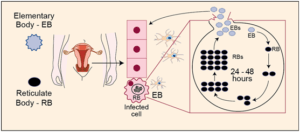 Figure: Life Cycle of Chlamydia trachomatis
C. trachomatis alternates between two forms, and understanding this cycle explains almost everything about the organism.
- The elementary body (EB) is the small, tough, infectious form. It does not divide. Its only job is to survive outside cells and get into a new cell. This is the form transmitted from person to person.
- The reticulate body (RB) is the larger, fragile, metabolically active form. It does not spread between people. Its only job is to multiply inside the cell.
The cycle runs like this: an elementary body attaches to and enters a host cell, where it stays inside a membrane-bound vacuole called an inclusion. Inside the inclusion it transforms into a reticulate body, which multiplies many times by binary fission. The reticulate bodies then convert back into elementary bodies, and the cell releases them to infect new cells. The whole cycle takes about 48 to 72 hours. This is why chlamydial infections build up slowly and why the diagnostic "inclusions" seen in stained cells are collections of these organisms.
A note on classification: this article follows the exam-standard grouping in which Chlamydia includes C. trachomatis, C. psittaci, and C. pneumoniae (the TWAR strains). Be aware that modern taxonomy has at times placed C. psittaci and C. pneumoniae in a separate genus, Chlamydophila. The biology and the diseases are what matter for study; the genus label has shifted back and forth.
How Chlamydia trachomatis causes disease
The damage in chlamydial infection comes from two things: the organism's growth inside cells, and the host's inflammatory response to it.
Each cycle of growth kills the infected host cell when the new elementary bodies are released, causing direct tissue damage. But much of the serious, long-term harm comes from repeated and persistent inflammation. In the eye, repeated infection causes chronic conjunctival inflammation that scars the inner eyelid, turns the eyelashes inward, and abrades the cornea, eventually leading to blindness (trachoma).
In the female genital tract, ascending infection and the resulting inflammation scar the fallopian tubes. This tubal scarring is what causes infertility, ectopic pregnancy, and chronic pelvic pain, and it can develop even when the infection itself caused few or no symptoms. This "silent damage" is why screening is so important.
Diseases caused by C. trachomatis
The single most important thing to know about C. trachomatis is that different serovars (serotypes) cause different diseases. Learn the three groups and their diseases:
| Serovars | Main transmission | Disease |
|---|---|---|
| A, B, Ba, C | Eye to eye by hands, fomites, flies (poor sanitation) | Endemic trachoma (chronic keratoconjunctivitis leading to blindness) |
| D to K | Sexual contact; mother to newborn during birth; autoinoculation to the eye | Genital infections (urethritis, cervicitis, PID, epididymitis) and, in newborns, inclusion conjunctivitis and pneumonia |
| L1, L2, L3 | Sexual contact | Lymphogranuloma venereum (LGV) |
A simple way to hold this: A B C at the start of the alphabet = the eye disease that can blind (trachoma); D through K in the middle = the common genital and neonatal infections; L = the invasive Lymphatic disease (LGV).
Eye disease
- Trachoma (serovars A–C): a chronic infection of the conjunctiva spread in areas with poor sanitation. Repeated infection scars the eyelid, turns the lashes inward, and damages the cornea, and it is the world's leading infectious cause of blindness.
- Inclusion conjunctivitis (serovars D–K): a milder eye infection caused by genital serovars reaching the eye, either in a newborn during birth or in adults by autoinoculation from genital secretions. It usually heals without scarring.
Genital and related infections (serovars D–K)
- Nongonococcal urethritis
- Cervicitis
- Pelvic inflammatory disease (PID), a major cause, which can lead to infertility, ectopic pregnancy, and chronic pelvic pain
- Epididymitis and proctitis
- In newborns: inclusion conjunctivitis and infant pneumonia (acquired during birth)
A key clinical point: genital chlamydia is frequently asymptomatic, especially in women, which is why it spreads and why routine screening of at-risk groups is recommended.
Lymphogranuloma venereum (serovars L1–L3)
LGV is different from the D–K infections because the L serovars are more invasive: they spread to and multiply in lymphatic tissue. It classically causes swollen, sometimes painful inguinal lymph nodes (buboes), often after a small painless genital ulcer that may be missed. In recent years it has also caused proctitis, particularly in men who have sex with men.
A note on the respiratory Chlamydia species
Two related species mainly cause respiratory disease rather than the infections above. C. pneumoniae (TWAR) causes upper respiratory infection, bronchitis, and atypical pneumonia and spreads person to person. C. psittaci causes psittacosis, an atypical pneumonia caught from infected birds (parrots and others).
Route of transmission
a. Direct contact
- Primarily spread from human to human by sexual transmission: Genital infections
- From mother to infant during birth: Neonatal pneumonia or inclusion conjunctivitis
b. Respiratory route: C. psittaci and C. pneumoniae
Laboratory diagnosis of C. trachomatis infection
Because C. trachomatis lives inside cells and cannot be seen on a Gram stain or grown on ordinary media, laboratory diagnosis is built around detecting the organism's DNA. The methods, in order of current importance:
Nucleic acid amplification tests (NAAT): the first-line test
NAATs (such as PCR) detect C. trachomatis DNA and are the recommended first-line test today. They are the most sensitive and specific method, and, importantly, they can be run on samples that are easy to collect, including first-catch urine and self-collected vaginal swabs, which makes screening practical and acceptable. This is the test to remember.
Specimen
Scrapings from the eyes or urogenital tract, materials aspirated from epididymis, fallopian tubes, sera, tissue biopsy.
The Gram stain is not useful for C. trachomatis: the organisms are intracellular and the cell wall does not take the stain well.
Cytology
Cytologic examination of cell scrapings from the conjunctiva of newborns or persons with ocular trachoma by Giemsa staining. Inclusion bodies in scraped tissues can also be identified by iodine staining of glycogen present in the cytoplasmic vacuoles of infected cells and viewing under a microscope. Staining of C. trachomatis elementary bodies by fluorescent monoclonal antibodies.
Serodiagnosis
Serologic testing has limited value for diagnosing urogenital infections in adults because most adults with chlamydial infection have had previous exposure to C. trachomatis and are, therefore seropositive. But negative serology can reliably exclude chlamydial infections.
Serology is more useful for LGV than for uncomplicated genital infection: a high complement-fixation antibody titer (for example, ≥1:64) supports a diagnosis of lymphogranuloma venereum. Detection of C. trachomatis specific IgM is useful in diagnosing neonatal infections.
In situ DNA hybridization with cloned C. trachomatis DNA probes in tissue biopsy specimens.
Cultivation/Culture
Culture is highly specific but is less sensitive than NAAT, and it is expensive, technically demanding, and needs careful specimen transport. It is now used mainly in special situations (for example, evaluating treatment failure or medico-legal cases such as suspected sexual assault). C. trachomatis is grown in cell lines such as cycloheximide-treated McCoy cells, HeLa cells, and monkey kidney cells, where it forms the characteristic intracellular inclusions.
Treatment of Chlamydia trachomatis infection
Treatment uses antibiotics that get inside host cells and act on protein synthesis, because the organism is intracellular. Beta-lactams are not reliable and are not used for chlamydia, which fits the pattern seen across intracellular organisms.
Genital infection. The current first-line treatment is doxycycline given for 7 days. This is a recent and important change: doxycycline is now preferred over single-dose azithromycin, because azithromycin has higher treatment-failure rates, especially for rectal infection. Azithromycin as a single dose is now an alternative, and it remains the preferred choice in pregnancy, where doxycycline is avoided.
Lymphogranuloma venereum (LGV). LGV needs a longer course of doxycycline than uncomplicated genital infection, because the infection is invasive and involves lymphatic tissue.
Newborns with chlamydial conjunctivitis or pneumonia are treated with an oral macrolide, not with topical eye treatment alone, because the organism also colonizes the nasopharynx.
Trachoma control uses azithromycin, often given to whole communities as part of public-health programs, alongside measures to improve hygiene and reduce transmission.
Two public-health essentials. First, sexual partners must be evaluated and treated, or the patient will simply be reinfected; many places allow expedited partner therapy for this. Second, because genital chlamydia is so often silent, screening of sexually active young women and other at-risk groups is a key strategy to prevent the tubal damage that causes infertility.
How to Remember
| Device | The memory hook |
|---|---|
| EB vs RB | Elementary Body = Enters and is Extracellular and infectious (the "spore-like" tough form that spreads). Reticulate Body = Replicates inside the cell (fragile, never spreads). |
| Serovars by alphabet | A B C (start) = the eye disease that can blind (trAchoma). D–K (middle) = the common genital and neonatal infections. L = invasive Lymphatic disease (LGV). |
| No Gram stain | No useful peptidoglycan/muramic acid and it is intracellular, so it does not Gram stain. "Invisible on Gram stain" fits chlamydia. |
| Energy parasite | It cannot make enough of its own ATP, so it must live inside a host cell. This is why it is obligate intracellular. |
| Silent but scarring | Often no symptoms, yet it scars fallopian tubes and causes infertility. Silence is the danger, which is why we screen. |
| Doxy first now | First-line genital treatment is doxycycline (7 days); azithromycin single-dose is the alternative, and the one used in pregnancy. |
Key exam facts
| Feature | Chlamydia trachomatis |
|---|---|
| Type | Obligate intracellular bacterium (not a virus) |
| Cell wall | Gram-negative-type but lacks muramic acid/peptidoglycan; Gram stain not useful |
| Energy | Depends on host cell for ATP ("energy parasite") |
| Infectious form | Elementary body (EB) |
| Replicating form | Reticulate body (RB) |
| Grows in | Cytoplasmic inclusion inside host cell; cycle ~48–72 h |
| Serovars A–C | Trachoma (blindness) |
| Serovars D–K | Genital infection, PID, neonatal conjunctivitis and pneumonia |
| Serovars L1–L3 | Lymphogranuloma venereum (LGV) |
| Key complication | Tubal scarring → infertility, ectopic pregnancy (often after silent infection) |
| First-line test | NAAT (PCR) on urine or swab |
| Culture cells | McCoy, HeLa, monkey kidney (special situations only) |
| Genital treatment | Doxycycline first-line (7 days); azithromycin alternative; azithromycin in pregnancy |
| LGV treatment | Longer doxycycline course |
| Prevention | Partner treatment, screening of at-risk groups |
Where Students Get Confused
| Confusion | The clarification |
|---|---|
| Is Chlamydia a virus? | No. It is a true bacterium (it has DNA, RNA, ribosomes, and a cell wall), but it is small and lives inside cells, which once caused confusion with viruses. |
| EB vs RB, which does what? | Elementary body = infectious, spreads between people, does not divide. Reticulate body = replicates inside the cell, never spreads. EB gets in; RB multiplies. |
| Which serovars cause what? | A–C = trachoma (eye/blindness), D–K = genital and neonatal, L1–L3 = LGV. Different serovars, different diseases. |
| Why doesn't it Gram stain? | It lacks a normal peptidoglycan wall and lives inside cells, so the Gram stain does not show it. Diagnosis uses NAAT, not microscopy of a Gram film. |
| Azithromycin or doxycycline first? | Doxycycline (7 days) is now first-line for genital chlamydia. Single-dose azithromycin is an alternative, and is preferred in pregnancy. |
| Why treat a partner who feels fine? | Chlamydia is often symptomless. An untreated partner will reinfect the patient, so partners are treated even without symptoms. |
| Why does it cause infertility silently? | Ascending infection scars the fallopian tubes through inflammation, and this can happen with few or no symptoms, which is why screening matters. |
References
- Tille, P. M. (2022). Bailey & Scott's Diagnostic Microbiology (15th ed.). Elsevier.
- Carroll, K. C., Pfaller, M. A., et al. (2020). Murray's Medical Microbiology (9th ed.). Elsevier.
- Workowski, K. A., Bachmann, L. H., Chan, P. A., et al. (2021). Sexually transmitted infections treatment guidelines, 2021. MMWR Recommendations and Reports, 70(4), 1–187.
- World Health Organization. Trachoma fact sheet. WHO. https://www.who.int/news-room/fact-sheets/detail/trachoma
Frequently Asked Questions
Why is Chlamydia trachomatis called an obligate intracellular bacterium?
Why is Chlamydia trachomatis called an obligate intracellular bacterium?
Because it cannot produce enough of its own energy (ATP) and depends on the host cell's energy to grow. As a result, it can only multiply inside host cells, not on ordinary laboratory media. It is a true bacterium, not a virus, but its intracellular lifestyle once caused it to be mistaken for one.
What is the difference between the elementary body and the reticulate body?
What is the difference between the elementary body and the reticulate body?
The elementary body is the small, tough, infectious form that survives outside cells and spreads from person to person, but it does not divide. The reticulate body is the larger, fragile form that multiplies inside the host cell but does not spread between people. The elementary body gets in, becomes a reticulate body, multiplies, then converts back to elementary bodies that infect new cells.
Which Chlamydia trachomatis serovars cause which diseases?
Which Chlamydia trachomatis serovars cause which diseases?
Serovars A to C cause trachoma, an eye infection that can lead to blindness. Serovars D to K cause genital infections and neonatal eye and lung infections. Serovars L1 to L3 cause lymphogranuloma venereum (LGV), a more invasive infection of lymphatic tissue.
How is chlamydia diagnosed in the laboratory?
How is chlamydia diagnosed in the laboratory?
The first-line test is a nucleic acid amplification test (NAAT), such as PCR, which detects the organism's DNA and can be done on urine or swabs. Gram stain is not useful, and culture is reserved for special situations because it is difficult and less sensitive.
Why is doxycycline now preferred over azithromycin for genital chlamydia?
Why is doxycycline now preferred over azithromycin for genital chlamydia?
Because studies showed higher treatment-failure rates with single-dose azithromycin, especially for rectal infection. Current guidelines make a 7-day course of doxycycline first-line, with azithromycin as an alternative. Azithromycin is still preferred in pregnancy, where doxycycline is avoided.
Why must sexual partners be treated even if they have no symptoms?
Why must sexual partners be treated even if they have no symptoms?
Chlamydia is frequently symptomless, so an untreated partner can still carry the infection and pass it back, causing reinfection. Treating partners breaks this cycle, and many places allow partners to be treated without a separate clinic visit.

Tankeshwar Acharya, MSc (Medical Microbiology)
Tankeshwar Acharya is an Assistant Professor in the Department of Microbiology at Patan Academy of Health Sciences (PAHS), Nepal, where he has been teaching and practicing clinical microbiology for over 14 years. He is the founder of Microbe Online, one of the leading free microbiology education resources on the web, covering bacteriology, mycology, parasitology, immunology, and clinical laboratory diagnostics written from direct experience in both the classroom and the diagnostic laboratory.
Comments
No comments yet. Be the first to share your thoughts.
Leave a comment
All comments are reviewed before they appear.