

A sputum culture grows an oxidase-positive, Gram-negative diplococcus. Under the microscope it could pass for a Neisseria, but the clinical picture is a chest infection. One disk, smeared with a few colonies, turns blue within five minutes. That blue answers the question the Gram stain could not: this is Moraxella catarrhalis, and because most strains make beta-lactamase, plain penicillin and ampicillin will not work.
The butyrate disk test is a rapid test that detects the enzyme butyrate esterase. Combined with typical colony morphology on blood agar, a typical Gram stain, and a positive oxidase test, it gives a rapid presumptive identification of Moraxella catarrhalis. This matters clinically, because most strains of M. catarrhalis produce beta-lactamase and are resistant to penicillin and ampicillin, and conventional identification can take up to 48 hours. A result in a few minutes lets treatment be adjusted much sooner.
Butyrate Test Overview
| Method | Butyrate Disk Test (Catarrhalis Test) |
|---|---|
| Detection of | Enzyme butyrate esterase |
| Use | Identification of Moraxella catarrhalis |
| Time Required | 5-7 minutes |
| Expected result | Development of blue color |
| Limitations | False positive reactions if incubation is longer than 5 minutes. |
Principle
Suspected bacterial colonies are applied on the filter paper disk impregnated with bromo-chloro-indolyl butyrate (butyrate esterase substrate) and are examined for the presence of a blue color.
The enzyme butyrate esterase hydrolyzes the bromo-chloro-indolyl butyrate impregnated in the disk, releasing indoxyl. In the presence of oxygen, indoxyl spontaneously forms indigo, a compound that appears blue to blue-violet. A blue disk is a positive result. In an oxidase-positive, Gram-negative diplococcus with typical colony morphology, a positive result gives a presumptive identification of Moraxella catarrhalis. A colorless (white) disk is a negative result. The test confirms the enzyme, so it is read alongside the Gram stain, oxidase result, and colony morphology rather than on its own.
4-methylumbelliferyl butyrate (MUB) can also be used as a substrate. Hydrolysis of the MUB produces a fluorescent compound visible under UV light.
Test Organism
Gram-negative, oxidase-positive diplococci growing on blood agar as white colonies that remain together when lifted with a loop or wire.
Quality control
- Discard disks if they do not appear white with no visible color.
- Perform quality control on each new lot and shipment of disks or MUB reagents before using them.
- Organism:
Moraxella catarrhalis ATCC 25240: butyrate positive Neisseria gonorrhoeae ATCC 43069: butyrate negative
Use
- Butyrate disk test helps to identify Moraxella catarrhalis.
- Butyrate disk test helps to differentiate Neisseria gonorrhoeae (negative) and Moraxella catarrhalis (positive), both are oxidase-positive, Gram-negative diplococci.
Procedure of Butyrate Disk Test
- Remove a disk from the vial and place it on a glass microscope slide
- Add 1 drop of reagent-grade water. This should leave a slight excess of water on the disk.
- Using a wooden applicator stick, rub a small amount of several colonies of oxidase-positive, Gram-negative diplococci from an 18 to 24-hour pure culture onto the disk.
- Incubate at room temperature for up to 5 minutes.
Expected results
- Positive: Development of blue color or fluorescence (if MUB is used as a substrate) during 5 minute incubation period.
- Negative: No color change
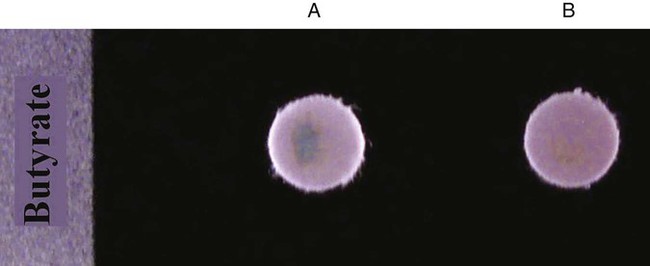 Figure: Butyrate disk test A, Positive test. B. Negative test
How to read the result
Read the disk within the incubation window, up to 5 minutes. A blue to blue-violet color is positive. No color change is negative. If the 4-methylumbelliferyl butyrate (MUB) substrate is used, a positive result is blue fluorescence under UV light instead of a visible blue color.
Read on time. Do not read past 5 minutes. Prolonged incubation can produce a false positive as color develops nonspecifically.
Confirm the starting point. The test is only meaningful on an oxidase-positive, Gram-negative diplococcus with typical morphology. A positive result on the wrong starting organism does not identify M. catarrhalis, because unrelated organisms can also be positive (see limitations).
If suspected but negative, do not stop. A false negative can occur with too small an inoculum. Repeat with a heavier inoculum, and for a colony that still tests negative but looks like M. catarrhalis, DNase production can be used as a further confirmatory test. DNase-positive colonies fitting the other criteria are reported as M. catarrhalis.
Where the test fits in identification
Butyrate esterase is the rapid step that separates Moraxella catarrhalis from the Neisseria species it resembles. M. catarrhalis, Neisseria gonorrhoeae, and other Neisseria such as Neisseria lactamica are all oxidase-positive, Gram-negative diplococci, so the Gram stain and oxidase test cannot tell them apart. M. catarrhalis is butyrate-positive, while the Neisseria species are butyrate-negative. That single reaction is the point of the test.
The identification usually runs in this order: colony morphology on blood agar, Gram stain, oxidase test, then the butyrate disk as the rapid confirmatory step.
Why the rapid answer matters
Because most M. catarrhalis strains produce beta-lactamase, identifying the organism quickly also flags likely resistance to penicillin and ampicillin. In practice, laboratories confirm beta-lactamase production directly with the nitrocefin test, which turns positive for the great majority of M. catarrhalis isolates.
The butyrate disk answers "which organism," and the nitrocefin test answers "will penicillins work," and together they guide therapy within minutes to hours rather than days. For beta-lactamase detection, see the article on the nitrocefin test, and the antimicrobial susceptibility testing section for how these results are reported.
Limitations
- False positives can occur if the disk is read after more than 5 minutes, as color develops nonspecifically over time.
- False positives can also occur with organisms other than Moraxella catarrhalis. Some other Moraxella species, as well as Acinetobacter, Eikenella, staphylococci, and pseudomonads, can give a positive or weakly positive reaction. This is why the test is interpreted only on an oxidase-positive, Gram-negative diplococcus with typical morphology.
- False negatives may occur if the inoculum is too small. If a suspected organism tests negative, repeat with a heavier inoculum, and consider DNase testing as a further confirmatory step for colonies that still fit the other criteria for M. catarrhalis.
References and further readings
- Leber, A. L. (Ed.). (2016). Clinical Microbiology Procedures Handbook (4th ed.). ASM Press. [DOI pending your convention decision, see note]
- Tille, P. M. (2022). Bailey and Scott's Diagnostic Microbiology (15th ed.). Elsevier.

Comments
No comments yet. Be the first to share your thoughts.
Leave a comment
All comments are reviewed before they appear.