
Exotoxins vs Endotoxins: Differences, Types, and Examples (Plus Where Enterotoxin and Cytotoxin Fit)
Exotoxins and endotoxins differ in structure, toxicity, and how they cause disease. Compare them side by side, and see how enterotoxins, cytotoxins, and neurotoxins fit as types of exotoxin.

On this page
Bacterial toxins are broadly divided into two general categories: exotoxins and endotoxins. Exotoxins are proteins produced inside pathogenic bacteria and are secreted into the surrounding medium, whereas endotoxins are an integral part of the bacterial cell wall and are released only during the lysis of bacteria.
The symptoms caused by endotoxin of gram-negative bacteria are similar (though vary in severity) to one another. In contrast, symptoms caused by exotoxins of different bacteria are usually different. For example, a strain of Escherichia coli that produces one type of exotoxin causes watery (non-bloody) diarrhea, whereas a different strain of E.coli that produces another type of exotoxin causes bloody diarrhea.
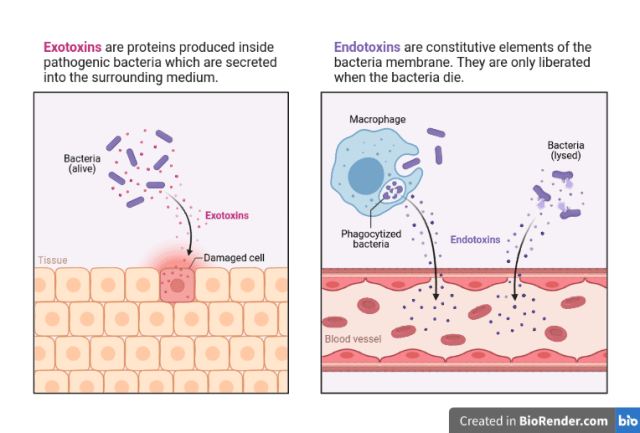 Figure: Exotoxins vs. Endotoxins (created with BioRender.com)
Exotoxins
Exotoxins are polypeptides released extracellularly as the organism grows. Exotoxins may travel from a focus of infection to a distant part of the body and cause damage. E.g., neurotoxin (botulinum toxin, tetanus toxin), enterotoxin (cholera toxin), and cytotoxin.
Are enterotoxins, cytotoxins, and neurotoxins the same as exotoxins?
This is the single most common point of confusion.
Enterotoxins, cytotoxins, and neurotoxins are all types of exotoxin. They are not a separate category, and they are not related to endotoxin. They are simply exotoxins grouped by which tissue they attack.
- A neurotoxin is an exotoxin that acts on nerves (for example, botulinum toxin and tetanus toxin).
- An enterotoxin is an exotoxin that acts on the gut and causes vomiting or diarrhea (for example, cholera toxin and staphylococcal enterotoxin).
- A cytotoxin is an exotoxin that kills or damages a broad range of cells (for example, diphtheria toxin and Shiga toxin).
So when you see a question like "enterotoxin vs exotoxin," the honest answer is that the comparison does not quite make sense: an enterotoxin is an exotoxin. The real distinction that matters for exams and for the clinic is the one below, between exotoxin (a secreted protein, of which enterotoxins, cytotoxins, and neurotoxins are subtypes) and endotoxin (the lipopolysaccharide of the gram-negative cell wall).
One clean way to hold it in your head:
Endotoxin is one specific molecule (LPS). Exotoxin is a whole family of proteins, and enterotoxin, cytotoxin, and neurotoxin are members of that family named for their target.
The exotoxins below are grouped in the following sections as neurotoxins, enterotoxins, or cytotoxins depending on the tissue they target. This table focuses on their molecular mechanism.
Name of Toxin | Mode of Action |
Bacillus anthracis toxin | Edema factor is an adenylate cyclase; the lethal factor is a protease that cleaves MAP kinase, which is required for cell division. |
Botulinum toxin | It is a protease; it blocks the release of acetylcholine by proteolytic cleavage of releasing proteins. |
C. difficile toxin | Exotoxin A and B inactivate GTPases by glucosylation. |
Cholera toxin | Stimulates adenylate cyclase by ADP-ribosylation |
Clostridium perfringens toxins | Alpha toxin is a lecithinase (phospholipase C) that damages cell membranes; the enterotoxin acts on the intestinal epithelium and disrupts membrane permeability. |
Diphtheria toxin | Inactivates EF-2 by ADP-ribosylation |
Enterotoxin of Escherichia coli | Labile toxin stimulates adenylate cyclase by ADP-ribosylation; stable toxin stimulates guanylate cyclase. |
Enterotoxin of S. aureus | It is a superantigen acting locally in the gastrointestinal tract |
Erythrogenic toxin (streptococcal pyrogenic exotoxins) | It is a superantigen of S. pyogenes. Its action is similar to toxic shock syndrome toxin of S. aureus. |
Pertussis toxin | Stimulates adenylate cyclase by ADP-ribosylation; inhibits chemokine receptor. |
Scalded skin syndrome toxin of S. aureus | It is a protease that cleaves desmoglein in desmosomes |
Shiga toxin (Shigella dysenteriae and E. coli) | Shiga toxin inhibits protein synthesis in enterocytes by removing adenine from 28S ribosomal RNA. |
Tetanus toxin | Blocks release of inhibitory neurotransmitter glycine by proteolytic cleavage of releasing proteins. |
Toxin shock syndrome toxin (TSST) of S. aureus | It is a superantigen. It binds to class II MHC protein and T-cell receptor; induces IL-1 and IL-2. |
Types of exotoxin (by target tissue)
Cytotoxin
Cytotoxin acts to disrupt the structure of individual cells. Destroyed cells slough from the surface of the mucosa, leaving it raw and unprotected, which causes loss of secretory and absorptive functions of these cells. Further damage to these cells occurs due to a strong inflammatory response from the host.
Some cytotoxins act on the intestinal (colonic) epithelial cells causing dysentery. The stool contains numerous PMNs and blood, and pain, cramps, and tenesmus are common symptoms. A cytotoxin produced by Staphylococcus aureus named Panton-Valentine leukocidin (PVL) causes leukocyte destruction and tissue necrosis.
Examples of cytotoxins-producing organisms are Clostridioides difficile, E.coli O157: H7, Staphylococcus aureus, Bacillus cereus, Haemophilus ducreyi, and Bordetella pertussis.
Enterotoxin
Enterotoxin causes food poisoning characterized by prominent vomiting and watery, non-bloody diarrhea. They act primarily in the jejunum and upper ileum, where most fluid transport takes place. Enterotoxins alter the metabolic activity of intestinal epithelial cells, causing an outpouring of electrolytes and fluid into the lumen, resulting in profuse and watery diarrhea. A classical example of enterotoxin is the cholera toxin.
Staphylococcal enterotoxin acts as a superantigen within the gastrointestinal tract, stimulating the release of large amounts of cytokines and activating the enteric nervous system, which signals the vomiting center in the brain. This is why staphylococcal food poisoning causes such prominent, rapid-onset vomiting.
Most protein exotoxins are heat-labile and are destroyed by cooking, but a few enterotoxins are notably heat-stable. Staphylococcal enterotoxin is the classic example: it survives boiling and brief cooking, which is why reheating contaminated food does not prevent staphylococcal food poisoning.
Endotoxin (LPS) is also heat-stable and survives standard sterilization. Many enterotoxins are also resistant to stomach acid and to digestive enzymes, which is how a preformed toxin swallowed in food can still act in the gut.
Enterotoxin producing Organisms
- Clostridium perfringens
- Staphylococcus aureus (staphylococcal enterotoxin)
- Escherichia coli (heat-labile toxin and heat-stable toxin)
- Vibrio cholerae (cholera toxin)
- Bacillus cereus
Neurotoxins
Botulinum is the most potent neurotoxin produced by Clostridium botulinum. The toxin prevents the release of the neurotransmitter acetylcholine at the synapse of the neuromuscular junction, causing flaccid paralysis.
Tetanus toxin is a neurotoxin that prevents the release of inhibitory neurotransmitters involved in muscle relaxation. Muscle spasms and spastic paralysis occur when the inhibitory neurons are nonfunctional, and the excitatory neurons are unopposed.
Exotoxins are produced by several Gram-positive and Gram-negative bacteria and are among the most toxic substances known.
Many exotoxins have an A-B subunit structure;
- A or active subunit possesses toxic activity, and
- B, or binding subunit, is responsible for binding the exotoxin to specific receptors on the human cell membrane. The binding of the subunit B determines the specificity of the exotoxin. For example, botulinum toxin acts at the neuromuscular junction because the subunit B binds to specific receptors on the surface of the motor neuron at the junction.
Important exotoxins that have A-B subunit structure include botulinum toxin, cholera toxin, diphtheria toxin, enterotoxin of E.coli, and tetanus toxin.
Important Bacterial Exotoxins and their Mechanism of Action
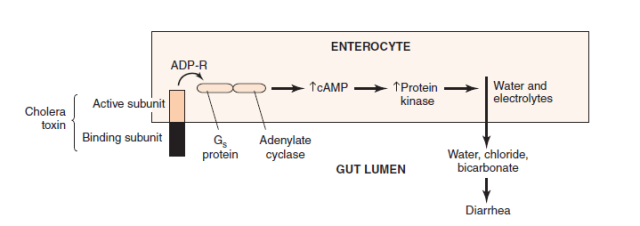 Figure: Mode of action of Escherichia coli and cholera toxin (Source: Ref-1)
Endotoxins
Endotoxin is the lipopolysaccharide (LPS) of the gram-negative outer membrane. Its toxic part is lipid A. The name endotoxin reflects that the toxin is built into the cell and released mainly when the cell is damaged or dies, not actively secreted like an exotoxin. For the full structure of LPS (lipid A, core oligosaccharide, and O-antigen), see the dedicated LPS article linked below.
Properties of Endotoxins
- Endotoxins are integral parts of the cell walls of gram-negative rods and cocci, in contrast to exotoxins, which are actively released from the cell. Endotoxins (LPS) are released from the surface of gram-negative bacteria in small pieces of the outer membrane.
- Endotoxins are lipopolysaccharides (LPS), whereas exotoxins are polypeptides.
- The enzymes that produce LPS are encoded by genes on the bacterial chromosomes rather than plasmid or bacteriophage DNA, which usually encodes the exotoxins.
- The toxicity of endotoxins is low in comparison with that of exotoxins.
- Though the severity varies, all endotoxins produce the same generalized effects of fever and shock, in contrast to the specific, tissue-targeted action of each exotoxin.
- Endotoxins are weakly antigenic; they induce protective antibodies so poorly that multiple episodes of toxicity can occur.
- No toxoids have been produced from endotoxins, and endotoxins are not used as antigens in any available vaccine.
Effects of Endotoxins
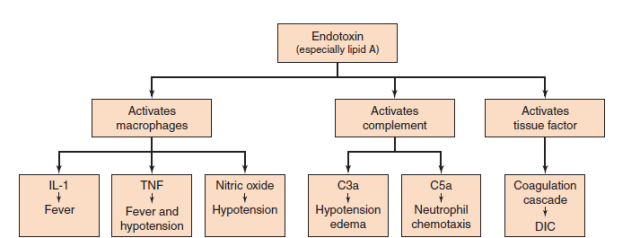 Figure: Mode of action of endotoxins (Source: Ref-1)
Unlike exotoxins, which each have a specific action, all endotoxins produce the same general picture: fever, hypotension progressing to shock, and, in severe cases, disseminated intravascular coagulation (DIC). This happens because endotoxin (the lipid A part of LPS) activates macrophages to release inflammatory cytokines such as IL-1, IL-6, and TNF-alpha. IL-1 and IL-6 act on the hypothalamus to cause fever. TNF-alpha and nitric oxide cause vasodilation and leaky capillaries, which drop the blood pressure. Widespread activation of the clotting cascade produces DIC.
This cascade, from LPS release through the TLR4 receptor to the full cytokine storm, septic shock, and the "antibiotic paradox" in which killing the bacteria worsens the patient, is covered step by step in the dedicated article: Lipopolysaccharide (LPS): structure, endotoxin, and how it causes septic shock.
Differences between Exotoxins and Endotoxins
Though various similarities exist between exotoxins and endotoxins, they differ in many aspects. For example, both exotoxins and endotoxins alone can cause symptoms without bacteria in the host. A person eating food containing preformed exotoxin can get botulism so does the person containing pyrogenic substances in the intravenous solution.
The major differences between exotoxins and endotoxins are tabulated here;
Property | Exotoxins | Endotoxins |
Biomolecule | Proteins | Lipopolysaccharide (LPS); toxic part is lipid A |
Location of genes | Plasmid or Bacteriophage | Bacterial chromosome |
Source | Exotoxins are released by certain Gram-positive or Gram-negative bacteria | Cell wall of Gram-negative bacteria, released only after lysis of cells |
Heat Stability | Destroyed rapidly at 60°C (except staphylococcal enterotoxin) | Stable at 100°C for one hour |
Mode of Action (Symptoms) | Specific. Either cytotoxin, enterotoxin, or neurotoxin with defined action on cells or tissues | General. Fever, hypotension and shock, DIC |
Toxicity | Highly toxic, often fatal (fatal dose on the order of 1 µg) | Weakly toxic; requires much larger amounts than exotoxin to cause harm |
Immunogenicity | Highly immunogenic, stimulate the production of neutralizing antibody (antitoxins) | Relatively poor immunogenicity |
Toxoid potential/Vaccines | Treatment of toxins with formaldehyde will destroy toxicity, but treated toxins remain immunogenic. These toxoids are used as vaccines. | No toxoid formed, and no vaccine is available |
Typical disease | Tetanus, Diphtheria, Botulism | Meningococcemia, sepsis by gram negative rods |
Which bacteria produce exotoxins?
Exotoxins are made by both gram-positive and gram-negative bacteria. This is a key point: exotoxins are not limited to one Gram group, whereas endotoxin is found only in gram-negative bacteria. Some of the most important exotoxin producers:
Gram-positive exotoxin producers:
- Corynebacterium diphtheriae (diphtheria toxin)
- Clostridium tetani (tetanus toxin)
- Clostridium botulinum (botulinum toxin)
- Clostridium perfringens (alpha toxin, enterotoxin)
- Staphylococcus aureus (enterotoxin, TSST-1, exfoliative toxin, PVL)
- Streptococcus pyogenes (streptococcal pyrogenic exotoxins)
Gram-negative exotoxin producers:
- Vibrio cholerae (cholera toxin)
- Escherichia coli (heat-labile toxin, heat-stable toxin, Shiga toxin in EHEC)
- Shigella dysenteriae (Shiga toxin)
- Bordetella pertussis (pertussis toxin)
- Pseudomonas aeruginosa (exotoxin A)
How to remember
exO = Out, endO = On the cell. Exotoxins are secreted Out of the cell. Endotoxin stays On (part of) the gram-negative cell wall and comes out only when the cell breaks.
Exotoxin = protein, specific, strong, and stoppable by a toxoid. Four features that all travel together: it is a Protein, it has a Precise action, it is Potent, and it can be Prevented with a toxoid vaccine. Endotoxin is the opposite on every count: it is a lipopolysaccharide, general in effect, weakly toxic, and cannot be made into a toxoid.
The subtype trap: enterotoxin, cytotoxin, neurotoxin all end in "-toxin" and all ARE exotoxins. They are named for their target (entero = gut, cyto = cells, neuro = nerves), not for being a different class. None of them is related to endotoxin.
Toxoid comes from exotoxin only. You can inactivate a protein and keep its shape (that is a toxoid: tetanus, diphtheria). You cannot do that to LPS, so there is no endotoxin toxoid and no endotoxin vaccine of that kind.
Key Exam Facts
| Feature | Exotoxin | Endotoxin |
|---|---|---|
| What it is | Protein (polypeptide), secreted | Lipopolysaccharide (LPS), part of the cell wall |
| Toxic part | The whole protein (A subunit in AB toxins) | Lipid A |
| Source | Gram-positive AND gram-negative bacteria | Gram-negative bacteria only |
| How it is released | Actively secreted while the cell is alive | Released mainly when the cell is damaged or dies |
| Genes usually on | Often plasmid or bacteriophage (sometimes chromosomal) | Bacterial chromosome |
| Action | Specific to a tissue: neuro-, entero-, or cytotoxin | General: fever, hypotension/shock, DIC |
| Potency | Very high (fatal dose around 1 microgram for the most potent) | Low (needs far larger amounts) |
| Heat stability | Mostly heat-labile (staphylococcal enterotoxin is a heat-stable exception) | Heat-stable |
| Immunogenicity | Strong; produces neutralizing antitoxin | Weak |
| Toxoid / vaccine | Yes: can be inactivated into a toxoid (tetanus, diphtheria) | No toxoid possible |
| Subtypes | Enterotoxin, cytotoxin, neurotoxin (named by target) | Not subdivided this way |
| Example diseases | Tetanus, diphtheria, botulism, cholera | Gram-negative sepsis, meningococcemia |
Where Students Get Confused
"Enterotoxin vs exotoxin" is a trick comparison. An enterotoxin is a type of exotoxin, so the two are not opposites. The same is true for cytotoxin and neurotoxin. If a question pits "enterotoxin" against "exotoxin," it is testing whether you know that enterotoxin sits inside the exotoxin family. The real opposite of exotoxin is endotoxin.
Endotoxin is not a protein. Students often assume all toxins are proteins. Endotoxin is a lipopolysaccharide (lipid A is the toxic part). This one fact explains why endotoxin is heat-stable, weakly immunogenic, and cannot be made into a toxoid, while exotoxins (proteins) are heat-labile, strongly immunogenic, and can.
Both Gram groups make exotoxins; only gram-negatives have endotoxin. A common error is to pair "exotoxin = gram-positive, endotoxin = gram-negative." Wrong. Gram-negative bacteria such as Vibrio cholerae and E. coli make powerful exotoxins too. What is exclusive is endotoxin: it is the LPS of the gram-negative wall, so gram-positive bacteria have no endotoxin.
Why endotoxin has no vaccine but exotoxins do. A toxoid is an exotoxin protein that has been chemically inactivated but keeps its shape, so the immune system still recognizes it. You cannot do this to LPS, which is not a protein, so there is no endotoxin toxoid. This is why tetanus and diphtheria (exotoxin diseases) are vaccine-preventable with toxoids, while gram-negative sepsis is not.
"Symptoms are the same" applies to endotoxin, not exotoxin. All endotoxins cause a similar picture (fever, shock) because they all act through the same LPS pathway. Exotoxins cause different, specific diseases because each has a precise molecular target. This is why one E. coli strain causes watery diarrhea and another causes bloody diarrhea: different exotoxins, different targets.
Frequently Asked Questions
What is the main difference between exotoxins and endotoxins?
What is the main difference between exotoxins and endotoxins?
Exotoxins are proteins that bacteria actively secrete, and they have specific actions on particular tissues. Endotoxin is the lipopolysaccharide (LPS) of the gram-negative cell wall, released mainly when the cell dies, and it causes a general reaction of fever and shock. Exotoxins are made by both gram-positive and gram-negative bacteria; endotoxin is found only in gram-negative bacteria.
Is an enterotoxin an exotoxin or an endotoxin?
Is an enterotoxin an exotoxin or an endotoxin?
An enterotoxin is a type of exotoxin. So are cytotoxins and neurotoxins. They are all secreted proteins, grouped by the tissue they act on: enterotoxins act on the gut, neurotoxins on nerves, cytotoxins on a range of cells. None of them is related to endotoxin.
What is the difference between enterotoxin, cytotoxin, and neurotoxin?
What is the difference between enterotoxin, cytotoxin, and neurotoxin?
All three are exotoxins named for their target. An enterotoxin acts on the intestinal lining and causes vomiting or diarrhea (for example, cholera toxin). A neurotoxin acts on the nervous system (for example, botulinum and tetanus toxins). A cytotoxin damages or kills a broad range of cells (for example, diphtheria toxin and Shiga toxin).
Are exotoxins produced by gram-positive or gram-negative bacteria?
Are exotoxins produced by gram-positive or gram-negative bacteria?
Both. Gram-positive producers include Corynebacterium diphtheriae, Clostridium tetani, and Staphylococcus aureus. Gram-negative producers include Vibrio cholerae, E. coli, and Bordetella pertussis. Only endotoxin is exclusive to gram-negative bacteria.
Are exotoxins heat stable?
Are exotoxins heat stable?
Most exotoxins are proteins and are heat-labile, meaning cooking destroys them. There are exceptions. Staphylococcal enterotoxin is heat-stable and survives boiling, which is why reheating contaminated food does not prevent staphylococcal food poisoning. Endotoxin (LPS) is also heat-stable.
Why is there a vaccine for tetanus and diphtheria but not for gram-negative sepsis?
Why is there a vaccine for tetanus and diphtheria but not for gram-negative sepsis?
Tetanus and diphtheria are caused by exotoxins, which are proteins. A protein can be chemically inactivated into a toxoid that keeps its shape, so the immune system still learns to recognize it. Endotoxin is a lipopolysaccharide, not a protein, so it cannot be turned into a toxoid. That is why there is no equivalent endotoxin toxoid vaccine.
Which is more toxic, exotoxin or endotoxin?
Which is more toxic, exotoxin or endotoxin?
Exotoxins are far more potent. The most powerful exotoxins, such as botulinum toxin, are fatal in microgram amounts. Endotoxin is weakly toxic by comparison and needs much larger amounts to cause harm, though in gram-negative sepsis the body's own reaction to endotoxin can still be lethal.
References
- Riedel, S., Hobden, J. A., Miller, S., Morse, S. A., Mietzner, T. A., Detrick, B., et al. (2019). Jawetz, Melnick & Adelberg's Medical Microbiology (28th ed.). McGraw-Hill.
- Levinson, W., Chin-Hong, P., Joyce, E. A., Nussbaum, J., & Schwartz, B. (2022). Review of Medical Microbiology and Immunology (16th ed.). McGraw-Hill.
- Madigan, M. T., Bender, K. S., Buckley, D. H., Sattley, W. M., & Stahl, D. A. (2021). Brock Biology of Microorganisms (16th ed.). Pearson.
- Tille, P. M. (2022). Bailey & Scott's Diagnostic Microbiology (15th ed.). Elsevier.

Tankeshwar Acharya, MSc (Medical Microbiology)
Tankeshwar Acharya is an Assistant Professor in the Department of Microbiology at Patan Academy of Health Sciences (PAHS), Nepal, where he has been teaching and practicing clinical microbiology for over 14 years. He is the founder of Microbe Online, one of the leading free microbiology education resources on the web, covering bacteriology, mycology, parasitology, immunology, and clinical laboratory diagnostics written from direct experience in both the classroom and the diagnostic laboratory.
Comments
No comments yet. Be the first to share your thoughts.
Leave a comment
All comments are reviewed before they appear.