
ASO Titer Test: How to Interpret Results (Single vs Paired) and Cutoffs

On this page
A 9-year-old is brought to a clinic in Kathmandu three weeks after a sore throat that was never cultured. Now she has migrating joint pain and a new heart murmur. The throat swab is negative, because the streptococci are long gone. But her blood still carries the immune system's paper trail: antibodies raised against streptolysin O, the toxin group A Streptococcus used weeks ago. The ASO titer does not tell you she has a strep infection today. It tells you she had one recently enough for rheumatic fever to be the explanation in front of you. That single distinction, between a current infection and an antecedent one, is the entire clinical reason this test exists, and it is where most interpretation goes wrong.
Why the ASO test matters clinically
The throat swab and rapid strep test answer one question: is there strep in the throat right now? By the time post-streptococcal complications appear, that window has closed. Rheumatic fever and post-streptococcal glomerulonephritis surface 2 to 3 weeks after the original infection, when cultures are already negative. The ASO titer fills that gap. It is retrospective evidence, confirming that a group A streptococcal infection occurred recently enough to plausibly explain immune-mediated sequelae. This is why ASO is one of the antibody criteria used to satisfy the "evidence of preceding streptococcal infection" requirement in the modified Jones criteria for acute rheumatic fever. It supports the diagnosis; it does not make it.
Most people infected with group A streptococci produce anti-streptolysin O (ASO) antibodies. In infections caused by β-hemolytic streptococci, streptolysin O is one of two hemolysins the bacteria release. Streptolysin S is oxygen-stable but poorly immunogenic, so it provokes little antibody response. Streptolysin O is oxygen-labile and strongly immunogenic, which is why it, and not streptolysin S, is the target of a serologic test. It stimulates the production of ASO antibodies in serum. The presence and the level of these antibodies in the serum may reflect the nature and severity of the infection. Rheumatic fever and poststreptococcal glomerulonephritis tend to occur 2 to 3 weeks after the initial streptococcal infection.
Streptolysin O is an enzyme that lyses RBC membranes and is responsible for the zone of beta-hemolysis around colonies of group A streptococci seen on agar plates. Classically, ASO antibodies were detected by demonstrating serum’s capacity to inhibit or neutralize the lysis of RBC membranes by streptolysin O. The test principle, procedure, and interpretation presented here is based on the latex anti-streptolysin O (ASO) test.
Assays for anti-DNase B (ADB) antibodies are also available to diagnose group A streptococcal infection. ADB test detects antibodies against the B isoenzyme of streptococcal DNases (also called streptodornase), a group of bacterial enzymes that depolymerize DNA.
Principle
The ASO titer (ASOT) tends to rise a week following infection, peaks at 3 to 5 weeks, begins to fall at 8 weeks, and returns to pre-infection levels at around 8 months. Stronger ASO responses follow throat infections than skin infections. Skin lipids, in particular free cholesterol, bind and neutralize streptolysin O at the site, blunting its immunogenicity. This has a practical consequence: in suspected post-streptococcal glomerulonephritis following skin infection (pyoderma), ASO is often unhelpful, and anti-DNase B is the more reliable marker. Qualitative and semi-quantitative determination of anti-streptolysin O antibodies (ASO) in serum can be performed using a rapid latex agglutination test.
ASO latex reagent is a stabilized buffered suspension of polystyrene latex particles coated with Streptolysin O. When the latex reagent is mixed with a serum containing ASO, agglutination occurs.
 Figure: ASO Latex test
Ideally, titers should be measured in both the acute and convalescent phases (2 to 4 weeks apart) to observe a rise in titer. However, single titers are frequently used in low-resource settings.
The sensitivity of the latex reagent has been adjusted to yield agglutination when the level of ASO is greater than 200 IU/mL, a level determined to be indicative of disease by epidemiological and clinical studies. With this reagent, sera containing between 200 IU/mL and 3500 IU/mL of ASO give a reactive (agglutination) result; this is the working range of the latex kit, not a clinical severity scale.
Sample Collection and Handling
Only fresh serum specimens should be used. Plasma must not be used since fibrinogen may cause non-specific agglutination of the latex. It is preferable to test samples on the same day as collected. Serum samples may be stored at 2-8°C for up to 48 hours prior to testing. If longer storage is necessary, sera should be stored frozen at -20°C.
Materials used in the ASO Test
- ASO antigen: A stabilized buffered suspension of polystyrene latex particles coated with Streptolysin O and 0.1% sodium azide as a preservative. Shake well prior to use.
- ASO positive control: Human serum-containing more than 200 IU/mL ASO and 0.1% sodium azide as a preservative.
- ASO negative control: Human serum containing 0.1% sodium azide as a preservative.
- Sufficient disposable pipettes.
- Glass test slide.
Procedure for Anti-streptolysin O Test
- Bring all test reagents and samples to room temperature.
- Use a disposable pipette to draw up and place one free-falling drop of each undiluted sample into its identified circle of the slide. Retain each pipette for mixing in step 5.
- Deliver one free-falling drop of positive and negative control into its identified circle.
- Mix the ASO latex reagent by gently shaking. Add one free-falling drop of a reagent to each control and sample.
- Using the flattened end of the appropriate plastic pipette as a stirrer (step 2), thoroughly mix each sample with reagent within the full area of the circle.
- Discard the disposable pipette.
- Slowly rock the slide for exactly two (2) minutes and observe for agglutination under a high-intensity light.
- Record results.
- Clean and disinfect the glass slide after use per your laboratory's biosafety protocol.
Test Result
A test sample is considered to contain ASO antibodies in excess of 200 IU/mL when agglutination (clumping) is observed when compared to the result of the negative control.
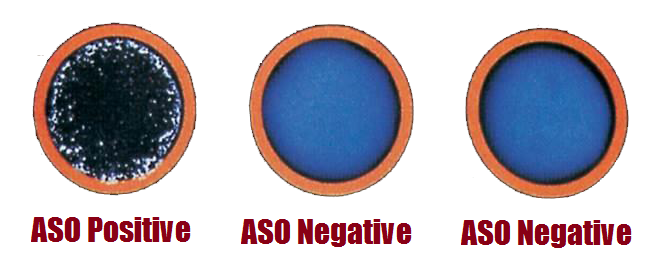 Figure: ASO titer results
Interpretation
Single titer vs paired sera
There are two ways to read an ASO result, and choosing the right one is the crux of the test.
A rise in titer of twofold or greater between an acute-phase and a convalescent-phase sample (drawn 2 to 4 weeks apart) is the strongest evidence of a recent group A streptococcal infection. A rising titer is unambiguous; a single high value is not, because it cannot tell you whether the antibody is climbing, plateaued, or already falling from an old infection.
Paired sera are the ideal. In practice, in low-resource and endemic settings, patients are frequently lost to follow-up and a single sample is all that is available. Here a single titer above the age-appropriate upper limit of normal is accepted as sufficient evidence of antecedent infection, and this single-titer-versus-ULN approach is explicitly permitted under the 2015 Jones criteria.
Age-stratified cutoffs
"Elevated" is not one number. Because group A streptococcal infection is far more common in children, healthy children carry higher baseline titers than adults, and an age-stratified upper limit of normal must be used.
As a working guide, titers above roughly 200 IU/mL in adults and above roughly 300 IU/mL in school-aged children are considered elevated. These are conventional reference figures; the true upper limit of normal is the 80th percentile of the local healthy population and varies geographically. In high-incidence settings, applying a Western cutoff of 200 IU/mL to children causes systematic over-diagnosis of rheumatic fever, which is why locally derived, age-stratified values are preferred wherever they exist.
The interpretation must stay tied to the clinic
ASO titer should be interpreted with considerable caution in the absence of a convincing clinical history of rheumatic fever or glomerulonephritis. A raised titer confirms recent exposure, nothing more. Many healthy people in endemic areas carry elevated titers with no disease. An elevated ASO on its own never confirms rheumatic fever; it contributes one piece to the Jones criteria alongside the clinical findings.
ASO titer may be interpreted either by comparison of acute and convalescent-phase titers or against reference upper limit of normal values. Rise in titer (≥ twofold) from the acute phase to the convalescent phase is the best evidence of antecedent infection with group A streptococci. In the area, where rheumatic fever or poststreptococcal glomerulonephritis is endemic, a single initial titer more than (>) upper limit of normal value is diagnostic.
As group A streptococcal infection is more common in children than adults, age-stratified upper limit of normal reference values should be used while interpreting the serological results. ASO titer should be interpreted with considerable caution, especially in the absence of a convincing history of rheumatic fever or glomerulonephritis.
Limitations
- False-negative ASO results can occur for patients with hyperlipidemia.
- False-positive ASO results may occur due to cross-reactivity in patients with myeloma, hypergammaglobulinemia, liver disease, and autoimmune disease with elevated rheumatoid factor.
How to Remember
Skin soaks up the signal. Skin infections give weak ASO responses because skin cholesterol mops up streptolysin O before the immune system sees much of it. So after impetigo/pyoderma, don't trust ASO, reach for anti-DNase B. Picture the streptolysin O being "absorbed" into oily skin and never reaching the bloodstream.
Rising beats high. A titer that is rising across two samples beats a single high number every time, because "high" could be an old scar rather than a fresh wound. When you can only get one sample, you're no longer measuring change, so you have to compare against the age-matched normal ceiling instead.
Key exam facts
| Point | What to remember |
|---|---|
| Target antigen | Streptolysin O, an oxygen-labile, immunogenic hemolysin of group A Streptococcus |
| Why not streptolysin S | Streptolysin S is oxygen-stable and poorly immunogenic, so it raises little antibody |
| What a positive means | Recent (antecedent) GAS infection, not a current one |
| Titer kinetics | Rises ~1 week post-infection, peaks at 3 to 5 weeks, falls by ~8 weeks, back to baseline by ~8 months |
| Best evidence of infection | Twofold or greater rise between paired acute and convalescent sera (2 to 4 weeks apart) |
| Single-titer rule | A single titer above the age-specific ULN is acceptable in endemic/low-resource settings (allowed by 2015 Jones criteria) |
| Adult cutoff | Elevated above ~200 IU/mL (locally validated 80th-percentile ULN preferred) |
| Child cutoff | Higher, ~300 IU/mL in school-aged children; children have higher baselines |
| Throat vs skin | Strong response after pharyngitis; weak after skin infection (cholesterol neutralizes SLO). Use anti-DNase B after skin infection |
| Detection threshold (latex) | Latex reagent agglutinates when ASO exceeds 200 IU/mL |
| Sample | Fresh serum only; never plasma (fibrinogen causes non-specific agglutination) |
| False negative | Hyperlipidemia |
| False positive | Myeloma, hypergammaglobulinemia, liver disease, elevated rheumatoid factor |
| Clinical rule | Elevated ASO alone never confirms rheumatic fever; it satisfies one Jones-criteria element |
Where students get confused
"A high ASO means the patient has a strep infection now." No. It means they had one, recently. By design, ASO is used precisely when the organism is already gone and cultures are negative. Confusing "recent" with "current" is the single most common error.
"Elevated ASO confirms rheumatic fever." It does not. It confirms antecedent infection, one required piece of the Jones criteria. Plenty of healthy people in endemic areas have elevated titers and no disease.
"200 IU/mL is the cutoff, full stop." The cutoff is age-dependent and population-dependent. Children run higher baselines, and the real upper limit of normal is the 80th percentile of the local healthy population. Applying an adult or Western number to a child in an endemic area over-diagnoses disease.
"A single normal ASO rules out rheumatic fever." No. Some patients are non-responders, and the titer may already be falling when symptoms appear. This is exactly why anti-DNase B exists as a second, complementary marker, and why one negative antibody test does not close the question.
"Why bother with anti-DNase B at all?" Because after skin infections ASO is unreliable (cholesterol blunts the response), and because pairing the two antibodies catches more true infections than either alone.
Frequently Asked Questions
Does a high ASO titer mean I currently have a strep infection?
Does a high ASO titer mean I currently have a strep infection?
No. A high ASO titer means you had a group A streptococcal infection recently, usually within the past several weeks. The test is designed for situations where the infection has already cleared and throat cultures are negative, which is exactly when post-streptococcal complications appear.
What is a normal ASO titer?
What is a normal ASO titer?
It depends on age and location. As a general guide, titers above about 200 IU/mL in adults and about 300 IU/mL in school-aged children are considered elevated. Children have higher normal baselines, and the true cutoff is the 80th percentile of the local healthy population.
Why do I need two blood samples for an ASO test?
Why do I need two blood samples for an ASO test?
A rise of twofold or more between an acute sample and a convalescent sample taken 2 to 4 weeks later is the strongest evidence of recent infection. A single value cannot tell you whether the titer is rising, steady, or already falling. Where follow-up is difficult, a single titer above the age-specific normal limit is accepted instead.
Can ASO confirm rheumatic fever?
Can ASO confirm rheumatic fever?
No. An elevated ASO confirms only that a recent streptococcal infection occurred. It satisfies one element of the modified Jones criteria and must be combined with clinical findings to diagnose rheumatic fever.
When should anti-DNase B be used instead of ASO?
When should anti-DNase B be used instead of ASO?
After skin infections (pyoderma, impetigo), the ASO response is weak because skin cholesterol neutralizes streptolysin O. Anti-DNase B is the more reliable marker in that setting, and testing both antibodies detects more true infections than either alone.
Why can't plasma be used for the ASO latex test?
Why can't plasma be used for the ASO latex test?
Plasma contains fibrinogen, which can cause non-specific clumping of the latex particles and a false result. Only fresh serum should be used.
References
- Gray, G. C., Struewing, J. P., Hyams, K. C., Escamilla, J., Tupponce, A. K., & Kaplan, E. L. (1993). Interpreting a single antistreptolysin O test: a comparison of the "upper limit of normal" and likelihood ratio methods. Journal of Clinical Epidemiology, 46(10), 1181–1185.
- Machado, C. S., Ortiz, K., Martins, A. de L., Martins, R. S., & Machado, N. C. (2001). Antistreptolysin O titer profile in acute rheumatic fever diagnosis. Jornal de Pediatria, 77(2), 105–111.
- Tille, P. M. (2022). Bailey & Scott's Diagnostic Microbiology (15th ed.). Elsevier.
- Procop, G. W., et al. (2017). Koneman's Color Atlas and Textbook of Diagnostic Microbiology (7th ed.). Wolters Kluwer.
- Gewitz, M. H., et al. (2015). Revision of the Jones Criteria for the diagnosis of acute rheumatic fever in the era of Doppler echocardiography: a scientific statement from the American Heart Association. Circulation, 131(20), 1806–1818.

Tankeshwar Acharya, MSc (Medical Microbiology)
Tankeshwar Acharya is an Assistant Professor in the Department of Microbiology at Patan Academy of Health Sciences (PAHS), Nepal, where he has been teaching and practicing clinical microbiology for over 14 years. He is the founder of Microbe Online, one of the leading free microbiology education resources on the web, covering bacteriology, mycology, parasitology, immunology, and clinical laboratory diagnostics written from direct experience in both the classroom and the diagnostic laboratory.
Comments
No comments yet. Be the first to share your thoughts.
Leave a comment
All comments are reviewed before they appear.