
Viral Transport Media (VTM): Composition, Uses, Storage, and VTM vs UTM

On this page
A nasopharyngeal swab for respiratory virus PCR is collected correctly and placed in viral transport medium. The laboratory is closed for the weekend, so the tube goes into the ward freezer at -20°C until Monday.
The specimen would have done better sitting in the refrigerator. At -20°C, ice crystals form and grow through the freeze and the thaw, shearing viral envelopes and fragmenting nucleic acid. A refrigerated specimen ages gently; a specimen at -20°C is actively damaged.
Viral transport medium protects a specimen only within the conditions it was designed for. The medium is one half of the job. The temperature it is held at is the other, and the wrong freezer is worse than no freezer at all.
Viral transport medium (VTM) is a buffered, protein-containing liquid used to collect and transport clinical specimens for viral detection, and to hold them stable until they can be cultured, tested by nucleic acid amplification, or frozen for storage.
Despite the name, VTM also suits three groups of bacteria: Chlamydia, Mycoplasma, and Ureaplasma. The reason is instructive. Chlamydia is an obligate intracellular organism, and Mycoplasma and Ureaplasma lack a cell wall entirely. All three are osmotically fragile and die quickly in the salt-based media used for ordinary bacteria. What they need is what viruses need: protein to stabilize them, buffering to hold pH, and protection from drying. A medium built for viruses happens to be right for them too.
On viability: specimens in VTM are best held at 2 to 8°C and processed within 48 to 72 hours. Room temperature is tolerated for short periods but is not equivalent to refrigeration, and recovery of labile viruses such as RSV falls measurably with time at ambient temperature. Refrigerate whenever the option exists.
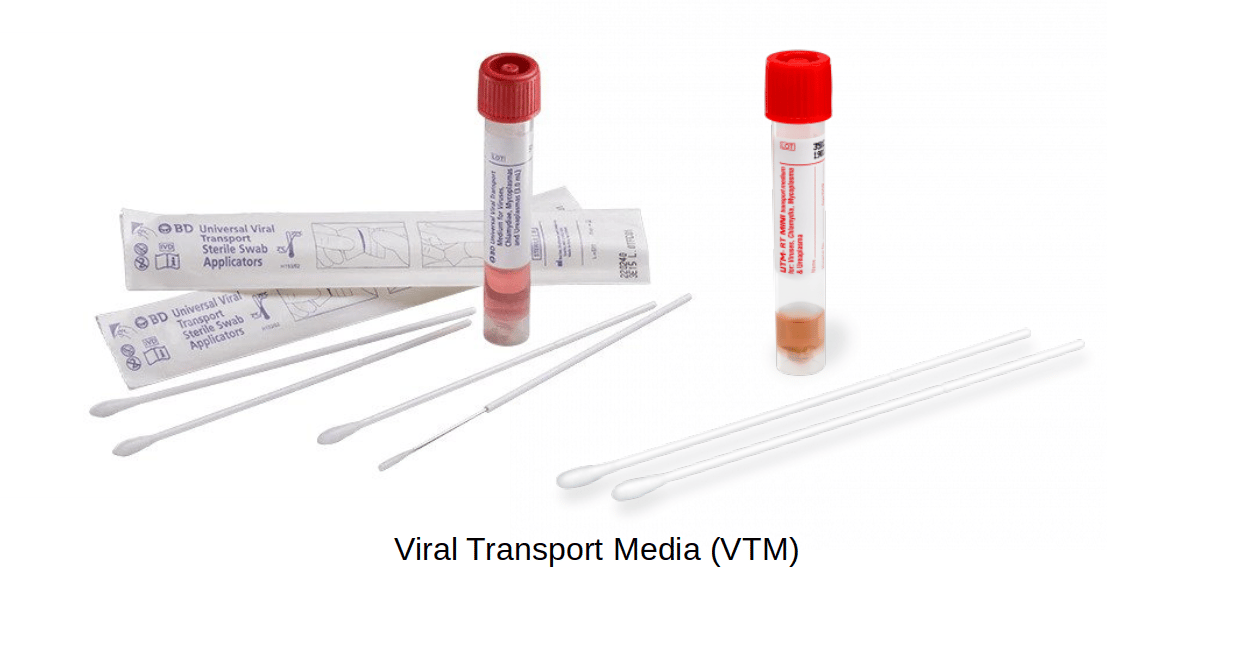 Figure: Viral Transport Medium (VTM)
What VTM Contains and Why
A viral transport medium is not a growth medium. Viruses cannot replicate outside living cells, so nothing in the formulation is there to feed anything. Every component is protective.
A balanced salt solution with buffer. Usually Hanks' or Earle's balanced salts with HEPES or bicarbonate buffering. Its job is to hold the specimen at physiological pH and osmolality. Viral envelopes and the cell membranes of infected cells both fail rapidly outside a narrow pH range, and a specimen that acidifies in transit loses infectivity before it arrives.
Protein: serum, albumin, or gelatin. This is the component that distinguishes VTM from a bacterial transport medium. Protein coats the plastic tube wall, so virions are not lost by simply sticking to it, and it stabilizes the lipid envelope of enveloped viruses. Fetal bovine serum, bovine serum albumin, and gelatin all serve this purpose.
Antibiotics and an antifungal. Typically an aminoglycoside such as gentamicin plus an antifungal such as amphotericin B. Clinical specimens from the respiratory tract, genital tract, and skin carry abundant bacteria and fungi that would otherwise overgrow a cell culture within a day. The antimicrobials suppress that overgrowth without harming viruses, which have no target for them.
Sometimes a pH indicator. Phenol red is included in some formulations so a color shift signals contamination or a pH problem before the specimen is processed.
The consequence of the antibiotics matters clinically. Because VTM actively suppresses bacteria and fungi, a specimen in VTM cannot be used for routine bacterial or fungal culture. If both viral and bacterial investigations are requested from the same site, two separate specimens must be collected. This is a frequent source of rejected requests.
Features of Viral Transport Medium (VTM)
- Maintains viruses, Chlamydia, Mycoplasma, and Ureaplasma in a condition suitable for both culture and nucleic acid amplification testing, using a single formulation
- Prevents the specimen drying out, which is what destroys a dry swab within hours
- Holds pH and osmolality stable during transport
- Suppresses contaminating bacteria and fungi through incorporated antimicrobials
- Tolerates refrigerated transport, with 2 to 8°C preferred over ambient temperature
- Supports long-term storage when frozen correctly at -70°C or below
VTM, UTM, and Bacterial Transport Media
| Liquid Amies (eSwab type) | VTM | UTM (universal) | |
|---|---|---|---|
| Designed for | Aerobic, anaerobic, and fastidious bacteria | Viruses, Chlamydia, Mycoplasma, Ureaplasma | Viruses plus Chlamydia, Mycoplasma, Ureaplasma |
| Contains protein stabilizer | No | Yes | Yes |
| Contains antimicrobials | No | Yes | Yes |
| Suitable for bacterial culture | Yes | No | No |
| Suitable for viral culture | No | Yes | Yes |
| Suitable for viral PCR | Not validated | Yes | Yes |
| Appearance | Flocked swab in clear liquid, screw-cap tube | Flocked swab in liquid, often pink if phenol red present | Nearly identical to VTM |
VTM versus UTM. Universal transport medium is a formulation designed to support viruses and the fastidious bacteria (Chlamydia, Mycoplasma, Ureaplasma) in one tube, and to work for both culture and molecular testing. In practice the terms are used almost interchangeably, and most commercial "VTM" sold today is a universal formulation. The distinction that matters at the bench is not VTM versus UTM but whether the medium in your hand is a viral medium or a bacterial one.
The error to avoid. Liquid Amies systems and viral transport systems look nearly identical: the same flocked swab, the same liquid, the same screw-cap tube. The medium inside is entirely different. A respiratory specimen for influenza, RSV, or SARS-CoV-2 sent in liquid Amies is not a valid specimen, and a wound swab for bacterial culture sent in VTM will be suppressed by the antibiotics in the medium. Read the label, not the swab.
Inactivating and Non-Inactivating Media
Two categories of viral transport medium exist, and the choice determines what the laboratory can do with the specimen.
- Non-inactivating (classical) VTM preserves the virus alive. It supports viral culture, antigen testing, and molecular testing. This is the traditional formulation and the one required if culture or isolation may be needed.
- Inactivating VTM contains a lysis agent, typically a guanidinium salt, which destroys the virus on contact while preserving its nucleic acid for PCR. It reduces the biohazard for everyone handling the specimen downstream and became widely used during the COVID-19 pandemic for that reason.
The trade-off is absolute. A specimen collected in inactivating medium cannot be cultured, and no viable virus can be recovered from it. If the request includes culture, isolation, phenotypic antiviral susceptibility, or any test requiring live virus, inactivating medium destroys that option before the specimen reaches the bench. If the request is molecular only, inactivating medium is the safer choice.
Check which type your laboratory stocks. The tubes look the same.
Use of Viral Transport Medium (VTM)
Do not add liquid specimens to VTM. Cerebrospinal fluid, bronchoalveolar lavage fluid, urine, vitreous and aqueous fluid, and other liquid specimens are submitted neat in a sterile container. VTM exists to keep a swab from drying and to stabilize what is on it. Adding it to a liquid specimen only dilutes the target, and dilution costs sensitivity in exactly the specimens where viral load is often lowest.
| Body Sites | Potential Viruses | Specimen Collection |
|---|---|---|
| Eye | Adenovirus, enterovirus, coxsackievirus A, cytomegalovirus (CMV), herpes simplex virus (HSV), varicella-zoster virus (VZV) | Collect conjunctival swab on Dacron or rayon swab moistened with saline and place in VTM; aqueous and vitreous fluid placed in a sterile container without VTM. |
| Feces | Adenovirus, astrovirus, CMV, norovirus, rotavirus | Fecal specimens (preferred) in a leak-proof container; fecal swabs in VTM |
| Genital | Adenovirus, CMV, HSV, papillomavirus, varicella-zoster virus (VZV) | Collect on swabs and transport in VTM |
| Respiratory | Adenovirus, coronavirus, hantavirus, CMV, HSV, influenza virus, parainfluenza virus, metapneumovirus, measles virus, rhinovirus, RSV, VZV | Nasopharyngeal aspirates (NPA) are specimens of choice from children, NPA or nasopharyngeal swabs collected from adults; bronchoalveolar lavage for the diagnosis of lower respiratory tract infections. Swabs are transported in VTM. |
| Skin | Adenovirus, enterovirus, HHV6, HHV8, HSV, measles virus, parvovirus B19, poxvirus, rubella virus, VZV | Swab or aspirate fluid in vesicle and scrape cells at the base of the lesion; place fluid in VTM |
| Tissue | Adenovirus, CMV, HSV, other viruses | Place in VTM |
Where the table specifies a sterile or leak-proof container rather than VTM, that specimen is a fluid or solid and should be submitted neat.
Obtaining VTM
Commercial viral transport medium is supplied ready to use, usually as 1 mL or 3 mL of medium in a flat-bottomed conical screw-cap tube, packaged with a polyester-tipped or nylon flocked swab. Minitip and flexible-shaft versions are available for nasopharyngeal and pediatric collection. Commercial preparations are sterile, quality controlled, and carry a validated expiry date.
On preparing VTM locally. Formulations for laboratory preparation exist and were widely used during periods of commercial supply shortage. They are not something to improvise from a recipe. Locally prepared medium requires sterility testing, quality control against a known viral stock, defined storage conditions, and a validated shelf life before it is used for clinical specimens. Medium that is contaminated, incorrectly buffered, or has lost its protein activity will produce false negatives that look exactly like true negatives.
Laboratories that need to prepare their own should work from a current published protocol with full QC requirements rather than a summary formulation. The CDC standard operating procedure for viral transport medium preparation and the WHO specimen collection guidance both include the necessary validation steps.
Storage and Transport
Refrigerate, do not leave at room temperature. Hold specimens at 2 to 8°C and deliver them to the laboratory as soon as possible. Under refrigeration, most respiratory viruses remain detectable for 48 to 72 hours. Room temperature is tolerated briefly during transit but is not an equivalent option: recovery of labile enveloped viruses, RSV in particular, declines measurably with time at ambient temperature.
If processing will be delayed beyond 72 hours, freeze at -70°C or below. Transport on dry ice and keep the specimen at -70°C or colder until processed.
Never freeze viral specimens at -20°C. This is the single most damaging and most common storage error. A -20°C freezer, whether domestic, ward, or standard laboratory, sits in the range where ice crystals form and grow, and where frost-free cycling repeatedly partially thaws and refreezes the contents. The result is sheared viral envelopes and fragmented nucleic acid. A specimen held at -20°C is in worse condition than one that stayed in the refrigerator. If -70°C is not available, refrigerate and expedite transport rather than using the -20°C freezer.
Avoid repeated freeze-thaw cycles. Each cycle costs viral titer and nucleic acid integrity. Where a specimen may need repeat or referral testing, aliquot it before the first freeze rather than thawing the original tube more than once.
How to Remember
VTM feeds nothing. Viruses cannot replicate outside a cell, so no component is nutritional. Every ingredient is protective: buffer holds pH, protein stops virions sticking to plastic and stabilizes envelopes, antimicrobials keep bacteria and fungi from taking over. A transport medium for viruses is a shelter, not a meal.
Protein is the difference. If you remember one thing separating VTM from a bacterial transport medium such as Amies, it is the protein. Serum, albumin, or gelatin. That is what an enveloped virus needs and what a bacterial medium does not supply.
The antibiotics cut both ways. They protect the viral specimen from overgrowth, and in doing so they make the same specimen useless for bacterial culture. Two investigations from one site means two specimens.
Cold, colder, or wrong. 2 to 8°C is right for up to 48 to 72 hours. Minus 70°C is right for longer. Minus 20°C is wrong at any duration, and worse than the refrigerator. There is no partial credit for a freezer that is merely cold.
Chlamydia, Mycoplasma, Ureaplasma travel with the viruses. Not because they are viruses, but because they are osmotically fragile in the same way: one has no cell wall, another lives only inside cells. What protects a virion protects them.
Key exam facts in one table
| Question a student actually gets asked | The answer, with the reasoning that makes it stick |
|---|---|
| What are the essential components of VTM? | A buffered balanced salt solution, a protein stabilizer (serum, albumin, or gelatin), and antimicrobials (an antibiotic plus an antifungal). Some formulations add phenol red as a pH indicator. |
| Why does VTM contain protein? | To stop virions adsorbing onto the plastic tube wall and to stabilize the lipid envelope of enveloped viruses. This is the main difference from a bacterial transport medium. |
| Why does VTM contain antibiotics? | To suppress the bacteria and fungi present in clinical specimens, which would otherwise overgrow a viral culture. Viruses are unaffected by antibacterial agents. |
| Can a specimen in VTM be used for bacterial culture? | No. The antimicrobials in the medium suppress bacterial growth. A separate specimen must be collected if bacterial culture is also requested. |
| Why is VTM suitable for Chlamydia, Mycoplasma, and Ureaplasma? | All three are osmotically fragile: Chlamydia is obligate intracellular, and Mycoplasma and Ureaplasma have no cell wall. They need the same protein stabilization and buffering that viruses need. |
| Correct short-term storage? | 2 to 8°C, processed within 48 to 72 hours. Room temperature is tolerated only briefly during transit. |
| Correct long-term storage? | -70°C or below, transported on dry ice. |
| Why must -20°C be avoided? | Ice crystal formation and freeze-thaw cycling shear viral envelopes and fragment nucleic acid. A specimen at -20°C is in worse condition than a refrigerated one. |
| Which specimens should not be placed in VTM? | Liquid specimens: CSF, bronchoalveolar lavage fluid, urine, vitreous and aqueous fluid. They are submitted neat, since VTM only dilutes them. |
| Inactivating versus non-inactivating VTM? | Non-inactivating preserves live virus and permits culture. Inactivating contains a lysis agent, allows PCR only, and makes culture impossible. |
| VTM versus liquid Amies? | VTM is for viruses and fastidious intracellular or wall-less bacteria. Liquid Amies is for ordinary bacteria. The tubes look nearly identical; the media are not interchangeable. |
| Preferred respiratory specimen in children? | Nasopharyngeal aspirate, with nasopharyngeal swab in VTM as the alternative. |
Where Students Get Confused
"A freezer is a freezer." It is not. Minus 70°C preserves; minus 20°C damages. The -20°C range is where ice crystals grow and where frost-free cycling repeatedly thaws and refreezes the specimen. If the choice is between a -20°C freezer and the refrigerator, choose the refrigerator.
"VTM is a growth medium for viruses." Nothing grows in VTM. Viruses replicate only inside living cells. The medium preserves what was collected; it does not increase it. A low viral load specimen stays a low viral load specimen.
"I can send one swab for both viral and bacterial testing." Not in VTM. The antibiotics that protect the viral specimen will suppress the bacteria you were trying to culture. Two investigations from the same site require two separately collected specimens.
"Liquid Amies and VTM are both liquid swab systems, so either will do." They look nearly identical on the shelf and are not interchangeable. Amies is a bacterial maintenance medium with no protein stabilizer and no antimicrobials. VTM is protein-rich and antimicrobial-containing. Check the label.
"Chlamydia and Mycoplasma go in VTM, so they must be viruses." They are bacteria. They travel in viral medium because they are osmotically fragile in the same way viruses are, not because of any taxonomic relationship. Chlamydia is an obligate intracellular bacterium; Mycoplasma and Ureaplasma lack a cell wall.
"Add the CSF to the VTM to preserve it." Do not add liquid specimens to VTM. Doing so only dilutes the target, and CSF is frequently a low viral load specimen where that dilution costs a result.
"Inactivating medium is just a safer version of the same thing." It is a different specimen from the laboratory's point of view. Inactivating medium destroys the virus, so culture, isolation, and any test needing live virus become impossible. Safer to handle, but a permanently narrowed set of options.
Reference and further reading
1. Centers for Disease Control and Prevention. Preparation of viral transport medium. CDC standard operating procedure SOP#: DSR-052-05. https://www.cdc.gov/coronavirus/2019-ncov/downloads/Viral-Transport-Medium.pdf
2. World Health Organization. Laboratory testing for coronavirus disease (COVID-19) in suspected human cases: interim guidance. Geneva: WHO. (Specimen collection, transport, and storage temperatures.)
3. Tille PM, editor. Bailey & Scott's Diagnostic Microbiology. 15th ed. St. Louis: Elsevier; 2022. (Specimen collection and transport for viral diagnosis.)
4. Leber AL, editor. Clinical Microbiology Procedures Handbook. 4th ed. Washington, DC: ASM Press; 2016. (Viral specimen collection and transport media.)
5. Clinical and Laboratory Standards Institute. Viral Culture; Approved Guideline. CLSI document M41-A. Wayne, PA: CLSI.
6. Copan Diagnostics. Universal Transport Medium (UTM) product literature. https://www.copanusa.com/sample-collection-transport-processing/utm-universal-transport-medium/
Frequently Asked Questions
What does viral transport medium contain?
Can I use one swab in VTM for both viral and bacterial testing?
At what temperature should VTM specimens be stored?
Why should viral specimens never be frozen at -20°C?
What is the difference between VTM and UTM?
Can I use liquid Amies (eSwab) for a viral specimen?
Why is VTM suitable for Chlamydia, Mycoplasma, and Ureaplasma if they are bacteria?
What is inactivating VTM and when should it be used?
Should CSF or urine be placed in VTM?

Tankeshwar Acharya, MSc (Medical Microbiology)
Tankeshwar Acharya is an Assistant Professor in the Department of Microbiology at Patan Academy of Health Sciences (PAHS), Nepal, where he has been teaching and practicing clinical microbiology for over 14 years. He is the founder of Microbe Online, one of the leading free microbiology education resources on the web, covering bacteriology, mycology, parasitology, immunology, and clinical laboratory diagnostics written from direct experience in both the classroom and the diagnostic laboratory.
Comments
No comments yet. Be the first to share your thoughts.
Leave a comment
All comments are reviewed before they appear.