
Types of Host in Parasitology: Definitive, Intermediate, Reservoir, and Host-Parasite Relationships
Understand the five types of host in parasitology (definitive, intermediate, reservoir, paratenic, and accidental) with worked examples, the definitive-vs-intermediate distinction explained, and host-parasite relationship types.
A medical student is asked a deceptively simple exam question: "In malaria, is the human the definitive host or the intermediate host?" Many students answer confidently and incorrectly. The intuitive assumption is that humans, being the ones who get sick, must be the "main" host. But the definitive host is defined by where sexual reproduction occurs, not by who suffers the disease. In malaria, that is the female Anopheles mosquito. The human, the patient lying in a hospital bed with cerebral malaria, is technically the intermediate host.
This single distinction trips up more students than almost any other concept in introductory parasitology. Getting the host classification system right is not academic trivia: it determines how you read a parasite's life cycle diagram, predict which organisms can be controlled by treating animal reservoirs versus human cases, and understand why some infections (like hydatid disease) behave very differently in humans than their "natural" life cycle would suggest.
Why Host Classification Matters Clinically
Understanding host types is not just exam terminology; it directly shapes public health strategy and clinical reasoning:
1. Reservoir host identification determines control strategy. If dogs are the reservoir host for Echinococcus granulosus (causing hydatid disease in humans), then a national control program must include deworming dog populations — treating human cases alone will never interrupt transmission, because the parasite's life cycle continues unaffected in the reservoir.
2. Recognizing humans as a dead-end (accidental) host changes risk communication. When a patient asks "can I pass this infection to my family?", the answer depends entirely on host type. A patient infected with Japanese encephalitis virus cannot transmit it onward to mosquitoes; humans are an accidental, dead-end host. A patient with active pulmonary tuberculosis can. Knowing the host classification tells you who needs isolation precautions and who does not.
3. Knowing which host carries the reproductive stage tells you where to break the cycle. Malaria control programs invest heavily in bed nets and indoor residual spraying rather than relying on treating patients alone. The reason is structural: the mosquito is the definitive host, where sexual reproduction (sporogony) occurs, so every new transmission event has to pass through it. Treating human cases clears individual patients but leaves that bottleneck intact. Attack the definitive host and the cycle cannot restart.
Types of host
There are five major types of host depending upon their role in the life cycle of the parasites.
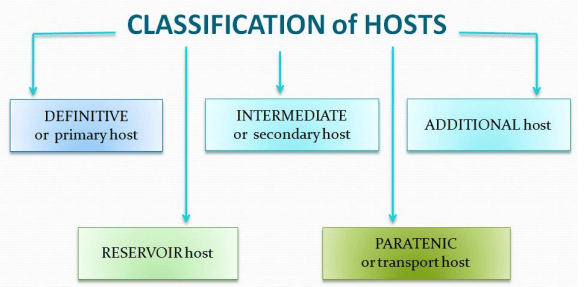 Figure: Hosts of parasite
Definitive or Primary Host
The host which harbors the adult parasites or where the parasite replicates sexually is called the definitive host. The definitive host can be a mammalian host or other living hosts. Examples include sheep for Fasciola gigantica, a dog for Echinococcus granulosus, and a female Anopheles mosquito for Plasmodium spp.
In the majority of human parasitic infections, man is definitive host; in malaria and hydatid disease, however, man acts as the intermediate host.
Intermediate or Secondary Host
Refers to the host which harbors the larval stages of a parasite or in which the parasite undergoes asexual multiplication. For example, humans are the intermediate hosts for Plasmodium (malarial parasites).
Intermediate hosts are mandatory for the completion of the life cycle for some parasites. Some parasites require two intermediate hosts to complete their different larval stages. These are known as the first and second intermediate hosts respectively. For example, in Clonorchis sinensis a freshwater snail is the first intermediate host and a freshwater fish is the second intermediate host, with the parasite developing in both.
(Note that some textbooks describe aquatic vegetation as the "second intermediate host" of Fasciola hepatica, but strictly the snail is the only true intermediate host. The metacercariae simply encyst on the vegetation without developing there, so the plant acts more as a passive transport surface. This distinction is explained in the worked example below.)
Reservoir Host
It is a host, which harbors the parasites, possibly grow, and multiply and serves as an important source of infection to other susceptible hosts. For e.g. a dog is the reservoir host for cystic echinococcosis.
Reservoir hosts typically show mild or no clinical disease, which is precisely what allows them to maintain the parasite in a population over long periods. This tolerance is a common feature, not a definitional requirement. What defines a reservoir is its epidemiological role as a persistent source of infection for other hosts, not the severity of illness it experiences.
Paratenic or Storage Host
A paratenic host serves as a temporary refuge and vehicle for reaching an obligatory host, usually the definitive host. A paratenic host harbors the sexually immature parasite, but it cannot develop further in this host. If a suitable definitive host ingests the paratenic host or a part of it containing the infective stage, the parasite can grow to maturity otherwise it remains stored in the host itself.
For example, lizards act as paratenic hosts for Spirocerca lupi in dogs. The role of such a host is to fill up an ecological gap between the intermediate host and the definitive host.
Incidental or Accidental host
A host organism that shelters the parasite, but since it can’t progress the life cycle development, it is dead-end for it. For example, humans are dead-end hosts for the Japanese encephalitis virus (JEV), whose life cycle is normally between culicine mosquitoes and birds. People can become infected, but the level of virus in their blood does not become high enough to pass on the infection to mosquitoes that bite them.
Worked Example: Fasciola hepatica's Complete Host Journey
Understanding host classification is easiest with one parasite traced through its entire cycle. Fasciola hepatica (the liver fluke) is worth tracing in full because it is commonly taught with an error attached: that watercress is a second intermediate host. It is not. Watercress is a plant surface on which metacercariae encyst. Nothing lives in it, and no development occurs there. Fasciola hepatica has exactly one intermediate host, the snail.
| Stage | Host | Host type | What happens |
|---|---|---|---|
| Adult fluke, egg production | Sheep, cattle, occasionally humans | Definitive host | Adult flukes live in bile ducts; sexual reproduction occurs; eggs passed in feces |
| Miracidium → sporocyst → cercaria | Freshwater snail (Lymnaea spp.) | First intermediate host | Asexual multiplication; larval development |
| Encystment as metacercariae | Aquatic vegetation (watercress) | Not a host. Inert substrate | Cercariae leave the snail and encyst on plant surfaces as metacercariae. No development occurs here. |
| Ingestion by definitive host | Sheep, cattle, human | Back to definitive host | Cycle completes when metacercariae are ingested with contaminated watercress |
The teaching point: the number of boxes in a life cycle diagram is not the number of hosts. Fasciola diagrams show four stages but involve only two hosts, one definitive and one intermediate, plus an inert vehicle. When you read any life cycle diagram, ask of every box: is this a living organism in which the parasite resides, or is it a surface, a food item, or an environmental stage? Only the first counts as a host.
Compare to a simpler example: Plasmodium
| Stage | Host | Host type |
|---|---|---|
| Sexual reproduction (sporogony) | Female Anopheles mosquito | Definitive host |
| Asexual reproduction (schizogony) | Human | Intermediate host |
Only two host types, no first/second distinction needed. The complexity of a life cycle diagram correlates directly with how many host roles the parasite requires.
Host-Parasite Relationships
Host-parasite relationships or symbiotic relationships are those in which the organisms (host and parasite) live in close proximity to each other and are dependent on each other in one or another way for their survival. The nature and extent of the association will determine the type of relationship existing between the co-habiting organisms (also called symbionts).
Symbiotic relationships are usually grouped into three main types: mutualism, commensalism, and parasitism. A fourth interaction, amensalism, is often discussed alongside them, though strictly it is a broader ecological interaction rather than a close symbiotic association.
Mutualism
Mutualism is a symbiotic relationship that is defined as an association between two living beings in such a way that both benefit from each other’s existence. This relationship can either be within the species or between the two different species.
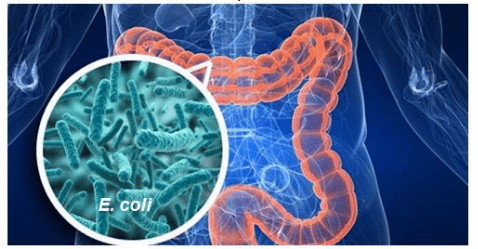 Figure: E. coli in the human large intestine, an example of mutualism
For example, humans have a mutualistic relationship with the bacterium Escherichia coli, which is a normal flora of the large intestine. E.coli produces vitamins (K and B) and bacteriocins (a chemical that wards off harmful bacteria) and the large intestine provides shelter and nutrients for its growth and multiplication.
Mutualism can further be classified as
Obligate mutualism: This is the type of relationship where both symbionts entirely depend on each other for survival. A famous example of obligate mutualism is lichen. Green algae and a colorless fungus form obligatory symbiotic organisms called lichens. The alga supplies carbohydrates formed during photosynthesis to the fungus. In turn, the fungus gives water, mineral salts, and protection to the alga. Thus, both are benefited from symbiosis.
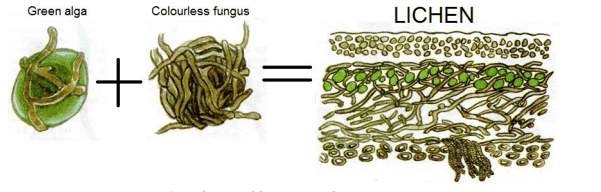 Figure: Lichen as obligatory symbiotic organism.
Facultative mutualism: In this relationship, mutualism benefits an organism, but the organism is not so dependent on mutualism that it cannot survive without it.
Parasitism
Parasitism is defined as a non-mutual symbiotic relationship in which one of the symbionts (the parasite), benefits at the expense of the host, while the host is harmed. The parasite lives on or in the body of the host.
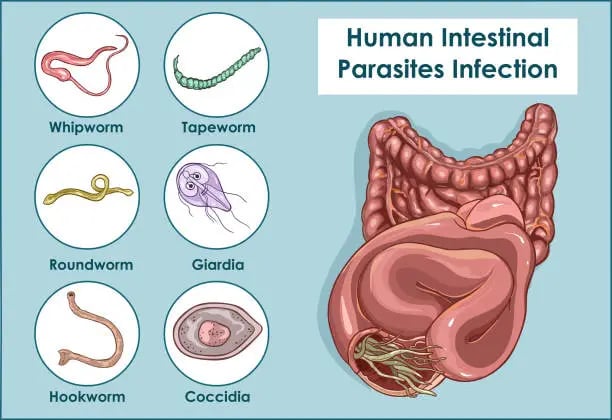 Figure: Human Intestinal Parasites: Creator: corbac40
Examples of parasitism include interactions between vertebrate hosts and diverse animals such as tapeworm, flukes, the Plasmodium species, and fleas. Worms attach themselves to the insides of the intestines of animals such as cows, pigs, and humans. They get food by eating the host’s partly digested food, depriving the host of nutrients, affecting the absorption capacity of the host intestine. Some worms may also cause a loss of blood and iron, which could lead to anemia.
Commensalism
Commensalism is a type of symbiotic relationship where one partner benefits whereas the second partner (the host) is neither helped nor harmed. The organism that receives the refuge and nourishment is called the ‘commensal’. Most of the normal floras of the human body can be considered as commensals.
For example, Humans harbor several species of commensal protistans such as Entamoeba gingivalis which lives in the mouth where it feeds on bacteria, food particles, and dead epithelial cells but never harms healthy tissues.
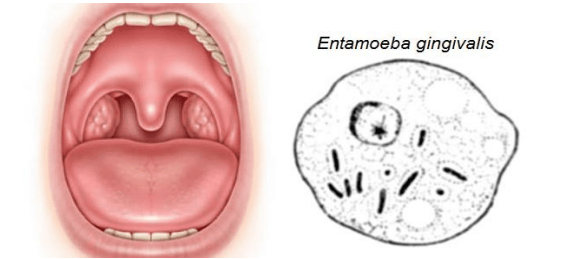 Figure: Entamoeba gingivalis as a typical commensal.
When organisms live on the external surface of the body of their hosts, they are called ‘ectocommensals’. Such an association is called ‘ectocommensalism’ but if the commensal is living inside the tissues or cavities of animals, they are called ‘endocommensals’, and the association is called ‘endocommensalism’.
Amensalism
Amensalism, unlike the three symbiotic relationships above, does not require the organisms to live in intimate association. It is the type of relationship in which one species is inhibited or harmed while the other is unaffected. For example, a sapling growing under the shadow of a mature tree. The mature tree usually robs the sapling of necessary sunlight and other nutrients (e.g., rainwater). It remains unaffected while the sapling dwindles and dies. The mature tree will even make use of nutrients arising from the decaying sapling.
Amensalism is sometimes confused with competition. The two are not the same, and the distinction is a standard exam point.
Antibiosis is the classic microbiological example of amensalism. One organism releases a chemical that inhibits or kills another, while gaining nothing measurable itself. Penicillium secretes penicillin as a secondary metabolite during growth, killing susceptible bacteria in its vicinity. The fungus is not feeding on those bacteria and does not benefit from their death in any direct nutritional sense. The bacteria are simply harmed. That is amensalism: harm in one direction, indifference in the other.
Competition is a different interaction and should not be listed under amensalism. In competition, two organisms both need the same limited resource, and both are worse off for the other's presence. The interaction is negative for both parties. Amensalism is negative for one and neutral for the other. When a textbook describes a larger species excluding a smaller one from food or space, that is competitive exclusion, not amensalism, because the larger species is also expending effort and losing some access to the shared resource.
Where Students Actually Get Confused
1. "The definitive host is the host that suffers the disease." This is the single most common error. The definitive host is defined purely by where sexual reproduction of the parasite occurs — it has nothing to do with which host experiences clinical disease. In malaria, the mosquito (definitive host) is unaffected by Plasmodium; the human (intermediate host) suffers fever, anemia, and potentially death. In hydatid disease, the dog (definitive host) is largely asymptomatic; the human (intermediate host, an accidental one) can develop large, dangerous hydatid cysts.
2. "Humans are always the definitive host for human parasitic infections." False, and explicitly noted as an exception in the article itself: in malaria and hydatid disease, the human is the intermediate host. Most human parasitic infections do follow the pattern of humans as definitive host (e.g., Taenia, Ascaris, Entamoeba, where the adult/sexually mature stage and reproduction occur in humans), but these two major exceptions are exactly the kind of detail examiners test.
3. "Reservoir host and intermediate host are the same thing." They serve different functions and are not interchangeable. A reservoir host harbors the parasite and serves as a source of infection for other susceptible hosts (the parasite doesn't necessarily need this host to complete its life cycle — it's a maintenance mechanism). An intermediate host is required for life cycle completion, hosting larval stages or asexual multiplication. A dog can be both the definitive host AND the reservoir host for Echinococcus simultaneously — these categories describe different functional roles, not mutually exclusive boxes.
4. "A paratenic host is the same as an intermediate host." A paratenic host is a biological dead-end unless a suitable definitive host eats it — no parasite development occurs in a paratenic host. An intermediate host, by contrast, is where actual development (larval stages, asexual multiplication) happens. The lizard harboring Spirocerca lupi for a dog to eventually eat is a paratenic host: the parasite simply waits there. This is functionally different from a mosquito where Plasmodium actively develops through sporogony.
5. "Amensalism, parasitism, and predation are the same thing." Amensalism is specifically defined by one organism being harmed while the other is completely unaffected — not benefited, just neutral. Parasitism requires the parasite to actively benefit (gain nutrients) at the host's expense. Predation involves one organism killing and consuming another directly. The shaded sapling under a mature tree is amensalism (the tree gains nothing from the sapling's presence or absence), which is distinct from a tapeworm benefiting from a host's nutrients (parasitism).
6. "Watercress is the second intermediate host for Fasciola." This appears in many teaching resources and is wrong. A host is a living organism in which a parasite resides. Metacercariae encyst on the outer surface of aquatic plants; nothing enters the plant and nothing develops there. Fasciola hepatica has one intermediate host, the snail. If an exam asks how many intermediate hosts Fasciola requires, the answer is one. If you need a parasite with two genuine intermediate hosts, use Diphyllobothrium latum.
7. "A vector is always a host." Not necessarily. If the parasite develops or multiplies in the arthropod, that arthropod is a host, usually the definitive host if sexual reproduction occurs there. If the arthropod merely carries the pathogen on its body surface, it is a mechanical vector and not a host at all. The housefly transmitting Shigella is a mechanical vector and not a host. The Anopheles mosquito transmitting Plasmodium is a biological vector and the definitive host. The test question is always: does anything develop inside the arthropod?
Key Exam Facts in One Table
| Fact | Detail | Memory hook |
|---|---|---|
| Definitive host defined by | Where sexual reproduction of the parasite occurs | Not by who gets sick |
| Intermediate host defined by | Larval stages / asexual multiplication | Required for life cycle completion |
| Human in malaria | Intermediate host | Exception to "humans = definitive" pattern |
| Human in hydatid disease | Intermediate (accidental) host | Dog is definitive host |
| Mosquito in malaria | Definitive host | Sexual reproduction (sporogony) occurs here |
| Dog in Echinococcus | Definitive host AND often reservoir host | Two roles, same animal |
| Reservoir host function | Source of infection for other susceptible hosts; parasite may not need this host for life cycle | Maintenance mechanism, not always essential |
| Paratenic host | Temporary refuge; NO parasite development occurs | "Storage" host — waiting room |
| Accidental/incidental host | Dead-end; parasite cannot complete life cycle | E.g., humans for JEV |
| First vs second intermediate host | Used when a parasite needs two intermediate hosts for different larval stages | E.g., snail then fish for Clonorchis sinensis |
| Mutualism | Both organisms benefit | E.g., E. coli in human gut |
| Commensalism | One benefits, host unaffected | E.g., Entamoeba gingivalis in mouth |
| Parasitism | Parasite benefits, host harmed | Defining relationship of this field |
| Amensalism | One harmed, other unaffected | E.g., sapling under mature tree |
| Ectocommensal vs endocommensal | External surface vs internal tissues/cavities | Location determines the term |
How to Remember
Definitive host = where sex happens. Not where sickness happens. If you can only carry one sentence into the exam, carry that one. The mosquito has the parasite's sex life; the human has the parasite's disease.
Paratenic = parked. Both start with par-. The parasite is parked in a paratenic host: no development, no change, just waiting for a lift. The lizard is a parking garage for Spirocerca.
Reservoir = the tank that refills the tap. You can treat every human case in a district and the disease returns, because the reservoir is still full. That image tells you why control programs deworm dogs for hydatid disease rather than only treating patients.
Accidental = the parasite made a wrong turn. The parasite gets in and then cannot get out to anywhere useful. Humans with Japanese encephalitis virus are a cul-de-sac: the virus arrives, the viremia never gets high enough for a mosquito to pick it up, and the lineage ends there.
For the relationship types, count the signs. Write plus, minus, or zero for each partner. Mutualism +/+. Commensalism +/0. Parasitism +/−. Amensalism −/0. Competition −/−. Five interactions, five sign pairs, and every exam question on this topic reduces to identifying which pair applies.
References:
- Garcia, L. S. (2016). Diagnostic Medical Parasitology (6th ed.). ASM Press.
- Sastry, A. S., & Bhat, S. (2021). Essentials of Medical Parasitology (4th ed.). Jaypee Brothers Medical Publishers.
- Combes, C. (2001). Parasitism: The Ecology and Evolution of Intimate Interactions. University of Chicago Press.
- Ukibe, S. N., Mbanugo, J. I., Obi-Okaro, A. N., & Ukibe, N. R. (2015). A review of host-parasite relationships. Annual Research & Review in Biology, 5(5), 372–384. https://doi.org/10.9734/ARRB/2015/14143
- Best, A., White, A., Kisdi, E., Antonovics, J., Brockhurst, M. A., & Boots, M. (2010). The evolution of host-parasite range. The American Naturalist, 176(1), 63–71. https://doi.org/10.1086/653002
- Centers for Disease Control and Prevention. Parasites: About Parasites. DPDx Laboratory Identification of Parasites of Public Health Concern.
Frequently Asked Questions
What is the difference between a definitive host and an intermediate host?
Can one animal be both a definitive host and a reservoir host?
What is a dead-end host?
What is the difference between amensalism and competition?
Are all normal flora commensals?

Tankeshwar Acharya, MSc (Medical Microbiology)
Tankeshwar Acharya is an Assistant Professor in the Department of Microbiology at Patan Academy of Health Sciences (PAHS), Nepal, where he has been teaching and practicing clinical microbiology for over 14 years. He is the founder of Microbe Online, one of the leading free microbiology education resources on the web, covering bacteriology, mycology, parasitology, immunology, and clinical laboratory diagnostics written from direct experience in both the classroom and the diagnostic laboratory.