Back to articles
Culture Media13 min read

Thayer-Martin Agar (Modified): Composition, Principle, Uses, and Colony Characteristics of Neisseria

Modified Thayer-Martin (MTM) agar is the standard selective medium for isolating Neisseria gonorrhoeae from genital specimens. Learn its VCNT antibiotic selectivity, GC agar base composition, colony types, and how it compares to NYC medium and Martin-Lewis agar.

Acharya Tankeshwar
Acharya Tankeshwar
MSc (Medical Microbiology)
On this page

A 24-year-old man presents to a sexual health clinic with urethral discharge and dysuria. The clinician performs a urethral swab. Two things happen at once in the laboratory: a Gram stain of the discharge is examined for Gram-negative intracellular diplococci, and the swab is inoculated directly onto a warm plate of Modified Thayer-Martin agar and placed immediately into a CO₂-enriched atmosphere.

The reason for this specific medium, and the urgency of inoculating before the swab dries, reflects the biology of Neisseria gonorrhoeae. It is one of the most fastidious organisms in clinical bacteriology: it cannot survive drying, cannot tolerate room temperature for more than a few minutes on a swab, needs an enriched medium with growth factors that standard media lack, and dies if incubated in air without added CO₂. Modified Thayer-Martin agar was designed to meet these needs while suppressing the commensal organisms that would otherwise overgrow the plate.

Thayer-Martin agar is a selective medium used to isolate gonococci (Neisseria gonorrhoeae) from specimens containing mixed flora, such as urogenital specimens. Modified Thayer-Martin (MTM) agar is a GC agar base enriched with hemoglobin and a growth supplement, made selective by four antibiotics: vancomycin, colistin, nystatin, and trimethoprim lactate (VCNT). This combination suppresses most other Gram-negative diplococci, Gram-negative bacilli, Gram-positive organisms, and yeasts while allowing N. gonorrhoeae to grow.

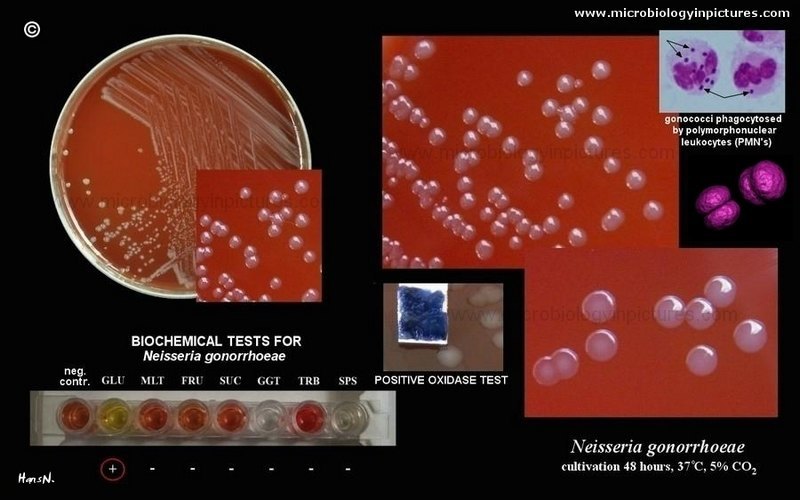
Colonies of Neisseria gonorrhoeae
Colonies of Neisseria gonorrhoeae (Image source: http://www.microbiologyinpictures.com/)

Principle

Why N. gonorrhoeae needs a specialized medium

Neisseria gonorrhoeae is an obligate human pathogen with demanding growth requirements that ordinary media cannot meet:

  • It needs an enriched base supplying cysteine, cystine, glucose, and an iron source, which standard nutrient and blood agars lack.
  • It needs several accessory growth factors, including NAD, thiamine (vitamin B1), and others, which are supplied by an enrichment supplement such as IsoVitaleX.
  • It is inhibited by toxic fatty acids present in many agar bases, including standard blood agar.
  • It is capnophilic, needing elevated CO₂ (5 to 10%) for good growth.
  • It is extremely sensitive to drying and temperature change, so the plate must be warm and inoculated promptly.

A clarification worth making, because it is a common point of confusion: N. gonorrhoeae does not require "X factor" and "V factor" the way Haemophilus does. That X/V terminology belongs to Haemophilus. Gonococcus needs an enriched medium and specific growth factors, and MTM supplies these through its hemoglobin and its enrichment supplement, but the organism is not an X/V-dependent organism in the Haemophilus sense.

How MTM meets each requirement

Requirement How MTM provides it
Enriched base with amino acids and iron GC agar base (proteose peptone) plus 2% hemoglobin
Accessory growth factors (NAD, thiamine, etc.) IsoVitaleX or an equivalent enrichment supplement
Toxic fatty acids neutralized Corn starch and protein in the GC base bind and neutralize toxic lipids
CO₂ requirement Incubation at 5 to 10% CO₂ (CO₂ incubator or candle jar)
Competing flora suppressed The four-antibiotic VCNT combination

Note that the hemoglobin does supply hemin and the IsoVitaleX supplement does contain NAD, so those ingredients are correctly part of the medium. The point is simply that gonococcus grows here because the medium is richly enriched, not because the organism has a Haemophilus-type X/V requirement.

The VCNT selectivity mechanism: why each antibiotic is chosen

The four antibiotics create broad suppression of competing flora while sparing N. gonorrhoeae.

Antibiotic Target Mechanism Why gonococci survive
Vancomycin (3 µg/mL) Gram-positive bacteria (staphylococci, streptococci, lactobacilli) Inhibits peptidoglycan synthesis by binding D-Ala-D-Ala N. gonorrhoeae is Gram-negative; vancomycin cannot cross the outer membrane
Colistin (7.5 µg/mL) Gram-negative rods (E. coli, Proteus, Pseudomonas) and commensal Neisseria Disrupts the Gram-negative outer membrane N. gonorrhoeae is intrinsically colistin-resistant through outer-membrane modifications
Nystatin (12.5 units/mL) Yeasts and fungi (Candida and others) Binds ergosterol in the fungal membrane, disrupting it N. gonorrhoeae has no ergosterol
Trimethoprim lactate (5 µg/mL) Proteus species (swarming) Inhibits dihydrofolate reductase; at this low concentration the main effect is suppressing Proteus swarming rather than broad killing The concentration is chosen to stop Proteus swarming without inhibiting gonococci

Key exam point: gonococci survive colistin, an agent that inhibits most Gram-negative organisms, because of specific outer-membrane modifications. This intrinsic colistin resistance is shared with N. meningitidis and is the basis for the selectivity of Thayer-Martin medium.

Thayer-Martin versus Modified Thayer-Martin. The original Thayer-Martin medium (1966) contained vancomycin, colistin, and nystatin (VCN). The Modified Thayer-Martin (MTM) formulation added trimethoprim lactate to suppress Proteus swarming, a recognized problem with the original medium in genital specimens. MTM is now the standard formulation in most laboratories. The terms "Thayer-Martin" and "Modified Thayer-Martin" are often used interchangeably in practice, though strictly MTM refers to the four-antibiotic version.

Composition of Modified Thayer-Martin Agar

MTM agar is assembled from three parts: the GC agar base, a 2% hemoglobin solution, and a growth supplement, with the four antibiotics added last.

GC agar base (per liter)

Ingredient Amount (g/L) Function
Proteose peptone No. 3 15.0 Nitrogen and amino acids
Corn starch 1.0 Neutralizes toxic fatty acids that would inhibit N. gonorrhoeae
Dipotassium phosphate 4.0 Buffer for pH
Monopotassium phosphate 1.0 Buffer
Sodium chloride 5.0 Osmotic balance
Agar 10.0 Solidifying agent

2% hemoglobin solution. Provides hemin (X factor for the medium) and iron in bioavailable form. Sheep or bovine hemoglobin is used. It is autoclaved separately from the enrichment and antibiotics, because lysis products could otherwise interfere with antibiotic activity.

Growth supplement (IsoVitaleX or equivalent). Provides NAD, thiamine pyrophosphate, glutamine, adenine, ferric nitrate, and other growth factors required by Neisseria. It is added aseptically after the base has cooled to about 50°C, because its heat-labile components would be destroyed by autoclaving.

Selective antibiotics (added aseptically to the cooled base): vancomycin 3 µg/mL, colistin 7.5 µg/mL, nystatin 12.5 units/mL, trimethoprim lactate 5 µg/mL.

Final pH: 7.2 ± 0.2 at 25°C.

Uses of Modified Thayer-Martin Agar

1. Primary isolation of N. gonorrhoeae from genital specimens. MTM is inoculated directly at the point of collection (or immediately after transport) for urethral swabs (men with discharge, and asymptomatic screening), endocervical swabs, vaginal swabs (including self-collected), rectal swabs (rectal gonorrhea), and pharyngeal swabs (oropharyngeal gonorrhea, which is increasing).

2. Conjunctival specimens. Ophthalmia neonatorum caused by N. gonorrhoeae is a sight-threatening emergency. Conjunctival swabs from neonates born to mothers with untreated gonorrhea are inoculated onto MTM.

3. Isolation of N. meningitidis from non-sterile sites. N. meningitidis is usually isolated from blood and CSF (sterile sites, where a selective medium is not needed), but nasopharyngeal swabs for meningococcal carrier screening use MTM to recover it from heavily colonized mucosa.

4. Gonorrhea surveillance. MTM is the medium of choice for surveillance cultures in sexual health clinics, contact tracing, and antimicrobial-resistance surveillance.

Specimen handling. N. gonorrhoeae is extremely sensitive to drying, cold, and delay. Swabs should be inoculated onto MTM immediately at collection where possible. If transport is unavoidable, use a CO₂-generating transport system (for example, JEMBEC plates). Swabs left in standard Stuart's or Amies transport medium for more than about 6 hours show significantly reduced recovery.

Media preparation

  1. Suspend 7.2 g of GC agar base in 100 mL distilled water in a flask. Mix, heat with frequent agitation, and boil for 1 minute to dissolve completely.
  2. Autoclave at 121°C for 15 minutes, then cool to 50°C in a water bath.
  3. Prepare the hemoglobin solution: mix 2 g soluble hemoglobin powder with 5 to 10 mL distilled water into a smooth paste, then add distilled water to 100 mL, stirring continuously. (Alternatively, use 100 mL of ready-made 2% sterile hemoglobin solution warmed to 50°C.)
  4. Autoclave the hemoglobin solution at 121°C for 15 minutes, then cool to 50°C.
  5. Reconstitute the lyophilized growth supplement by aseptically adding the accompanying diluent; shake to dissolve. Use immediately, or store at 4°C and use within 2 weeks.
  6. Aseptically combine 100 mL sterile hemoglobin solution and the growth supplement with 100 mL of the GC agar base. Mix gently but thoroughly to avoid air bubbles.
  7. Add the antibiotics: vancomycin 3.0 µg/mL, colistin 7.5 µg/mL, nystatin 12.5 units/mL, trimethoprim lactate 5.0 µg/mL.
  8. Dispense 20 mL into 15 × 100 mm Petri dishes. Allow to solidify and the condensation to dry.
  9. Store the plates in sterile plastic bags at 4°C until use.

Culture and isolation

  • Inoculate the specimen (urethral, endocervical, or other) directly onto the plate. Swabs with plastic or wire shafts and rayon, Dacron, or calcium alginate tips are used to collect specimens for gonococcal culture.
  • Place the inoculated plate promptly into a CO₂-enriched atmosphere (3 to 10%) and incubate at 35 to 37°C.
  • After 24 to 48 hours, small, opaque, grayish-white to colorless, raised, glistening, smooth colonies appear.

Quality control

  • Grow an N. meningitidis (or N. gonorrhoeae) QC strain for 18 to 24 hours on MTM at 35 to 37°C with about 5% CO₂ (or in a candle jar) and confirm the expected colony morphology.
  • As a sterility check, incubate an uninoculated plate for 48 hours under the same conditions and confirm no growth.

Colony characteristics of Neisseria on MTM

Typical gonococcal colonies appear at 24 to 48 hours: 0.5 to 1 mm in diameter, grey-white to colorless, raised, convex, smooth, glistening, with an entire margin. They are oxidase-positive.

N. gonorrhoeae also shows colony phase variation (classically described as opaque and transparent types, and as colony types T1 to T4 based on pili and outer-membrane proteins). Fresh clinical isolates are heavily piliated and more virulent; repeated subculture selects for non-piliated, avirulent variants, so first- or second-passage cultures are used for susceptibility testing and characterization. This phase variation is a property of the organism rather than the medium; it is covered in detail on the Neisseria gonorrhoeae page.

Distinguishing N. gonorrhoeae from N. meningitidis on MTM

Feature N. gonorrhoeae N. meningitidis
Colony size Smaller (0.5 to 1 mm) Larger (1 to 2 mm)
Colony surface Glistening, convex Smooth, slightly mucoid (capsule)
Growth on nutrient agar No Yes
Glucose Fermented Fermented
Maltose Not fermented Fermented (key differentiator)
Lactose Not fermented Not fermented

The maltose rule: both organisms ferment glucose, but only N. meningitidis ferments maltose. This single sugar test is the most reliable rapid way to tell them apart after growth on MTM, which matters clinically because a meningococcal isolate from a genital specimen has different treatment and contact-tracing implications from a gonococcal one.

Choosing a Neisseria isolation medium: MTM, NYC, and Martin-Lewis

Three selective media are commonly used for N. gonorrhoeae. Knowing the differences helps in choosing a medium and in reading references that mention all three.

Feature Modified Thayer-Martin (MTM) New York City (NYC) Martin-Lewis (ML)
Base GC agar plus hemoglobin Peptone and starch base GC agar base
Blood component 2% hemoglobin Lysed horse blood Hemoglobin
Growth supplement IsoVitaleX Yeast dialysate IsoVitaleX
Antibiotics Vancomycin, colistin, nystatin, trimethoprim (VCNT) Vancomycin, colistin, amphotericin B, trimethoprim Vancomycin, colistin, anisomycin, trimethoprim
Antifungal Nystatin Amphotericin B Anisomycin
Supports Ureaplasma / Mycoplasma No Yes No
N. gonorrhoeae recovery Good Good Good
Main use Most widely used worldwide STI labs needing Ureaplasma/Mycoplasma alongside gonococci Alternative to MTM when nystatin batches vary

Practical note. Modified Thayer-Martin is the standard and most widely available choice. NYC medium additionally supports Ureaplasma and Mycoplasma, useful where one plate is wanted for several fastidious urogenital pathogens. Martin-Lewis substitutes anisomycin for nystatin, preferred by some when nystatin batch variability is a concern.

How to remember

MTM = GC base + hemoglobin + enrichment supplement + VCNT. Four parts, each answering one question:

  • GC base: why doesn't blood agar work? Its peptone base carries toxic fatty acids that inhibit N. gonorrhoeae; the corn starch in the GC base neutralizes them.
  • Hemoglobin: enriches the medium with hemin and iron; autoclaved separately so it does not interfere with the antibiotics.
  • Enrichment supplement (IsoVitaleX): supplies NAD, thiamine, and other heat-labile growth factors; added aseptically after cooling.
  • VCNT: four targeted antibiotics, each suppressing one category of competing flora, all of which gonococci survive.

The VCNT mnemonic, what each suppresses: Vancomycin removes Gram-positives; Colistin removes Gram-negatives (including commensal Neisseria, with gonococci the intrinsically resistant exception); Nystatin removes fungi; Trimethoprim stops Proteus swarming.

Not an X/V organism. Do not confuse this medium's enrichment with a Haemophilus-style requirement. Haemophilus needs X and V factors; N. gonorrhoeae needs a richly enriched medium and CO₂. The medium contains hemin and NAD as enrichment, but gonococcus is not an X/V-dependent organism.

Inoculate before the patient leaves the room. N. gonorrhoeae is so fragile that it can die within minutes on a dry swab. Pre-warming the plate, CO₂ incubation, and JEMBEC transport systems all exist because of this fragility.

Maltose is the key next test. After any Neisseria colony grows on MTM, maltose fermentation separates the two that matter: N. gonorrhoeae does not ferment maltose; N. meningitidis does.

References

  1. Tille PM. Bailey and Scott's Diagnostic Microbiology. 15th ed. St. Louis: Elsevier; 2022.
  2. Procop GW, Church DL, Hall GS, et al. Koneman's Color Atlas and Textbook of Diagnostic Microbiology. 7th ed. Philadelphia: Wolters Kluwer; 2017.
  3. Greenwood JR, Voss J, Smith RF, et al. Comparative evaluation of New York City and modified Thayer-Martin media for isolation of Neisseria gonorrhoeae. J Clin Microbiol. 1986;24(6):1111-1112.
  4. Morse SA, Lysko PG. Gonococcal colony types. Infect Immun. 1985;49(2):341-350.
  5. World Health Organization. WHO guidelines for the treatment of Neisseria gonorrhoeae. Geneva: WHO; 2016.
FAQ

Frequently Asked Questions

What is Modified Thayer-Martin agar used for?

It is a selective medium used to isolate Neisseria gonorrhoeae (and N. meningitidis from non-sterile sites) from specimens that contain mixed flora, such as urethral, endocervical, vaginal, rectal, pharyngeal, and conjunctival swabs. Its four antibiotics suppress the competing bacteria and fungi so the gonococcus can be recovered.

Is Thayer-Martin agar selective or differential?

It is a selective medium, not a differential one. Its purpose is to suppress unwanted organisms (with the VCNT antibiotics) so that Neisseria can grow, rather than to distinguish organisms by a visible reaction on the plate. The organisms are told apart afterward by tests such as oxidase and sugar (maltose) utilization.

What grows on Thayer-Martin agar?

Mainly the pathogenic Neisseria: N. gonorrhoeae and N. meningitidis, which survive the VCNT antibiotics. Most other organisms are suppressed: Gram-positive bacteria (by vancomycin), Gram-negative rods and commensal Neisseria (by colistin), fungi (by nystatin), and swarming Proteus (by trimethoprim).

Why does Neisseria gonorrhoeae survive the antibiotics in the medium?

Because each antibiotic targets organisms other than gonococcus. Vancomycin cannot cross its Gram-negative outer membrane, it is intrinsically resistant to colistin, it has no ergosterol for nystatin to bind, and the low trimethoprim concentration targets Proteus swarming rather than gonococci. The combination clears the competition while sparing the target.

What is the difference between Thayer-Martin and Modified Thayer-Martin?

The original Thayer-Martin medium (1966) contained three antibiotics: vancomycin, colistin, and nystatin (VCN). Modified Thayer-Martin added trimethoprim lactate (making VCNT) to suppress Proteus swarming. MTM is now the standard formulation, and the two names are often used interchangeably.

Downloaded from Microbe Online · https://microbeonline.com/thayer-martin-agar-composition-preparation-uses-colony-characteristics/
Acharya Tankeshwar
About Author
Acharya Tankeshwar

Tankeshwar Acharya, MSc (Medical Microbiology)

Tankeshwar Acharya is an Assistant Professor in the Department of Microbiology at Patan Academy of Health Sciences (PAHS), Nepal, where he has been teaching and practicing clinical microbiology for over 14 years. He is the founder of Microbe Online, one of the leading free microbiology education resources on the web, covering bacteriology, mycology, parasitology, immunology, and clinical laboratory diagnostics written from direct experience in both the classroom and the diagnostic laboratory.

Related articles

Comments

No comments yet. Be the first to share your thoughts.

Leave a comment

All comments are reviewed before they appear.

Never published or shared.

5000 characters remaining · Comments appear after review.