
T-Dependent and T-Independent Antigens: Differences and Why Conjugate Vaccines Exist

On this page
Activation of B cells requires two signals. Depending on the nature of the antigen, B-cell activation proceeds by two different routes, one dependent on helper T cells (TH cells), the other not. In the case of T-dependent antigen the interaction between CD40 of B Cells and CD40 ligand of T cells gives a second signal but in T independent antigen, cross-linking of membrane-bound immunoglobulin to polymeric carbohydrate gives the needed signal.
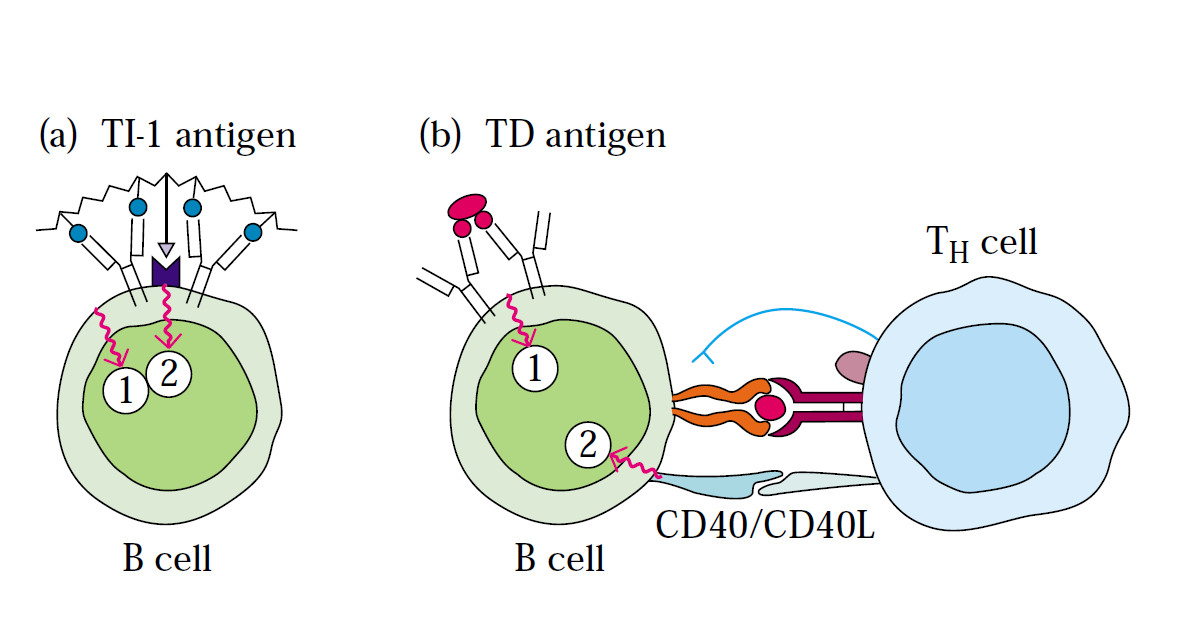 Figure: B cells activation by T-independent antigen and T-dependent antigen(Source: Kuby Immunology)
The B-cell response to thymus-dependent (TD) antigens requires direct contact with TH cells, not simply exposure to TH-derived cytokines.
Antigens that can activate B cells in the absence of this kind of direct participation by TH cells are known as thymus-independent (TI) antigens. TI antigens are divided into type 1 and type 2, which activate B cells by different mechanisms. TI-1 antigens (such as bacterial LPS) can act as polyclonal activators; TI-2 antigens are typically large, repetitive polysaccharides (such as bacterial capsules and Ficoll) that work by extensively cross-linking the B-cell receptor.
T Independent (TI) Antigen
A typical large polysaccharide is made up of repeating sequences of a few simple sugars so it has multiple copies of identical antigenic determinants.
When specific naïve B cells come in contact with such antigens, these antigenic determinants bind the surface IgM and IgD receptors. This binding leads to the clustering of surface immunoglobulins which generates a signal, strong enough to activate the naïve B cells. These activated B cells produce and release first immunoglobulin i.e. IgM.
Most TI-1 antigens are polyclonal B-cell activators (mitogens); i.e. they are able to activate B cells regardless of their antigenic specificity. At higher concentrations, some TI-1 antigens will stimulate proliferation and antibody secretion by as many as one-third of all B cells but in lower concentrations of TI-1 antigens, only those B cells specific for epitopes of the antigen will be activated.
TI-2 antigens activate B cells by extensive crosslinking of membrane-bound immunoglobulin (mIg) receptors.
Unlike TI-1 antigens, TI-2 antigens do not act as polyclonal activators and activate only mature B cells. Their response can be amplified by cytokines from T cells, which is why the TI-2 response, though it does not need T-cell contact, is still weak in young children whose marginal-zone B-cell compartment is immature.
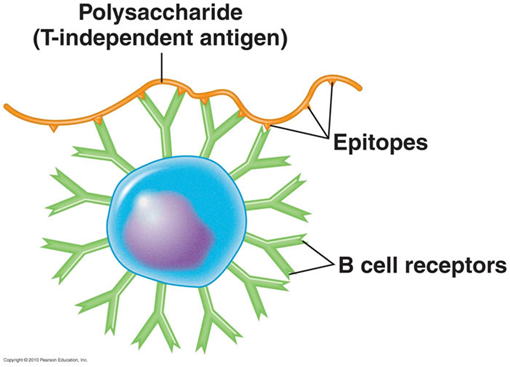 Figure: Interaction of B cell receptors with T independent antigen
Main features of T Independent Antigen (Ti-Ag)
- Antigens that stimulate B-cells directly, without co-stimulationby helper T-cells
- Usually polysaccharides or lipopolysaccharides (e.g. bacterial capsules)
- Crosslink antigen receptors on the surface of B-cells to activate them
- Don’t generate a strong immune response (no memory cells, IgM is the only antibody class produced, and the immunity doesn’t last long).
T Dependent Antigen (Td-Ag)
Humoral response to protein and most other antigens requires the interaction of B cells with helper T cells. These are thymus-dependent or simply T-dependent (TD) responses. B cell activation by T-dependent antigens requires contact-dependent help delivered by the interaction between CD40 on B cells and CD40L on activated TH cells.
Main steps during B-cell activation by a thymus-dependent antigen:
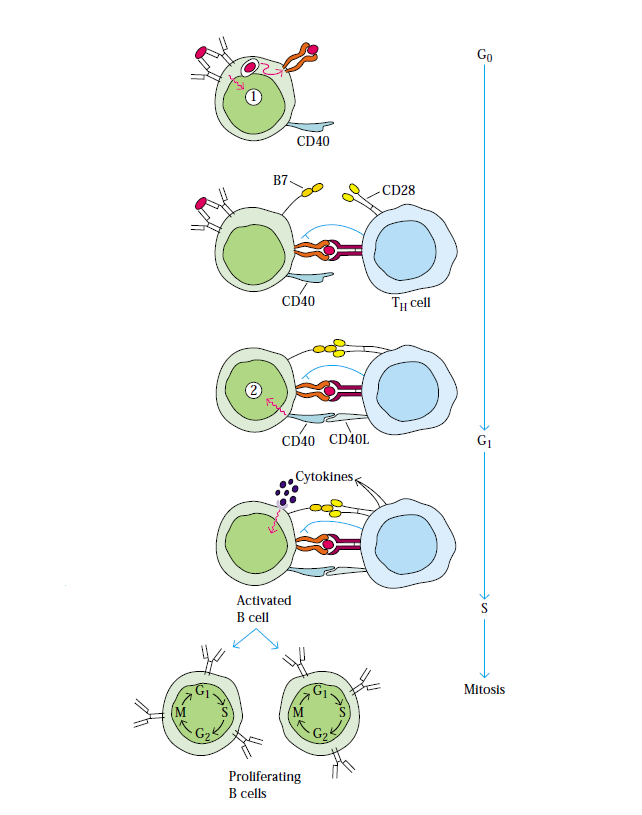 - Soluble protein antigens which bind to membrane-bound immunoglobulin on the surface of B Cell are internalized, processed, and displayed as peptide-MHC-II complexes.
- TH cell recognizes class II MHC-antigen complex on B-cell surface via TCR. It also interacts with costimulatory molecule B7 via CD28. These interactions activate TH cells. Activated TH cells produce various cytokines.
- TH cell begins to express CD40L and interacts with CD40 of the B Cell. The interaction between CD40 and CD40L provides a second signal to activate B cells.
- B cells begin to express receptors for various cytokines and bind to cytokines released from TH cells. Which activates B cells and differentiates them into plasma cells.
- The activated B-cell clonally proliferates to produce a population of plasma cells and memory cells, which all recognize the same antigen.
This CD40/CD40L interaction is essential for B-cell survival, the formation of germinal centers, the generation of memory-cell populations, and somatic hypermutation (for affinity maturation).
Difference between T dependent Antigen and T independent Antigen
Conjugate vaccines: A way of developing IgG response against polysaccharide antigen.
| T dependent (TD) Antigen | T independent Antigen |
|---|---|
| Soluble proteins | Bacterial cell wall components Lipopolysaccharide (LPS), Capsular polysaccharide, flagella, etc. |
| Antigen is processed and displayed on the surface of antigen-presenting cells (B Cells) in association with MHC-II. | Antigen processing is not needed |
| Immunogenic over a wide range of dose | Dose-dependent immunogenicity |
| No polyclonal activation i.e. Activate B cells monoclonally. | Polyclonal activation of B cells occurs in high doses of Type-I TI Antigens |
| Immunologic memory present | No immunologic memory |
| Affinity maturation- Yes | Affinity maturation- No |
| Isotype switching occurs (i.e. antibodies of all classes are produced) | Little or no class switching. Response is predominantly IgM, with limited switching to IgG2 (the anti-polysaccharide subclass in humans) |
| Activate mature B cells only | Activate both mature and immature B cells |
Capsular polysaccharides (e.g. of Neisseria meningitidis, Haemophilus influenzae, Streptococcus pneumoniae) and/or lipopolysaccharides (major cell wall component of Gram-negative bacteria e.g. Salmonella typhi, E.coli, etc) are the major structural components of bacterial pathogens. But these polysaccharide antigens are mostly poor immunogens; the antibody response to these antigens is mostly restricted to IgM (lack of isotype switching) because of their T-lymphocyte independent (TI) nature. IgM antibodies though excellent in activating complement penetrate poorly into tissues and are not themselves opsonizing. Anti-polysaccharide immune response is also characterized by a lack of T-lymphocyte memory.
Immunity against these surface components confers protection against the disease caused by these pathogens but the most vulnerable age group (children below 2 years of age and the elderly) responds poorly to carbohydrate antigen. If the B cells are switched to produce IgG, the vaccine would be more effective. To overcome the problem that arises due to TI nature of carbohydrate antigen and to produce IgG response against such antigen conjugate vaccine is being used.
In the conjugate vaccine, carbohydrate is coupled to an immunogenic protein also known as carrier molecule/peptide. The carrier is an immunogenic protein such as a diphtheria toxoid (notably CRM197, a non-toxic mutant of diphtheria toxin) or tetanus toxoid. These are the carriers used in the Hib, pneumococcal, and meningococcal conjugate vaccines.
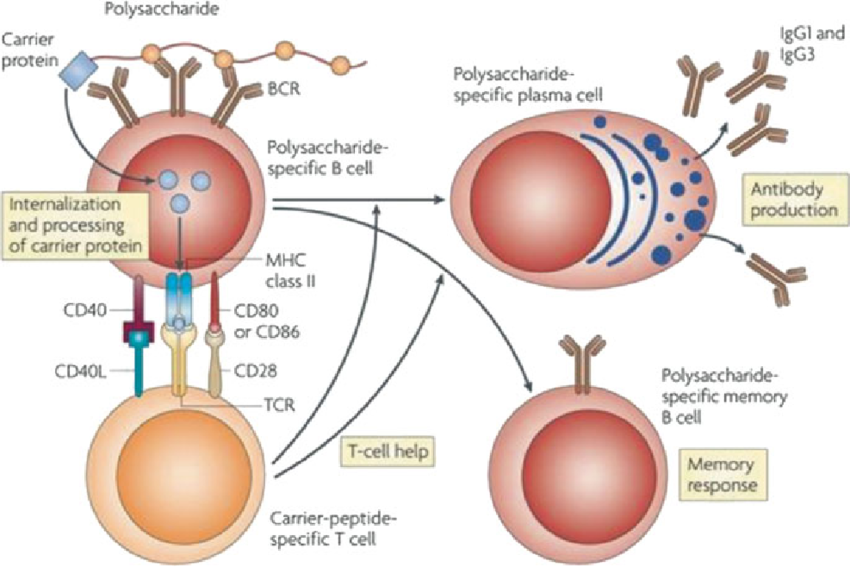 Figure: Generation of IgG response against polysaccharide antigen by conjugate vaccine
Here is how the conjugate vaccine works:
- The capsular polysaccharide is coupled to a highly immunogenic carrier protein (commonly the diphtheria-derived protein CRM197 or tetanus toxoid).
- B cell-specific to the polysaccharide antigen binds to polysaccharide antigen, and endocytose polysaccharide antigen along with the coupled protein.
- The protein is broken down into various peptides. Some of the processed peptides are loaded on MHC Class II molecules and move to the surface for recognition by the T cells (i.e. Processing and Presentation of Peptide antigen presentation by B cell)
- Carrier peptide-specific T cells (mainly follicular helper T Cells), recognize the MHC-II peptide antigen by its T Cell Receptor (TCR). Engagement of CD40 and CD40 ligand also takes place which gives switch signal.
- The activated B cell first secretes anti-carbohydrate IgM antibodies and because of the T cell’s help, it then switches to secreting IgG antibodies.
- Thus by coupling the protein with polysaccharide antigen we make the B cell able to do something that it could not have done on its own.
How to Remember
T-dependent needs a "conversation"; T-independent just needs a "crowd." A TD (protein) antigen has to be processed and presented to a helper T cell, which then talks back to the B cell through CD40-CD40L. That conversation is what buys you class switching, affinity maturation, and memory. A TI (polysaccharide) antigen skips the conversation entirely: it just cross-links enough B-cell receptors at once (a crowd of identical repeating epitopes) to fire the B cell directly. No conversation, no memory.
"Polysaccharides are forgettable." TI antigens are polysaccharides, and they leave no memory. If you remember that polysaccharide equals no T cell equals no memory equals mostly IgM, you have reconstructed most of the difference table from one idea.
Why babies can't handle polysaccharides: the under-2 rule. Children below two years respond poorly to pure polysaccharide antigens because the B-cell compartment that handles TI-2 responses matures late. This single fact explains three exam favorites at once: why plain polysaccharide vaccines (PPSV23) fail in infants, why conjugate vaccines (PCV, Hib) were invented, and why asplenic and IgG2-deficient patients are vulnerable to encapsulated organisms.
Conjugate = giving the polysaccharide a protein "passport." On its own, a polysaccharide cannot get T-cell help. Bolt it to a carrier protein and the B cell now internalizes the whole complex, presents the protein's peptides to a T cell, and receives the help it was previously denied. The polysaccharide sneaks in on the protein's passport, and the response upgrades from IgM-only to memory-plus-IgG.
Key exam facts in one table
| Question | Answer |
|---|---|
| What are the two signals for B-cell activation? | Signal 1: antigen binding to BCR. Signal 2: CD40-CD40L (TD) or extensive BCR cross-linking (TI) |
| Which antigen type gives immunological memory? | T-dependent only |
| Chemical nature of TD antigens | Proteins |
| Chemical nature of TI antigens | Polysaccharides, LPS, polymeric flagellin |
| Antibody class in TI responses | Predominantly IgM, limited IgG2 |
| Which IgG subclass is the anti-polysaccharide subclass in humans? | IgG2 |
| Does affinity maturation occur with TI antigens? | No (no germinal center, no somatic hypermutation) |
| TI-1 vs TI-2 | TI-1 = polyclonal activator (e.g. LPS); TI-2 = repetitive polysaccharide cross-linking BCR (e.g. capsule, Ficoll) |
| Why do children under 2 respond poorly to polysaccharide vaccines? | TI-2 responses depend on marginal-zone B cells that mature late |
| How does a conjugate vaccine fix this? | Polysaccharide is coupled to a carrier protein, recruiting T-cell help, giving class switch to IgG and memory |
| Common conjugate carrier proteins | CRM197 (diphtheria mutant), tetanus toxoid |
| Which vaccines are conjugate vaccines? | Hib, pneumococcal PCV, meningococcal MenACWY |
References and further reading:
- Punt, J., Stranford, S. A., Jones, P. P., & Owen, J. A. (2018). Kuby Immunology (8th ed.). W. H. Freeman.
- Abbas, A. K., Lichtman, A. H., & Pillai, S. (2021). Cellular and Molecular Immunology (10th ed.). Elsevier.
- Delves, P. J., Martin, S. J., Burton, D. R., & Roitt, I. M. (2017). Roitt's Essential Immunology (13th ed.). Wiley-Blackwell.
Frequently Asked Questions
What is the main difference between T-dependent and T-independent antigens?
Why do polysaccharide antigens produce a poor immune response?
Why don't polysaccharide vaccines work well in children under two?
How does a conjugate vaccine convert a T-independent response into a T-dependent one?
What carrier proteins are used in conjugate vaccines?
Which common vaccines are conjugate vaccines?

Tankeshwar Acharya, MSc (Medical Microbiology)
Tankeshwar Acharya is an Assistant Professor in the Department of Microbiology at Patan Academy of Health Sciences (PAHS), Nepal, where he has been teaching and practicing clinical microbiology for over 14 years. He is the founder of Microbe Online, one of the leading free microbiology education resources on the web, covering bacteriology, mycology, parasitology, immunology, and clinical laboratory diagnostics written from direct experience in both the classroom and the diagnostic laboratory.
Comments
No comments yet. Be the first to share your thoughts.
Leave a comment
All comments are reviewed before they appear.