

What is a serotype?
A serotype is a group within a single species of microorganism, bacterium or virus, whose members share distinctive surface structures (antigens) that the immune system and specific antisera can recognize. Two organisms can be the same species, look identical under the microscope, and behave alike biochemically, yet belong to different serotypes because their surface antigens differ.
For example, all Salmonella look alike under the microscope, but they can be separated into thousands of serotypes based on their somatic (O) antigen and flagellar (H) antigen. The same approach types Escherichia coli: the well-known E. coli O157:H7 is a serotype defined by its O157 somatic antigen and H7 flagellar antigen, associated with hemorrhagic colitis and hemolytic-uremic syndrome (HUS).
Because members of one species can differ in the antigens on their surface, they can be sorted by serological typing (serotyping). Serotyping is a classic tool for epidemiology and can be applied to any species that has multiple serotypes, such as Escherichia coli, Salmonella, Vibrio, Shigella, and Streptococcus pneumoniae.
Serotype vs serovar vs serogroup vs strain
These four words are used loosely and often interchangeably, which causes most of the confusion around this topic. Here is the clean distinction:
- Serotype: a group within a species defined by its surface antigens (detected serologically). "Serotype" is the general term and is used for both bacteria and viruses.
- Serovar: the same idea as serotype, used mainly in formal bacterial nomenclature. "Serovar" and "serotype" mean essentially the same thing; Salmonella Typhi is a serovar (serotype) of Salmonella enterica. In writing, the serovar name is capitalized and not italicized, while the genus stays italic: Salmonella Typhi, not S. typhi.
- Serogroup: a broader grouping that contains several related serotypes sharing one antigen. For example, Neisseria meningitidis serogroups (A, B, C, W, Y) are defined by the capsular polysaccharide, and Salmonella serogroups (A, B, C, D...) are defined by the shared O antigen, each containing many serovars.
- Strain: a specific isolate with a defined ancestry. A strain is narrower than a serotype: many different strains can share the same serotype, and a serotype is not itself a strain. Serotype describes surface antigens; strain describes a particular lineage.
How serotyping is done
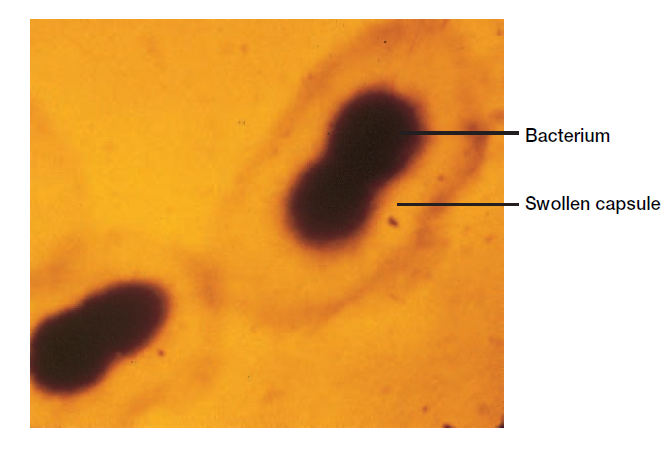 Figure: Serotyping of Streptococcus pneumoniae
Serotyping detects the surface antigens of an organism using antisera that contain antibodies of known specificity. When the matching antibody meets its antigen, a visible reaction (agglutination, or capsular swelling) confirms the serotype.
- Slide agglutination. A suspension of the organism is mixed with a specific antiserum on a slide. Visible clumping (agglutination) means the organism carries the antigen that antiserum targets. This is the routine method for Salmonella, Shigella, and E. coli O and H antigens.
- The Kauffmann-White scheme (Salmonella). Salmonella serovars are named from the specific combination of O (somatic) and H (flagellar, often two phases) antigens an isolate carries. Testing the isolate against a panel of O and H antisera and reading the pattern against the Kauffmann-White table gives the serovar (for example, Typhi, Enteritidis, Typhimurium).
- The Quellung (capsular swelling) reaction (Streptococcus pneumoniae, Haemophilus influenzae). When capsule-specific antiserum binds the capsule, the capsule appears to swell and becomes more visible under the microscope. This identifies the capsular serotype and is the classic pneumococcal serotyping method. See more about Quellung reaction in this article.
Why serotypes matter
Having many serotypes of a pathogen makes both prevention and eradication harder. Immunity raised against one serotype often fails to protect against another, so re-infection is common. This is why people catch the common cold many times: there are over 100 serotypes of rhinovirus (the cause of roughly half of common colds), and each infection produces only serotype-specific immunity, leaving a person open to all the others.
The same problem makes vaccines difficult. With so many rhinovirus serotypes, a preventive vaccine is impractical. Where a vaccine is possible, it often has to cover several serotypes at once (as with the pneumococcal conjugate vaccines), and the influenza vaccine is reformulated each season to match the strains most likely to circulate.
Pathogens and their serotypes
| Organism | Number of serotypes | Notes |
|---|---|---|
| Streptococcus pneumoniae | >90 (capsular serotypes) | Pneumococcal conjugate vaccines cover a subset. PCV13 covers serotypes 1, 3, 4, 5, 6A, 6B, 7F, 9V, 14, 18C, 19A, 19F, 23F; newer PCV15 and PCV20 add further serotypes. |
| Poliovirus | 3 (types 1, 2, 3) | Oral polio vaccine (OPV) was trivalent, then WHO removed type 2 to make it bivalent. IPV contains all three serotypes. |
| Rhinovirus | >100 | Serotype-specific immunity; too many serotypes for a practical vaccine. |
| Chlamydia trachomatis | 15+ (A, B, Ba, C, D-K, L1-L3) | Disease depends on the serovar (see table below). |
| Adenovirus | >50 (classic serotypes; >100 genotypes now recognized) | Serotype-specific immunity. |
| Dengue virus | 4 (DEN-1 to DEN-4) | A second infection with a different serotype raises the risk of severe dengue. |
| Salmonella | >2500 | Fewer than 100 serovars cause most human infection. Enteric fever is mainly caused by Salmonella Typhi and Salmonella Paratyphi. |
| Shigella | ~50 | Four species/subgroups (S. dysenteriae, S. flexneri, S. boydii, S. sonnei) with many serotypes. |
| Haemophilus influenzae | 6 (a-f) | Serotype b (Hib) is the most virulent; the Hib vaccine targets it. |
| Herpes simplex virus | 2 (HSV-1, HSV-2) | HSV-1 typically causes oral lesions, HSV-2 typically genital. |
Chlamydia trachomatis serovars and diseases
| Serovars (serotypes) | Disease |
|---|---|
| A-C | Trachoma (a leading infectious cause of blindness) |
| D-K | Urogenital infections; also inclusion conjunctivitis and neonatal infections |
| L1-L3 | Lymphogranuloma venereum (LGV) |
How to Remember
Serotype = a surface-antigen "uniform," not a family tree. Organisms of one species can wear different uniforms (surface antigens). Serotyping reads the uniform. Strain, by contrast, is the family tree (the lineage). Many strains can wear the same uniform, so a serotype is not a strain.
Serovar is just serotype's formal name in bacterial nomenclature. When you see Salmonella Typhi, "Typhi" is a serovar, which is the same idea as a serotype. Remember the writing rule: genus italic, serovar upright and capitalized. Salmonella Typhi, never S. typhi.
O and H are the two Salmonella antigens: O for the body, H for the tail. O (somatic) antigen is on the cell body (from the German ohne Hauch, "without film"); H (flagellar) antigen is on the flagellum (Hauch, "film," from the spreading growth flagellated bacteria show). The Kauffmann-White scheme names each serovar from its O + H combination.
Many serotypes means hard-to-vaccinate. The rule of thumb for exams: the more serotypes a pathogen has, the harder a broad vaccine is (rhinovirus, over 100, no vaccine; poliovirus, only 3, a successful vaccine). Immunity is usually serotype-specific, which is why you catch colds repeatedly but polio vaccine works.
Key exam facts
| Concept | Detail |
|---|---|
| Serotype | A group within a species defined by shared surface antigens, detected serologically |
| Serovar | Same concept as serotype, used in formal bacterial nomenclature (e.g. Salmonella Typhi) |
| Serogroup | A broader group of related serotypes sharing one antigen (e.g. N. meningitidis A, B, C, W, Y) |
| Strain | A specific lineage/isolate; narrower than a serotype (many strains can share one serotype) |
| Salmonella antigens | O (somatic) and H (flagellar); combination gives the serovar via the Kauffmann-White scheme |
| Pneumococcal serotyping | Quellung (capsular swelling) reaction with type-specific antiserum |
| Writing rule | Genus italic, serovar upright and capitalized: Salmonella Typhi, not S. typhi |
| Serotype-specific immunity | Immunity to one serotype usually does not protect against another (repeat colds; secondary dengue) |
| Vaccine implication | Many serotypes make a broad vaccine hard (rhinovirus >100, no vaccine; poliovirus 3, successful vaccine) |
| Classic examples | E. coli O157:H7; Salmonella Typhi; poliovirus types 1-3; H. influenzae type b |
Where Students Get Confused
- "Serotype and strain are the same thing." They are not. A serotype is defined by surface antigens; a strain is a specific lineage. Many different strains can belong to the same serotype, and one serotype can contain countless strains. Serotype is the uniform, strain is the ancestry.
- "Serotype and serovar are different concepts." They are essentially the same idea. "Serovar" is the term used in formal bacterial nomenclature (as in Salmonella Typhi); "serotype" is the more general word used for both bacteria and viruses. Do not treat them as two different things to learn.
- "Serogroup and serotype mean the same thing." A serogroup is broader. It groups several serotypes that share one antigen. Salmonella serogroup D contains the serovar Typhi among others; N. meningitidis serogroup B contains many strains. Serogroup is the bigger box, serotype is the smaller box inside it.
- "You can write it S. typhi." No. The current rule is genus italic, serovar upright and capitalized: Salmonella Typhi or Salmonella enterica serovar Typhi. The old S. typhi style treats the serovar as if it were a species, which it is not.
References
- Procop GW, Church DL, Hall GS, Janda WM. Koneman's Color Atlas and Textbook of Diagnostic Microbiology. 7th ed. Wolters Kluwer; 2017.
- Tille PM. Bailey & Scott's Diagnostic Microbiology. 15th ed. Elsevier; 2022.
- Grimont PAD, Weill FX. Antigenic Formulae of the Salmonella Serovars. 9th ed. WHO Collaborating Centre for Reference and Research on Salmonella, Institut Pasteur; 2007.

Comments
No comments yet. Be the first to share your thoughts.
Leave a comment
All comments are reviewed before they appear.