The Quellung (or Neufeld) reaction is the gold standard technique for serotyping Streptococcus pneumoniae (pneumococcus). This microscopic “precipitin test” can be used to identify pneumococci or to determine the capsular serotype of individual pneumococcal isolates.
There are over 90 different capsular serotypes of S. pneumoniae. This technique utilizes a high-quality microscope and specific pneumococcal antisera (commercially available as pooled, group, or serotype-specific) and is commonly used in reference and research laboratories worldwide.
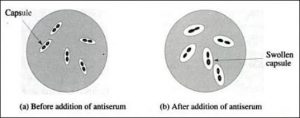
The Quellung reaction (swelling of the capsule) is reasonably simple to perform and can be applied wherever a suitable microscope and antisera are available.
This method involves testing a pneumococcal cell suspension with pooled and specific antisera directed against the capsular polysaccharide. The antigen-antibody reactions are observed microscopically. A positive quellung reaction is the result of the binding of the capsular polysaccharide of pneumococci with type-specific antibodies contained in the typing antiserum.
The protocol has three main steps:
- preparation of a bacterial cell suspension,
- mixing of cells and antisera on a glass slide, and reading the Quellung reaction using a microscope.
It is recommended to initially test with pooled antisera in succession until a positive reaction is observed. Typing should then proceed by testing with the individual group and serotype-specific antisera included in the antisera pool that gave a positive reaction to determine the serogroup and serotype.
Some strains of H. influenzae produce a polysaccharide capsule, which is demonstrable by capsule stains and a Quellung reaction with type-specific antisera.
Principle
Anticapsular antibodies present in the serum react with the carbohydrate material of the pneumococcal capsule, causing a microprecipitin reaction on the surface of the Streptococcus pneumoniae. This antigen-antibody reaction causes a change in the refractive index of the capsule so that it appears “swollen” and more visible.
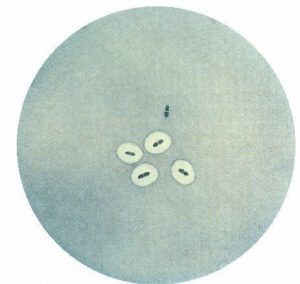
After the addition of a counterstain (methylene blue), the pneumococcal cells stain dark blue and are surrounded by a sharply demarcated halo which represents the outer edge of the capsule. The light transmitted through the capsule appears brighter than either the pneumococcal cell or the background. Single cells, pairs, chains, and even clumps of cells may have positive quellung reactions.
Procedure of the quellung reaction
A. Preparation of a bacterial cell suspension
- Grow the isolate(s) to be tested for 18-24 hours on a blood agar plate (BAP) at 35-37°C with ~5% CO2 (or in a candle-jar).
- From overnight growth on the BAP, use a sterile loop to prepare a light to moderate cell suspension (approximately equal to a 5McFarland density standard) in 0.5 ml of 0.85% saline.
Optimum quellung reactions can be observed when there are 25-50 cells visible in a microscopic field at 1000X magnification.
B. Mixing of cells and antisera on a glass slide
- Dispense equal amounts of antiserum (5 µl) and methylene blue (5 µl) onto a microscope slide.
- Add approximately 0.2-1.0 µl of the diluted cell suspension and mix all three with a pipette tip.
- Cover the suspension with a 22 mm2 square cover-slip and incubate at room temperature (25°C) for 10-15 minutes.
Do not allow the fluid on the slide to dry.
C. Reading the Quellung reaction using a microscope
- Examine the slide at 1000X using an oil immersion lens.
- Begin testing with pooled antisera. Once a positive reaction is obtained, proceed with individual group and serotype-specific antisera included in the pooled antisera that gave the positive reaction to determine the serogroup and serotype.
Results
- A positive quellung reaction is observed when the capsule appears as a sharply demarcated halo around the dark blue stained cell
- A negative quelling reaction is observed when there is no appearance of a clear, enlarged halo surrounding the stained cell.
VIDEO*(Source: Habib et al The University of Melbourne):(The procedure mentioned in this video is slightly different than described in the text)*