

A laboratory tests a patient's Escherichia coli against ciprofloxacin and reports it susceptible. But how does the lab know the antibiotic disc was still potent, the medium was made correctly, and the reading was accurate?
It knows because, alongside the patient's organism, it also tested a strain whose exact answer is already known. If that known strain gives its expected result, the patient's result can be trusted. If it does not, something in the test is wrong and no patient result is released. That known, well-characterized organism is a quality control strain, and this article is about what they are, where they come from, and which ones to use.
Quality control strains (standard strains) are well-characterized microorganisms with defined susceptibility or resistance profiles to the antimicrobial agent(s) tested. They are routinely used to standardize antibiotic susceptibility testing (AST) methodologies and check antibiotic discs’ efficacy before use.
For example, the expected zone size of E. coli ATCC 25922 against ampicillin has a defined range in the CLSI tables. Suppose the strain gives a zone within that range when tested against recently purchased ampicillin discs. In that case, we can assume that these antibiotic discs are of correct potency (working well) as the zone size lies within the range set by the quality control strain.
QC strains are also used to monitor the test procedure and quality control of culture media & reagents. Reference strains are one component of the laboratory's overall quality control. For how they fit alongside media, reagent, equipment, and susceptibility-testing checks, see Quality Control in the Microbiology Laboratory.
What is a quality control strain, and why do laboratories need one?
A quality control strain (also called a reference strain, control strain, or standard strain) is a microorganism that has been thoroughly studied and whose characteristics are precisely known and stable. For antimicrobial susceptibility testing, this means the strain has a defined, published result for each antibiotic, for example, a known zone-diameter range or a known minimum inhibitory concentration (MIC).
The reason laboratories need them is simple: a patient result is only trustworthy if the test itself is working. When a laboratory tests a patient's organism, it cannot see whether the antibiotic disc has lost potency, the medium is faulty, the incubation conditions have drifted, or the technique is off. A quality control strain solves this by acting as a known standard run alongside the patient sample. Because its correct answer is already known, its result is a check on the whole test system.
The logic in practice: if Escherichia coli ATCC 25922 is tested against ampicillin and gives a zone of inhibition within its expected range (for example, within the published limits for that antibiotic), the discs, medium, and method are all performing correctly, and the patient results from that run can be trusted. If the control strain's zone falls outside its expected range, the run has failed, and no patient results are reported until the problem is found and fixed. The control strain fails so the patient result never does.
Quality control strains are used to:
- Verify that antibiotic discs are of correct potency before and during use.
- Monitor the performance of the susceptibility testing method (disc diffusion or MIC).
- Check that culture media and reagents support proper growth and give correct reactions. For how reference strains are used to test each medium and the expected colony reactions, see Quality Control of Culture Media.
- Train new staff and validate new tests or new batches of materials.
What is ATCC, and what do the other collections mean?
ATCC stands for the American Type Culture Collection. It is a nonprofit organization, founded in 1925, that acquires, authenticates, preserves, and distributes reference microorganisms and other biological materials. It is the largest general culture collection in the world, and its strains are a global standard for quality control.
ATCC is not the only such collection. Reference strains are held in national and international culture banks, and the common ones are:
- ATCC, American Type Culture Collection (United States)
- NCTC, National Collection of Type Cultures (United Kingdom)
- NCIMB, National Collection of Industrial, Food and Marine Bacteria (United Kingdom)
- DSMZ, the German Collection of Microorganisms and Cell Cultures
- CIP, Collection of the Institut Pasteur (France)
- WDCM, the World Data Centre for Microorganisms, an international database that links the collections together
Because the same strain is often deposited in several collections, one organism can carry several different catalog numbers. For example, the same reference Escherichia coli is E. coli ATCC 25922, and also NCTC 12241, DSM 1103, and CIP 76.24. They are the same organism with the same properties, listed under each collection's own numbering.
How to read a strain designation
A strain name such as Escherichia coli ATCC 25922 has three parts:
- The organism: Escherichia coli.
- The collection: ATCC.
- The accession number: 25922, the unique catalog number that collection assigned to that specific, characterized strain.
The number is not random and it is not a property of the organism itself; it is simply the strain's catalog entry in that collection. It matters because different strains of the same species can behave very differently, and the number pins down exactly which one you mean. For example, E. coli ATCC 25922 does not produce beta-lactamase and is used as a susceptible control, while E. coli ATCC 35218 does produce beta-lactamase and is used to control beta-lactam and beta-lactamase-inhibitor combination tests. Both are E. coli; only the number tells them apart, and choosing the wrong one gives the wrong control.
This is why quality control always specifies the full designation, genus, species, collection, and number, never just the species name.
How to get Quality Control Strains?
Standard strains come from the culture collections described above. There are many more collections worldwide that can be accessed here.
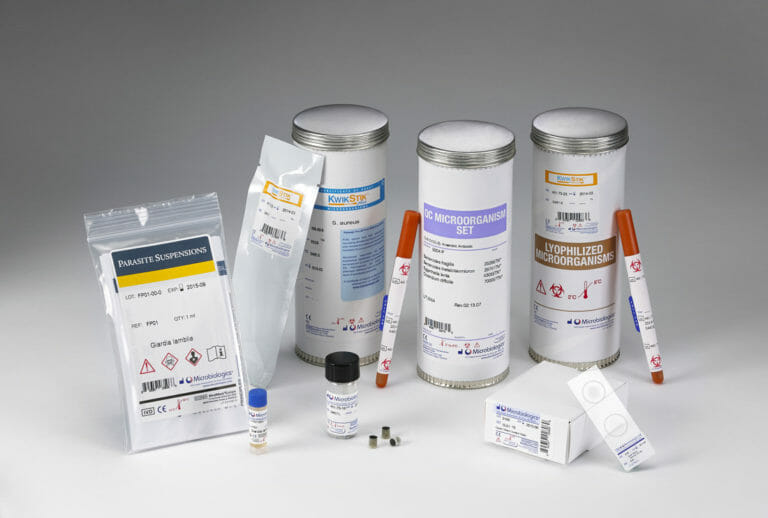 Figure: Quality control strains
They can be procured from various commercial sources. They are available in freeze-dried form in glass ampoules or as sticks or swabs that contain a dried form of the microorganism. The organism can be revived following the manufacturer’s instructions.
How to select the right type of microorganism for QC?
The right strain depends on the test. As explained above, strains of the same species can serve opposite roles, so quality control always specifies the full designation, not just the species.
The table below lists the common quality control strains and the tests each is primarily used for. Most laboratories keep only a few for routine work; the rest are supplemental, used for specific tests, training, or investigating unusual resistance.
| QC Strain | Test(s), for which strain is primarily used |
|---|---|
| Escherichia coli ATCC® 25922 | Disk diffusion and MIC of Enterobacteriaceae, Pseudomonas aeruginosa, Acinetobacter spp. , Burkholderia cepacia, Stenotrophomonas maltophilia |
| MIC of other non- Enterobacteriaceae | |
| Screening and confirmatory tests for ESBLs (negative) | |
| Disk diffusion and MIC of Neisseria meningitidis (for ciprofloxacin, nalidixic acid, minocycline, and sulfisoxazole) | |
| Escherichia coli ATCC® 35218 | Disk diffusion and MIC for β-lactam/β-lactamase inhibitor combination drugs of Enterobacteriaceae, Pseudomonas aeruginosa, Acinetobacter spp. , Burkholderia cepacia, Stenotrophomonas maltophilia, Staphylococcus spp. |
| MIC for β-lactam/β-lactamase inhibitor combination drugs of other non- Enterobacteriaceae | |
| Testing of amoxicillin-clavulanic acid for Haemophilus spp . | |
| Klebsiella pneumoniae ATCC® 700603 | Screening and confirmatory tests for ESBLs (positive) |
| Klebsiella pneumoniae ATCC® BAA-1705 | Confirmatory test for suspected carbapenemase production in Enterobacteriaceae ( MHT positive) |
| Klebsiella pneumoniae ATCC® BAA-1706 | Confirmatory test for suspected carbapenemase production in Enterobacteriaceae (MHT negative) |
| Pseudomonas aeruginosa ATCC® 27853 | Disk diffusion and MIC of Pseudomonas aeruginosa, Acinetobacter spp. , Burkholderia cepacia, Stenotrophomonas maltophilia |
| MIC of other non- Enterobacteriaceae | |
| Staphylococcus aureus ATCC® 25923 | Disk diffusion of Staphylococcus spp. and Enterococcus spp. |
| Screening test for β-lactamase production of Staphylococcus aureus group and coagulase-negative Staphylococci (negative) | |
| Screening test for mecA -mediated oxacillin resistance using cefoxitin in Staphylococcus aureus group and coagulase-negative Staphylococci ( mecA negative; disk diffusion susceptible) | |
| Screening test for inducible clindamycin resistance in Staphylococcus aureus group and coagulase-negative Staphylococci with disk diffusion ( D-zone test ) (negative) | |
| Screening test for high-level mupirocin resistance in Staphylococcus aureus group (mupA negative; disk diffusion susceptible) | |
| Staphylococcus aureus ATCC® 29213 | MIC of Staphylococcus spp. |
| Screening test for β-lactamase production in Staphylococcus aureus group and coagulase-negative Staphylococci (positive) | |
| Screening test for oxacillin resistance in Staphylococcus aureus group (susceptible) | |
| Screening test for mecA -mediated oxacillin resistance using cefoxitin in Staphylococcus aureus group (mecA negative; MIC susceptible) | |
| Screening test for inducible clindamycin resistance in Staphylococcus aureus group, coagulase-negative Staphylococci, and Streptococcus spp. β-hemolytic group with broth microdilution (no growth) | |
| Screening test for high-level mupirocin resistance in Staphylococcus aureus group ( mupA negative; MIC susceptible) | |
| Staphylococcus aureus ATCC® 43300 | Screening test for oxacillin resistance in Staphylococcus aureus group (resistant) |
| Screening test for mecA -mediated oxacillin resistance using cefoxitin in Staphylococcus aureus group (disk diffusion and MIC) and coagulase-negative Staphylococci (disk diffusion) ( mecA positive) | |
| Staphylococcus aureus ATCC® BAA-976 | Screening test for inducible clindamycin resistance in Staphylococcus aureus group, coagulase-negative Staphylococci, and Streptococcus spp. β-hemolytic group with broth microdilution (no growth) |
| Staphylococcus aureus ATCC® BAA-977 | Screening test for inducible clindamycin resistance in Staphylococcus aureus group, coagulase-negative Staphylococci and Streptococcus spp. β-hemolytic group with broth microdilution (growth) |
| Staphylococcus aureus ATCC® BAA-1708 | Screening test for high-level mupirocin resistance in Staphylococcus aureus group (mupA positive; disk diffusion and MIC resistant) |
| Enterococcus faecalis ATCC® 29212 | MIC of Enterococcus spp . |
| Screening test for vancomycin MIC ≥8 µg/mL in Staphylococcus aureus group (susceptible) | |
| Screening test for high-level aminoglycoside resistance in Enterococcus spp . (disk diffusion, broth microdilution, agar dilution: susceptible) | |
| Screening test for vancomycin resistance in Enterococcus spp. (agar dilution: susceptible) checking that medium is acceptable for testing sulfonamides, trimethoprim, and trimethoprim/sulfamethoxazole | |
| Enterococcus faecalis ATCC® 51299 | Screening test for vancomycin MIC ≥8 µg/mL for Staphylococcus aureus group (resistant) |
| Screening test for high-level aminoglycoside resistance in Enterococcus spp . (broth microdilution, agar dilution: resistant) | |
| Screening test for vancomycin resistance in Enterococcus spp. (agar dilution: resistant) | |
| Haemophilus influenzae ATCC® 49247 | Disk diffusion and MIC of Haemophilus spp . (BLNAR; β-lactamase negative, ampicillin resistant) |
| Haemophilus influenzae ATCC® 49766 | Disk diffusion and MIC of Haemophilus spp . with selected cephalosporins (β-lactamase positive) |
| Haemophilus influenzae ATCC® 10211 | Checking growth capabilities of medium used for disk diffusion and MIC tests for Haemophilus spp. |
| Neisseria gonorrhoeae ATCC® 49226 | Disk diffusion and MIC of Neisseria gonorrhoeae (CMRNG; chromosomally mediated (penicillin) resistant N. gonorrhoeae) |
| Streptococcus pneumoniae ATCC® 49619 | Disk diffusion and MIC of Streptococcus pneumoniae (penicillin intermediate), Streptococcus spp. β-hemolytic group Streptococcus spp. viridans group and Neisseria meningitidis |
| Screening test for inducible clindamycin resistance in Streptococcus spp. β-hemolytic group with disk diffusion (D-zone test) and broth microdilution (negative) | |
| Bacteroides fragilis ATCC® 25285 | MIC of anaerobes |
| Bacteroides thetaiotaomicron ATCC® 29741 | MIC of anaerobes |
| Clostridium difficile ATCC® 700057 | MIC of anaerobes |
For routine antimicrobial susceptibility testing, a laboratory needs only a few strains: Escherichia coli ATCC 25922 for Enterobacterales, Staphylococcus aureus ATCC 25923 for gram-positive organisms, and Pseudomonas aeruginosa ATCC 27853 for non-Enterobacterales gram-negative rods. The many supplemental strains are used to assess a new test, train staff, or investigate specific resistance mechanisms, and are not part of routine daily QC.
How to Remember
The control fails so the patient result never does. A quality control strain is a known organism run alongside the unknown patient sample. If the known one gives its expected answer, the test is working and the patient result can be trusted. If the known one is wrong, the run is scrapped before any patient result goes out. That is the whole purpose in one sentence.
ATCC is a library, and the number is the shelf. ATCC is the American Type Culture Collection, a bank of known organisms. The number (25922) is that strain's catalog entry, like a call number. Genus, species, collection, number, that is the full address of a strain.
Same strain, many numbers. The identical reference E. coli is ATCC 25922 in America and NCTC 12241 in Britain. Different libraries, same book. The properties are the same; only the catalog number changes.
The routine three: coli, aureus, pseudomonas. For everyday AST, remember E. coli 25922, S. aureus 25923, and P. aeruginosa 27853, one gram-negative, one gram-positive, one non-Enterobacterales. Everything else is supplemental.
The number tells strains apart, not just species. E. coli 25922 is a susceptible control; E. coli 35218 makes beta-lactamase. Same species, opposite jobs. Always quote the number.
Key exam facts
| Point | Fact |
|---|---|
| QC strain | A well-characterized organism with known, stable, defined results |
| Other names | Reference, control, standard strain |
| Purpose | Check that discs, media, method, and reading are all working |
| ATCC | American Type Culture Collection (nonprofit, founded 1925, USA) |
| Other collections | NCTC (UK), NCIMB (UK), DSMZ (Germany), CIP (France), WDCM (global database) |
| Strain designation | Organism + collection + accession number (e.g. E. coli ATCC 25922) |
| Same strain, many numbers | E. coli ATCC 25922 = NCTC 12241 = DSM 1103 |
| Routine gram-negative control | Escherichia coli ATCC 25922 |
| Routine gram-positive control | Staphylococcus aureus ATCC 25923 |
| Routine non-Enterobacterales control | Pseudomonas aeruginosa ATCC 27853 |
| Beta-lactamase negative E. coli | ATCC 25922 |
| Beta-lactamase positive E. coli | ATCC 35218 |
| ESBL positive control | Klebsiella pneumoniae ATCC 700603 |
| MRSA (oxacillin resistant) control | Staphylococcus aureus ATCC 43300 |
| If control result is out of range | Run fails; no patient results released until fixed |
| Form supplied | Freeze-dried in ampoules, or on sticks or swabs; revived per instructions |
Where Students Get Confused
"What actually is ATCC?" ATCC is the American Type Culture Collection, a nonprofit organization that stores and distributes well-characterized reference microorganisms. When a strain is labeled "ATCC 25922," it means that organism came from, and is cataloged by, ATCC under the number 25922.
"What does the number in ATCC 25922 mean?" It is a catalog accession number, the unique entry for that specific characterized strain in the ATCC collection. It is not a property of the organism; it is simply its catalog entry. The number matters because it pins down exactly which strain you mean, since different strains of the same species behave differently.
"Why not just use any E. coli as a control?" Because a control strain must have a known, published, stable result for each antibiotic. A random clinical E. coli has unknown susceptibility, so it cannot verify anything. Only a characterized reference strain, with a defined expected result, can tell you whether the test is working.
"The control strain and the patient organism are the same species, so does the control test the patient's organism?" No. The control strain tests the system, the discs, medium, method, and reading, not the patient's organism. It is run in parallel as an independent check. The patient's organism is tested separately, and its result is only trusted if the control passed.
"Is a QC strain only for antibiotic testing?" No. It is most associated with antimicrobial susceptibility testing, but reference strains are also used to check that culture media grow organisms properly, that biochemical reagents give the right reactions, to train staff, and to validate new tests and new batches of materials.
"ATCC 25922 and NCTC 12241 sound like different organisms." They are the same strain, deposited in two different collections and given each collection's own number. The organism and its properties are identical; only the catalog number differs.
References and further readings
- CLSI. Performance Standards for Antimicrobial Susceptibility Testing. CLSI supplement M100 (current edition). Wayne, PA: Clinical and Laboratory Standards Institute.
- The European Committee on Antimicrobial Susceptibility Testing (EUCAST). https://www.eucast.org/
- Karatuna O. Quality Assurance in Antimicrobial Susceptibility Testing. IntechOpen.
- American Type Culture Collection (ATCC). https://www.atcc.org/

Comments
No comments yet. Be the first to share your thoughts.
Leave a comment
All comments are reviewed before they appear.