

Pyrrolidonyl Arylamidase (PYR) test is a rapid test that is used for the presumptive identification of group A beta-hemolytic streptococci and enterococci. PYR test is also used for the identification of Escherichia coli (-ve), separating it from other indole-positive, lactose-positive, Gram-negative rods.
The substrate for the PYR test is L-Pyrrolidonyl- β-naphthylamide (PYR) which is hydrolyzed by a specific bacterial aminopeptidase enzyme (pyrrolidonyl peptidase). Hydrolysis of the substrate by this enzyme releases free β-naphthylamine (the substrate is the β-naphthylamide; cleavage frees the amine), which is detected by the addition of N,N-dimethylaminocinnamaldehyde. This detection reagent couples with the naphthylamide to form a red Schiff base.
Why It Matters
A child comes in with a sore throat, fever, and tender cervical nodes. The throat swab is plated on blood agar, and overnight it grows small colonies surrounded by a clean zone of complete (beta) hemolysis. Beta-hemolytic streptococci. But that is a category, not an answer, because Group A, C, and G streptococci can all look like this on a plate, and only one of them is the organism that causes rheumatic fever if the infection is missed.
The question the clinician needs answered is: is this Group A Strep, Streptococcus pyogenes?
A technician touches a few of those colonies onto a PYR disk, waits two minutes, and adds a drop of reagent. The disk flushes bright cherry red.
Among beta-hemolytic streptococci, that red is close to a name. S. pyogenes is strongly PYR positive; Groups B, C, and G are PYR negative. A positive PYR on a beta-hemolytic, catalase-negative Gram-positive coccus is a presumptive identification of Group A Strep, available in minutes, long before any serogrouping kit would return.
That speed matters because the stakes of S. pyogenes are high and delayed: untreated, it can lead to acute rheumatic fever and rheumatic heart disease, still a major cause of acquired heart disease in children across South Asia and sub-Saharan Africa. A test that presumptively flags GAS at the bench, using a disk and a drop of reagent, is exactly the kind of tool that fits a resource-limited laboratory.
PYR does two more jobs besides. It separates Enterococcus (positive) from the group D streptococci like S. bovis (negative), and it separates E. coli (negative) from other indole-positive Gram-negative rods. But the reason it earns a place on the bench is the first one: a fast, specific, presumptive call on the most consequential of the beta-hemolytic streptococci.
Principle: one enzyme, three separations
PYR detects a single enzyme, L-pyrrolidonyl arylamidase (also called pyrrolidonyl peptidase or pyrrolidonyl aminopeptidase). It is a peptidase: it cleaves a specific bond in a synthetic substrate built for the test, L-pyrrolidonyl-β-naphthylamide.
The reaction is two steps:
- If the organism has the enzyme, it hydrolyzes the substrate, releasing free β-naphthylamine, which is colorless. Nothing visible happens yet.
- You then add the developer, N,N-dimethylaminocinnamaldehyde. It couples with the free β-naphthylamine to form a bright cherry-red Schiff base. The red is the readout.
No enzyme means no free β-naphthylamine, so the developer has nothing to couple with and the disk stays yellow or pale orange.
What makes the test useful is that PYR activity is unevenly distributed in a way that happens to line up with three clinically important separations:
- Among beta-hemolytic streptococci, only Streptococcus pyogenes (Group A) is PYR positive. Groups B, C, and G are negative.
- Among the group D organisms, the enterococci (Enterococcus faecalis, E. faecium) are PYR positive, while the group D non-enterococcal streptococci such as S. bovis (S. gallolyticus) are negative.
- Among Gram-negative rods, E. coli is PYR negative, which helps separate it from other indole-positive, lactose-fermenting enterics.
So one enzyme test does three different jobs depending on what you started with. That is unusual, and it is why PYR appears in three different identification pathways.
How to Remember PYR Test
PYR is asking one specific question: can this organism cleave this particular amino-acid-like substrate? That's it, everything else is interpretation.
PYR points to pyogenes. The alliteration is the whole mnemonic: PYR → pyogenes. Among the beta-hemolytic streptococci, the PYR-positive one is Streptococcus pyogenes, Group A. Groups B, C, and G are negative.
You've already met the answer twice. From the S. pyogenes and S. agalactiae articles: GAS is PYR-positive, GBS is PYR-negative, one of the three results that flips between them. From the Enterococcus faecalis article: Enterococcus is also PYR-positive, which is exactly why PYR alone never finishes an identification. It can't tell GAS and Enterococcus apart on its own; catalase and morphology have to come first. Add a third PYR-positive organism to the list: Staphylococcus lugdunensis, the same coagulase-negative staph that also breaks the usual DNase rules. PYR-positive isn't a single-organism signal, it's a short list, and the rest of the workup narrows it down.
The Enterococcus-vs-S. bovis pairing. That second use is how you tell Enterococcus (positive) from the group D streptococci like S. bovis (negative). Pair it with the starch test: S. bovis is starch positive and PYR negative; the enterococci are the reverse.
Catalase first, always. PYR only carries meaning after catalase has placed the organism among the streptococci and enterococci. Ask yourself before you read the red: have I confirmed this is a catalase-negative Gram-positive coccus? If not, the red could be a staphylococcus or an aerococcus, and it means nothing yet. Several other organisms produce the enzyme too, including some staphylococci, aerococci, Gemella, and Arcanobacterium haemolyticum. PYR is a second-line presumptive test, run after the catalase test, never before.
PYR beat bacitracin on speed and specificity. Same job (presumptive GAS), two minutes instead of overnight, and it does not get fooled by the group C and G strep that some bacitracin-susceptible organisms are. That is why PYR replaced the Taxo A disk.
Procedure
PYR test is available in different formats. Original PYR test used to take 16-20 hours but now 4-hour broth assay is available, which is described in this post. Other formats include rapid (10-15 minutes) tests, in which PYR reagent impregnated filter paper disks or strips are inoculated with the organisms to be tested.
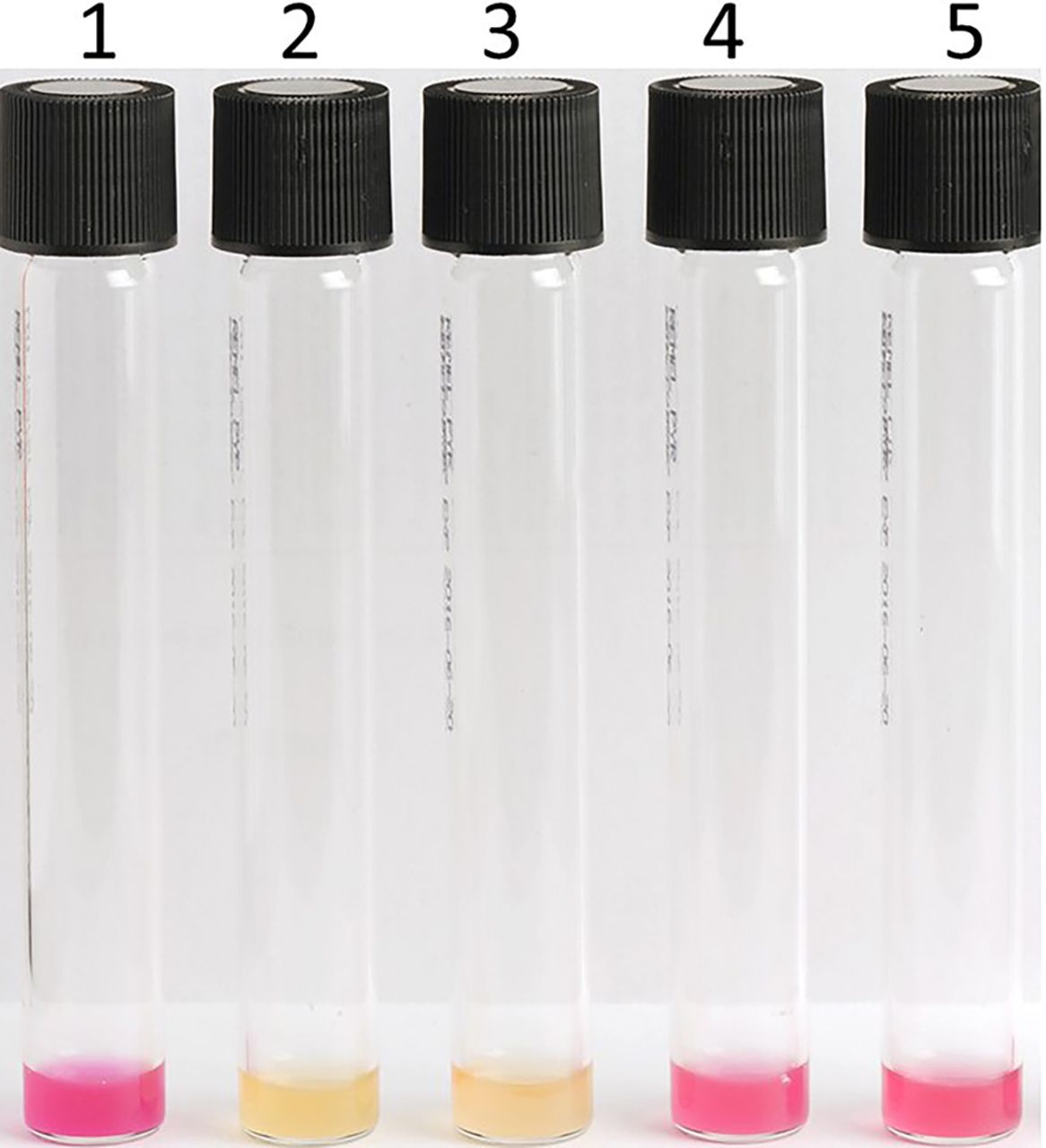 Figure: PYR broth test Positive (1,4 and 5): brilliant red-fuchsia color. Negative (2&3) yellow or weakly orange color
PYR Broth test
- With a sterile bacteriologic loop, pick up the growth of two to three morphologically similar colonies and emulsify them in the small volume of PYR broth
- Incubate the tube at 35°C for 4 hours.
- Add one drop of PYR reagent and observe for color change.
- The reaction should be read and recorded 1 minute after the addition of the reagent.
PYR Disc Test
- Using forceps, place PYR disk in Petri dish.
- Moisten, but do not saturate, disk with sterile water.
- Using a sterile stick, remove one or two loopfuls of culture from a blood agar plate that is 24 to 48 hours old. Use several loopfuls for organisms that take 48 hours or more to grow.
- Smear the colonies onto PYR disk.
- Allow to react for 2 min (extend the time to 10 min for poorly growing organisms).
- After the incubation period, add 1 drop of cinnamaldehyde reagent and observe for red color.
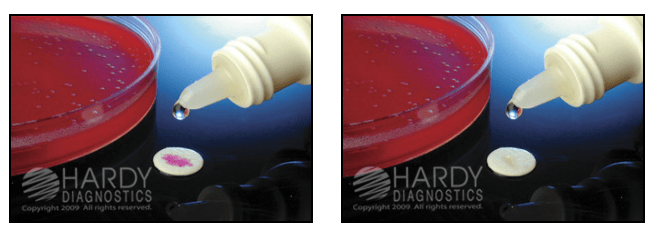 Figure: PYR Disc Test (Left-Positive; Right-Negative)
Results and interpretations
- Positive: the development of a deep cherry red color within a minute of addition of the reagent
- Negative: no color change or yellow or orange color
Quality control
- Positive control: Enterococcus faecalis, Streptococcus pyogenes
- Negative control: Streptococcus agalactiae
Note: It is essential that testing be performed before the PYR test to determine that the organism is Streptococcus (i.e. gram-positive cocci, catalase-negative). Other organisms (e.g., some aerococci, staphylococci, nutritionally variant streptococci, Arcanobacterium haemolyticum) may also be PYR positive.
PYR by organism
PYR positive:
- Streptococcus pyogenes (Group A) — the key positive among beta-hemolytic strep
- Enterococcus species (E. faecalis, E. faecium)
- Aerococcus, Gemella, some coagulase-negative staphylococci (S. haemolyticus, S. lugdunensis)
- Arcanobacterium haemolyticum
- Staphylococcus lugdunensis (a point of overlap with the coagulase story: PYR positive helps flag it)
PYR negative:
- Streptococcus agalactiae (Group B), and Groups C and G beta-hemolytic strep
- Streptococcus bovis / S. gallolyticus (group D non-enterococcus) — PYR separates it from the enterococci
- Most viridans streptococci
- Escherichia coli — the diagnostically useful Gram-negative negative
- Staphylococcus aureus
The two separations to hold onto: S. pyogenes is the PYR-positive beta-hemolytic strep, and Enterococcus is PYR positive while group D S. bovis is not.
Limitations
- If the disc is too moist, a false-negative test can occur.
- If selective media or tube biochemical agars are used to provide inocula, false-negative tests result may appear.
PYR versus the bacitracin disk
Before PYR, the standard presumptive test for Group A Strep was bacitracin susceptibility (the Taxo A disk): S. pyogenes is susceptible, most other beta-hemolytic strep are resistant. It works, but it has two weaknesses PYR fixes.
- Specificity. Some Group C and G streptococci are also bacitracin susceptible, giving false-positive GAS calls. PYR is more specific: Groups C and G are PYR negative.
- Speed. Bacitracin needs overnight incubation to read the zone of inhibition. The PYR disk reads in about two minutes.
| Bacitracin (Taxo A) disk | PYR test | |
|---|---|---|
| Detects | Bacitracin susceptibility | Pyrrolidonyl arylamidase |
| GAS result | Susceptible | Positive |
| Time | Overnight | ~2 minutes (disk) |
| False positives | Some group C, G strep | Few |
| Current status | Largely superseded | Preferred presumptive test |
PYR is faster and more specific, which is why it is now the preferred presumptive test for Group A Strep in most labs. Bacitracin is still taught and still used where PYR is unavailable.
Other diagnostic uses of PYR
Beyond Streptococcus and Enterococcus, PYR has two other identification roles worth knowing:
- Differentiating E. coli from other indole-positive, lactose-positive Gram-negative rods. E. coli is PYR-negative. In a multi-lab validation study, PYR-negative plus indole-positive plus lactose-positive correctly identified the large majority of E. coli isolates directly, with an overall error rate of 0.3%.
- Screening coagulase-negative staphylococci for S. lugdunensis. Unlike most CoNS, S. lugdunensis is PYR-positive, useful since this species behaves more aggressively than typical CoNS and is sometimes mistaken for a contaminant.
Where students actually get confused
- PYR-positive alone never confirms a single organism. GAS, Enterococcus, and S. lugdunensis are all PYR-positive. Catalase and Gram stain morphology have to come first, this test narrows a list, it doesn't finish an identification by itself.
- PYR-negative doesn't automatically mean E. coli. Morganella, Providencia, and P. vulgaris can also be PYR-negative and indole-positive. A quick urease test resolves this, E. coli is urease-negative, all three of those aren't.
- Pre-testing matters as much for the Gram-negative use case as the Gram-positive one. Just as PYR for Streptococcus requires confirming catalase-negative status first, PYR for E. coli requires confirming indole-positive, lactose-positive, oxidase-negative status first, it's not a stand-alone test in either direction.
Key exam facts in one table
| Question | Answer | The reason behind it |
|---|---|---|
| What does PYR detect? | L-pyrrolidonyl arylamidase (pyrrolidonyl peptidase) | A peptidase that cleaves the synthetic PYR substrate |
| Substrate | L-pyrrolidonyl-β-naphthylamide | Cleaved to release β-naphthylamine |
| Developer | N,N-dimethylaminocinnamaldehyde | Couples with β-naphthylamine to form a red Schiff base |
| Positive result | Bright cherry-red within 1 minute | Free β-naphthylamine reacted with the developer |
| Negative result | Yellow or pale orange | No enzyme, no free β-naphthylamine |
| Key beta-hemolytic positive | Streptococcus pyogenes (Group A) | The only PYR-positive beta-hemolytic strep |
| Beta-hemolytic negatives | Groups B, C, G | PYR separates GAS from these |
| Group D separation | Enterococcus positive; S. bovis negative | Distinguishes enterococci from group D strep |
| Gram-negative use | E. coli is PYR negative | Separates it from other indole-positive enterics |
| Morganella, Providencia, P. vulgaris | PYR negative | Can mimic E. coli (also indole-positive); resolved by urease, which these are positive and E. coli negative |
| S. lugdunensis | PYR positive | Unlike most other coagulase-negative staphylococci; PYR helps flag it |
| Prerequisite | Confirm catalase-negative Gram-positive coccus first | Staphylococci, aerococci, others can be PYR positive |
| Other positives to know | Aerococcus, Gemella, Arcanobacterium haemolyticum, S. lugdunensis, S. haemolyticus | Why catalase and Gram stain must come first |
| PYR vs bacitracin | PYR faster (2 min vs overnight) and more specific | Group C, G strep can be bacitracin susceptible but are PYR negative |
| Broth method time | 4 hours at 35°C | The modern standard broth assay |
| Disk method time | ~2 minutes | The rapid presumptive format |
| Positive QC | Enterococcus faecalis, S. pyogenes | Strong positives |
| Negative QC | Streptococcus agalactiae (Group B) | Reliable negative |
| Main clinical value | Rapid presumptive Group A Strep ID | Speed matters given rheumatic fever risk |
| False negative cause | Disk too moist; inoculum from selective/agar media | Dilutes reagent or carries interfering substances |
Where students actually get confused
Reading PYR before doing catalase and Gram stain. The defining error. PYR positive only means "Group A Strep or Enterococcus" if you already know the organism is a catalase-negative Gram-positive coccus. Staphylococci, aerococci, Gemella, and Arcanobacterium can all be PYR positive. On an unidentified colony, a red PYR disk means nothing until catalase and Gram stain have narrowed the field. PYR is second-line, always after catalase.
PYR-positive alone never confirms a single organism. GAS, Enterococcus, and S. lugdunensis are all PYR-positive. This test narrows a list; it doesn't finish an identification by itself.
PYR-negative doesn't automatically mean E. coli. Morganella, Providencia, and P. vulgaris can also be PYR-negative and indole-positive. A quick urease test resolves this: E. coli is urease-negative, all three of those are urease-positive.
Pre-testing matters for the Gram-negative use case too. Just as PYR for Streptococcus requires confirming catalase-negative status first, PYR for E. coli requires confirming indole-positive, lactose-positive, oxidase-negative status first. It is not a stand-alone test in either direction.
Thinking PYR confirms Group A Strep. It is presumptive, not confirmatory. A positive PYR on a beta-hemolytic catalase-negative Gram-positive coccus is a strong presumptive GAS call, enough to guide same-day management, but definitive identification uses serogrouping (Lancefield) or molecular methods.
A pale pink read as positive. A true positive is a deep, brilliant cherry-red within a minute. A pale or weak pink is negative. Do not upgrade a faint color to a positive; if unsure, repeat.
Too-moist disk giving a false negative. Over-wetting the disk dilutes the substrate and the developer. Moisten, do not saturate. This is the most common technical cause of a false negative.
Inoculating from selective or biochemical media. Colonies picked from selective agars or tubed biochemical media can carry substances that interfere with the reaction and cause false negatives. Use growth from a non-selective medium such as blood agar.
Confusing the two positive uses. PYR positive is either S. pyogenes (among beta-hemolytic strep) or Enterococcus (among group D). Which separation you are making depends on what you started with. In a throat swab it is the GAS question; in a group D workup it is the enterococcus-versus-S. bovis question. Pair the latter with starch: S. bovis is starch positive, PYR negative.
Forgetting bacitracin exists and why PYR replaced it. Bacitracin susceptibility does the same presumptive GAS job but is slower (overnight) and less specific (some group C and G strep are susceptible). PYR is faster and more specific. Knowing both, and why PYR won, is a common exam point.
References and further readings
- Procop GW, Church DL, Hall GS, Janda WM, Koneman EW, Schreckenberger PC, Woods GL. Koneman's Color Atlas and Textbook of Diagnostic Microbiology. 7th ed. Philadelphia: Wolters Kluwer; 2017.
- Leber AL, editor. Clinical Microbiology Procedures Handbook. 4th ed. Washington, DC: ASM Press; 2016. doi:10.1128/9781683670438
- Tille PM. Bailey and Scott's Diagnostic Microbiology. 15th ed. St. Louis: Elsevier; 2022.
- Facklam RR, Thacker LG, Fox B, Eriquez L. Presumptive identification of streptococci with a new test system. J Clin Microbiol. 1982;15(6):987-990. doi:10.1128/jcm.15.6.987-990.1982

Comments
No comments yet. Be the first to share your thoughts.
Leave a comment
All comments are reviewed before they appear.