
MRS Broth Test: Principle, Procedure, and Results

On this page
The vancomycin-resistant result that wasn't the alarm it looked like
A blood culture from a hospitalized, immunocompromised patient grows a Gram-positive rod. Susceptibility testing comes back vancomycin-resistant, a result that would normally trigger real concern, since vancomycin resistance in a Gram-positive bloodstream isolate is exactly the kind of finding infection control takes seriously.
But two other results on the same isolate point somewhere else entirely: it's catalase-negative and PYR-negative. Combined with the vancomycin resistance, these three findings together suggest a lactic acid bacterium, Lactobacillus, Leuconostoc, Pediococcus, or Weissella, genera that are intrinsically, harmlessly vancomycin-resistant as a normal trait, not a marker of the same public-health concern as resistant Enterococcus or Staphylococcus.
Correctly identifying which of these four genera is responsible actually matters, it changes how the isolate's clinical significance gets interpreted. The fastest way to narrow it down is a single, simple question: does it produce gas while fermenting glucose? That's exactly what the MRS broth test answers.
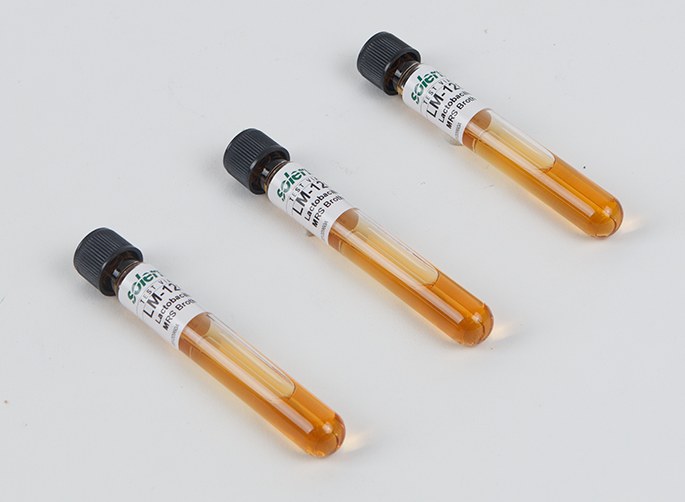 Figure: Uninoculated MRS broth tubes
Lactobacillus MRS Broth test is used to test gas production by Gram-positive rods in a glucose-containing medium. MRS is an acronym for the authors of the original publication (De Man, Rogosa, and Sharpe), who developed this medium for the cultivation of lactobacilli.
MRS broth test determines whether Gram-positive bacilli form gas during glucose fermentation, and is helpful specifically to differentiate Leuconostoc spp., which produce gas, from Lactobacillus spp., which do not. Weissella confusa is also a gas producer, while streptococci and Pediococcus are not.
Principle
MRS broth is a selective medium that uses sodium acetate and ammonium citrate to prevent overgrowth by contaminating organisms. It contains sources of carbon, nitrogen, and vitamins to support the growth of lactobacilli and other Gram-positive organisms.
Growth alone is considered a positive result before gas is even assessed; a Durham tube (or a petroleum jelly/wax plug) added to the broth is what actually detects gas production, a rise in the plug or displacement of broth by trapped air indicates a positive gas result. Ordinary sugar fermentation tubes cannot reliably detect gas from these organisms, since they don't produce enough of it to register on that less sensitive setup.
Why Test for This at All?
The organisms this test is designed for share a specific, recognizable profile: Gram-positive coccobacilli that are catalase-negative, PYR-negative, vancomycin-resistant, and grow aerobically. That combination, especially the vancomycin resistance, is exactly what makes this group worth correctly identifying rather than dismissing. As in the hook above, an isolate meeting this profile isn't behaving like a dangerous resistant pathogen; it's very likely one of the intrinsically vancomycin-resistant lactic acid bacteria. The MRS gas test is the next step that narrows down exactly which genus is responsible.
Materials
- Sterile sticks
- Incubator
- Gas detection option: Durham tube, or Vaspar/liquid paraffin/petroleum jelly maintained in liquid form at 56°C
- Test organism meeting the screening profile above
- MRS Broth
| Ingredients | Amount (g/liter) |
|---|---|
| Enzymatic digest of animal tissue | 10 |
| Beef extract | 10 |
| Yeast extract | 5 |
| Dextrose | 20 |
| Polysorbate 80 | 1 |
| Ammonium citrate | 2 |
| Sodium acetate | 5 |
| Magnesium sulfate | 0.1 |
| Manganese sulfate | 0.05 |
| Dipotassium phosphate | 2 |
| Final pH | 6.5 |
Quality Control
Perform QC on each new lot or media shipment using positive and negative controls before use. Inspect the broth for lack of turbidity before inoculation, and invert to check for any pre-existing bubble if a Durham tube is used.
- Positive (growth, no gas): Lactococcus lactis (ATCC 19435)
- Positive (growth, gas): Leuconostoc mesenteroides (ATCC 10830)
- Negative (no growth, no gas): Enterococcus faecalis (ATCC 29212)
Method
- Using a pure culture of the test organism, inoculate MRS broth containing either a Durham tube or a wax/petroleum jelly plug.
- Incubate aerobically at 35–37°C for 24–48 hours.
- Examine the broth for turbidity first; growth is required before gas can even be assessed.
- If growth is present, examine for gas: a trapped bubble in the Durham tube, or visible lifting and separation of a wax plug from the broth surface, indicates gas production.
Results
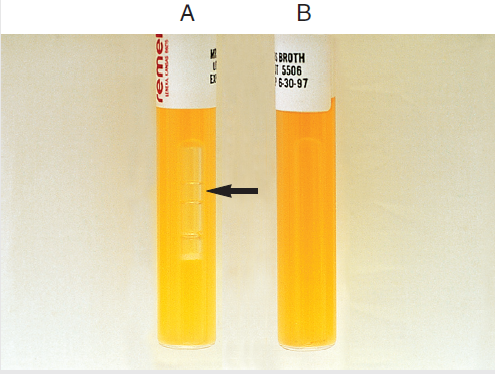 Figure: MRS broth test A: positive with gas; B: Positive but no gas.
- Positive, gas-producing: Leuconostoc spp. growth with a trapped gas bubble in the Durham tube, or, if a wax plug is used, visible lifting and complete separation of the plug from the broth surface.
- Positive, no gas: Lactobacillus spp., growth present, but no gas bubble and no plug lifting.
- Negative: No growth.
How to Remember This
Anchor for the genus split: "same family reunion, different party trick." Lactobacillus, Leuconostoc, Pediococcus, and Weissella are all lactic acid bacteria, all catalase-negative, all intrinsically vancomycin-resistant, essentially cousins at the same family reunion. Gas production from glucose is the one party trick that splits the group: Leuconostoc and Weissella confusa do it, Lactobacillus, Pediococcus, and streptococci don't.
Limitation: Since some Leuconostoc strains produce copious gas, a Durham tube is generally a safer, more reliable choice than a petroleum jelly plug, which doesn't perform as consistently.
Key exam facts in one table
| Fact | Detail |
|---|---|
| MRS acronym | De Man, Rogosa, and Sharpe |
| Purpose | Detects gas production during glucose fermentation, differentiating Leuconostoc/Weissella confusa (gas+) from Lactobacillus/Pediococcus/streptococci (gas−) |
| Screening profile for candidate organisms | Gram-positive coccobacilli, catalase-negative, PYR-negative, vancomycin-resistant, aerobic growth |
| Selective ingredients | Sodium acetate and ammonium citrate suppress contaminating organisms |
| Gas detection methods | Durham tube (more reliable) or wax/petroleum jelly plug (less consistent) |
| QC organisms | Lactococcus lactis (growth, no gas), Leuconostoc mesenteroides (growth, gas), Enterococcus faecalis (no growth) |
| Why not a standard fermentation tube | These organisms don't produce enough gas to register reliably on a less sensitive setup |
| Clinical relevance | Vancomycin resistance in this specific organism profile reflects a normal, low-virulence trait, not the same concern as resistant Enterococcus or Staphylococcus |
Where Students Get Confused
- Assuming any vancomycin-resistant Gram-positive isolate is a VRE-level concern. Lactic acid bacteria are intrinsically, harmlessly vancomycin-resistant; the catalase-negative, PYR-negative profile is what signals this is a different situation entirely.
- Mixing up which genera produce gas. Leuconostoc and Weissella confusa do; Lactobacillus, Pediococcus, and streptococci don't.
- Assuming a standard sugar fermentation tube could substitute for this test. It can't; these organisms don't generate enough gas to register reliably on that less sensitive setup, which is exactly why a dedicated Durham tube or plug method is needed.
- Treating growth alone as the final result. Growth only confirms the organism is present and viable; the actual differentiating read is whether gas forms afterward.
References and further readings
- Tille, P. M. (2022). Bailey & Scott's Diagnostic Microbiology (15th ed.). Elsevier.
- Leber, A. L. (Ed.). (2016). Clinical Microbiology Procedures Handbook (4th ed.). ASM Press.
- De Man, J. C., Rogosa, M., & Sharpe, M. E. (1960). A medium for the cultivation of lactobacilli. Journal of Applied Bacteriology, 23(1), 130–135.
Frequently Asked Questions
What does the MRS broth test detect?
Whether a Gram-positive rod produces gas while fermenting glucose, distinguishing Leuconostoc and Weissella confusa (gas-producing) from Lactobacillus, Pediococcus, and streptococci (non-gas-producing).
Why is vancomycin resistance part of the screening criteria for this test?
Because the organisms this test is designed for, lactic acid bacteria like Lactobacillus and Leuconostoc, are intrinsically, harmlessly vancomycin-resistant. That resistance profile, combined with catalase-negative and PYR-negative results, points toward this group rather than a genuinely concerning resistant pathogen.
Why can't a standard sugar fermentation tube be used instead?
What does a positive MRS broth test with gas indicate?
Growth plus a trapped gas bubble (or a lifted wax plug) suggests Leuconostoc species or Weissella confusa.
What does a positive MRS broth test without gas indicate?
Growth with no gas bubble or plug lifting suggests Lactobacillus species.

Tankeshwar Acharya, MSc (Medical Microbiology)
Tankeshwar Acharya is an Assistant Professor in the Department of Microbiology at Patan Academy of Health Sciences (PAHS), Nepal, where he has been teaching and practicing clinical microbiology for over 14 years. He is the founder of Microbe Online, one of the leading free microbiology education resources on the web, covering bacteriology, mycology, parasitology, immunology, and clinical laboratory diagnostics written from direct experience in both the classroom and the diagnostic laboratory.
Comments
No comments yet. Be the first to share your thoughts.
Leave a comment
All comments are reviewed before they appear.