
Mechanism of Action of Antiviral Drugs: How Each Drug Class Targets the Viral Life Cycle

On this page
Why is it so much harder to develop drugs against viruses than against bacteria? The answer is one of the fundamental constraints in pharmacology: a virus is not a free-living organism with its own metabolism to disrupt; it is a set of instructions that hijacks a host cell's machinery. Any drug that kills the virus risks killing the cell along with it.
The history of antiviral drug development is largely a history of finding the exceptions to this constraint: the handful of biochemical steps in viral replication that use a viral-specific enzyme or protein, not a host enzyme. Acyclovir's discovery in the 1970s was the proof of concept that made the field possible; here was a drug that could be selectively activated only in herpesvirus-infected cells (because only those cells contain the viral thymidine kinase needed to phosphorylate it), leaving uninfected cells essentially untouched. HIV therapy later revealed that a retrovirus carries three enzymes entirely absent from human cells, reverse transcriptase, integrase, and protease; giving drug developers three distinct targets.
Every antiviral drug discussed in this article exploits a step in the viral life cycle where the virus is doing something the host cell doesn't, or where a viral protein is different enough from its host-cell counterpart to be targeted selectively. Understanding the mechanism of each drug class isn't just pharmacology revision, it's the same logic that explains why a neuraminidase inhibitor works on influenza but not RSV (RSV has no neuraminidase), why acyclovir works on HSV but needs a dose adjustment for CMV, and why HIV therapy requires three drugs from two or more drug classes simultaneously rather than just one.
Virus: Structure and Replication
Antiviral drugs target specific stages of the viral replication cycle. For a full overview of viral structure and the replication cycle from attachment through to release, see the Virus Properties and Classification article. The stages relevant to drug targeting are summarised in the mechanism sections below.
Mechanisms of Action of Antiviral Drugs
Rather than killing or inactivating viruses, antiviral drugs focus on inhibiting viral replication by interfering with specific stages of the viral life cycle.
Antiviral drugs use two approaches: targeting the viruses themselves or the host cell factors. Direct virus targets include:
- The inhibitors of virus attachment/entry
- Uncoating inhibitors
- Inhibition of viral replication
- Inhibition of viral protein synthesis
- Inhibition of viral assembly
- Inhibition of release
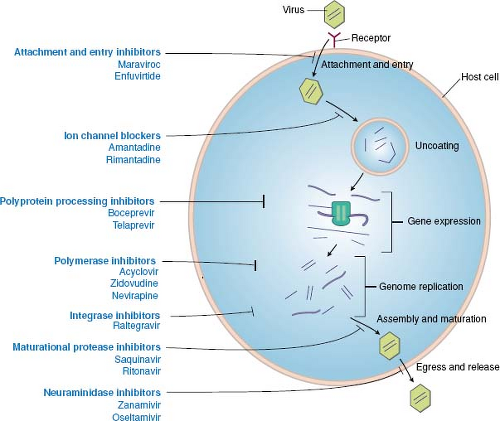 Figure: Figure:Antiviral drugs block various stages of viral replication.Source:https://basicmedicalkey.com/antiviral-agents-3/
Inhibitors of virus attachment and entry inhibitors
Drugs of this category target host receptors, co-receptors, or viral spike proteins. Drugs that inhibit attachment and virus entry prevent all subsequent steps of the viral replication cycle and virus infection. It permits the clearing of virion by the host immune system at the beginning. Example; a drug maraviroc binds CCR5 of a host cell receptor and blocks the viral attachment. Drugs like enfuvirtide bind gp41 of the viral envelope and inhibit viral fusion with the host cell membrane. Membrane fusion inhibitor drugs target mainly the enveloped viruses.
Inhibition of viral uncoating in the host cell
Some antiviral drugs, like amantadine, prevent uncoating and the release of the viral genome in the cell. Amantadine is a narrow spectrum drug that works against only Influenza A. Amantadine blocks M2 ion channel function and thereby prevents acidification, dissociation, and uncoating, which prevents the release of nucleic acid from the endosome to the host cell cytosol.
Inhibition of viral replication
Drugs inhibiting replication of viral nucleic acid target various sites:
- Polymerase and Reverse Transcriptase Inhibitors
Some antiviral drugs target DNA or RNA polymerase to inhibit DNA/RNA replication, e.g., viral DNA polymerase inhibitors, like acyclovir and tenofovir. On the other hand, some drugs target the reverse transcriptase (RT) enzyme inhibiting the synthesis of DNA from RNA. Drugs targeting the RT enzyme are efficient and safe, as RT is present only in viruses, not humans.
The drugs that inhibit replication is nucleotide/nucleoside analogs and non-nucleotide/nucleoside analogs. Nucleotide or nucleoside analogs compete with regular nucleotide/ nucleoside and insert themselves into a growing nucleic acid chain. It stops the process prematurely. Nucleoside analogs, like, acyclovir and AZT, lack a 3’OH. Thus, if they get incorporated into a growing nucleic acid strand, all nucleic acid synthesis requires a 3’OH site for adding the next nucleotide.
Nonnucleoside inhibitors bind non-competitively to the polymerase or reverse transcriptase, impairing its function, e.g., nevirapine.
Nucleoside RT inhibitors (NRTI) and nonnucleoside RT inhibitors (NNRTI) combine to treat HIV with maximum effect.
- Integrase Inhibitors
Integrase inhibitors, like raltegravir, are frequently used. Such drugs prevent the binding of the viral genome to the host genome, which is essential for some viruses.
- Interferons
Interferons are low-molecular-weight signalling proteins produced by virus-infected cells and certain immune cells. They act on adjacent uninfected cells by binding to specific cell-surface receptors, activating the JAK-STAT signalling pathway, and inducing transcription of a set of interferon-stimulated genes (ISGs). The resulting ISG-encoded proteins collectively create an antiviral state in the cell — inhibiting viral entry, replication, translation of viral proteins, and assembly of new virions.
Recombinant (artificial) interferons, particularly pegylated interferon alfa, are used clinically as antiviral agents. They were formerly the cornerstone of treatment for chronic hepatitis B and C, though for HCV they have been largely superseded by direct-acting antivirals (DAAs) with far higher cure rates and fewer side effects. They retain a role in some HBV management regimens and in certain other viral conditions.
Viral protein synthesis inhibitors
Some drugs inhibit protein synthesis by an antisense mechanism. Antisense antiviral drug is a short synthetic nucleic acid strand that complements the specific part of mRNA, which binds to mRNA and prevents the protein from being translated.
An example of such a drug is fomivirsen (also spelled formivirsen), which was approved for CMV retinitis but is now discontinued in most markets. Antisense approaches remain an active area of antiviral research.
Inhibitors of viral assembly
Protease inhibitor drugs fall under a drug inhibiting viral assembly category. The protease cleaves precursor viral protein into a functional component for viral assembly. Protease inhibitors, like ritonavir, atazanavir, and darunavir, are designed to block the active site of a specific protease. Variation led to ritonavir, indinavir. Due to the action of drugs, polyproteins will not get proteolytically cut into their final proteins. Protease inhibitors against HIV are saquinavir, ritonavir, indinavir, and nelfinavir.
Inhibitors of viral release
Although, on completion of virus replication and assembly, some drugs inhibit the last step, i.e., viral release from the host cell. Anti- Influenza or anti-COVID-19 drugs like oseltamivir block neuraminidase which is required to release a new virus.
Targets of antiviral Drugs | Drugs | Mechanisms of action |
|---|---|---|
Inhibitors of viral Attachment/ Entry | Enfuvirtide (HIV) Maraviroc (HIV) | Block the fusion of virus in the host cell membrane by directly binding to gp41. Binds CCR5 of host receptor blocks fusion and entry of the virus. |
Uncoating inhibitors prevent the release of the genome | Amantadine and Rimantadine (Influenza) | Inhibit M2 ion channel preventing pH-dependent dissociation of viral proteins, which contain the release of nucleic acid to host cell. |
Inhibition in viral replication | Remdesivir (COVID-19) Favipiravir (COVID-19), Foscarnet (HSV) Acyclovir & Ganciclovir (Herpes) Ribavirin (RSV) Dolutegravir, Elvitegravir and Raltegravur (HIV) Zidovudine(HIV) and Lamivudine (HIV &HBV) Nevirapine & Efavirenz (HIV) | RNA dependent RNA polymerase inhibitor, an analog of adenosine nucleotide RNA dependent RNA polymerase inhibitor, an analog of guanosine nucleotide DNA polymerase inhibitor DNA polymerase and Reverse Transcriptase inhibitors (nucleoside analogs) Inhibitor of integrase NRTI (nucleotide analog) NNRTI |
Viral protein synthesis inhibitors | Fomivirsen(CMV) Interferon alfa (HBV, HCV) | Antisense therapy for termination. Translation inhibitors prevent viral protein synthesis, which promotes the breakdown of viral components. |
Inhibitors of Viral Assembly | Ritonavir/ Lopinavir (COVID-19) Boceprevir (HCV) Atazanavir (HIV) | Inhibit protease |
Inhibitors of viral release | Oseltamivir (Influenza, COVID-19) and Zanamivir ( Influenza ) | Block neuraminidase which is required for the release of a new virus. |
Besides the drugs that target viruses, some drugs have been developed that act as immunomodulators. For example, nitazoxanide interferes with host-regulated pathways of virus replication, amplification of type I interferon pathways, and cytoplasmic RNA sensing.
Ivermectin has shown antiviral activity in laboratory studies via inhibition of nuclear import of viral proteins, but at concentrations substantially higher than those achievable clinically. Multiple randomised controlled trials have not demonstrated clinical benefit for COVID-19 or other viral infections, and it is not currently approved or recommended as an antiviral drug by major regulatory agencies.
How to Remember the Drug Classes
Follow the viral life cycle from entry to release — one drug class at each step. The viral replication cycle has a predictable sequence: attachment → entry/fusion → uncoating → replication → protein synthesis/processing → assembly → release. There is at least one drug class targeting each step. Rather than memorising the classes as an isolated list, anchor each one to the step it interrupts: attachment inhibitors (maraviroc, enfuvirtide) → uncoating inhibitors (amantadine, now largely obsolete due to resistance) → replication inhibitors (nucleoside/nucleotide analogues, NNRTIs, integrase inhibitors) → assembly inhibitors (protease inhibitors) → release inhibitors (neuraminidase inhibitors). Following the life cycle order makes the list sequential rather than arbitrary.
Nucleoside analogues work by looking like a building block but being a dead end. Nucleoside analogues (acyclovir, zidovudine/AZT, tenofovir) resemble the natural nucleosides that polymerases use to extend a growing nucleic acid chain. The viral polymerase incorporates the analogue into the chain — but because the analogue lacks the 3'-OH group needed for the next nucleotide to be added, chain extension stops. The analogue is essentially a "road closed" sign embedded in the DNA/RNA chain. This mechanism is common to all NRTI and DNA polymerase inhibitor drugs; the differences between them are which specific polymerase they target and how they achieve selectivity.
Acyclovir's selectivity mechanism is the gold standard example of targeted antiviral therapy. Acyclovir is inactive until phosphorylated. The first phosphorylation step requires viral thymidine kinase (TK) — an enzyme made by HSV and VZV but not present in healthy human cells. Uninfected cells cannot phosphorylate acyclovir, so the drug remains inert in them. Only HSV/VZV-infected cells (which contain viral TK) can activate it. This is why acyclovir can be given at meaningful doses without prohibitive host cell toxicity.
Protease inhibitors stop the virus at the assembly stage — the last opportunity to prevent infectious progeny. HIV's protease cleaves long polyprotein precursors into the individual structural proteins needed to build a new virion. Protease inhibitors block the active site of this enzyme, so virions assemble but remain immature and non-infectious. The key insight: by the time protease inhibitors act, the genome has already been copied — the drug isn't stopping replication, it's stopping the final packaging step that would make the replicated genome infectious.
Key Exam Facts Table
| Drug class | Target in viral life cycle | Key drug examples | Specific viruses targeted |
|---|---|---|---|
| Attachment/entry inhibitors | Viral entry (pre-replication) | Maraviroc (CCR5 blocker); Enfuvirtide (gp41 fusion inhibitor) | HIV |
| Uncoating inhibitors | Viral uncoating | Amantadine, Rimantadine (now largely obsolete — widespread resistance) | Influenza A only |
| Nucleoside/nucleotide analogues (NRTI / DNA polymerase inhibitors) | DNA/RNA polymerase (chain termination via 3'-OH absence) | Acyclovir, Valacyclovir (HSV/VZV); Zidovudine/AZT, Tenofovir, Lamivudine (HIV/HBV); Ganciclovir (CMV) | HSV, VZV, CMV, HIV, HBV |
| Non-nucleoside RT inhibitors (NNRTI) | Reverse transcriptase (non-competitive binding, not chain termination) | Nevirapine, Efavirenz | HIV only |
| Integrase inhibitors | Integration of viral DNA into host chromosome | Raltegravir, Dolutegravir, Elvitegravir | HIV |
| RNA polymerase inhibitors | Viral RNA-dependent RNA polymerase | Remdesivir (adenosine analogue), Ribavirin, Favipiravir | SARS-CoV-2, RSV, broad-spectrum |
| Protease inhibitors | Viral polyprotein cleavage (final assembly step) | Ritonavir, Lopinavir, Atazanavir, Boceprevir | HIV, HCV |
| Neuraminidase inhibitors | Viral release from host cell | Oseltamivir (Tamiflu), Zanamivir (Relenza) | Influenza A and B |
| Interferons (immunomodulator) | Host JAK-STAT pathway → antiviral ISG induction | Interferon alfa-2a, Interferon alfa-2b (Peg-IFN) | HBV, HCV (largely superseded by DAAs for HCV) |
| Antisense therapy | Viral mRNA translation | Fomivirsen (now discontinued in most markets) | CMV retinitis |
Where Students Get Confused
"Interferons are converted to triphosphate to inhibit viral DNA synthesis." This is incorrect — it describes acyclovir's mechanism, not interferon's. Interferons are proteins that bind to cell-surface receptors, activate the JAK-STAT signalling pathway, and induce the transcription of a set of interferon-stimulated genes (ISGs). The resulting proteins create an intracellular antiviral state — inhibiting viral entry, replication, and protein synthesis through multiple mechanisms. Interferon molecules are not converted to triphosphate and do not directly inhibit DNA synthesis. See Fix 1 in the Existing Content Review below.
"Acyclovir works against all herpesviruses equally." Acyclovir is highly active against HSV-1, HSV-2, and VZV, but requires much higher concentrations for CMV and EBV because CMV and EBV encode different kinases with lower affinity for acyclovir. CMV infection requires ganciclovir (a different nucleoside analogue with better CMV kinase affinity) or valganciclovir. Knowing which herpesvirus responds to which drug prevents clinical errors.
"NRTIs and NNRTIs both work by blocking the same site on reverse transcriptase." They don't. NRTIs (nucleotide/nucleoside reverse transcriptase inhibitors) compete with natural nucleotides at the active site of RT and terminate chain elongation. NNRTIs bind allosterically to a different, non-catalytic site on RT, changing its shape and reducing its catalytic efficiency. This distinction matters for resistance: mutations that confer NRTI resistance often don't confer NNRTI resistance and vice versa, which is why combination therapy uses drugs from both classes.
"Protease inhibitors prevent viral replication." They prevent viral maturation, not replication. By the time protease inhibitors act, the viral genome has already been copied and packaged. The drug blocks the protease that cleaves the viral polyprotein precursors into individual structural proteins, leaving virions that bud from the cell but are immature and non-infectious. Effective HIV treatment requires drugs that hit replication (NRTIs, NNRTIs) and maturation (protease inhibitors) simultaneously, which is why multi-drug regimens became standard.
Development of Antiviral Drugs and its Challenges
Public health measures and vaccinations are an effective way to control viruses to a great extent. However, preventive measures are not always succeeded for numerous viral diseases. Antiviral drugs are necessary if the viral infection is life-threatening or causes serious illness.
The first highly successful antiviral drug was acyclovir, developed during the 1970s, which was against HSV-1 and two and VZV. After that, antiviral drug discovery expanded markedly with HIV-AIDS epidemics. Meanwhile, different drugs were developed against the opportunists like HIV and CMV. With time, knowledge about viral genetics, molecular biology, enzymology, and protein structure led to the development modern and more effective approaches against viruses.
Now, antiviral drugs are successful in saving lives and relieving suffering. One of the greatest achievements is that HIV is manageable for a lifetime as long as antiretroviral therapy is maintained in infected patients. In addition, an effective host response is required to recover any viral diseases.
Antiviral drugs effectively improve public health, and some emerge as life savers. Still, some problems arise while developing antiviral drugs. Most antiviral drugs are prodrugs that require phosphorylation before their work.
Some challenges of antiviral drugs include:
Selective Toxicity
Several compounds inhibit mammalian viruses in tissue culture, but only a few can be used in treating human viral infection; the problem is the lack of selective toxicity. Since viruses are inside the host cell, drugs that affect viruses also affect the host cell. Recovery of a healthy cell after infection is difficult in such infections. In comparison with antibacterial agents, very few are safe antiviral drugs. However, the situation is improving with more new approaches to antiviral therapy.
Latency
In some cases, the viral nucleic acid does not cause any replication or damage to the host and remains integrated into the host nucleus (latent virus). While in other cases, the production of the virus by the host cell causes cell death. Problems arise in treatment when latent viruses become activated. Current antiviral drugs inhibit only active replication, which resumes following the removal. Such drugs do not recognize and eliminate non-replicating or latent viruses.
Antiviral Drug Resistance
Antiviral drug resistance is the leading cause to make drug inefficient, and this tendency is increasing with time. The main reason behind the drug resistance is mutant virus strains. Single nucleotide changes are often sufficient for the development of antiviral drug resistance. Nucleotide change leads to critical amino acid substitutes in the target protein, which alters the structure and mechanism of the virus.
Viruses have a short generation time (high number of replication cycles), which is one of the reasons for developing the resistant gene. The higher the replication magnitude, the higher the chances of mutation rate, and the more rapidly resistance can develop. A large virus population and drug-resistant mutants will be present among the array of genetic variants.
References
- Kausar, S., Said Khan, F., Ishaq Mujeeb Ur Rehman, M., Akram, M., Riaz, M., Rasool, G., Hamid Khan, A., Saleem, I., Shamim, S., & Malik, A. (2021). A review: Mechanism of action of antiviral drugs. International Journal of Immunopathology and Pharmacology, 35, 20587384211002621. https://doi.org/10.1177/20587384211002621
- Alsafi, R., Alghamdi, S., & Asif, M. (2022). Antiviral drugs and their roles in the treatment of coronavirus infection. In Antiviral Drugs: Intervention Strategies. IntechOpen. https://doi.org/10.5772/intechopen.101717
- Vardanyan, R. S., & Hruby, V. J. (2006). Synthesis of Essential Drugs. Elsevier.
- Hugo, W. B., & Denyer, S. P. (2011). Hugo and Russell's Pharmaceutical Microbiology (8th ed.). Wiley-Blackwell.
- De Clercq, E., & Li, G. (2016). Approved antiviral drugs over the past 50 years. Clinical Microbiology Reviews, 29(3), 695–747. https://doi.org/10.1128/CMR.00102-15
Frequently Asked Questions
Why is it harder to develop antiviral drugs than antibiotics?
Why does acyclovir work against herpes but not most other viruses?
Why do HIV patients need at least three antiviral drugs simultaneously?
Why don't neuraminidase inhibitors work against RSV?

Tankeshwar Acharya, MSc (Medical Microbiology)
Tankeshwar Acharya is an Assistant Professor in the Department of Microbiology at Patan Academy of Health Sciences (PAHS), Nepal, where he has been teaching and practicing clinical microbiology for over 14 years. He is the founder of Microbe Online, one of the leading free microbiology education resources on the web, covering bacteriology, mycology, parasitology, immunology, and clinical laboratory diagnostics written from direct experience in both the classroom and the diagnostic laboratory.
Comments
No comments yet. Be the first to share your thoughts.
Leave a comment
All comments are reviewed before they appear.