Klebsiella pneumoniae is a Gram-negative rod-shaped bacteria of the genus Klebsiella and the family *Enterobacteriaceae.*They are members of the normal intestinal flora of humans and animals and may be isolated from a variety of environmental sources.
K. pneumoniaewas first isolated in the late 19th century and was initially known as Friedlander’s bacterium. Classic cases of pneumonia, characterized by production of brick-red or “currant jelly” sputum, were known to be caused by Friedlander’s bacillus (Klebsiella pneumoniae).
Klebsiellapneumoniae causes infections in people of all age groups, especially in infants, the elderly, immunocompromised, and alcoholics. It is one of the leading causes of hospital-acquired (nosocomial) infections. The range of infections includes pneumonia (it is a frequent cause of ventilator-associated pneumonia), urinary tract infection, bloodstream infection (BSI), and liver abscesses. Though Klebsiellapneumoniae accounts for a small percentage of pneumonia cases, the case fatality rates are high (up to 90% in untreated cases).
Klebsiellapneumoniae is a major threat to public health with the emergence of multidrug-resistant strains, rendering infection by these strains very challenging to treat. Strains of K.pneumoniae producing extended-spectrum beta-lactamases (ESBLs)or carbapenemases are considered global priority pathogens.
General Properties ofKlebsiella pneumoniae
- Gram–negative
- Non-spore-forming rods
- Facultative anaerobes
- Catalase Test: Positive
- Oxidase Test: Negative
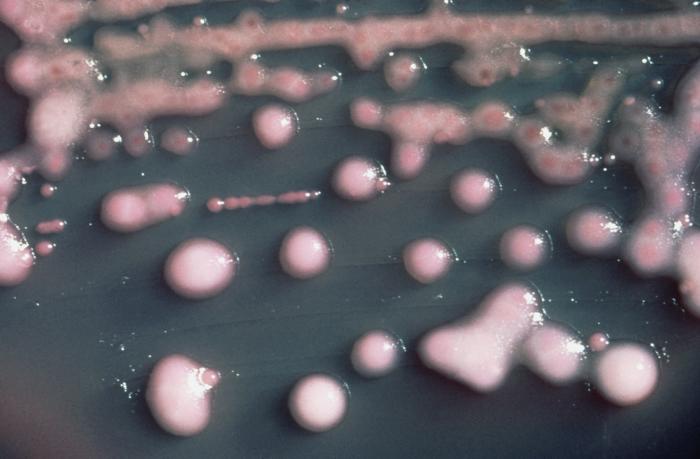
- Lactose fermenter (forms pink-colored colonies on MacConkey Agar).
- Presence of polysaccharide capsule (in the culture plate mucoid colonies are seen).
- Non-motile (Klebsiella species are nonmotile and non-flagellated and thus have no H antigens).
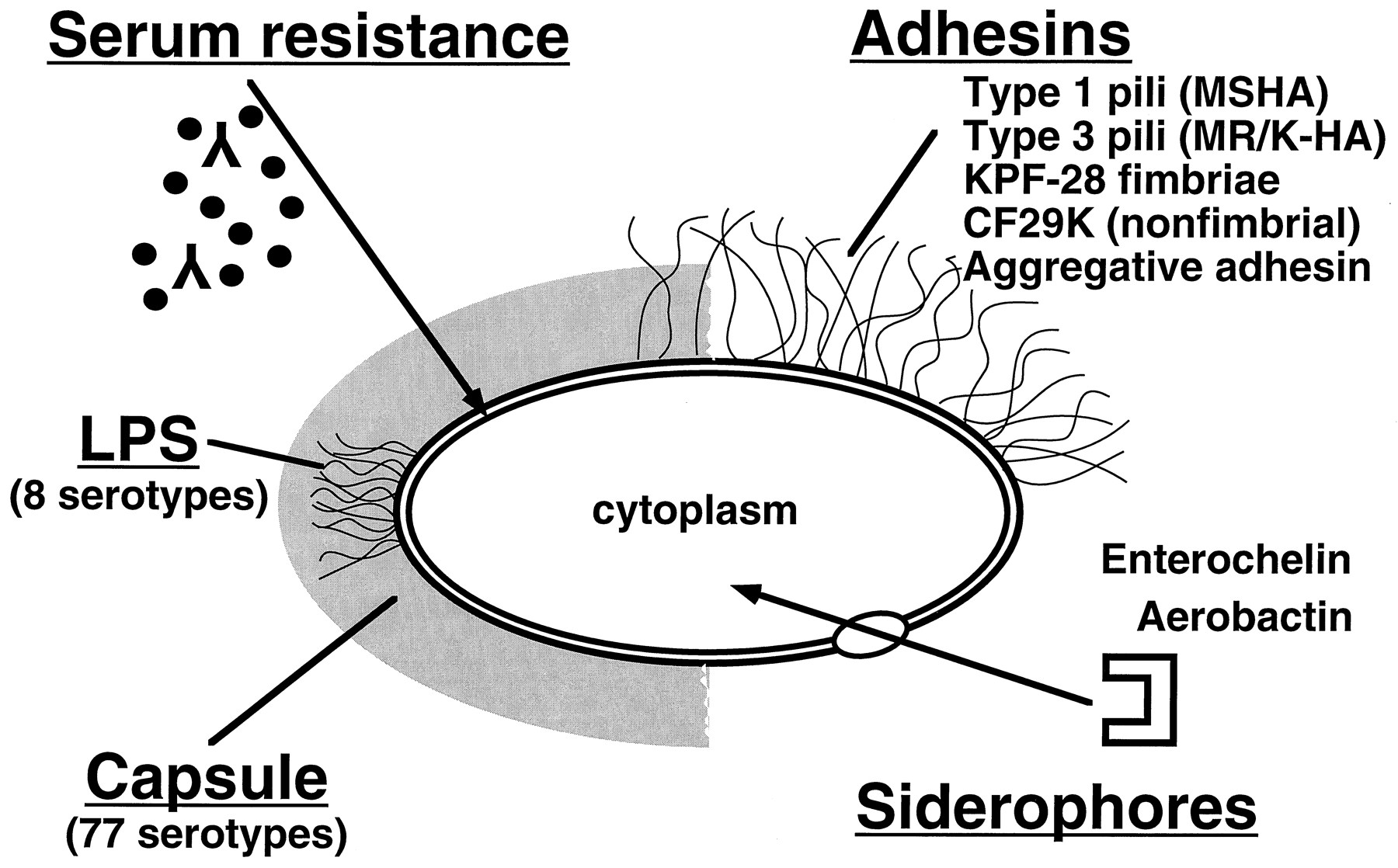
Virulence Factors ofK. pneumoniae
- Capsule
- Cell wall receptors
- Lipopolysaccharide (endotoxin)
- Fimbriae
- Siderophores
Virulence factors ofKlebsiella pneumoniae will be discussed in-depth in another post.
Laboratory diagnosis ofK. pneumoniaeinfection
**Sample:**Sputum (Red currant-jelly sputum may be seen in a patient infected with K.pneumoniae), mid-stream urine, or blood (depending on the suspected illness/clinical presentation).
Colony characteristics ofKlebsiella pneumoniae
- Blood Agar: Mucoid, non-hemolytic colonies
- MacConkey Agar: Mucoid, lactose-fermenting (pink colored) colonies
| Test Name | Results |
|---|---|
| Catalase test | Positive |
| Oxidase test | Negative |
| Indole Production Test | Negative ( K.oxytoca is indole positive) |
| Methyl-Red Test | Negative |
| Voges-Proskauer Test | Positive |
| Citrate Utilization Test | Positive |
| Hydrogen Sulfide (H2S) Production | Negative |
| TSI test | Acid/Acid, Gas (++), No H2S |
| Urea Hydrolysis Test | Positive |
| Lysine Decarboxylase Test | Positive |
| Arginine Dihydrolase Test | Negative |
| Ornithine decarboxylase test | Negative |
| Motility at 36 °C | Non-motile |
| D-Glucose (acid/gas) | Positive/Positive |
| D-mannitol fermentation | Positive |
| Sucrose fermentation | Positive |
| Lactose fermentation | Positive |
| D-sorbitol fermentation | Positive |
| Cellobiose | Positive |
| Esculin hydrolysis | Positive |
| Acetate Utilization Test | Positive |
| ONPG Test | Positive |
Various biochemical tests using conventional methods or miniature commercial system (API-20E or Enterotube test) is done to identify the suspected colony as Klebsiellapneumoniae. Some of the commonly used tests****for the identification of Klebsiellapneumoniaeare given below. ****
Note: To minimize the cost and effort, some diagnostic/hospital laboratories perform only certain tests such asTriple Sugar Iron Agar (TSI), sulfite indole motility (SIM) / urease indole motility (UIM), and citrate utilization test to identify isolates of Enterobacteriaceae family, full panel/commercially available miniature test system (API-20E and Enterotube test) is used only when the test results are inconclusive.
References
- Bailey & Scott’s Diagnostic Microbiology, Forbes, 11th edition
- Ashurst JV, Dawson A. Klebsiella Pneumonia. [Updated 2023 Jul 20]. In: StatPearls [Internet]. Treasure Island (FL): StatPearls Publishing; 2023 Jan-. Available from: https://www.ncbi.nlm.nih.gov/books/NBK519004/
- Qu, T. T., Zhou, J. C., Jiang, Y., Shi, K. R., Li, B., Shen, P., Wei, Z. Q., & Yu, Y. S. (2015). Clinical and microbiological characteristics of Klebsiella pneumoniae liver abscess in East China. BMC infectious diseases, 15, 161. https://doi.org/10.1186/s12879-015-0899-7
- Madigan Michael T, Bender, Kelly S, Buckley, Daniel H, Sattley, W. Matthew, & Stahl, David A. (2018). Brock Biology of Microorganisms (15th Edition). Pearson.