
GasPak Anaerobic System: Principle, How to Read the Indicator, and Troubleshooting
How the GasPak system creates anaerobiosis, how to read the methylene blue indicator correctly, and how to troubleshoot a jar that failed to go anaerobic. Bench-tested interpretation, not just the reaction.
You set up an anaerobic jar on Friday for a suspected Clostridium wound isolate. Monday morning, the plate is bare and the methylene blue strip is still blue. Did the anaerobe fail to grow, or did the jar never go anaerobic? These are two completely different problems with two completely different fixes, and the indicator strip is telling you which one you have. Reading it correctly is the difference between reporting a false negative and repeating the run.
GasPak anaerobic system is used to create an oxygen-free environment for the growth of anaerobic microorganisms. At present, it is the most commonly used method for anaerobiosis. It is very simple to perform and is perfect for a laboratory having less sample load.
Components of GasPak Anaerobic System
- polycarbonate jar (or anaerobic container)
- a lid with a gasket to prevent airflow (for jar system)
- Indicator strip (a strip impregnated with an oxidation-reduction indicator such as methylene blue or resazurin)
- disposable gas generating pouch (a pouch containing sodium borohydride, sodium bicarbonate, and citric acid (classic water-activated systems))
- a palladium catalyst
Principle
Inoculated plates or tubes are placed inside the polycarbonate jar or anaerobic container along with gas generator sachet and indicator strip and is sealed completely. In the presence of water, chemicals present inside the sachet (sodium borohydride, sodium bicarbonate, and citric acid) react chemically, producing hydrogen and carbon dioxide gas.
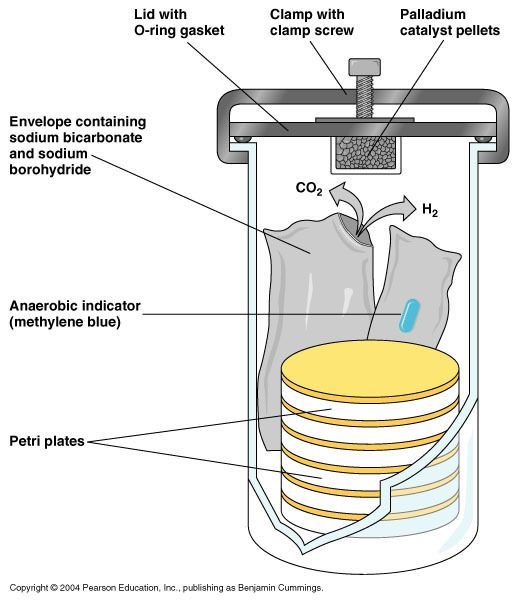 Figure: Anaerobic Jar: GasPak system
The hydrogen thus produced reacts with oxygen present inside the jar producing water (which forms as condensation on the inside of the jar).
2H2 + O₂ + catalyst = 2H2O
This reaction is catalyzed by the element palladium, which is attached to the underside of the lid of the jar. The oxygen inside the jar is consumed as it combines with hydrogen to form water; this consumption creates the anaerobic environment. The carbon dioxide generated by the sachet enriches the atmosphere and supports the growth of capnophilic and many anaerobic organisms.
Note: Current anaerobic gas-generating systems do not require a catalyst and/or the addition of water to activate these systems. Please refer to the user manual provided by the supplier before commencing your works.
Steps
- Inoculate agar plate with test strain.
- Place inoculated agar plates in an anaerobic jar, container, or pouch.
- Add anaerobic indicator strip.
- Add the required number of gas generator sachet after opening the sealed GasPak container and place the lid in place or seal the pouch/container.
- Incubate at the desired temperature.
- Check anaerobic indicator strip for color change.
Note: These steps may slightly vary based on commercial suppliers. Please refer to the user manual provided by the supplier.
Indicator of anaerobiosis
The effectiveness of GasPak anaerobic system can be checked by the following methods:
Anaerobic indicator strips:
Impregnated with methylene blue: blue in the presence of oxygen, colorless in anaerobic conditions.Impregnated with resazurin, a redox indicator: pink in the presence of oxygen, colorless (white) in anaerobic conditions.
Biological indicator: a plate inoculated with an obligate aerobe (classically Pseudomonas aeruginosa) run in the same jar. Covered in full under "Why the Biological Control Beats the Strip" below.
Commercial products
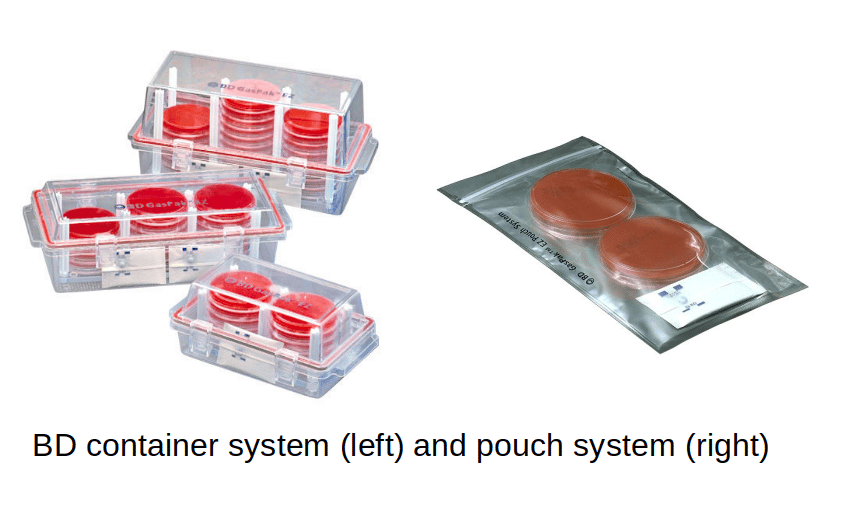 Figure: BD GasPak System
The BD GasPak EZ gas-generating system is a waterless, catalyst-free system that produces an anaerobic, microaerophilic, or carbon dioxide-enriched environment. Because it needs neither added water nor a separate palladium catalyst, it removes the two most common activation and catalyst-poisoning failure points of classic systems.
This fully integrated system is easy to use and is available on two systems; container system & pouch system. BD container system is available in 10, 15, and 30 Petri dish capacity. Pouch system is available in 1-4 petri dish capacity with all needed materials (pouches, sachets, and indicators).
How to Read the Indicator (and the Trap)
The indicator strip tells you whether anaerobiosis was achieved. It does not tell you whether your organism grew. Keep those two questions separate.
Methylene blue strip: blue when oxygen is present, colorless (white) when anaerobic. Resazurin strip: pink with oxygen, colorless when anaerobic.
The interpretation trap is that colorless is the target state, but a strip that was never properly exposed can also read pale. Always confirm the strip turned its oxidized color (blue/pink) at setup, then went colorless by the time you open the jar. A strip that is colorless at both setup and readout tells you nothing.
Read the strip the moment you open the jar. Both indicators re-oxidize on exposure to air within minutes, so a strip that has gone blue again on your bench does not mean the jar failed. It means you were slow.
The four things the strip can tell you:
| Strip at setup | Strip at readout | Interpretation |
|---|---|---|
| Blue/pink (oxidized) | Colorless | Anaerobiosis achieved. Trust your plate result. |
| Blue/pink (oxidized) | Still blue/pink | Jar failed to go anaerobic. Run is invalid, repeat. |
| Colorless | Colorless | Uninformative. Strip may be exhausted or was never exposed. |
| Any | Colorless, but Pseudomonas control grew | Anaerobiosis incomplete despite strip. Trust the biological control. |
Why the Biological Control Beats the Strip
The chemical strip confirms the redox potential dropped. It does not guarantee the atmosphere was anaerobic enough to suppress an obligate aerobe, and it can lag or read falsely. A plate streaked with an obligate aerobe (classically Pseudomonas aeruginosa) run inside the same jar is the definitive control: if it fails to grow, anaerobiosis was genuinely achieved. If it grows, oxygen got in, regardless of what the strip said. When the strip and the biological control disagree, believe the control.
Troubleshooting a Jar That Failed to Go Anaerobic
When the strip stays blue or the Pseudomonas control grows, work through these in order:
- Gasket and seal. A perished, dirty, or misseated gasket is the most common cause. Inspect and clean the sealing surface; replace a cracked gasket.
- Catalyst poisoning (classic catalyst systems only). Palladium catalyst is progressively poisoned by H₂S and other metabolic gases from anaerobic cultures. A poisoned catalyst cannot convert H₂ + O₂ to water, so residual oxygen persists. Regenerate the catalyst by heating the pellets in a hot air oven at 160°C for about two hours, then cool in a desiccator. Many labs regenerate after every run as routine.
- Sachet activation. For water-activated systems, too little water stalls gas generation. For BD GasPak EZ (waterless, catalyst-free), the sachet begins reacting the instant the foil is opened, so seal the jar fast. A sachet left open on the bench before sealing has already spent part of its capacity.
- Overloading. Too many plates for the sachet's rated capacity leaves the jar unable to reach anaerobiosis. Match sachet count to the number of plates per the manufacturer's rating.
- Delayed sealing. Every minute the open jar sits on the bench is more oxygen to scavenge. Set up quickly and seal.
How to Remember
The indicator lies in one direction only. Colorless can mean "anaerobic" or "never worked." Blue can only mean "oxygen is here." So a blue strip is always trustworthy bad news; a colorless strip is only trustworthy if you watched it start blue.
"Believe the bug, not the dye." When the Pseudomonas control and the chemical strip disagree, the living obligate aerobe is the honest witness.
Key exam facts in one table
| Fact | Detail |
|---|---|
| Purpose | Creates an anaerobic (also microaerophilic or CO₂-enriched) atmosphere in a sealed jar/pouch |
| Classic gas generation | Sodium borohydride + sodium bicarbonate + citric acid + water → H₂ + CO₂ |
| How O₂ is removed | H₂ + O₂ → H₂O over a palladium catalyst (O₂ is consumed, not displaced) |
| Modern BD GasPak EZ | Waterless, catalyst-free; ascorbic acid / activated carbon chemistry |
| Chemical indicators | Methylene blue: blue (O₂) → colorless (anaerobic). Resazurin: pink (O₂) → colorless (anaerobic) |
| Biological control | Obligate aerobe (Pseudomonas aeruginosa); no growth confirms anaerobiosis |
| Catalyst poisoning | Palladium poisoned by H₂S; regenerate at 160°C for ~2 h, cool in desiccator |
| Most common failure | Faulty/misseated gasket seal |
| When to read strip | Immediately on opening; both indicators re-oxidize in air within minutes |
Where Students Get Confused
"Colorless strip means it worked." Only if it started colored. A strip colorless at both setup and readout is uninformative, not a pass.
"The strip proves my anaerobe grew." No. The strip only proves the atmosphere went anaerobic. Whether your organism grew is a separate reading on the plate itself.
"CO₂ pushes the oxygen out." Anaerobiosis comes from H₂ consuming O₂ over palladium, forming water. The CO₂ enriches the atmosphere but does not remove the oxygen by displacement.
"Modern kits still need a catalyst and water." Classic systems do. BD GasPak EZ is deliberately waterless and catalyst-free. Confusing the two leads students to look for a catalyst that isn't there or add water that isn't needed. Always check the specific product's manual.
"A blue strip when I open the jar means the run failed." Not necessarily. If it was colorless in the jar and re-blued on your bench, that's air re-oxidizing it. Read it the instant you open.
References and further reading
- Procop GW, Church DL, Hall GS, Janda WM, Koneman EW, Schreckenberger PC, Woods GL. Koneman's Color Atlas and Textbook of Diagnostic Microbiology. 7th ed. Philadelphia: Wolters Kluwer; 2017.
- Tille PM. Bailey & Scott's Diagnostic Microbiology. 15th ed. St. Louis: Elsevier; 2022. (Chapter on anaerobic bacteriology and cultivation systems.)
- Jorgensen JH, Pfaller MA, editors. Manual of Clinical Microbiology. 12th ed. Washington, DC: ASM Press; 2019.
- BD GasPak systems. Becton, Dickinson and Company. https://www.bd.com/en-us/offerings/capabilities/microbiology-solutions/environmental-systems/bd-gaspak-systems-and-accessories
Frequently Asked Questions
Why is my methylene blue strip still blue after incubation?
Does a colorless indicator strip mean my anaerobe grew?
Do modern GasPak systems still need water and a catalyst?
Why use a Pseudomonas plate with anaerobic cultures?
How do I regenerate a poisoned palladium catalyst?
GasPak or McIntosh-Fildes, which should I use?

Tankeshwar Acharya, MSc (Medical Microbiology)
Tankeshwar Acharya is an Assistant Professor in the Department of Microbiology at Patan Academy of Health Sciences (PAHS), Nepal, where he has been teaching and practicing clinical microbiology for over 14 years. He is the founder of Microbe Online, one of the leading free microbiology education resources on the web, covering bacteriology, mycology, parasitology, immunology, and clinical laboratory diagnostics written from direct experience in both the classroom and the diagnostic laboratory.