
Extracellular and Intracellular Bacteria
Extracellular and Intracellular Bacteria
Pathogenic bacteria can be grouped into two major categories on the basis of their invasive properties for eukaryotic cells.
- Extracellular bacteria
- Intracellular bacteria
Facultative intracellular Obligate intracellular
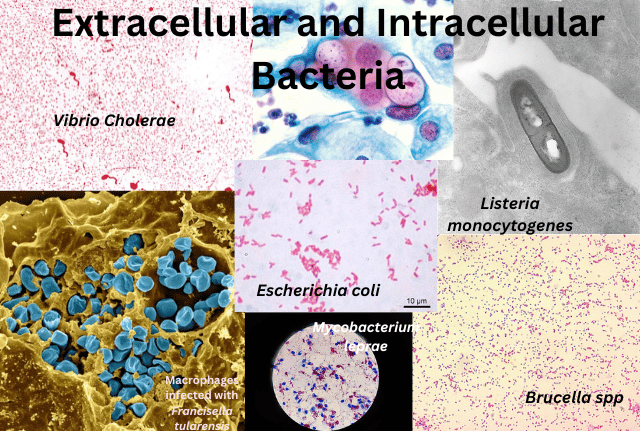 Figure: Extracellular and Intracellular Bacteria
Extracellular bacteria
Extracellular bacterial pathogens do not invade cells instead, they proliferate in the extracellular environment which is enriched with body fluids. Some extracellular bacteria even don’t penetrate body tissues (e.g. Vibrio cholerae) but adhere to epithelial surfaces and cause disease by secreting potent toxins.
Although bacteria such as E. coli and P. aeruginosa are termed noninvasive, they frequently spread rapidly to various tissues once they gain access to the body. Extracellular bacteria do not have the capacity to survive the intracellular environment or to induce their own uptake by most host cells.
Predominantly extracellular bacteria are
- Bacillus anthracis
- EnterotoxigenicEscherichia coli
- Haemophilus influenzae
- Mycoplasma spp
- Pseudomonas aeruginosa
- Staphylococcus aureus
- Streptococcus pyogenes
- Vibrio cholerae
Intracellular Bacteria
Intracellular pathogens commonly cause “granulomatous lesions”. They are divided into two groups-
- Those that can be cultured in microbiologic media in the laboratory (facultative) or
- Those that required living cells/animals (obligate).
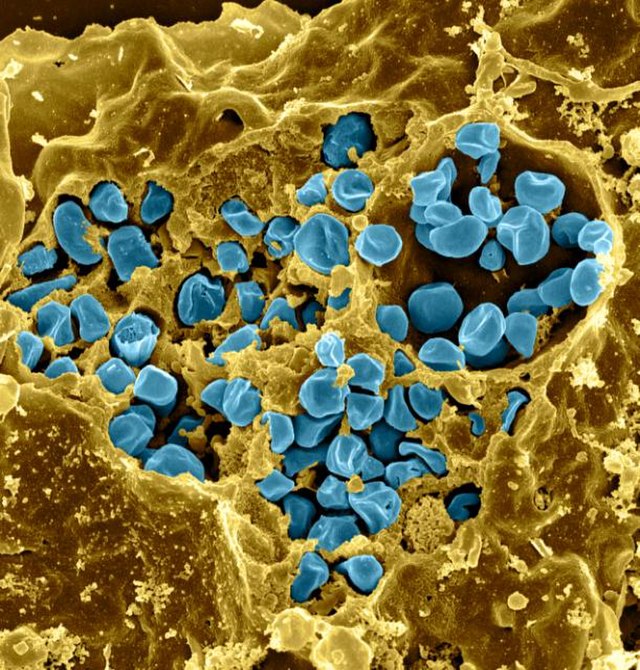 Figure: Macrophage infected withFrancisella tularensis
Facultative Intracellular Bacteria
Facultative intracellular bacteria invade host cells when it gives them a selective advantage. Bacteria that can enter and survive within eukaryotic cells are shielded from humoral antibodies and can be eliminated only by a cellular immune response. However, these bacteria must possess specialized mechanisms to protect them from the harsh environment of the lysosomal enzymes encountered within the cells.
- Legionella pneumophila: It prefers the intracellular environment of macrophages for growth. Legionella induces its own uptake and blocks lysosomal fusion by an undefined mechanism.
- R. rickettsii destroys the phagosomal membrane with which the lysosomes fuse.
- Mycobacterium tuberculosis: M.tuberculosis survives intracellularly by inhibiting phagosome-lysosome fusion.
- Listeria monocyotogenes: Listeria quickly escapes the phagosome into the cytoplasm before phagosome-lysosome fusion.
- Salmonellas pp: Very resistant to intracellular killing by phagocytic cells.
Other facultative intracellular bacteria are:
- **Invasive Escherichia coli
- Neisseria spp
- Brucella spp
- Shigella spp
- Francisella tularensis
Histoplasma capsulatum and Cryptococcus neoformans are facultative intracellular fungi.
Obligate intracellular bacteria
This group of bacteria can’t live outside the host cells. For e.g. Chlamydial cells are unable to carry out energy metabolism and lack many biosynthetic pathways, therefore they are entirely dependent on the host cell to supply them with ATP and other intermediates. Because of this dependency, chlamydiae were earlier thought to be a virus.
All viruses are obligate intracellular parasites.
Obligate intracellular bacteria cannot be grown in artificial media (agar plates/broths) in laboratories but requires viable eukaryotic host cells (eg. cell culture, embryonated eggs, susceptible animals).
Pneumocystis jiroveciis an obligate intracellular fungi.
Other obligate intracellular bacteria are:
- Mycobacterium leprae cannot be cultured in vitro; it is an obligate intracellular parasite.
- Coxiella burnetti: The metabolic activity of Coxiella burnettii is greatly increased in the acidic environment of the phagolysosome.
- Rickettsia spp
Toxoplasma, Cryptosporidium, Plasmodium, Leishmania, Babesia,and Trypanosomaare obligate intracellular parasites.
References
- Madigan Michael T, Bender, Kelly S, Buckley, Daniel H, Sattley, W. Matthew, & Stahl, David A. (2018). Brock Biology of Microorganisms (15th Edition). Pearson.
- Color Atlas and Textbook of Diagnostic Microbiology, Koneman, 5th edition

Tankeshwar Acharya, MSc (Medical Microbiology)
Tankeshwar Acharya is an Assistant Professor in the Department of Microbiology at Patan Academy of Health Sciences (PAHS), Nepal, where he has been teaching and practicing clinical microbiology for over 14 years. He is the founder of Microbe Online, one of the leading free microbiology education resources on the web, covering bacteriology, mycology, parasitology, immunology, and clinical laboratory diagnostics written from direct experience in both the classroom and the diagnostic laboratory.