DNA (deoxyribonucleic acid) sequencing is the process of identifying the exact sequence of nucleotides: Adenine (A), Guanine (G), Cytosine (C), and Thymine (T) in the genome or DNA molecule. In order to determine the sequence, the first DNA sequencing method, the “chain termination method,” or Sanger sequencingwas developed in 1997 by Frederick Sanger, using radiolabeled partially digested fragments. It enabled Frederick Sanger and his team to sequence the phiX174 virus’s first complete genome.
Sanger sequencing is the method of sequencing where incorporation of chain terminating oligonucleotides occurs as primers during in vitroDNA replication. [2]
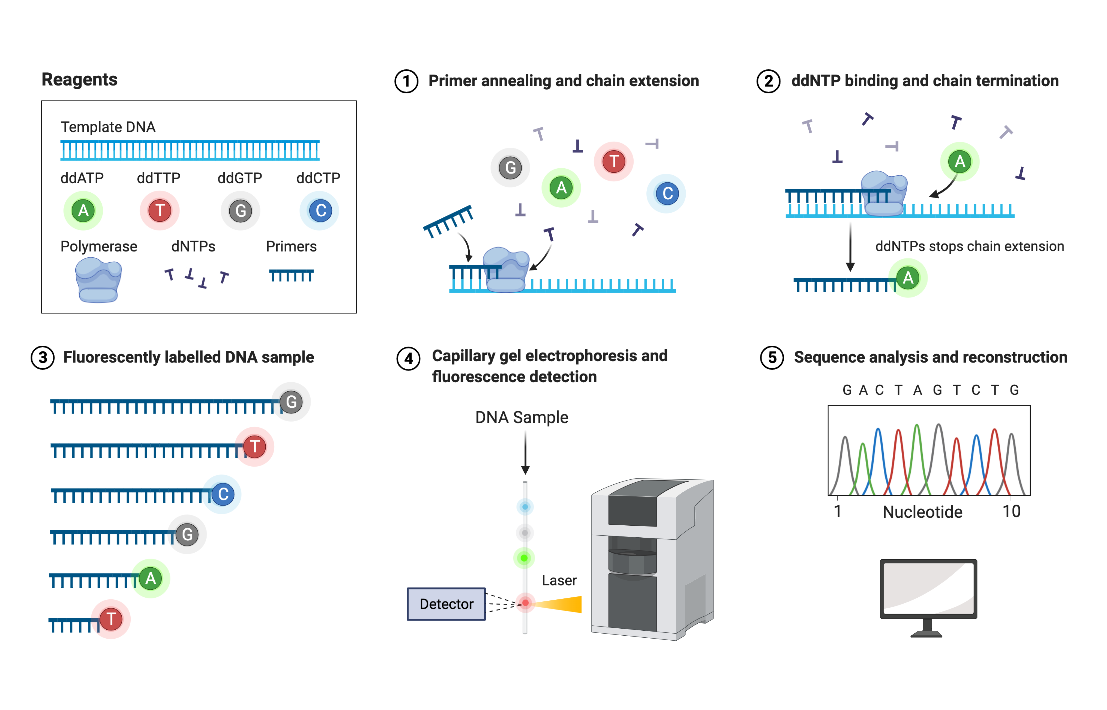
Single-stranded DNA molecules, DNA polymerase, four deoxyribonucleotide triphosphates (dNTPs; dATP, dCTP, dGTP, and dTTP), and dideoxyribonucleotides triphosphates (ddNTPs; ddATP, ddCTP, ddGTP, and ddTTP) labeled with various fluorescent markers are the essential components for sequencing.
Principle of Sanger Sequencing
The Sanger Sequencing method synthesizes the DNA complementary to a single-stranded DNA template by adding deoxynucleotide triphosphate and dideoxynucleotide triphosphates labeled with a different fluorescent marker that terminates the elongation. Based on these labels, the sequence is identified.
Components of Sequencing
DNA template
The starting material for sequencing is a single-stranded DNA template to be sequenced. In the traditional method, single-stranded DNA was obtained using a vector or by denaturing double-stranded DNA with an alkali or boiling method. However, nowadays, polymerase chain reaction (PCR) method helps in obtaining single-stranded DNA.
Primer
Primer is a short oligonucleotide complementary to a short sequence of DNA templates and anneals with it. The region of the template molecule that will be sequenced is the crucial role that the primer plays.
DNA polymerase enzyme
It extends the primer and adds nucleotide complementary to the template. This polymerase lacks exonuclease activity as it may degrade the nucleotide from either 5ʹ- 3ʹ or 3ʹ- 5ʹ and affects the accuracy of determining the sequence.
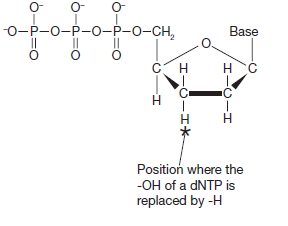
Nucleotide triphosphate: Two different types of nucleotides are used in this method: deoxyribonucleotide triphosphates and dideoxyribonucleotide triphosphates.
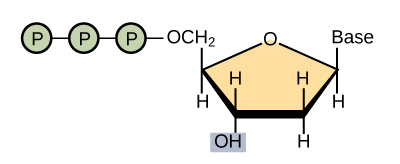
- Deoxyribonucleotide triphosphates: These are typical nucleotide triphosphates, which comprise nitrogenous bases (A, T, G, C), ribose sugar with a hydroxyl group at 3ʹ carbon and phosphate group at the 5ʹ carbon respectively, which aids in the formation of a phosphodiester bond between each deoxyribonucleotide triphosphates.
- Dideoxyribonucleotide triphosphates: These are modified nucleotide triphosphates so that the 3ʹ carbon of the ribose sugar does not have a hydroxyl group. So, these are used as 3ʹ-end chain terminators as the phosphodiester bond does not form with the next incoming nucleotide.
Steps Involved in Sanger Sequencing
Elongation and chain termination
The DNA template to be sequenced is subjected to Polymerase Chain Reaction (PCR), except that dideoxynucleotide triphosphate is also included. dNTPs, DNA polymerase, primer, and template are all in the typical PCR reaction.
The primer anneals to the template DNA, and DNA polymerase extends the primer by randomly adding dNTPs or ddNTPs, but once the ddNTP is incorporated, the reaction gets terminated. These deoxynucleotides are larger than dideoxynucleotides, so the termination does not occur near the primer region. For example, if dATP binds during the elongation, it ceases the elongation, and the sequence is read as A (shown below). Similarly, if ddGTP, ddTTP, or ddCTP is added, the sequence is read as G, T, or C, respectively.
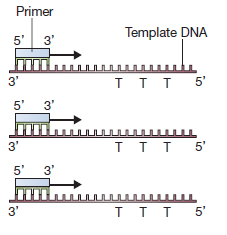
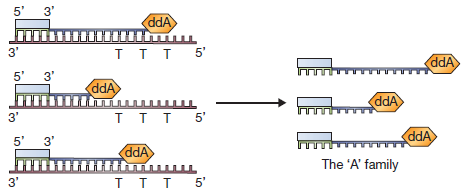
The traditional method performs these reactions in four tubes containing typical PCR mixtures. Still, each tube includes either dideoxynucleotide triphosphate (ddATP, ddCTP, ddTTP, or ddGTP) that is radioactively labeled.
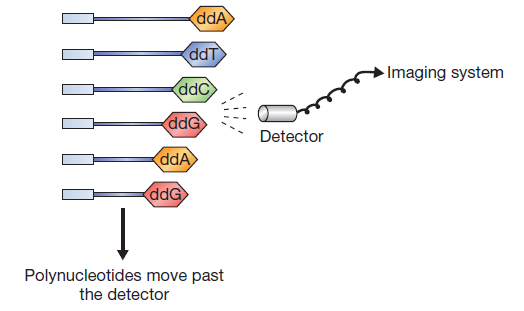
On the other hand, nowadays, all these reactions are performed in a single tube with ddNTPs, each labeled with a different fluorescent dye.
Electrophoresis and Sequence Identification
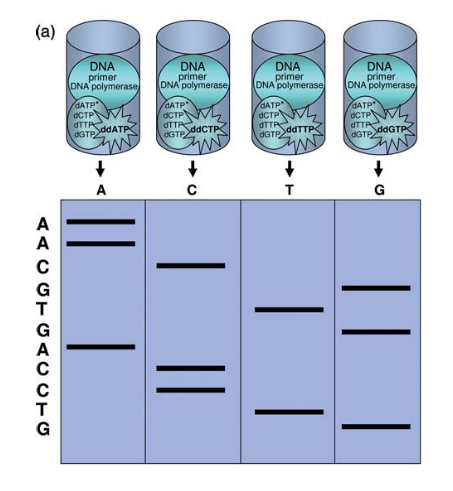
After the amplification,electrophoresis is carried out. The mixture is loaded either in the polyacrylamide gel (in the traditional method) or into a capillary gel system tube. These molecules are separated according to their lengths; each contains dideoxynucleotide at their end.
In the traditional method, the products are separated through polyacrylamide gel gel electrophoresis in four separate lanes and are scored according to their molecular masses, as shown below. Based on their masses, and the radiolabelled ddNTPs, the bases are identified. Their sequences are shown on the left side of the figure below. The identification is done with the help of the spectrophotometer.
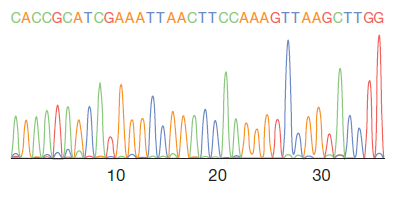
In the new technique, the products are separated in a single glass capillary filled with a polymer and are passed through a fluorescent detector that determines if each molecule ends in A, T, G, or C based on the label attached to the dideoxynucleotides.
Advantages of Sanger Sequencing
Compared to other methods of sequencing, Sanger sequencing have many advantages which are as follows:
- It is more specific for testing the variants of the same families.
- Extensive validation is not required as the method is verified on one or a small number of sequences of interest.
- Less reliant on computational tools.
- Cost-effective for a single sample.
Limitations of Sanger Sequencing
Although the Sanger sequencing is the preferable method of DNA sequencing it has some limitations, which are as follows:
- It only sequences short fragments of DNA of about 300-1kb bases.
- Cannot detect different genes simultaneously.
- It requires a more significant amount of DNA as an input.
- As primer binds to the first 15 – 40 bases, the quality of sequences in this region is often poor.
- It is a time-consuming method.
- If the traditional method is used, the cloning vector sequences may be present in the final sequences.
REFERENCES
- Brown, T. (2010). Gene Cloning And DNA Analysis An Introduction. A John Wiley & Sons, Ltd., Publication.
- Clark, D. P., Pazdernik, N. J., & McGehee, M. R. (2010). In Molecular biology: Academic cell update (Third, pp. 241–242). essay, Academic Press/Elsevier.
- Janitz, M. (2008). Next-Generation Genome Sequencing. WILEY-VCH Verlag GmbH & Co. KGaA.
- https://the-dna-universe.com/2020/11/02/a-journey-through-the-history-of-dna-sequencing/
- Timeline: History of genomics. . @Yourgenome · Science Website. https://www.yourgenome.org/facts/timeline-history-of-genomics/
- https://www.news-medical.net/life-sciences/Challenges-with-Sanger-Sequencing.aspx
- https://www.mlo-online.com/home/article/13009097/back-to-basics-sanger-sequencing-and its-applications