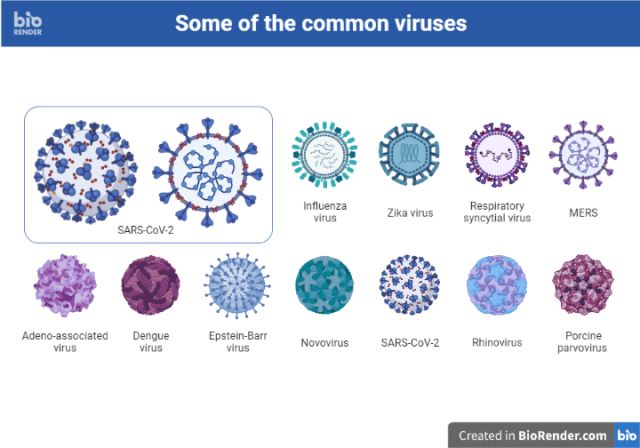
Viruses are submicroscopic particles made by complicated assemblies of proteins, nucleic acids, lipids, and carbohydrates. These smallest infectious agents can infect a human, animal, plant, or bacterial cells. Viruses are strict obligate intracellular parasites incapable of replication without living hosts. Due to the lack of independent replication capability, viruses are considered non-living.
Bacteria are unicellular prokaryotes. They are ubiquitous and play both beneficial and harmful roles. Bacteria are used as micro-factories in the industries for synthesizing various important compounds, as a starter culture for making yogurt and cheese, and as probiotics to prevent infections. Pathogenic bacteria can cause diseases from small boils to deadly diseases like meningitis or plague.
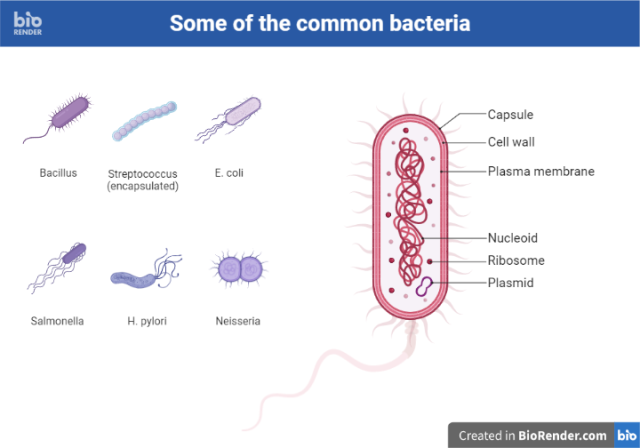
There are many clear-cut structural differences between bacteria and viruses such as size, cellular components, nature, and size of nucleic acid. Other differences lie in the method of replication, host cell requirements, and weapons used to kill them. The main question which always intrigued many is, are viruses alive?
Some of the major differences between bacteria and viruses are summarized in the table below;
- 1 Mb = 1,000,000 bases
You can visit this blog if you are interested in knowing the difference between bacterial and viral infections.
References and further readings
- Brown N & Bhella D (2016). Are Viruses Alive, Issue: What is Life? Microbiology Society.
- What’s the difference between bacteria and viruses? The University of Queensland Australia. Retrieved on 5th July, 2022 from https://imb.uq.edu.au/article/2020/04/difference-between-bacteria-and-viruses
- Claverie JM, Grzela R, Lartigue A, Bernadac A, Nitsche S, Vacelet J, Ogata H, Abergel C. Mimivirus and Mimiviridae: giant viruses with an increasing number of potential hosts, including corals and sponges. J Invertebr Pathol. 2009 Jul;101(3):172-80. doi: 10.1016/j.jip.2009.03.011. Epub 2009 May 18. PMID: 19457438.
- Volland JM, Gonzalez-Rizzo S, Gros O, Tyml T, Ivanova N, Schulz F, Goudeau D, Elisabeth NH, Nath N, Udwary D, Malmstrom RR, Guidi-Rontani C, Bolte-Kluge S, Davies KM, Jean MR, Mansot JL, Mouncey NJ, Angert ER, Woyke T, Date SV. A centimeter-long bacterium with DNA contained in metabolically active, membrane-bound organelles. Science. 2022 Jun 24;376(6600):1453-1458. doi: 10.1126/science.abb3634. Epub 2022 Jun 23. PMID: 35737788.