

A patient arrives with fever, aches, and fatigue. Bacterial or viral? The honest answer at the bedside is often "not yet clear," because the two share so much: similar symptoms, similar routes of spread, and the same broad stages of illness. Yet the distinction decides everything that follows, above all whether an antibiotic will help or do nothing at all. This article covers what bacterial and viral infections have in common, how they differ, and, most usefully for a student at the bench, how the laboratory actually tells them apart.
Whatever the causative agent, an infection typically moves through four stages: the incubation period, when the patient is infected but asymptomatic; the prodromal period, with vague, non-specific symptoms; the specific-illness period, when the characteristic signs and symptoms appear; and the recovery (convalescent) period, when the illness wanes and the patient regains health.
What bacterial and viral infections have in common
As causes of illness, bacterial and viral infections overlap in ways that make them hard to tell apart at the bedside.
- Both spread by overlapping routes: respiratory droplets, the fecal-oral route, contaminated food and water, sexual contact, blood, and vectors.
- Both can be symptomatic or asymptomatic, and both can be carried and transmitted by people with no symptoms.
- Both provoke fever and inflammation as the immune system responds. And both progress through the same four stages of infection described above.
These shared clinical features are why the distinction usually rests on laboratory findings rather than symptoms, as set out below. This article focuses on the infections. For how bacteria and viruses differ as organisms, in size, structure, genome, and replication, and whether a virus is even alive, see the related article on the differences and similarities between bacteria and viruses.
Features of Viral Infections
Most viral infections are asymptomatic. Of those that cause symptoms, most are mild and self-limiting. Viral infections are either localized to the portal of entry (the common cold involves only the upper respiratory tract; influenza involves the upper and lower respiratory tracts) or spread systemically through the body, as in poliomyelitis and measles. Systemic infections are generally the most serious.
The severity and outcome of a viral infection depend on host variables such as age, immune status, and nutrition. Infections tend to be more severe in neonates and the elderly than in older children and young adults. Malnutrition worsens outcomes, as seen with measles in low-resource settings. Immunosuppression, including from corticosteroid therapy, predisposes to more severe or disseminated infection, for example varicella-zoster and disseminated herpes.
Although viruses are obligate intracellular parasites, both humoral and cell-mediated immunity control them: cytotoxic T cells kill virally infected cells, and antibodies neutralize free virus in blood and CSF. Viral infections are usually diagnosed by PCR for viral nucleic acid, or by serology for specific antibodies or antigens.
Features of Bacterial Infections
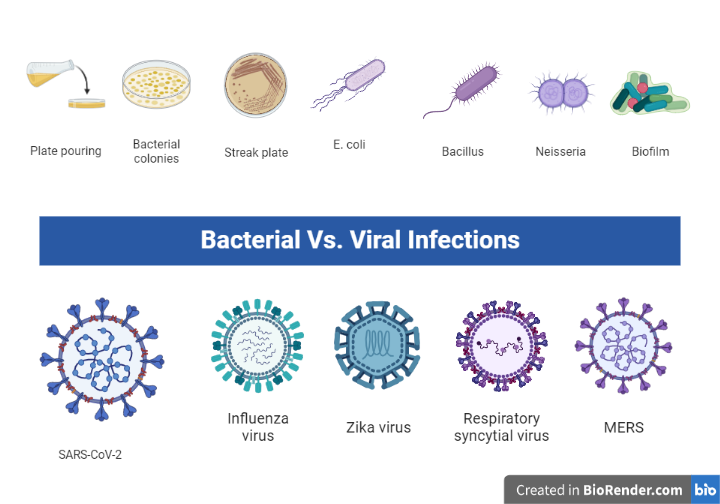 Figure: Bacterial vs Viral Infections
- The initial step in the process of many bacterial infections is the adherence of the organism to mucous membranes. Many bacterial components such as pili (fimbriae), glycocalyx, capsule, lipoteichoic acid, etc. mediate the attachment process.
- Most bacterial infections are acquired from external sources. However, some bacterial infections are caused by members of the normal flora when there are breaches in the anatomical barriers (e.g. trauma) or when the host immune status is weakened.
- Most bacterial infections are communicable but some are not, for example, botulism and Legionella pneumophila.
- Bacteria cause disease by two major mechanisms: toxin production (exotoxins and endotoxins) and invasion and inflammation.
- Polymorphonuclear leukocytes (PMNs) are the predominant cellular defense in bacterial infection.
- Host defenses against bacterial infections include both innate and adaptive immunity. Innate defenses are nonspecific and may include physical barriers, cells, and proteins. Adaptive (acquired) defenses are highly specific for the organism and include antibodies and cells such as CD4-positive helpers;
- Microbiologic diagnosis of bacterial infections frequently is made using Gram stain and culture. Gram stain evaluation of direct smears is routinely used to diagnose bacterial infections.
- Serologic tests and PCR assays have limited but specific roles in bacterial diagnosis. Serologic tests are used for systemic bacterial infections where culture is impractical (e.g., typhoid fever, brucellosis, syphilis). PCR is reserved for non-cultivable or hard-to-culture pathogens (e.g., Mycoplasma pneumoniae, Tropheryma whipplei, Rickettsia spp.).
How the laboratory tells them apart
This is the section a bench student actually needs, and it is where clinical judgment lives, because symptoms alone frequently cannot separate the two. The distinction is made on laboratory patterns, not on how the patient feels.
White cell pattern. Bacterial infection typically raises the neutrophil (PMN) count. Viral infection is usually lymphocyte-predominant. An important exception proves the rule: some bacterial infections, notably typhoid fever, cause leukopenia rather than a raised count, so the pattern guides but does not decide.
CSF findings in meningitis. This is one of the highest-yield discriminations in all of clinical microbiology. Bacterial meningitis lowers CSF glucose (organisms and neutrophils consume it) and raises CSF protein with a neutrophil pleocytosis. Viral (aseptic) meningitis leaves CSF glucose normal, with a lymphocyte predominance. Low CSF glucose is a strong pointer to a bacterial cause.
Direct microscopy. A Gram stain of the specimen is a routine first step for bacterial infection and can give a same-day presumptive answer. Viruses are far too small to see on a Gram stain; instead, virology looks for the cytopathic effect (CPE), the visible changes a virus produces in cultured cells. Not all viruses produce CPE, so its absence does not exclude a virus.
Definitive tests. Bacteria are usually confirmed by culture with antimicrobial susceptibility testing, which also guides treatment. Viruses are usually confirmed by PCR or by antigen or antibody detection, because most are difficult or impossible to grow routinely.
Differences between Bacterial and Viral Infections
| Bacterial Infections | Viral Infections |
|---|---|
| Treated with antibiotics; antimicrobial susceptibility testing selects the appropriate agent. | Antibiotics are ineffective. Antiviral agents are used where available. |
| Can be symptomatic or asymptomatic; asymptomatic carriers can still transmit (for example cholera, typhoid, tuberculosis). | Most infections are asymptomatic, and symptomatic cases are usually mild. |
| Symptomatic infection generally requires effective antimicrobial therapy. | Most resolve spontaneously (for example adenovirus infection, the common cold). |
| Neutrophil (PMN) count usually rises; some infections such as typhoid fever instead cause leukopenia. | Lymphocyte-predominant. Reticuloendothelial and alveolar macrophages are important in limiting infection. |
| Bacterial meningitis is associated with low CSF glucose. | Viral CNS infections have normal CSF glucose. |
| A few bacteria are linked to cancer, notably Helicobacter pylori (gastric cancer and MALT lymphoma). | Several viruses cause or predispose to cancer, including HPV, hepatitis B, and hepatitis C. |
| Direct Gram stain of the specimen is a key diagnostic step. | Cytopathic effect (CPE) is a key early step in diagnosing many viral infections, though not all viruses produce CPE. |
| Examples: cholera, enteric fever, gonorrhea, syphilis, tuberculosis, leprosy. | Examples: common cold, chickenpox, influenza, measles, mumps, COVID-19, dengue, Japanese encephalitis, HIV/AIDS. |
Note on cancer burden: infectious agents overall (bacteria, viruses, and parasites) are estimated to cause roughly 12 to 15% of cancers worldwide, and viruses are the single largest contributor within that share. This is a preventable fraction, which is why HPV and hepatitis B vaccination reduce cancer incidence.
How to Remember
Antibiotics have nothing to grab onto in a virus. Bacteria are cells with their own machinery, so antibiotics have a target. Viruses borrow the host cell's machinery, so there is nothing bacterial for the drug to attack. This one idea explains the most important practical difference between the two.
Bacteria bring neutrophils; viruses bring lymphocytes. The white-cell pattern is the fastest bedside clue. Neutrophils rise in bacterial infection; lymphocytes predominate in viral. Typhoid is the classic trap, it lowers the count instead of raising it.
Low sugar in the fluid means bacteria in the meninges*.* In meningitis, low CSF glucose points to a bacterial cause, because the organisms and neutrophils consume it. Viral meningitis leaves the glucose normal. "Bugs eat sugar."
See the bug or see the damage. You can see bacteria directly on a Gram stain. You cannot see viruses; you see the damage they do to cells, the cytopathic effect. One is the organism, the other is its footprint.
Where Students Get Confused
You can tell a bacterial from a viral infection by symptoms alone*.* Usually you cannot. Fever, aches, and fatigue occur in both, and both follow the same four stages. The reliable separation comes from laboratory patterns: the white-cell shift, CSF glucose, Gram stain versus CPE, and the confirmatory test.
Antibiotics will help any serious infection. They do nothing against viruses, because a virus has no independent cellular machinery for the drug to attack. Giving antibiotics for a viral illness does not help the patient and contributes to antimicrobial resistance.
A normal CSF glucose rules out meningitis. It does not. It points away from a bacterial cause and toward a viral (aseptic) one. Viral meningitis is still meningitis; the glucose is characteristically normal.
No cytopathic effect means no virus. Not all viruses produce visible CPE in culture, so its absence does not exclude a viral infection. This is one reason PCR and antigen detection have largely taken over viral diagnosis.
Only viruses cause cancer. Both can. Viruses are the larger contributor (HPV, hepatitis B and C, EBV), but Helicobacter pylori is a leading infectious cause of gastric cancer and MALT lymphoma.
References
- Madigan MT, Bender KS, Buckley DH, Sattley WM, Stahl DA. Brock Biology of Microorganisms. 16th ed. Hoboken: Pearson; 2021.
- Tille PM. Bailey & Scott's Diagnostic Microbiology. 15th ed. St. Louis: Elsevier; 2022.
- Levinson W, Chin-Hong P, Joyce EA, Nussbaum J, Schwartz B. Review of Medical Microbiology and Immunology. 17th ed. New York: McGraw Hill; 2022.

Comments
No comments yet. Be the first to share your thoughts.
Leave a comment
All comments are reviewed before they appear.