
Commonly Used Anaerobic Culture Media in the Diagnostic Bacteriology Laboratory
A complete guide to anaerobic culture media: non-selective, selective, and differential media used in clinical anaerobic bacteriology, including primary plating battery, PRAS media, and key organisms recovered.

On this page
The organism that dies on the way to the lab
The hardest part of growing an anaerobe is not the plate. It is everything that happens before the specimen reaches the plate.
Obligate anaerobes begin to die on contact with atmospheric oxygen, and the routine steps of specimen handling, a swab exposed to air, a syringe of pus left sitting, a transport delay, are often enough to kill the very organisms the culture is meant to recover.
By the time a poorly collected specimen reaches the bench, the anaerobes may already be dead, and the plate, however carefully prepared and incubated, grows nothing. The culture is reported as negative, and a true anaerobic infection is missed, not because the lab failed, but because the specimen did.
This is why anaerobic bacteriology is built around protecting oxygen-sensitive organisms at every step: reducing agents and pre-reduced media that scavenge dissolved oxygen, redox indicators that reveal when anaerobic conditions have been lost, and a battery of media run together because no single plate recovers the full range of anaerobes.
Think, how do you grow an organism that is dying from the moment it meets air? The media are only half the answer; the other half is getting the specimen there alive.
Anaerobic bacteria cause a wide range of serious clinical infections from intra-abdominal sepsis and aspiration pneumonia to brain abscesses, necrotizing fasciitis, and Clostridioides difficile colitis. Recovering these organisms in the laboratory requires specialized culture media, because anaerobes die rapidly on exposure to atmospheric oxygen and will not grow on standard aerobic plating media.
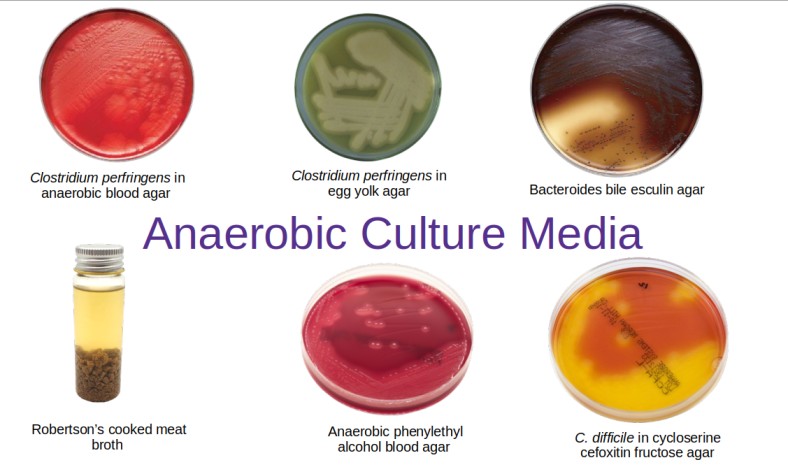 Figure: Various types of anaerobic culture media are used in diagnostic bacteriology laboratory
Unlike aerobic culture, where a single blood agar plate serves most purposes, anaerobic bacteriology requires a combination of media, at minimum one non-selective plate and two or more selective media, to maximize recovery of the diverse range of anaerobic organisms encountered in clinical specimens. This is because no single medium recovers all clinically significant anaerobes equally well.
Why do anaerobes require special media?
Standard culture media prepared and stored under atmospheric conditions accumulate dissolved oxygen and oxidized compounds that are toxic to obligate anaerobes. Anaerobic media address this in two ways:
Reducing agents: substances such as L-cysteine, sodium thioglycollate, sodium sulfite, and dithiothreitol are incorporated into the medium to chemically scavenge dissolved oxygen and maintain a low oxidation-reduction potential (Eh). A reduced Eh of −150 mV or lower is essential for growth of most obligate anaerobes.
Pre-reduced, anaerobically sterilized (PRAS) media: commercial media manufactured under strict anaerobic conditions, flushed with oxygen-free gas, and sealed with butyl rubber stoppers. PRAS media have a shelf life of up to six months and give superior recovery of fastidious anaerobes compared to freshly prepared media.
Laboratory-prepared anaerobic media, by contrast, should be used within two weeks of preparation as oxygen penetration, peroxide accumulation, and dehydration progressively degrade quality.
Redox indicators: resazurin or methylene blue are added to some anaerobic media as oxidation-reduction indicators. These dyes are colorless under sufficiently reduced conditions and turn pink (resazurin) or blue (methylene blue) when the medium becomes oxidized, alerting the laboratory that anaerobic conditions have been compromised.
Primary Plating Battery for Anaerobic Specimens
In clinical practice, anaerobic specimens are inoculated onto a combination of media simultaneously at the time of receipt. A standard primary anaerobic battery typically includes:
| Media | Type | Primary purpose |
|---|---|---|
| Anaerobic blood agar (Brucella or CDC base) | Non-selective | Recovery of all anaerobes |
| Robertson's Cooked Meat (RCM) broth | Non-selective enrichment | Recovery of fastidious/slow-growing anaerobes |
| Thioglycollate broth | Non-selective enrichment | Broad recovery including aerobes and anaerobes |
| Bacteroides bile esculin agar (BBE) | Selective/differential | Bacteroides fragilis group presumptive ID |
| Laked kanamycin-vancomycin blood agar (LKV) | Selective | Prevotella and Bacteroides spp. |
| Phenylethyl alcohol agar (PEA) | Selective | Gram-positive anaerobes; swarming inhibition |
All primary plates are incubated anaerobically at 35–37°C and examined at 48 hours, with a further reading at 72 hours if no growth is seen.
Non-Selective Anaerobic Media
Non-selective media support the growth of most anaerobes and facultative anaerobes without suppressing any particular group. They are used as primary plating media to ensure broad recovery.
1. Anaerobic Blood Agar (Brucella Blood Agar / CDC Anaerobe Blood Agar)
The most widely used non-selective primary plating medium for anaerobic bacteriology. Two base formulations are commonly used:
Brucella blood agar contains Brucella broth base (rich in amino acids and peptones), supplemented with 5% sheep blood, hemin, and vitamin K₁. Hemin and vitamin K₁ are essential growth factors for many clinically important anaerobes, particularly the Bacteroides fragilis group and Prevotella melaninogenica.
CDC anaerobe blood agar uses a similar formulation with additional supplements optimized for fastidious anaerobes.
Both media recover gram-positive and gram-negative anaerobes and allow observation of colony morphology, pigmentation, and hemolysis patterns that give early presumptive identification clues. For example:
- Bacteroides fragilis: grey, non-hemolytic, circular colonies with irregular edges
- Clostridium perfringens: double zone of hemolysis (inner complete, outer partial)
- Prevotella melaninogenica: brown-black pigmented colonies (pigment develops after 5–7 days)
- Fusobacterium nucleatum: flat, irregular, "breadcrumb" colonies with a distinctive foul odor
2. Robertson's Cooked Meat (RCM) Medium
Robertson's Cooked Meat medium is a classic non-selective anaerobic enrichment broth consisting of pieces of cooked ox heart or beef muscle in peptone water. The meat particles absorb dissolved oxygen and provide a low oxidation-reduction environment through the reducing action of sulfhydryl groups in muscle proteins. It is one of the most reliable media for maintaining and recovering fastidious and slow-growing anaerobes.
Key features:
- Meat particles scavenge oxygen: no additional reducing agent required
- Excellent for recovering Clostridium spp., particularly C. tetani and C. botulinum
- With the addition of glucose, can be used to prepare cultures for gas-liquid chromatography (GLC), a technique for identifying anaerobes by their metabolic end products (volatile fatty acids)
- Long-term storage medium: anaerobes can survive for months in sealed RCM tubes
Primary use: Recovery and maintenance of Clostridium spp.; general non-selective enrichment for all anaerobes. Read in details about: Robertson's Cooked Meat Medium
3. Thioglycollate Broth
Thioglycollate broth is a versatile non-selective liquid medium that supports the growth of anaerobes, facultative anaerobes, aerobes, and microaerophiles simultaneously in different zones of the same tube. Sodium thioglycollate acts as a reducing agent, creating an oxygen gradient: the bottom of the tube is anaerobic, the middle is microaerophilic, and the surface is aerobic.
Reading the tube:
- Growth throughout = facultative anaerobe
- Growth only at bottom = obligate anaerobe
- Growth at surface only = obligate aerobe
- Growth in a band just below the surface = microaerophile
Key features:
- Broad recovery: detects organisms regardless of oxygen requirements
- Resazurin indicator turns pink when upper portion becomes oxidized
- Should not be used if more than one-third of the tube has turned pink, indicates excessive oxygen penetration
- Used for blood culture workup, sterility testing, and general anaerobic enrichment
Read in details about: Thioglycollate Broth
4. Peptone-Yeast Extract Glucose (PYG) Broth
A non-selective enrichment broth specifically designed for gas-liquid chromatography (GLC) identification of anaerobes. PYG broth provides optimal conditions for the production of volatile and non-volatile fatty acids characteristic of each anaerobic species. After incubation, the broth is acidified and the metabolic end products are extracted and injected into a gas-liquid chromatograph.
Primary use: GLC-based identification of anaerobes in reference or specialized anaerobic bacteriology laboratories; not typically used in routine clinical labs.
5. Egg Yolk Agar (EYA)
A non-selective medium used to detect lecithinase and lipase production. These are two important virulence-associated enzymes produced by certain anaerobes.
Reactions observed:
- Lecithinase (phospholipase C): opaque white precipitate around colonies due to lecithin hydrolysis. Produced by Clostridium perfringens, C. novyi, C. bifermentans
- Lipase: iridescent sheen (mother-of-pearl appearance) around colonies due to lipid hydrolysis. Produced by C. sporogenes, C. novyi, Fusobacterium necrophorum
- Proteolysis: clearing of the opaque medium. Produced by C. histolyticum, C. sporogenes
Primary use: Characterization of Clostridium spp. and Fusobacterium spp.; part of reference anaerobic identification protocols.
Selective and Differential Anaerobic Media
Selective media suppress commensal flora and allow target anaerobes to grow preferentially. Differential media additionally allow distinction between organisms based on colony appearance or metabolic reactions.
6. Bacteroides Bile Esculin Agar (BBE)
BBE agar is both selective and differential, specifically designed for the presumptive identification of the Bacteroides fragilis group. This group is the most clinically significant gram-negative anaerobes.
Selective component: 20% oxgall (bile) inhibits most anaerobes other than bile-tolerant Bacteroidetes.
Differential component: Esculin hydrolysis produces esculetin, which reacts with ferric ammonium citrate to produce a black/brown precipitate, turning the medium dark around esculin-positive colonies.
Reading BBE agar:
- Growth + dark precipitate = Bacteroides fragilis group (presumptive positive)
- Growth without precipitate = bile-tolerant but esculin-negative (e.g. Fusobacterium mortiferum, Bilophila wadsworthia)
- No growth = not bile-tolerant
Primary use: Presumptive identification of B. fragilis group directly from primary plating; significantly speeds up identification of the most important anaerobic pathogen in intra-abdominal infections.
7. Laked Kanamycin-Vancomycin Blood Agar (LKV)
LKV agar is a selective blood agar containing kanamycin and vancomycin in laked (hemolyzed) sheep blood.
Selective components:
- Kanamycin: inhibits most facultative gram-negative rods (Enterobacteriaceae)
- Vancomycin: inhibits gram-positive organisms
- Laked blood: enhances pigment production by Prevotella melaninogenica and related species
Primary use: Selective isolation of Prevotella spp. and Bacteroides spp. from specimens containing mixed flora. The laked blood enhances and accelerates the characteristic brown-black pigmentation of Prevotella melaninogenica and Porphyromonas spp., allowing earlier presumptive identification.
Note: Bacteroides fragilis group is resistant to kanamycin and may also grow on LKV, but BBE agar is more specific for this group.
8. Phenylethyl Alcohol Agar (PEA)
PEA agar is a selective medium containing phenylethyl alcohol (PEA), which inhibits the growth of gram-negative facultative anaerobes (Enterobacteriaceae) and prevents swarming by Proteus and some Clostridium spp.
Selective action: PEA inhibits the growth of facultative gram-negative rods (including swarming Proteus) while allowing gram-positive anaerobes and gram-negative obligate anaerobes to grow. Its exact mechanism is not fully established; the practical effect is suppression of facultative gram-negatives and prevention of swarming.
Primary use:
- Selective recovery of gram-positive anaerobes (Peptostreptococcus, Clostridium, Actinomyces, Propionibacterium) from specimens with mixed flora.
- Prevention of Proteus swarming that would otherwise obscure anaerobic colonies on primary plates.
- Recovery of gram-negative obligate anaerobes such as Bacteroides and Prevotella, which are permitted to grow while the facultative gram-negative rods (Enterobacteriaceae) in the same specimen are suppressed. The distinction is facultative gram-negatives (inhibited) versus obligate anaerobic gram-negatives (permitted), which is why PEA is not simply "anti-gram-negative."
→ Full article: Phenylethyl Alcohol Agar
9. Cycloserine Cefoxitin Fructose Agar (CCFA)
CCFA is a highly selective medium specifically designed for the isolation of Clostridioides difficile (formerly Clostridium difficile) from fecal specimens.
Selective components:
- Cycloserine: inhibits gram-positive organisms other than C. difficile
- Cefoxitin: inhibits gram-negative anaerobes and facultative organisms
- Fructose: fermented by C. difficile, producing acid that changes the pH indicator
Appearance of C. difficile on CCFA:
- Yellow, ground-glass, circular colonies with irregular edges
- Characteristic "horse barn" or "barnyard" odor (due to p-cresol production)
- Yellow-green fluorescence under long-wave UV (366 nm) — a very useful presumptive feature
Primary use: Isolation of C. difficile from fecal specimens in patients with suspected antibiotic-associated diarrhea or pseudomembranous colitis. Often used in combination with toxin immunoassay or PCR for complete C. difficile diagnosis.
→ Full article: Clostridioides difficile
10. Neomycin Blood Agar
A selective blood agar containing neomycin (an aminoglycoside antibiotic) that inhibits most gram-negative anaerobes while permitting the growth of gram-positive anaerobes.
Selective action: Neomycin inhibits Bacteroides, Prevotella, Fusobacterium, and facultative gram-negative rods, creating a selective environment for gram-positive anaerobes.
Primary use: Selective isolation of gram-positive anaerobes including Clostridium spp., Peptostreptococcus spp., Actinomyces spp., and Propionibacterium spp. from specimens with mixed flora containing gram-negative organisms.
Media Shelf Life and Quality Control
| Medium | Form | Typical shelf life | Storage |
|---|---|---|---|
| Laboratory-prepared anaerobic plates | Solid | Up to 2 weeks | Anaerobic atmosphere, 4°C |
| PRAS commercial media | Solid/liquid | Up to 6 months | Manufacturer instructions |
| Robertson's Cooked Meat broth | Liquid | 3–6 months (sealed) | Room temperature |
| Thioglycollate broth | Liquid | 3–6 months | Room temperature |
| CCFA | Solid | 2–4 weeks | 4°C, protect from light |
| BBE agar | Solid | 2–4 weeks | 4°C |
Quality control strains:
- Bacteroides fragilis ATCC 25285: positive control for BBE, LKV, anaerobic blood agar
- Clostridium perfringens ATCC 13124: positive control for RCM, EYA (lecithinase), anaerobic blood agar
- Clostridioides difficile ATCC 43255: positive control for CCFA
- Peptostreptococcus anaerobius ATCC 27337: positive control for PEA
Where students get confused
Thinking the plate is where anaerobic culture succeeds or fails. It usually is not. The commonest reason an anaerobic culture is falsely negative is that the organisms died during collection or transport, before the specimen ever reached the bench. Aspirates in a capped syringe or an anaerobic transport system survive; a dry swab exposed to air often does not. The media matter, but specimen quality matters first.
BBE and LKV both grow Bacteroides, so which do you use? They do different jobs. BBE agar is designed to presumptively identify the Bacteroides fragilis group specifically, using bile tolerance plus esculin hydrolysis (growth with a black precipitate).
LKV is a broader selective plate for pigmented gram-negative anaerobes, especially Prevotella, using laked blood to accelerate pigmentation. B. fragilis can grow on both, but BBE is the one that identifies it. Use BBE to pin down B. fragilis; use LKV to recover and reveal Prevotella.
PRAS versus laboratory-prepared media. These are not interchangeable in shelf life. Pre-reduced anaerobically sterilized (PRAS) media are manufactured, gassed, and sealed under oxygen-free conditions and last up to six months with superior recovery of fastidious anaerobes.
Media poured in the lab under room air accumulate dissolved oxygen and peroxides and should be used within about two weeks. An old lab-poured plate is not a minor compromise; it can be the reason a fastidious anaerobe fails to grow.
Reading the thioglycollate tube. The tube is an oxygen gradient, not a single culture. Facultative anaerobes grow throughout, obligate anaerobes grow at the bottom, obligate aerobes grow at the surface, and microaerophiles grow as a band just below the surface.
If more than about a third of the tube has turned pink (oxidized resazurin), the reducing capacity is exhausted and the tube should not be trusted for anaerobic work.
Why so many plates? No single medium recovers the full range of clinically significant anaerobes. The battery is deliberate: a non-selective plate for broad recovery, an enrichment broth to catch slow growers, and two or more selective plates to pull out specific groups (B. fragilis on BBE, Prevotella on LKV, gram-positives on PEA, C. difficile on CCFA). Running one plate and expecting complete recovery is the mistake the battery exists to prevent.
Frequently Asked Questions
What is the difference between selective and non-selective anaerobic media?
Non-selective (blood agar, RCM, thioglycollate): support all anaerobes for broad recovery. Selective: use antibiotics to target specific organisms. BBE for B. fragilis, LKV for Prevotella/Bacteroides, CCFA for C. difficile, PEA for gram-positive anaerobes.
Why does Robertson's Cooked Meat Medium support anaerobic growth without a reducing agent?
Sulfhydryl groups in muscle proteins chemically reduce oxygen, lowering Eh naturally. Meat particles physically absorb dissolved oxygen. Supports C. tetani and C. botulinum without added chemical reducing agents.
What is PRAS media?
Pre-Reduced Anaerobically Sterilized. Manufactured under anaerobic conditions, 6-month shelf life. Superior recovery of fastidious anaerobes vs laboratory-prepared plates (use within 2 weeks).
What does resazurin color indicate in thioglycollate broth?
Colorless = sufficiently anaerobic. Pink = oxygen has penetrated. If more than one-third of tube is pink, the broth is compromised, boil briefly to drive off oxygen, or discard.
Why is laked blood used in LKV agar?
Hemolyzed blood releases hemin and growth factors that enhance and accelerate brown-black pigment in Prevotella and Porphyromonas, allowing identification at 48-72 hours rather than 5-7 days.
What is the minimum anaerobic primary plating battery?
Anaerobic blood agar (non-selective) + BBE or LKV (Bacteroides/Prevotella) + PEA (gram-positive anaerobes) + enrichment broth. Add CCFA for suspected C. difficile. Incubate anaerobically at 35-37°C; examine at 48 and 72 hours.
How does CCFA select for Clostridioides difficile?
How does CCFA select for Clostridioides difficile?
Cycloserine inhibits most gram-positives; cefoxitin inhibits gram-negatives. C. difficile: yellow ground-glass colonies with horse-barn odor and yellow-green UV fluorescence. Always combine with toxin immunoassay or PCR.
Why is Bacteroides fragilis the most clinically important anaerobe?
References
- Tille, P. M. (2022). Bailey and Scott's Diagnostic Microbiology (15th ed.). St. Louis: Elsevier.
- Jousimies-Somer, H., Summanen, P., Citron, D. M., Baron, E. J., Wexler, H. M., & Finegold, S. M. (2002). Wadsworth-KTL Anaerobic Bacteriology Manual (6th ed.). Belmont, CA: Star Publishing.
- Procop, G. W., Church, D. L., Hall, G. S., Janda, W. M., Koneman, E. W., Schreckenberger, P. C., & Woods, G. L. (2017). Koneman's Color Atlas and Textbook of Diagnostic Microbiology (7th ed.). Philadelphia: Wolters Kluwer.
- Leber, A. L. (Ed.). (2016). Clinical Microbiology Procedures Handbook (4th ed.). Washington, DC: ASM Press.
- Madigan, M. T., Bender, K. S., Buckley, D. H., Sattley, W. M., & Stahl, D. A. (2021). Brock Biology of Microorganisms (16th ed.). Pearson.

Tankeshwar Acharya, MSc (Medical Microbiology)
Tankeshwar Acharya is an Assistant Professor in the Department of Microbiology at Patan Academy of Health Sciences (PAHS), Nepal, where he has been teaching and practicing clinical microbiology for over 14 years. He is the founder of Microbe Online, one of the leading free microbiology education resources on the web, covering bacteriology, mycology, parasitology, immunology, and clinical laboratory diagnostics written from direct experience in both the classroom and the diagnostic laboratory.
Comments
No comments yet. Be the first to share your thoughts.
Leave a comment
All comments are reviewed before they appear.