Cetrimide agar also known as pseudosel agar is used for the selective isolation and presumptive identification of Pseudomonas aeruginosa.
The medium was first developed by Lowburry. It is a modification of Tech Agar (developed by King et al.) with the addition of 0.1% cetrimide (cetyl trimethyl ammonium bromide) for the selective inhibition of organisms other than Pseudomonas aeruginosa. Because of the increased purity of the inhibitory agent, the concentration was later reduced to 0.03%, as reported by Lowbury and Collins in1955.
Principle
Cetrimide is a quaternary ammonium salt. It acts as a cationic detergent when it comes in contact with the bacterial cell. It causes the release of nitrogen and phosphorus which in turn has denaturing effects on membrane proteins of a bacterial cell. Cetrimide exhibits inhibitory actions on a wide variety of microorganisms including Pseudomonas species other than Pseudomonas aeruginosa.
Pseudomonas aeruginosa produces a number of water-soluble pigments, including the yellow-green or yellow-brown fluorescent pigment pyoverdin (fluorescein). When pyoverdin combines with the blue water-solublepigment pyocyanin, the bright green color characteristic of Pseudomonas aeruginosa is created.
Cetrimide enhances the production of both pyocyanin and fluorescein pigment. Besides cetrimide, the media also contains gelatin pancreatic digest which provides nitrogen, vitamins, minerals, and amino acids essential for growth.
- Glycerol acts as the carbon source.
- Magnesium chloride and potassium chloride enhance the production of pyocyanin and fluorescein.
- Agar is the solidifying agent.
- Cetrimide is the selective agent. It is a toxic substance that inhibits the growth of many bacteria.
Composition of Cetrimide Agar
Final pH: 7.2 ± 0.2 at 25°C
| Ingredients | Gram/liter |
|---|---|
| Enzymatic digest of gelatin | 20 g |
| Magnesium chloride | 1.4 g |
| Potassium chloride | 10 g |
| Cetrimide (cetyltrimethylammonium bromide) | 0.3 g |
| Glycerol | 10 mL |
| Agar | 13.6 g |
Quality Control
Perform QC on each new lot or shipment of media prior to using them. Inspect cetrimide agar for evidence of contamination, cracks, dehydration, and bubbles prior to storage and before use. Perform performance testing of the media with the following organisms;
- P. aeruginosa ATCC 27853—growth; yellow-green to blue pigment
- Escherichia coliATCC 25922—inhibited
MediaPreparation
- Suspend 45.3 g of the medium and 10 ml of glycerol in one liter of purified water.
- Heat with frequent agitation and boil for one minute to completely dissolve the medium.
- Autoclave at 121°C for 15 minutes.
- Mix well and pour into sterile Petri plates.
Colony Characteristics
After 18 – 48 hr of incubation, the plates should show isolated colonies in streaked areas and confluent growth in areas of heavy inoculation. Colonies may be presumptively identified as Pseudomonas aeruginosawhen it exhibits a blue-green to green pigment and fluoresces under short wavelength (254 nm) ultraviolet light.
Note: Certain strains ofP. aeruginosamay not produce pyocyanin. Other species ofPseudomonasdo not produce pyocyanin, but fluoresce under UV light. Some non-fermenters and some aerobicspore formers may exhibit a water-soluble tan to brown pigmentation on this medium.Serratiamay exhibit pink pigmentation
Limitations
- Growth on cetrimide agar alone is not sufficient for identification ofP. aeruginosato the species level, since other non-glucose-fermenting species such as Achromobacter xylosoxidans subsp. xylosoxidansand Alcaligenes faecalis may grow. Pigment must also be present.
- Lack of growth on cetrimide agar does not rule out the identification of P. aeruginosa.
Cetrimide test
To perform cetrimide test, take isolated colonies of non-glucose-fermentative, Gram-negative rods that are suggestive of P. aeruginosaandinoculate on cetrimide agar slant.
Procedure
- Streak the cetrimide agar slant back and forth with inoculum picked from the center of a well-isolated colony.
- Place cap loosely on tube.
- Incubate aerobically at 35 to 37°C for up to 7 days.
- Observe for growth and pigment.
- If no pigment is visible, examine growth under UV light for the presence of fluorescein.
Expected Results
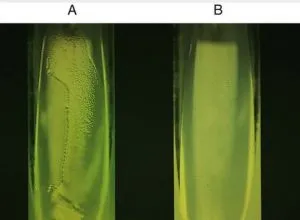
- Positive: Growth of organism is seen in the slant. Optionally a yellow-green (fluorescein) to dark blue-green (pyocyanin) color may be observed.
- Negative: No growth
Reporting
- Gram-negative oxidase-positive bacilli that grow on cetrimide agar and produce a blue-green (pyocyanin) pigment can be definitively identified as P. aeruginosa.
- Pseudomonas fluorescensand Pseudomonas putidamay also grow on cetrimide agar and may produce a fluorescent pigment but are separated from P. aeruginosa because they do not grow at 42°C.
References and further readings
- Bailey & Scott’s Diagnostic Microbiology, Forbes, 11th edition
- Andrea J. Linscott, 2016. *Clinical Microbiology Procedures Handbook,*4th Edition. ASM Press, Washington, DC. doi: 10.1128/9781683670438.