
Bacteriological Agar: Properties, Composition, and Uses in Microbiology

On this page
Before agar, Robert Koch's laboratory used gelatin as the gelling agent for solid culture media. The problem: many bacteria produce gelatinase and liquefy the medium. More critically, gelatin melts at 37°C which is the optimal incubation temperature for most human pathogens. A medium that turns to liquid at body temperature is useless for isolation.
Angelina Fanny Eilshemius Hesse, wife of Walther Hesse (a colleague of Koch), suggested the use of agar which was a gelling agent from seaweed she had used in cooking in 1881. Koch adopted it immediately. Agar does not melt until 100°C and does not resolidify until 40–45°C, allowing media to be poured at 50°C and solidifying reliably at incubation temperature. This single substitution made modern clinical bacteriology possible.
Agar (agar agar) or bacteriological agar is a thermoreversible gelling agent extracted from the cell walls of smaller seaweeds (red algae). Agar is obtained from red algae belonging to the genera Gracilaria, Ahnfeltia, Gelidium, and Pterocladiella.
Bacteriological agar has no taste or smell and is often added to food with other ingredients. About 90% of agar is used for food applications such as bakery bread, ice cream, meringue, fruit puddings, jams, and marmalade. In microbiology laboratories, agar is commonly used to solidify culture media.
Bacteriological Agar
Bacteriological agar is a hydrophilic colloidal substance made from cell wall components of Gelidium and Rhodoyceae (marine algae) species. Agar is used to solidifying culture media because of its high gelling strength; a setting temperature of 32-39°C, and a melting temperature of 90-95°C. Low gelling temperature (34-36°C) allows the addition of heat-sensitive nutrients such as whole blood to be added safely at 45-50°C with a minimum risk of heat damage.
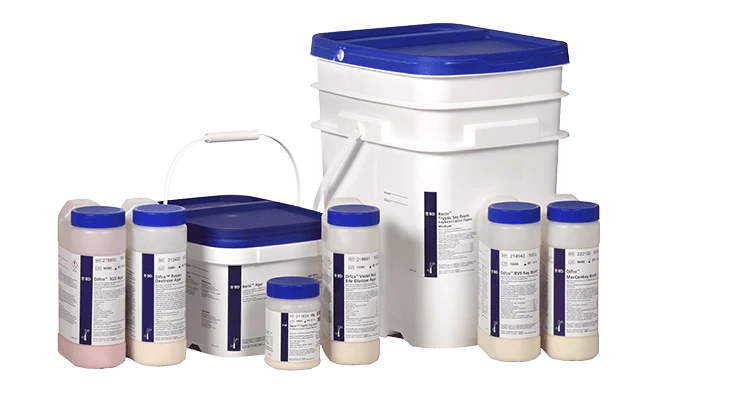 Figure: Bacteriological agar from a commercial supplier
Most agars used in bacteriological work produce a firm gel at an agar concentration of 1.5% w/v. At a concentration of 0.4-0.5% w/v, agar gives semisolid gel, which is used to make biochemical media and transport media such as Amies medium.
As agar media are used to grow bacteria, “Bacto” agars must not contain trace metals and other materials that might inhibit the growth of bacteria or fungi. The gels must be strong and have good clarity.
Bacteriological agar is obtained from sea algae at only a few harvesting sites and requires rigorous processing to remove naturally occurring pigments, salts, miscellaneous inhibitory substances, and bacterial spores. Manufacturers of bacteriological agar keep all processing details confidential. The increasing use of agar is pushing its cost, and also, there are shortages. So companies are searching for cheaper alternatives to agar to solidify culture media.
Key Properties of Bacteriological Agar
| Property | Value | Significance |
|---|---|---|
| Melting temperature | 96–100°C | Must be autoclaved to dissolve |
| Solidification temperature | 40–45°C | Can be poured at 50°C without premature solidification |
| Incubation stability | Solid at 37°C | Does not melt at bacteriological incubation temperatures |
| Concentration in solid media | 1.5–2.0% | Standard; below 0.5% = semi-solid (motility media) |
| Nutritional value | None | Agar itself provides no nutrients — only a scaffold |
| Inhibitory substances | Low (bacteriological grade) | Technical grade agar contains impurities that inhibit organism growth |
| Bacteriological vs technical grade | Must specify bacteriological grade | Technical grade agar used in food industry — inhibitory to bacteria |
| pH effect | Agar solidifies poorly below pH 5 | Low pH media may require higher agar concentration |
| Gelatinase degradation | Not degraded by most bacteria | Unlike gelatin — major advantage |
Usage History
Angelina Fanny Hesse (1850-1934) was the first to propose agar use in culture media. She is the wife of one of Robert Koch’s colleagues, Walther Hesse. Ironically, neither Lina nor Walter Hesse was given credit for using agar in microbiology.
Fanny Hesse suggested Robert Koch to add agar to his bacteriological media. The use of agar created a firm surface over which microorganisms could be spread very thinly, so thinly that some individual organisms were separated from all others. Robert Koch used agar to isolate Mycobacterium tuberculosis.
Chemical Nature
Agar (also called agar-agar) is a mixture of polysaccharides whose basic monomer is galactose. Agar consists of two fractions, agarose and agaropectin. Agarose is a linear polysaccharide and the gel-forming component; agaropectin is a branched, nongelling component of agar.
Agar is a creamy white powder soluble in hot water but insoluble in cold water.
Agarose
Agarose is a neutral, long-chain polysaccharide formed by alternating D-galactose and 3,6-anhydro-alpha-L-galactopyranose residues joined by alpha-(1->3)- and beta-(1->4)-linkages. This electrically neutral polysaccharide is suitable for electrophoresis and chromatography.
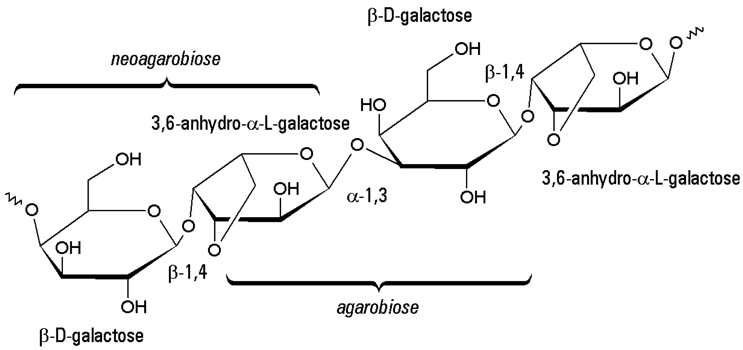 Figure: Backbone structure of agarose.
Uses
Agar is widely used in many industries due to its ability to form a gel. The large difference between gel-forming and melting temperatures gives agar its unique properties.
- Bacteriological agar is an indispensable ingredient in diagnostic labs and research projects, e.g., culture and AST, tissue culture, cell assays, etc. Due to the ease with which agar can be transported (dry, dissolved, and gelled), it is ubiquitous in the modern-day laboratory. In the Microbiology lab, agar is the most commonly used growth medium for microorganisms. Agar media is essential for isolating and identifying microorganisms/pathogens from various samples.
- Agar is one of the most common basic media for gel electrophoresis, gel bead chromatography, and size exclusion chromatography. Due to its porous 3D framework, agar is frequently used in biomolecular separation and purification.
- Agar has been fabricated in different forms (e.g., microspheres and films) to encapsulate molecules for sustained-drug delivery or immobilize proteins for tissue engineering. Due to the gelation property of agar, it is most often used as a hydrogel. Other applications of Agar are; emulsifier, carrier, lubricant, stabilizer, and laxative disintegrant in the pharmaceutical and cosmetic industries.
- Applications in Food Industries
Refined grades of agar are used in food applications, and agar is easier to use in food gels than many other substances. Common food applications of agar include puddings, custards, and soft candies. In Asian countries, jellies made from agar and natural fruit juices are very popular. Agar improves the texture of processed cheese and frozen desserts. In the Bakery industry, agar is used in icings and frostings because it is compatible with large amounts of sugar. Its products neither melt at high storage temperatures nor stick to the packaging material. Agar-agar serves as a preservative in food processing and is used in baked goods to inhibit staling. Agar is also used for the preparation of canned meat and fish products. It is also used in retorted meat products such as canned corned beef. Agar-agar is high in dietary fiber (80 g per 100 g). Agar is used in low-calorie dishes, as it can not be digested in the gastrointestinal tract. Agar’s properties are similar to gelatin. It is a good substitute for animal-based gelatin in vegetarian foods. Agar is useful for the fermentation process. - In the agricultural industry, agar is a neutral carrier for nutrients and growth substances. Seedling germination herbaceous plants from meristematic tissue use agar as a nutrient substance.
- Other uses of agar are; its usage in photographic emulsion, fermentation process, and making dental impressions, etc.
Alternatives
Apart from agar, media can be solidified by incorporating a gelling agent such as gelatin. Researches are underway to find newer and cost-effective alternatives to bacteriological agar.
Some possible candidates are; low-cost food-grade agar, cellulose produced by engineered bacteria, and fewer alternative gelling agents.
Key Exam Facts in One Table
| Feature | Detail |
|---|---|
| Source | Polysaccharide extract from red algae (Gelidium, Gracilaria) |
| Introduced by | Angelina Fanny Eilshemius Hesse (1881) — suggested to Koch's colleague |
| Melting point | 96–100°C |
| Solidification point | 40–45°C |
| Standard concentration (solid) | 1.5–2.0% |
| Semi-solid concentration | 0.1–0.5% (motility media, transport media) |
| Advantage over gelatin | Does not melt at 37°C; not degraded by most bacteria |
| Nutritional contribution | None |
| Grade required | Bacteriological grade — technical grade contains inhibitory impurities |
References and further readings
- Madigan MT, Bender KS, Buckley DH, Sattley WM, Stahl DA. Brock Biology of Microorganisms. 16th ed. Pearson; 2021.
- Zimbro MJ, Power DA, Miller SM, Wilson GE, Johnson JA (eds). Difco & BBL Manual: Manual of Microbiological Culture Media. 2nd ed. Becton, Dickinson and Company; 2009.
- Prescott LM, Harley JP, Klein DA. Microbiology. 7th ed. McGraw-Hill; 2008.
- Agar Wikipedia note: Hesse WA. Ueber Parasiten in der Luft. Mitt. Kaiserl. Gesundh. 1884;2:182. (Historical reference for Angelina Hesse's contribution.)
Frequently Asked Questions
Why is agar preferred over gelatin as a solidifying agent in culture media?
What is the difference between bacteriological grade and technical grade agar?
What agar concentration is used for different types of culture media?

Tankeshwar Acharya, MSc (Medical Microbiology)
Tankeshwar Acharya is an Assistant Professor in the Department of Microbiology at Patan Academy of Health Sciences (PAHS), Nepal, where he has been teaching and practicing clinical microbiology for over 14 years. He is the founder of Microbe Online, one of the leading free microbiology education resources on the web, covering bacteriology, mycology, parasitology, immunology, and clinical laboratory diagnostics written from direct experience in both the classroom and the diagnostic laboratory.
Comments
No comments yet. Be the first to share your thoughts.
Leave a comment
All comments are reviewed before they appear.