
Bacteriophages: Discovery, Detection, and Applications in Modern Medicine
The history of bacteriophage discovery, how phages are detected in the environment, and why a century-old idea is now central to fighting antibiotic-resistant infections.
Bacteriophages were discovered decades before antibiotics existed, then almost forgotten once penicillin arrived; phages needed a living, matched host culture to work, while a antibiotic pill worked the same way against almost anything susceptible. For most of the 20th century, that made phages a historical footnote outside a handful of countries that never stopped using them clinically.
That changed as multidrug-resistant infections stopped being rare. Patients have now been treated, as a last resort when every available antibiotic had failed, with phage cocktails sourced and matched specifically to the resistant strain infecting them, sometimes isolated from environmental samples within weeks of the patient's diagnosis. The same basic idea Twort and d'Herelle described in the 1910s, a virus that kills a specific bacterium and nothing else, is the reason those patients had an option left at all.
This hub exists to connect three things students often learn as separate facts: where phages came from, how a lab actually finds and confirms one is present, and why, a century later, that discovery is being taken seriously again.
Bacteriophages are viruses that infect bacteria and archaea. They have a simple structure with genetic materials covered in a protein coat, just like typical viruses. Bacteriophages have recently been exploited for various purposes, prompting intensive research into their understanding.
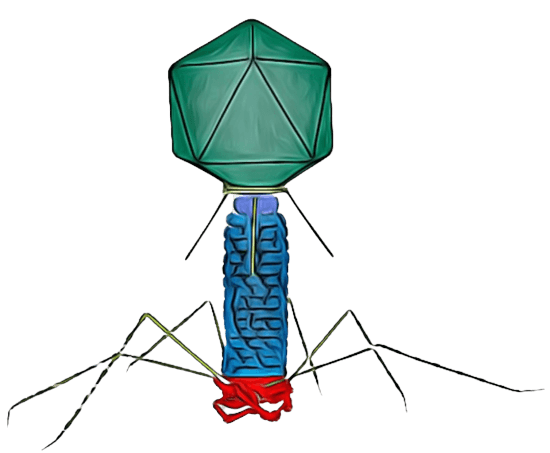 Figure: Diagram of the T4 bacteriophage. Source; The phage blog
Discovery of Bacteriophages
Bacteriophages were discovered in 1915 by Frederick Twort, and their ability to kill bacteria was found in 1917 by Felix d’Herelle. These viruses were ignored entirely in the Western Hemisphere after discovering antibiotics. Phage appeared to be less effective and time-consuming to prepare compared to antibiotics. Bacteriophage research and use continued in some countries at the time, such as Georgia and other USSR members, where they were used as a standard form of medication to treat various bacterial diseases.
This turbulent discovery, followed by a loss of interest, has resulted in a patchy understanding of phage biology. However, after scientists discovered that phages control many aspects of Bacterial/Archaeal biological evolution, things had to change and can be used as a last resort for antimicrobial resistance. These discoveries have sparked renewed interest in bacteriophages, prompting many scientists to conduct extensive and in-depth research on these organisms.
Bacteriophage replication
Bacteriophages have two replication cycles: Lysogenic and Lytic cycles. In the lysogenic process, the phage invades a bacterium and then integrates itself into the host genome, allowing the host to survive but carrying its genome. Bacteriophages are also known as prophages once integrated into the host genome. And during the lytic replication process, a phage attaches to a susceptible host bacterium, inserts its genetic material cell cytoplasm, and manufactures its protein molecules using the host’s ribosomes. When the viral proteins become too numerous and assemble themselves, they cause host cell rupture and thus released into the extracellular environment, ready to attack their next prey.
Where to find phages?
Phages, like their “prey,” are present almost anywhere. The basic principle is that the presence of bacteria determines the presence of these viruses. As a result, if one needs to isolate phage for a specific bacteria, one must look for a location where such bacteria is common. Not to mention that bacteriophages are more numerous than bacteria, and a single bacteria can be susceptible to multiple types of phages.
Detection of Bacteriophages in the Environment
Because phage distribution tracks host bacterial distribution, environmental phage isolation typically starts with a sample likely to contain the target host, sewage for E. coli and other enteric bacteria, for example. The sample is filtered to remove bacterial cells, optionally enriched by adding an overnight culture of the target host bacterium, then spotted onto a bacterial lawn. A clear zone where the sample was spotted indicates phage activity against that host; this is a spot test, a quick presence/absence check, not a quantitative titer. Confirming and quantifying a specific phage isolate from a positive spot test is done with a plaque assay, using the same double-layer (soft agar overlay) principle described in that article.
Consider the image below: AE/ED and AE/ED2 are positive samples, while the rest are harmful. If you get a double clearance, also known as phage plaque halo, it’s because of the effect of the enzymes released by bacteriophages.
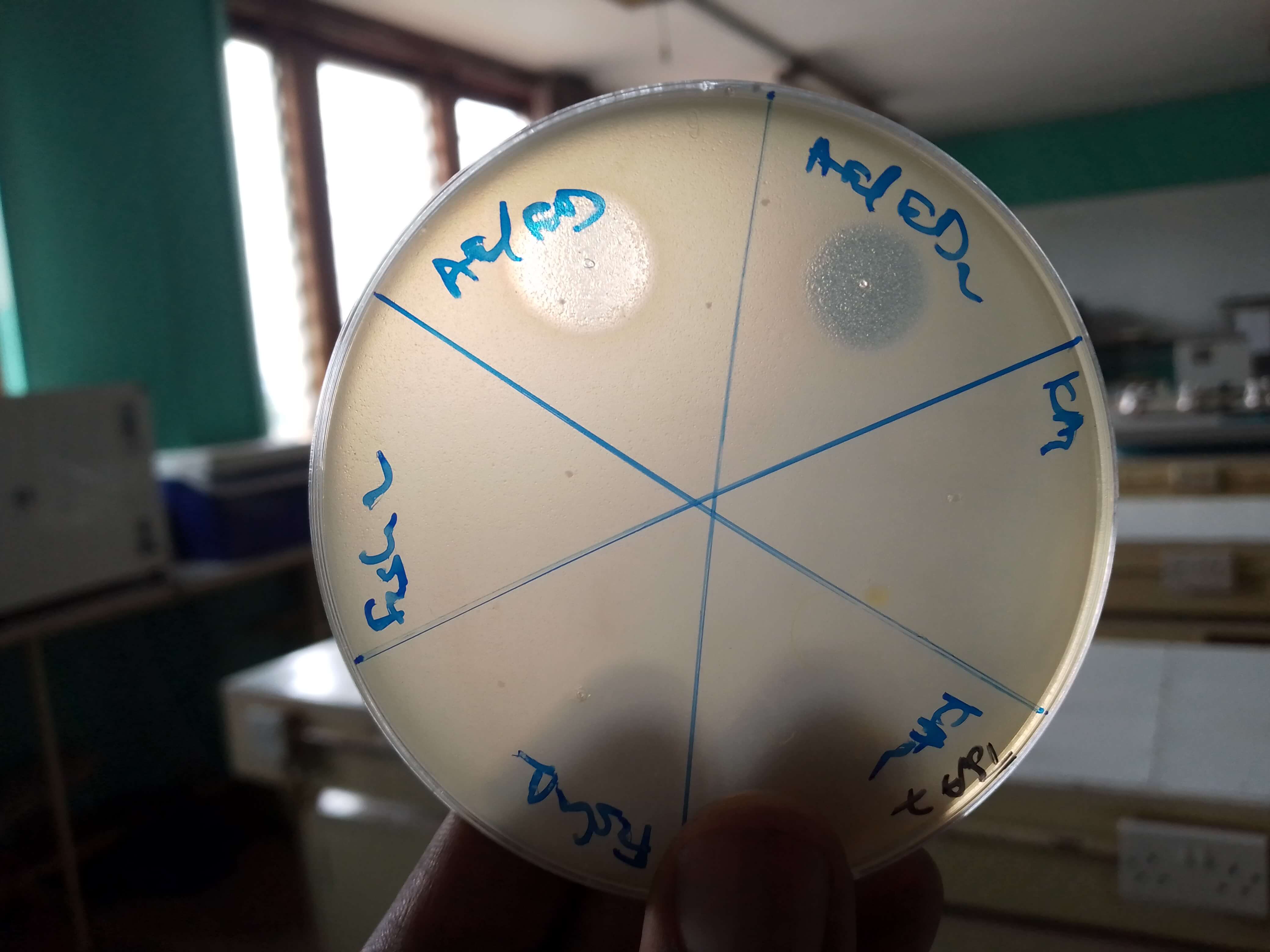 Figure: A plate with a positive and negative spot assay test, with areas with transparent patches indicating bacteriophage activity on susceptible host bacteria. Taken by Raphael Hans Lwesya at Makerere University
This procedure is for detecting bacteriophages in a sample; the plaque you’re looking at could have been induced by more than one phage type. Individual phage isolates are required for better characterization of the phage. The phage filtrate is serially diluted (see the dedicated Phage Plaque Assay article) and surface poured on a solid media to create a double layer of agar during the isolation steps.* This is optional, but it produces better and more consistent results.
Applications of Bacteriophages
Bacteriophages, which are considered safe for humans, have been assigned to various uses. They have remained one of the most widely beneficial viruses today, either through genetic engineering or through their natural life cycle. Bacteriophages are used in the following ways.
- Vaccine production
- Drug delivery (especially filamentous phages due to their large sizes)
- As a biomarker agent
- Phage therapy (for bacterial diseases)
- Monitoring infections
- Diagnosis of bacterial diseases. Read in details about Phage Typing
- Decontaminating surfaces
And many others. Despite having a wide range of applications, some of them, particularly those involving therapy, are still in the early stages of development and are only used in emergencies where antibiotics have failed.
How to Remember
- The two-year discovery gap: Twort found it first (1915), d'Herelle confirmed it and named it two years later (1917). If a question asks who discovered phages first, the answer is Twort, even though d'Herelle is the more commonly cited name because he coined the term "bacteriophage" and pursued it much further.
- Why phages nearly disappeared, then came back: Antibiotics won the mid-20th century because they worked broadly and needed no host-matching. Phages are winning back relevance for the exact opposite reason, extreme specificity, which is exactly what you want when the alternative is a bacterium nothing else can touch.
- Spot test vs. plaque assay, the confusion to avoid: A spot test answers "is an active phage present against this host, yes or no?" A plaque assay answers "how many infectious phage particles are in this sample?" One is a screen, the other is a count. If a question gives you a clear zone on a bacterial lawn and asks what it proves, the answer is presence of activity, not a quantity.
References
- Twort, F. W. (1915). An investigation on the nature of ultra-microscopic viruses. The Lancet, 186(4814), 1241–1243.
- d'Herelle, F. (1917). Sur un microbe invisible antagoniste des bacilles dysentériques. Comptes Rendus de l'Académie des Sciences, 165, 373–375.
- Kortright, K. E., Chan, B. K., Koff, J. L., & Turner, P. E. (2019). Phage therapy: A renewed approach to combat antibiotic-resistant bacteria. Cell Host & Microbe, 25(2), 219–232. https://doi.org/10.1016/j.chom.2019.01.014
About the Author
 Raphael Hans Lwesya is a young scientist, phage enthusiast, and passionate about driving bacteriophage development for application to combat communicable and non-communicable diseases. He is also the creator of The Phage blog, an online hub for providing phage technology updates and the possible alternative to antibiotic use. Raphael found the booming AMR cases in recent years to be of concern, hence decided to dig deep into Antibiotics’ promising alternatives. Contac tLinkedIn, Twitter, and Facebook
Frequently Asked Questions
Who discovered bacteriophages, and when?
Why did interest in bacteriophages decline after antibiotics were introduced?
What is the difference between a spot test and a plaque assay for detecting bacteriophages?
Why has interest in bacteriophage therapy increased in recent years?
What are the main applications of bacteriophages besides therapy?

Tankeshwar Acharya, MSc (Medical Microbiology)
Tankeshwar Acharya is an Assistant Professor in the Department of Microbiology at Patan Academy of Health Sciences (PAHS), Nepal, where he has been teaching and practicing clinical microbiology for over 14 years. He is the founder of Microbe Online, one of the leading free microbiology education resources on the web, covering bacteriology, mycology, parasitology, immunology, and clinical laboratory diagnostics written from direct experience in both the classroom and the diagnostic laboratory.