
API 20E Test: Procedure, Reading the 21 Reactions, and the 7-Digit Profile Code

On this page
A stool-culture isolate grows as a lactose-fermenting, oxidase-negative Gram-negative rod. The colony morphology and a couple of tube tests point somewhere between Escherichia coli and Enterobacter, but the single tubes disagree: citrate is weakly positive, and the indole read is ambiguous. In a lab without MALDI-TOF, this is exactly where the API 20E strip earns its place.
Twenty-one standardized biochemical reactions, read together and converted to a single profile number, resolve in one strip what a handful of individual tubes left unsettled. This is still routine practice across many clinical laboratories in resource-limited settings, where the strip remains the workhorse for identifying Enterobacterales to species level.
API 20E (Analytical Profile Index) is a biochemical panel from bioMérieux for identifying and differentiating members of the family Enterobacteriaceae. and other non-fastidious, Gram-negative rods. The plastic strip holds 20 miniature test chambers of dehydrated, chemically defined media. Rehydrated with a bacterial suspension and incubated, the strip produces a pattern of reactions that is converted into a numerical profile and matched against a database to identify the isolate.
 Figure: API 20 E Biochemical Test Strip
These include:
- ONPG: test for β-galactosidase enzyme by hydrolysis of the substrate o-nitrophenyl-b-D-galactopyranoside
- ADH: hydrolysis of the amino acid arginine by arginine dihydrolase (a dihydrolase pathway, not a decarboxylation)
- LDC: decarboxylation of the amino acid lysine by lysine decarboxylase
- ODC: decarboxylation of the amino acid ornithine by ornithine decarboxylase
- CIT: utilization of citrate as only carbon source
- H₂S: production of hydrogen sulfide
- URE: test for the enzyme urease
- TDA (Tryptophan deaminase): detection of the enzyme tryptophan deaminase: Reagent to put- Ferric Chloride.
- IND: Indole Test-production of indole from tryptophan by the enzyme tryptophanase. Reagent- Indole is detected by the addition of Kovac’s reagent.
- VP: the Voges-Proskauer test for the detection of acetoin (acetyl methylcarbinol) produced by fermentation of glucose by bacteria utilizing the butylene glycol pathway
- GEL: test for the production of the enzyme gelatinase which liquefies gelatin
- GLU: fermentation of glucose (hexose sugar)
- MAN: fermentation of mannitol (sugar alcohol)
- INO: fermentation of inositol (cyclic polyalcohol)
- SOR: fermentation of sorbitol (alcohol sugar)
- RHA: fermentation of rhamnose (methyl pentose sugar)
- SAC: fermentation of sucrose (disaccharide)
- MEL: fermentation of melibiose (disaccharide)
- AMY: fermentation of amygdalin (glycoside)
- ARA: fermentation of arabinose (pentose sugar)
The 21st reaction: oxidase
The strip has 20 wells, but a complete API 20E identification uses 21 reactions. The oxidase test is run separately, off the strip, because it must be read from fresh growth using oxidase reagent rather than from a dehydrated well. Its result occupies the final position when the profile is assembled, so a strip read without an oxidase result gives an incomplete code. Always run oxidase alongside the strip, not after you have already discarded the plate.
Setting up an API20E Biochemical Test Strip
- Pick up a single isolated colony (from a pure culture) and make a suspension of it in sterile distilled water.
- Take the API20E biochemical test strip which contains dehydrated bacterial media/biochemical reagents in 20 separate compartments. API20E biochemical test strip is commercially available. (Bacteria will react with them and will give different colors which will help to identify bacteria to the species level).
- Take a Pasteur pipette and fill up (up to the brim) these compartments with the bacterial suspension.
- Overlay the ADH, LDC, ODC, H₂S, and URE wells with sterile mineral oil to create the anaerobic conditions these reactions require. Skipping the overlay is the single most common setup error: without it, the decarboxylase and urease reactions read falsely, because the color chemistry depends on an anaerobic, alkaline environment.
- Put some drops of water in the tray and put the API Test strip and close the tray.
- Mark the tray with an identification number (patient ID or organism ID), date, and your initials.
- Incubate the tray at 35–37 °C for 18–24 hours. If the profile is non-discriminating at 24 hours, some reactions can be re-read after extended incubation per the manufacturer's instructions, but do not read reagent-dependent wells twice.
Results and Interpretation
- Read the strip in the correct order. First record every well that changes color on its own (the sugars, CIT, H₂S, GEL, and the oil-overlaid enzyme wells). Only then add reagents to the three wells that need them. This order matters: reagents added to a well change its chemistry permanently, so a reagent placed in the wrong well cannot be undone and invalidates that reaction.
- Add the following reagents to these specific compartments
- TDA: add 1 drop of ferric chloride. A reddish-brown color is positive. Read immediately.
- IND: add 1 drop of Kovács' reagent. A pink-red ring is positive. Read within a few minutes.
- VP: add 1 drop of VP reagent 1 (40% KOH), then 1 drop of VP reagent 2 (α-naphthol). Wait a full 10 minutes before calling it negative; a pink-red color developing in that window is positive.
- Get the API reading scale (color chart)
Mark each test as positive or negative on the lid of the tray The wells are marked off into triplets by black triangles, for which scores are allocated as follows:
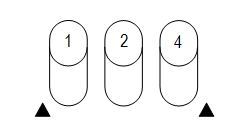 Figure: API 20 E 124
- Add up the scores for the positive wells only in each triplet. Supplementary tests, e.g.: oxidase may also be included in the profile. The highest score possible for a triplet is 7 (the sum of 1, 2 and 4) and the lowest is 0.
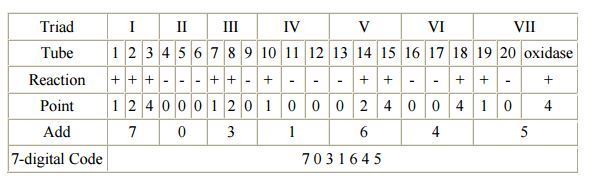 Figure: Numbering in API 20E Test Strip
- The profile for this combination of reactions is therefore 7031645 (7 digit code)
- Identify the organism by using API catalog or apiweb VIDEO: Reading an API20E using the online database
- Identify the organism using APIWEB: Start Google Chrome or Firefox web browser Go to: https://apiweb.biomerieux.com
Login: your login name Password: your password Select the correct test (e.g. API 20E). Enter the numerical profile to obtain the identity. Record the identity along with comments (% ID and T value) on the results sheet.
How to Remember
Which five wells get the oil? The oil wells are the ones that need to breathe out, not in: the two decarboxylases (LDC, ODC), the dihydrolase (ADH), urease (URE), and H₂S. A quick handle is "A LOUH" — ADH, LDC, ODC, URE, H₂S — the five you cap with mineral oil. If a well is about an amino-acid enzyme or sulfide, it wants to be sealed.
Which three wells get reagents, and when? TIV — TDA, IND, VP — are the only wells you touch after incubation. TDA and IND read on sight; VP makes you wait ten minutes. Everything else is read before you open a single reagent bottle.
The profile is built in triplets. Each black-triangle group scores 1, 2, 4 from top to bottom, summed for positives only. Max per triplet is 7, minimum 0. Seven triplets (20 strip wells plus oxidase) give the 7-digit code.
Key exam facts in one table
| Feature | Detail |
|---|---|
| Manufacturer | bioMérieux |
| Primary use | Identification of Enterobacteriaceae and other non-fastidious Gram-negative rods |
| Wells on strip | 20 dehydrated biochemical reactions |
| Reactions in a full profile | 21 (the 20 strip wells plus oxidase, run separately) |
| Oil-overlaid wells | ADH, LDC, ODC, URE, H₂S (anaerobic reactions) |
| Reagent-added wells | TDA (ferric chloride), IND (Kovács'), VP (KOH + α-naphthol) |
| VP read time | Wait 10 minutes before calling negative |
| Incubation | 35–37 °C, 18–24 hours |
| Scoring | Triplets scored 1-2-4; positives summed; max 7 per triplet |
| Output | 7-digit numerical profile |
| Identification database | apiweb (apiweb.biomerieux.com) or the printed API catalog |
| ADH pathway note | Arginine dihydrolase, not a decarboxylase |
| MAN well substrate | Mannitol, not mannose |
Where Students Get Confused
- "There are only 20 wells, so why a 21-reaction profile?" Oxidase is run off-strip and fills the final code position. Run it at setup, not as an afterthought.
- Forgetting the oil overlay. Without mineral oil on ADH, LDC, ODC, URE, and H₂S, these reactions read falsely. This is the most common cause of a mis-ID.
- Adding reagents in the wrong order or the wrong well. Read all self-developing wells first. Reagents are permanent; a drop of Kovács' in the wrong well cannot be reversed.
- Calling VP negative too early. The color can take the full 10 minutes to appear. TDA and IND, by contrast, read almost at once.
- Confusing MAN with mannose. The well tests mannitol.
- Treating a doubtful profile as final. A non-discriminating or low-%ID code needs supplementary tests (oxidase, nitrate, motility) or a repeat, not a guess. apiweb flags these with the %ID and T-value.
References
- Winn, W. C., et al. (2017). Koneman's Color Atlas and Textbook of Diagnostic Microbiology (7th ed.). Wolters Kluwer.
- Tille, P. M. (2022). Bailey & Scott's Diagnostic Microbiology (15th ed.). Elsevier.
- bioMérieux. API 20E Identification System — Package Insert / Technical Sheet. bioMérieux SA.
- O'Hara, C. M., Rhoden, D. L., & Miller, J. M. (1992). Reevaluation of the API 20E identification system versus conventional biochemicals for identification of members of the family Enterobacteriaceae. Journal of Clinical Microbiology, 30(1), 123–125.
Frequently Asked Questions
How many tests are in the API 20E, 20 or 21?
Which API 20E wells need a mineral oil overlay?
Which wells need reagents added after incubation?
Why does the VP well take longer to read?
How is the 7-digit profile number generated?
What do I do if the profile gives a doubtful or low-confidence identification?
Can API 20E identify organisms other than Enterobacteriaceae?

Tankeshwar Acharya, MSc (Medical Microbiology)
Tankeshwar Acharya is an Assistant Professor in the Department of Microbiology at Patan Academy of Health Sciences (PAHS), Nepal, where he has been teaching and practicing clinical microbiology for over 14 years. He is the founder of Microbe Online, one of the leading free microbiology education resources on the web, covering bacteriology, mycology, parasitology, immunology, and clinical laboratory diagnostics written from direct experience in both the classroom and the diagnostic laboratory.
Comments
No comments yet. Be the first to share your thoughts.
Leave a comment
All comments are reviewed before they appear.