
Tryptic Soy Agar (TSA): Composition, Preparation, Uses, and Colony Morphology

On this page
Walk into any clinical microbiology laboratory and the two media you will see prepared in the largest quantities are blood agar and tryptic soy agar. Blood agar is made by adding sheep blood to a tryptic soy agar base. Tryptic soy broth is the standard liquid used for blood culture bottles. The McFarland suspension you prepare before every antibiotic susceptibility test is made in tryptic soy broth. When you subculture a colony from a primary plate to obtain a pure culture for biochemical identification, you streak it onto tryptic soy agar.
TSA and TSB (its broth form) are not just one medium among many; they are the backbone of the entire workflow of clinical bacteriology.
Tryptic Soy Agar (TSA), also called Soybean Casein Digest Medium (SCDM), is a non-selective, non-differential, general-purpose culture medium that supports the growth of a wide variety of non-fastidious and moderately fastidious microorganisms. Unlike nutrient agar, which uses beef extract as its nitrogen source, TSA derives its nutrients from two peptone digests (tryptic (pancreatic) digest of casein and peptic digest of soybean meal) providing a richer and more complete amino acid profile. This makes TSA more nutritionally versatile than nutrient agar and better at supporting the growth of organisms with slightly higher nutritional requirements.
TSA is the most widely used general-purpose medium in clinical microbiology laboratories worldwide. Its broth form, Tryptic Soy Broth (TSB), is equally ubiquitous.
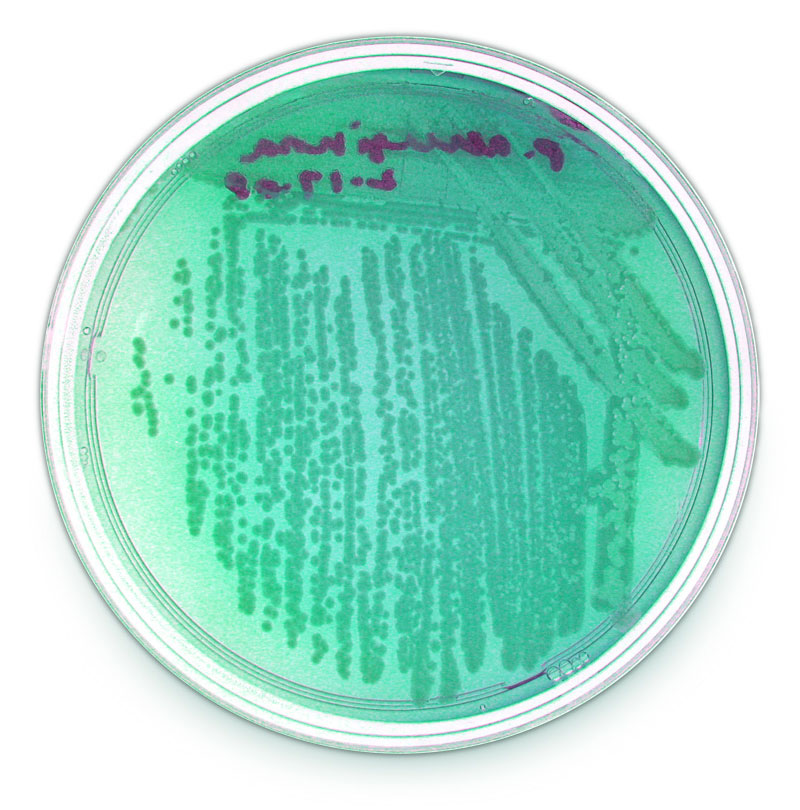 Figure: Pseudomonas aeruginosa in Tryptic Soy Agar (Image source: Michigan State University)
TSA vs. Nutrient Agar: The Key Difference
This is one of the most commonly asked questions in microbiology practicals, and the answer is straightforward.
| Feature | Tryptic Soy Agar (TSA) | Nutrient Agar (NA) |
|---|---|---|
| Nitrogen source | Casein digest + soybean meal digest | Beef extract + peptone |
| Amino acid profile | Richer: casein digest provides all essential amino acids | More limited |
| Moderately fastidious organisms | Grows (e.g., Streptococcus with blood supplementation) | May not support |
| Strictly fastidious organisms (Haemophilus, Neisseria) | Does not grow without supplementation | Does not grow |
| Primary clinical use | Routine bacteriology: subculture, pure culture, QC | Environmental microbiology, food/water testing, teaching |
| Blood agar base | Yes. TSA is a standard blood agar base; Columbia agar base is the other common choice. | No. Blood agar is not made on nutrient agar base |
| Standard for clinical labs | Yes | Less common in clinical settings |
The practical answer for students: TSA and nutrient agar are both general-purpose non-selective media, but TSA is richer and more reliable across a wider range of organisms. In modern clinical laboratories, TSA has largely replaced nutrient agar. Nutrient agar remains useful in environmental microbiology and resource-limited teaching settings because of its low cost and simplicity.
Key exam point: Blood agar is a nutrient-rich base plus 5% sheep blood, and TSA is the most commonly used base (Columbia agar base is the other frequent choice). Whichever base is used, it is the blood, not the base, that supplies the extra growth factors fastidious organisms need.
Composition of Tryptic Soy Agar (TSA)
Final pH 7.3 +/- 0.2 at 25°C
| Ingredients | Amount (g/L) |
|---|---|
| Pancreatic digest of casein | 15.0 |
| Peptic digest of soybean meal | 5.0 |
| Sodium chloride | 5.0 |
| Agar | 15.0 |
| Distilled water | 1000 mL |
Tryptic soy agar contains digests of casein and soybean meal. The combination of casein and soy peptones renders the medium nutritious by supplying organic nitrogen, particularly amino acids and longer-chained peptides. Sodium chloride is added to maintain the osmotic equilibrium, and agar is the solidifying agent.
Preparation
Tryptic Soy Agar (TSA) Plates
- Suspend 40 grams of dehydrated TSA powder in one liter of distilled water. (Follow manufacturer instructions as formulations vary slightly. BD Difco TSA: 40 g/L; Oxoid: 40 g/L.)
- Mix well and heat with frequent agitation, boiling for one minute until completely dissolved.
- Sterilize by autoclaving at 121°C for 15 minutes.
- Cool to 50–55°C before pouring.
- Dispense approximately 20 mL into sterile Petri plates under aseptic conditions.
- Allow to solidify on a level surface. Label with medium name and date.
- Store inverted at 2–8°C. Warm to room temperature before use.
Tryptic Soy Broth (TSB) Tubes
- Weigh 30 grams of TSB powder and dissolve in one liter of distilled water.
- Mix well. Dispense 10 mL into screw-cap tubes.
- Autoclave at 121°C for 15 minutes.
- Cool to room temperature. Tighten caps. Store at 2–8°C.
- Pre-warm to room temperature before use.
Blood Agar from TSA Base
- Prepare TSA as above; after autoclaving, cool to exactly 50°C (critical: too hot lyses RBCs; too cool causes premature solidification).
- Aseptically add 5% v/v defibrinated sheep blood (50 mL per liter of TSA base).
- Mix gently by swirling to avoid frothing, which creates bubbles in the final plate.
- Pour immediately into sterile Petri plates.
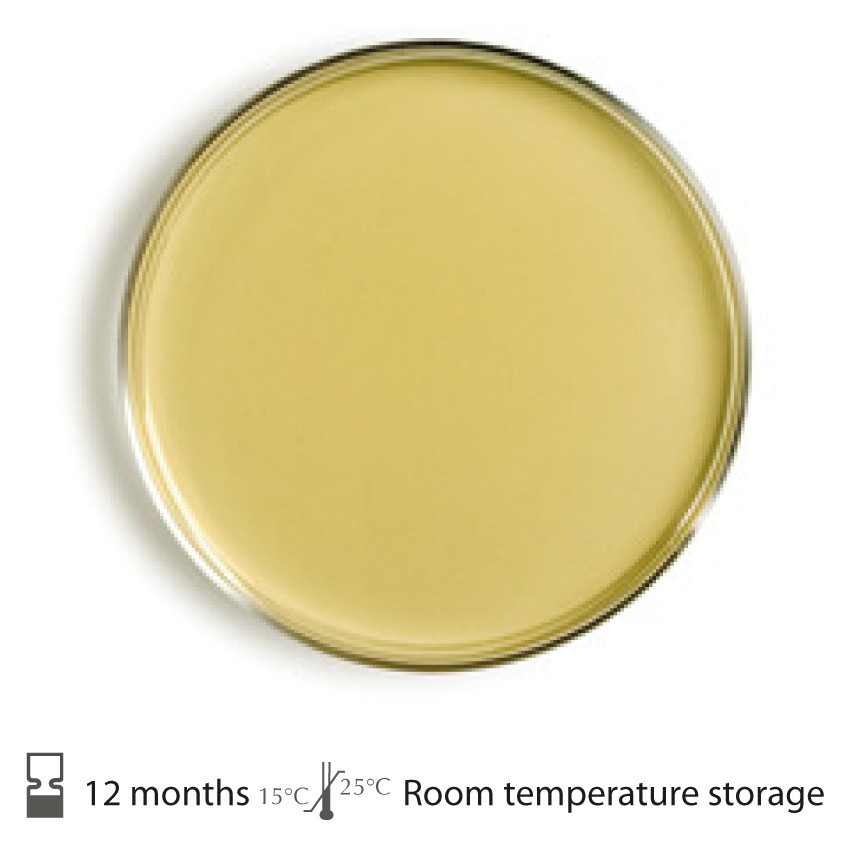 Figure: Tryptic Soy Agar Plate (source:mkldiagnostics)
Uses of Tryptic Soy Agar (TSA)
1. Pure culture development and subculture TSA is the standard medium for obtaining a pure culture from a primary isolation plate. A single colony from a selective or differential medium (e.g., MacConkey, blood agar) is subcultured onto TSA to produce sufficient biomass for biochemical identification, MALDI-TOF analysis, or antibiotic susceptibility testing.
2. Blood agar base TSA is the base for blood agar, the most widely used enriched medium in clinical bacteriology. Adding 5% sheep blood to molten TSA at 50°C produces blood agar, which supports fastidious organisms that TSA alone cannot grow. This relationship makes TSA the foundational medium of clinical microbiology, even when it is not used directly.
3. Base medium for growth factor testing X and V factor testing for Haemophilus species requires a base medium free of hemin and NAD, so that growth appears only around the discs or strips supplying the missing factor. Mueller-Hinton agar or a purpose-made factor-free base is used for this purpose rather than routine TSA, since standard casein-soy formulations may carry enough residual growth factors to blur the result. See the X and V factor strip/disc test for the full procedure.
4. McFarland suspension preparation TSB is used to prepare the 0.5 McFarland turbidity standard inoculum for Kirby-Bauer disc diffusion and broth microdilution susceptibility testing. Standardized in TSB, the suspension ensures reproducible inoculum density for all susceptibility methods.
5. Blood culture broth TSB supplemented with sodium polyanethol sulfonate (SPS) is the standard broth for blood culture bottles. SPS anticoagulates the blood sample and inhibits complement, lysozyme, and phagocytic activity, improving recovery of organisms from blood. After incubation in TSB-SPS, flagging positive bottles are subcultured to solid media (including blood agar and MacConkey) for identification.
6. Halotolerance testing Tryptic soy agar (TSA) with various sodium chloride concentrations (2%, 6.5%, and 10%) is used to determine the salt tolerance of organisms, which is a characteristic used to differentiate genera, such as enterococci growing in 6.5% sodium chloride while most streptococci do not.
7. Culture maintenance and storage TSA slants are used for short-term maintenance and transport of bacterial cultures. Stab cultures in TSA tubes, sealed with sterile mineral oil or paraffin, extend viability for several months at room temperature, though survival varies considerably by organism.
Colony Morphology on TSA
Because TSA contains no differential agents or inhibitors, colonies appear in their natural state. This makes TSA ideal for observing true pigmentation, surface texture, and colony form.
| Organism | Colony on TSA | Key features |
|---|---|---|
| Escherichia coli | Circular, convex, greyish-white, 2–3 mm, smooth | Moist, entire margin |
| Staphylococcus aureus | Circular, golden-yellow, convex, smooth, 1–3 mm | Pigmentation clearly visible; beta hemolysis not visible (no blood) |
| Pseudomonas aeruginosa | Flat, spreading, 2–4 mm; blue-green pyocyanin diffuses into agar | Sweet, grape-like odor; flat with irregular margin |
| Klebsiella pneumoniae | Large, mucoid, dome-shaped, greyish-white | Very sticky; string test positive; capsule evident |
| Streptococcus pyogenes | Small, greyish-white, 0.5–1 mm | Poor growth on TSA without blood. This demonstrates why blood agar is needed |
| Bacillus subtilis | Large, flat, irregular, dry, off-white | "Ground-glass" or "frosted glass" surface; wrinkled |
| Micrococcus luteus | Small, bright yellow, opaque | Brilliant lemon-yellow pigment; very distinctive |
Teaching note: Comparing S. aureus on TSA (golden pigment visible) vs. on blood agar (golden pigment + beta hemolysis visible) demonstrates exactly what blood supplementation adds to a TSA base and reinforces why the two media are used together.
How to Remember
TSA is the foundation everything else is built on.
Two relationships anchor TSA in memory:
- Blood agar = TSA + blood. Every time you look at a blood agar plate, you are looking at TSA enriched with sheep RBCs. Understanding TSA explains blood agar.
- TSB = TSA without the agar. The broth and agar share identical nutritional composition. Blood culture bottles, McFarland suspensions, and MIC dilution tests all use TSB, the liquid version of the same medium.
TSA vs. nutrient agar
TSA uses casein and soy digests (richer, more complete amino acid profile); nutrient agar uses beef extract and simple peptone (simpler, cheaper, less versatile). In clinical laboratories, TSA has replaced nutrient agar. In environmental and food microbiology, nutrient agar remains standard.
The name tells you the composition:
- Tryptic = pancreatic (tryptic) digest of casein: breaks casein into peptides and free amino acids
- Soy = peptic digest of soybean meal: adds complementary nitrogen compounds
- Agar = solidifying agent (15 g/L)
Together, casein and soy provide all essential amino acids, which is why TSA supports a broader range of organisms than simple peptone-based media.
Where Students Get Confused
- TSA, TSB, and blood agar are the same thing wearing different clothes. TSB is TSA without agar. Blood agar is TSA base with sheep blood added. Students treat these as three separate media to memorize, then get confused about why blood culture bottles and susceptibility inocula both use "TSB." One formulation, three physical forms, three jobs.
- TSA is neither selective nor differential, and that is the point. Every named medium students meet in practicals seems to inhibit something or change color for something, so they assume TSA must too. It does not. It has no inhibitors and no indicators. That absence is exactly why it works for subculture and for reading true pigment: nothing is being suppressed or stained, so what you see is the organism's natural appearance.
- "Blood agar is just TSA plus blood" makes the growth difference confusing. If blood agar contains everything TSA contains, why does Streptococcus pyogenes grow poorly on TSA and well on blood agar? Because the base is unchanged, and the blood is doing the work. Sheep blood supplies growth factors and a richer environment that the casein-soy base alone cannot provide. The base grows most things; the supplement grows the fastidious ones.
- Same medium, four different names. Tryptic Soy Agar, Trypticase Soy Agar, Soybean Casein Digest Medium (SCDM), and Casein Soy Peptone Agar all refer to the same formulation. "Trypticase" is a BD trade name; "tryptic" is the generic. Exam questions and package inserts use these interchangeably.
- "Tryptic" refers to the enzyme, not to tryptone or tryptophan. Tryptic means digested by trypsin, a pancreatic enzyme. It has nothing to do with tryptophan, and TSA is not an indole medium.
References and further readings
- Tille, P. M. (2022). Bailey and Scott's Diagnostic Microbiology (15th ed.). Elsevier.
- Mahon, C. R., & Lehman, D. C. (2022). Textbook of Diagnostic Microbiology (7th ed.). Elsevier.
- Clinical and Laboratory Standards Institute (CLSI). (2023). M100: Performance Standards for Antimicrobial Susceptibility Testing (33rd ed.). CLSI.
- BD Diagnostics. Tryptic Soy Agar. Package insert. Becton, Dickinson and Company.
Frequently Asked Questions
What is the difference between tryptic soy agar and nutrient agar?
Is tryptic soy agar selective or differential?
What is the difference between TSA and TSB?
Why is tryptic soy agar used as a blood agar base?
Why must TSA be cooled to 50°C before adding blood?
Can tryptic soy agar be used for antimicrobial susceptibility testing?
What is soybean casein digest medium?
How long can TSA plates be stored?

Tankeshwar Acharya, MSc (Medical Microbiology)
Tankeshwar Acharya is an Assistant Professor in the Department of Microbiology at Patan Academy of Health Sciences (PAHS), Nepal, where he has been teaching and practicing clinical microbiology for over 14 years. He is the founder of Microbe Online, one of the leading free microbiology education resources on the web, covering bacteriology, mycology, parasitology, immunology, and clinical laboratory diagnostics written from direct experience in both the classroom and the diagnostic laboratory.
Comments
No comments yet. Be the first to share your thoughts.
Leave a comment
All comments are reviewed before they appear.