
Transposons: Definition, Types, Functions
Transposons (jumping genes) — types, structure, mechanism of transposition, insertion sequences, and why transposons are the primary engine driving antibiotic resistance evolution and the rise of MRSA. With clinical stories.
Transposons are mobile genetic elements that are found in almost all organisms. Scientists believe that transposons make up more than 40% of the human genome. They are also referred to as ‘jumping genes’ as they can move (or jump) from one location in the genome to another.
Why transposons matter — the theory connection students need
Transposons are the "jumping genes" of bacterial genomes. The name sounds almost playful — genes that can pick themselves up and move to a new location. But the clinical consequences of this mobility are deadly serious:
Transposons are the engine of resistance gene spread at the molecular level.
Plasmids transfer resistance between bacteria. But transposons are what allow resistance genes to jump from plasmid to plasmid, from plasmid to chromosome, and from chromosome to chromosome — making resistance genes almost impossible to contain once they emerge in a microbial community.
The three-level mobile genetic element system:
INTEGRONS (capture individual resistance gene cassettes)
    ↓ carried by
TRANSPOSONS (jump between plasmids and chromosomes)
    ↓ carried by
CONJUGATIVE PLASMIDS (transfer between bacterial cells and species)
Understanding transposons is understanding the molecular machinery that assembles multi-drug resistant bacteria from individual resistance gene components.
Two historical moments that show why this matters:
The birth of MRSA: Methicillin-resistant Staphylococcus aureus (MRSA) is resistant to all beta-lactam antibiotics because it carries a gene called mecA encoding an alternative penicillin-binding protein (PBP2a) with low affinity for beta-lactams. The mecA gene sits within a large mobile genetic element called the Staphylococcal Cassette Chromosome mec (SCCmec) — a composite transposon-like element. SCCmec almost certainly acquired the mecA gene from a different bacterial species through transposon-mediated transfer. One transposon event created MRSA from ordinary S. aureus.
The assembly of a super-resistant bacterium: Multi-drug resistant Klebsiella pneumoniae strains isolated in ICUs often carry 5–8 different resistance genes on a single large plasmid. These genes did not arise simultaneously through mutation; each was captured at a different time and place into integrons, then mobilised by transposons onto the same plasmid through successive transposition events. The plasmid is essentially a mosaic assembled piece by piece over years of transposon activity.
The mechanism of transposition: cut-and-paste vs copy-and-paste
Understanding the two fundamentally different mechanisms of transposition helps explain both the biology and the consequences of transposon activity:
Class II DNA transposons ("Cut and paste")
- Transposase enzyme (encoded within the transposon) recognises the inverted repeat sequences at both ends of the transposon
- Transposase cuts the transposon out of its original location ("cut")
- Transposase inserts the transposon into a new location ("paste")
- Result: the transposon moves to a new location; it is absent from the original location
Consequence for resistance: A resistance gene on a transposon can be cut from a plasmid and inserted into the chromosome — stable, harder to lose than a plasmid, replicated with the chromosome.
Class I Retrotransposons ("Copy and paste")
- Transposon DNA is transcribed to RNA
- RNA is reverse transcribed back to DNA (by reverse transcriptase encoded within the retrotransposon)
- The new DNA copy is inserted at a new chromosomal location
- Result: the transposon is now at both the original and new locations — copy number increases
More significant in eukaryotes (making up >40% of the human genome) than in bacteria. In bacteria, DNA transposons (Class II) dominate.
Features of Bacterial Transposons
- Transposons are pieces of DNA that move readily from one site to another, either within or between the DNA’s of bacteria, plasmids, and bacteriophage.
- They can code for drug resistance enzymes, toxins, or a variety of metabolic enzymes. They either cause mutations in the gene into which they insert or alter the expression of nearby genes.
- Transposons are not capable of independent replication; they replicate as part of the recipient DNA. eg. a plasmid can contain several transposons carrying drug resistance genes.
Transposable elements, or “jumping genes”, were first identified by Barbara McClintock in 1940s. She was awarded the Nobel Prize in Physiology or Medicine for 1983 for the discovery of “mobile genetic elements”.
Insertion sequences are a type of transposons that have fewer bases.
Domains of Transposons
Transposons have four identifiable domains.
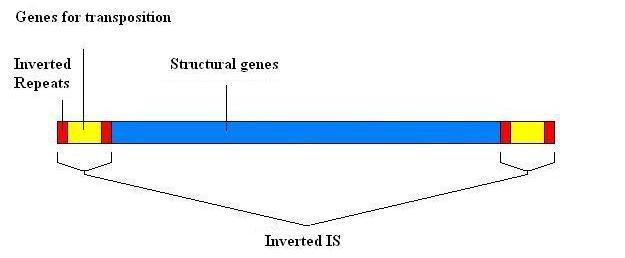 Figure: Domain transposons (jumping genes)
- Inverted repeats (IR): Involved in the integration of the transposons into the recipient DNA.
- Transposase gene: It codes the enzyme that mediates the excision and integration process.
- Repressor gene: It regulates the synthesis of both the transposase and gene product of the fourth domain
- Fourth domain codes for an enzyme that mediates antibiotic resistance.
Functions of Transposons
Scientists have found transposons are highly useful in studying genomes. The transposons have the following functions:
- It can help understand the evolutionary history of organisms.
- Transposons or jumping genes can also help in analyzing the regulatory genome.
- It can also help insert foreign DNA into different genomes’ genome.
- Transposons can also help identify genes and pathways applied in the disease or pathogenesis of different pathogens.
- It can also help in contributing to gene therapy.
Clinical Significance of Transposons
1. Transposons in MRSA emergence — the SCCmec story
The most clinically important transposon-related event in recent medical history is the emergence of MRSA. The mecA gene — encoding the alternative penicillin-binding protein PBP2a that confers resistance to all beta-lactam antibiotics — is carried within the Staphylococcal Cassette Chromosome mec (SCCmec), a large (21–67 kb) mobile genetic element that has the structural characteristics of a complex transposon.
SCCmec integrates at a specific site on the S. aureus chromosome and excises through a recombination mechanism similar to transposition. At least 13 SCCmec types have been identified (SCCmec I through XIII), differing in size and gene content. Different MRSA lineages (community-acquired MRSA, hospital-acquired MRSA) carry different SCCmec types — their spread can be traced through SCCmec typing.
The critical insight: Without transposon-like mobile elements, the mecA gene could not have transferred from its original host to S. aureus, and MRSA would not exist. Every methicillin-resistant organism we face today owes its resistance to a transposon-mediated gene transfer event that probably occurred in the 1950s-60s.
2. Integrons — transposon-associated cassette systems for resistance gene capture
Integrons are not strictly transposons but are intimately associated with them and deserve mention here because they are the downstream machinery that captures individual resistance genes:
What integrons are: An integron is a genetic element containing:
- An integrase gene (IntI) — a site-specific recombinase
- An attachment site (attI) — where new gene cassettes are inserted
- A promoter (Pc) — that drives expression of the captured cassette genes
How integrons capture resistance genes: Small circular DNA elements carrying individual resistance genes (gene cassettes) circulate in bacterial populations. The integron integrase recognises specific sites on these cassettes and inserts them into the integron's attachment site — capturing the resistance gene and placing it under control of the integron promoter. Multiple cassettes can be inserted sequentially, building up a "resistance cassette stack."
Clinical significance of integrons: Class 1 integrons are the most clinically relevant and are found in a large proportion of multi-drug resistant gram-negative bacteria worldwide. A single Class 1 integron can carry cassettes for resistance to aminoglycosides, trimethoprim, chloramphenicol, and other agents — all under a single promoter. Class 1 integrons are typically embedded within transposons (particularly Tn21-family transposons), which are themselves carried on conjugative plasmids. This three-level structure (integron → transposon → plasmid) is the molecular architecture of most clinical multi-drug resistance.
3. Transposons as research tools
Beyond clinical significance, transposons have been revolutionary research tools:
Transposon mutagenesis: Inserting transposons randomly throughout the bacterial genome disrupts (knocks out) genes wherever they insert. By comparing the growth of thousands of random insertion mutants, researchers can identify which genes are essential for growth, virulence, or antibiotic survival — a powerful approach to discovering new antibiotic targets.
Mariner and Tn10 transposons are widely used in research. The principle is simple: if inserting the transposon into a gene makes the bacterium unable to grow under a specific condition (e.g. in the presence of an antibiotic, inside macrophages), that gene is essential for survival in that condition.
How to Learn and Remember Transposons
The calibration: pure theory — address the "why does this matter?" question
The terminology is unfamiliar and the molecular details feel abstract. The MRSA story below makes it concrete instantly.
One sentence that captures the entire clinical relevance
"Transposons are the scissors and glue that cut resistance genes from one location and paste them into another — building multi-drug resistant bacteria one resistance gene at a time."
Key distinctions to master
| Element | What it is | What it does |
|---|---|---|
| Insertion sequence (IS) | Simplest transposon — transposase + inverted repeats only | Moves itself; can activate nearby genes by providing promoters |
| Composite transposon | Two IS elements flanking resistance/other genes | Moves IS elements + everything between them — carries resistance genes |
| Complex transposon (Tn3 family) | Single unit with transposase + resolvase + passenger genes | Moves by replicative transposition; often carries integrons |
| Integron | Gene capture system with integrase + attachment site | Captures resistance gene cassettes — works with transposons but distinct |
| SCCmec | Large chromosomal cassette with recombinase system | Carries mecA (MRSA resistance); integrates/excises from S. aureus chromosome |
Three clinical stories that make transposons unforgettable
Story 1 — How MRSA was born from a single transposon event
In the early 1960s, methicillin was introduced specifically to treat penicillin-resistant S. aureus. Within two years, methicillin-resistant S. aureus (MRSA) was reported in UK hospitals. The mecA gene responsible was later traced to a distantly related coagulase-negative staphylococcus — the gene had transferred to S. aureus via a transposon-like mobile element. That single molecular event — one transposon insertion, probably occurring in a patient being treated with early antibiotics — created MRSA. Today MRSA causes tens of thousands of deaths annually worldwide. One transposon jump changed medical history.
Story 2 — The maize that revealed jumping genes
Barbara McClintock spent decades studying unusual colour patterns in maize kernels that didn't follow normal Mendelian inheritance. Through meticulous cytogenetic work in the 1940s-50s, she concluded that genes were physically moving within the chromosome — "controlling elements" that could jump to new locations and affect gene expression. Her contemporaries were largely dismissive — genes simply didn't jump. She continued her work in relative obscurity for 30 years. In 1983, she was awarded the Nobel Prize in Physiology or Medicine. By then, transposons had been found in bacteria, Drosophila, yeast, and humans — making up >40% of the human genome. McClintock's maize was merely the beginning.
Story 3 — The resistance gene that assembled itself overnight
In 2015, the mcr-1 gene — encoding resistance to colistin, the antibiotic of absolute last resort — was identified in China on a conjugative plasmid that also carried carbapenem resistance genes. The mcr-1 gene was flanked by insertion sequences, indicating it had been captured and mobilised by transposon activity. Within 18 months, mcr-1 had been identified in isolates from 47 countries. The gene spread not because it mutated repeatedly in different locations — it spread because it was carried on a highly mobile plasmid that was assembled through transposon-mediated gene capture. Colistin resistance, which was essentially unknown before 2015, is now found worldwide. That is the speed at which transposons and plasmids can spread resistance.
Key exam facts in one table
| Question | Answer |
|---|---|
| Who discovered transposons and for what were they awarded the Nobel Prize? | Barbara McClintock — Nobel Prize in Physiology or Medicine 1983 |
| What are transposons also called? | Jumping genes or transposable elements |
| What enzyme mediates transposition? | Transposase |
| What DNA sequences flank all transposons? | Inverted repeat (IR) sequences |
| What is an insertion sequence (IS)? | Simplest transposon — transposase gene + inverted repeats only; no passenger genes |
| What is a composite transposon? | Two IS elements flanking passenger genes (e.g. antibiotic resistance genes) |
| What is the difference between cut-and-paste and copy-and-paste transposition? | Cut-and-paste (Class II): transposon moves; copy-and-paste (Class I/retro): transposon copies to new location, original remains |
| What resistance gene does SCCmec carry? | mecA — encoding PBP2a that confers MRSA phenotype |
| What are integrons? | Gene capture systems that work with transposons to assemble multiple resistance cassettes |
| Can transposons replicate independently? | No — they replicate as part of the host DNA (chromosome or plasmid) |
References
- Madigan, M. T., Bender, K. S., Buckley, D. H., Sattley, W. M., & Stahl, D. A. (2018). Brock Biology of Microorganisms (15th ed.). Pearson.
- Murray, P. R., Rosenthal, K. S., & Pfaller, M. A. (2020). Medical Microbiology (9th ed.). Elsevier.
- Partridge, S. R., Kwong, S. M., Firth, N., & Jensen, S. O. (2018). Mobile genetic elements associated with antimicrobial resistance. Clinical Microbiology Reviews, 31(4). https://doi.org/10.1128/CMR.00088-17
- Gillings, M. R. (2014). Integrons: past, present, and future. Microbiology and Molecular Biology Reviews, 78(2), 257–277. https://doi.org/10.1128/MMBR.00056-13
Frequently Asked Questions
What is the difference between a transposon and an insertion sequence?
How do transposons cause antibiotic resistance?
What is the significance of Barbara McClintock's discovery?
What is the role of integrons in antibiotic resistance?
What is SCCmec and how did it create MRSA?

Tankeshwar Acharya, MSc (Medical Microbiology)
Tankeshwar Acharya is an Assistant Professor in the Department of Microbiology at Patan Academy of Health Sciences (PAHS), Nepal, where he has been teaching and practicing clinical microbiology for over 14 years. He is the founder of Microbe Online, one of the leading free microbiology education resources on the web, covering bacteriology, mycology, parasitology, immunology, and clinical laboratory diagnostics written from direct experience in both the classroom and the diagnostic laboratory.