
Composition, Principle, Uses, and Colony Characteristics of Vibrio Species
TCBS (Thiosulfate Citrate Bile Salts Sucrose) agar is the selective medium for isolating Vibrio cholerae and V. parahaemolyticus. Learn its three-layer selectivity mechanism, colony colours, how to use it with APW enrichment, and why you must never autoclave it.
In August 2010, an outbreak of cholera began in Haiti following the earthquake — one of the largest cholera outbreaks in modern history, ultimately infecting over 800,000 people. Stool specimens from suspected cases were plated onto a bright green medium. Within 18–24 hours, large yellow colonies appeared against the green background: Vibrio cholerae O1, confirmed by agglutination and biochemical testing.
That bright green medium — its colour coming from the bromothymol blue and thymol blue pH indicators — was TCBS agar. In any laboratory setting up a cholera surveillance programme, in any outbreak response, and in any clinical workup of a patient with profuse watery diarrhoea, TCBS agar is the first and most important plating medium.
In South Asia, including Nepal, Vibrio cholerae remains endemic in many regions, and sporadic outbreaks follow flooding and monsoon seasons. Knowing how TCBS agar works — and how to read it — is directly clinically relevant.
Principle
Thiosulfate citrate bile salts sucrose (TCBS) agar is a selective as well as differential culture medium used for selective isolation of Vibrio spp from a variety of clinical and nonclinical specimens. Vibrio cholerae is the causative agent of cholera. Other Vibrio species have been associated with gastroenteritis and extraintestinal infections, especially of the ear, soft tissue, and blood.
TCBS agar achieves selectivity through three synergistic mechanisms working simultaneously:
1. Alkaline pH (8.6) Most intestinal flora — including coliforms, Enterobacteriaceae, and Gram-positive organisms — grow optimally at pH 7.0–7.4 and are significantly inhibited at pH 8.6. Vibrio species, by contrast, grow well at alkaline pH and actually prefer it: V. cholerae grows optimally between pH 8.0 and 9.6. This extreme alkalinity is the primary selective barrier.
2. Bile salts (ox bile) Bile salts inhibit the growth of Gram-positive organisms and further suppress Gram-negative non-enteric bacteria that survived the pH barrier.
3. Sodium thiosulfate and sodium citrate These act as additional selective agents that inhibit coliforms and other normal intestinal flora, particularly Gram-negative organisms that tolerate alkaline conditions but not high citrate concentrations.
Differential mechanism — sucrose fermentation: Sucrose is the sole fermentable carbohydrate in TCBS. Bromothymol blue and thymol blue act as dual pH indicators:
- Vibrio species that ferment sucrose produce acid, lowering the pH and turning colonies yellow
- Vibrio species that do not ferment sucrose produce alkaline or neutral reactions, maintaining blue-green colony colour
This single visual cue — yellow vs. blue-green — is the primary differentiating signal between V. cholerae and V. parahaemolyticus on TCBS.
Critical preparation note — DO NOT AUTOCLAVE: TCBS agar must never be autoclaved. The high temperature of autoclaving degrades the selective agents and pH indicators, rendering the medium non-selective and producing unreliable colony colours. Dissolve by boiling only (one minute with constant stirring), then pour directly into plates. This is one of the most commonly made errors with TCBS in teaching laboratories.
Composition of TCBS Agar
| Ingredient | Amount (g/L) | Function |
|---|---|---|
| Yeast extract | 5.0 | Nitrogen, vitamins, growth factors |
| Bacteriological peptone | 10.0 | Nitrogen, amino acids, carbon |
| Sodium thiosulfate | 10.0 | Selective agent; sulphur source; H2S indicator (with ferric citrate) |
| Sodium citrate | 10.0 | Selective agent — inhibits coliforms and Gram-positive organisms |
| Ox bile (bile salts) | 8.0 | Inhibits Gram-positive organisms |
| Sucrose | 20.0 | Fermentable carbohydrate — sucrose fermenters produce yellow colonies |
| Sodium chloride | 10.0 | Osmotic support for halophilic Vibrio spp. |
| Ferric citrate | 1.0 | H2S indicator — reacts with H2S to form black iron sulfide precipitate |
| Bromothymol blue | 0.04 | pH indicator — yellow in acid, blue in alkaline |
| Thymol blue | 0.04 | pH indicator — yellow in acid, blue in alkaline |
| Agar | 14.0 | Solidifying agent |
Final pH: 8.6 ± 0.2 at 25°C
Note on sodium chloride: Vibrio species are halophilic — they require sodium chloride for optimal growth and cell wall maintenance. The 1% NaCl in TCBS supports the metabolic activity of Vibrio while the alkaline pH suppresses competing intestinal flora that do not share this halophilic requirement.
Preparation of TCBS Agar
TCBS agar is commercially available or can be prepared from ready to use dehydrated powder purchased from suppliers of culture media. Prepare as described by the manufacturer.
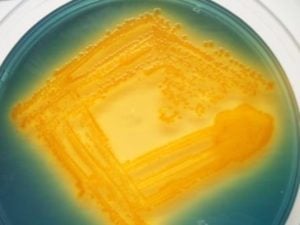 Figure: Yellow-colored colonies of Vibrio cholerae in TCBS culture medium
- Suspend 88 g of the medium in one liter of purified water (concentration may vary depending on the manufacturer).
- Heat with frequent agitation and boil for one minute to completely dissolve the medium. Do not over-heat the medium.
- DO NOT AUTOCLAVE.
- Dispense aseptically in sterile Petri dishes. Date the medium and give it a batch number.
- Store the plates at 2-8°C, in sealed plastic bags to prevent loss of moisture.
Shelf-life: TCBS agar is green when prepared. Up to 4 weeks or longer providing there is no change in the appearance of the medium to suggest contamination or alteration of pH. pH of the medium: This should be within the range of pH 8.4- 8.8 at room temperature.
Quality control
A medium of good quality gives the following mentioned results when cultured at 35°C in aerobic condition for 18-24 hours
- Vibrio parahaemolyticus ATCC® 17802: Growth; blue-green centered colonies
- Escherichia coli ATCC® 25922: Partial to complete inhibition; small, clear colonies
Using TCBS with Alkaline Peptone Water (APW) Enrichment
For stool specimens with low Vibrio counts — including convalescent cases, carriers, and environmental samples — direct plating onto TCBS may miss the organism due to overgrowth by any remaining coliform survivors. In these situations, Alkaline Peptone Water (APW) is used as an enrichment step before TCBS plating.
Procedure:
- Inoculate the stool specimen or rectal swab into APW (pH 8.6–9.0).
- Incubate at 37°C for 6–8 hours.
- Vibrio cholerae grows preferentially at this alkaline pH and forms a pellicle (surface film) in APW — a distinctive feature reflecting its motility and preference for oxygenated alkaline environments.
- Subculture from the surface pellicle only (do not shake or mix the broth before inoculating) onto TCBS agar.
- Incubate TCBS plates at 37°C for 18–24 hours.
Why the pellicle matters: V. cholerae is motile and aerophilic — it migrates to the oxygenated surface of APW, concentrating itself in the pellicle while slower-growing contaminants settle to the bottom. Inoculating from the surface preferentially enriches for Vibrio. This is not just a procedural detail — it reflects the organism's biology and is frequently tested in examinations.
Colony Characteristics on TCBS Agar
| Organism | Colony colour | Colony morphology | Sucrose fermentation |
|---|---|---|---|
| Vibrio cholerae O1 and O139 | Yellow | Large (2–4 mm), slightly flattened, opaque centre, translucent periphery, button-shaped | Yes |
| Vibrio cholerae non-O1/non-O139 | Yellow | Similar to O1; differentiated by serology only | Yes |
| Vibrio parahaemolyticus | Blue-green | 2–3 mm, smooth, opaque | No |
| Vibrio vulnificus | Blue-green | Similar to V. parahaemolyticus; associated with raw oyster consumption | No |
| Vibrio mimicus | Blue-green | Similar morphology to V. cholerae; differentiated biochemically (sucrose-negative) | No |
| Vibrio alginolyticus | Yellow | Similar to V. cholerae; differentiated by salt tolerance testing (grows in 10% NaCl) | Yes |
| Aeromonas spp. | Blue-green to yellow (variable) | Partial inhibition; small colonies; growth less robust than Vibrio | Variable |
| Escherichia coli | Partial inhibition | Small, clear, poorly growing colonies if any | — |
Important limitation — yellow colony reversion: Vibrio cholerae and other sucrose-fermenting Vibrio colonies that appear yellow when freshly read may revert to green if plates are left at room temperature for more than 30–60 minutes after removal from the incubator. Always read TCBS plates immediately after removing from the incubator, before the pH shifts back to alkaline at room temperature. This is one of the most common causes of misread plates in cholera diagnosis.
Subculture requirement: Colony morphology on TCBS is presumptive only. All suspect colonies must be subcultured onto a non-inhibitory medium (TSA, blood agar, or TSI) for confirmatory biochemical testing and serological agglutination with V. cholerae O1 and O139 antisera.
Limitation of TCBS Agar
- TCBS Agar may not support the good growth of some Vibrio spp. (e.g., V. hollisae and V. metschnikovii). The identification of the various Vibriospp. on TCBS Agar is presumptive and further tests are required for confirmation.
- It is recommended that non-selective media be used in conjunction with selective media for optimum recovery of pathogenic organisms.
- Cultures grown on TCBS should be examined immediately after removal from the incubator as yellow colonies of Vibrio spp. (e.g., V. cholerae) may revert to a green color when left at room temperature.
How to Remember
The name describes all four selective/differential components:
- Thiosulfate — selective agent, inhibits coliforms
- Citrate — selective agent, inhibits coliforms and Gram-positive organisms
- Bile Salts — inhibit Gram-positive organisms
- Sucrose — differential carbohydrate (yellow vs. blue-green colonies)
Colour logic — one rule:
Yellow = sucrose fermenter = V. cholerae group (and V. alginolyticus) Blue-green = sucrose non-fermenter = V. parahaemolyticus, V. vulnificus, V. mimicus
Three things never to forget about TCBS:
- Never autoclave — destroys selective agents and pH indicators
- Read plates immediately — yellow colonies revert to green at room temperature
- Always confirm — TCBS is presumptive only; serology and biochemical tests are required
The APW-TCBS workflow as a clinical anchor:
Stool specimen → APW (6–8 hrs, 37°C) → pellicle forms → subculture surface to TCBS → yellow colonies → oxidase test → string test → agglutination with O1/O139 antisera
This five-step workflow is the standard cholera diagnostic pathway in resource-limited laboratories and summarises the entire relationship between enrichment, selective plating, and confirmation.
References
- Pfeffer, C., & Oliver, J. D. (2003). A comparison of thiosulphate-citrate-bile salts-sucrose (TCBS) agar and thiosulphate-chloride-iodide (TCI) agar for the isolation of Vibrio species from estuarine environments. Letters in Applied Microbiology, 36(3), 150–151.
- Lotz, M. J., Tamplin, M. L., & Rodrick, G. E. (1983). Thiosulfate-citrate-bile salts-sucrose agar and its selectivity for clinical and marine vibrio organisms. Annals of Clinical and Laboratory Science, 13(1), 45–48.
- Tille, P. M. (2017). Bailey and Scott's Diagnostic Microbiology (14th ed.). Elsevier.
- Cheesbrough, M. (2006). District Laboratory Practice in Tropical Countries, Part 2 (2nd ed.). Cambridge University Press.
- World Health Organization. (2010). Cholera vaccines: WHO position paper. Weekly Epidemiological Record, 85(13), 117–128.

Tankeshwar Acharya, MSc (Medical Microbiology)
Tankeshwar Acharya is an Assistant Professor in the Department of Microbiology at Patan Academy of Health Sciences (PAHS), Nepal, where he has been teaching and practicing clinical microbiology for over 14 years. He is the founder of Microbe Online, one of the leading free microbiology education resources on the web, covering bacteriology, mycology, parasitology, immunology, and clinical laboratory diagnostics written from direct experience in both the classroom and the diagnostic laboratory.