
Radiation Sterilization: Types, Mechanism, and Applications

On this page
The syringe that used to not be disposable
It's easy to take for granted that a sealed syringe, straight out of its packaging, is simply sterile. For most of medical history, that wasn't how syringes worked at all. Reusable glass syringes had to be cleaned and re-sterilized, by whatever method a given facility had available, between uses, and that process wasn't always reliable. Inadequately reprocessed injection equipment has been a real, documented route for transmitting bloodborne pathogens in settings where resources or infrastructure for proper sterilization were limited.
What changed this wasn't a new syringe design. It was a sterilization method that could be applied after a device was already sealed inside its final packaging: gamma irradiation. Because gamma rays penetrate deeply enough to sterilize an item without ever opening its package, manufacturers could mass-produce plastic syringes, sterilize millions of them at once in a factory, seal them, and ship them out genuinely ready for single use, no autoclave, no reprocessing, no risk of an imperfect manual sterilization cycle at the point of care.
This is exactly what makes radiation sterilization different from every other method in this cluster: it's less something a hospital does and more something a manufacturer does, invisibly, before a sterile disposable device ever reaches a clinical setting at all.
Radiation is currently used for sterilization and decontamination in medical supplies (surgical supplies, vaccines, and drugs) and in the food industry.
Types of Radiation Sterilization
Radiation used for sterilization falls into two broad types: ionizing and non-ionizing. Radiation sterilization is not widely used in the food industry, since consumers have raised concerns about radioactive contamination, the production of toxic or carcinogenic byproducts, changes in nutritional value, and taste alteration.
Ionizing Radiation
Ionizing radiation is an excellent sterilization/disinfection agent. It kills organisms without raising temperature, which is exactly why it is aptly called cold sterilization, a term that, in this context, refers specifically to ionizing radiation rather than to sterilization methods in general. It destroys bacterial endospores and vegetative cells, both eukaryotic and prokaryotic, but is not always effective against viruses.
Non-Ionizing Radiation
Non-ionizing radiation is lethal to microorganisms but does not penetrate glass, dirt, films, or water. Its use is therefore restricted to disinfecting clean, directly exposed surfaces, in operation theaters, laminar flow hoods, and water treatment. The most common examples are infrared and ultraviolet radiation.
Mechanism of Sterilization by Ionizing Radiation
When ionizing radiation collides with particles, it produces electrons (e⁻) and other reactive molecules, such as hydroxyl radicals (•OH) and hydride radicals (H•). Each of these reactive species is capable of degrading and altering biopolymers such as DNA and protein. Breakage of DNA and degradation of enzymes lead to the death of the irradiated cell. This mechanism, generating reactive species that damage biomolecules indirectly, is distinct from ultraviolet radiation's mechanism (below), which directly alters DNA structure without ionizing atoms at all.
Several sources of ionizing radiation are used in sterilization: X-ray machines, cathode ray tubes (electron-beam radiation), and radioactive nuclides (sources of gamma/X-rays).
X-rays are lethal to microorganisms and higher life forms but are rarely used for sterilization, since their production is expensive and efficient utilization is difficult (radiation is emitted in all directions from the point of origin).
Gamma rays are high-energy radiations emitted from radioisotopes such as caesium-137 (¹³⁷Cs) and cobalt-60 (⁶⁰Co), both relatively inexpensive byproducts of nuclear fission. Gamma rays resemble X-rays but have a shorter wavelength and higher energy, giving them excellent penetration into matter and lethality to all life, including microorganisms. This is exactly the property the hook above depends on: gamma rays are attractive for commercial sterilization of thick or high-volume materials, such as packaged food or medical devices, precisely because they can sterilize through sealed final packaging.
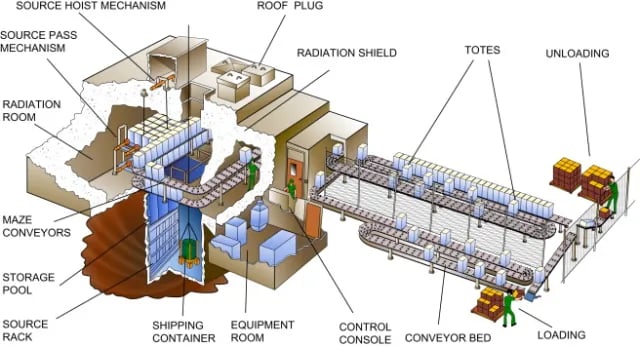 Figure: Gamma irradiation facility (Image source: MDS Nordion, Canada).
Cathode rays (electron-beam radiation) can sterilize materials at room temperature with brief exposure but have limited penetrating power, making them suitable for surgical supplies, drugs, and other relatively thin materials.
Applications of Ionizing Radiation
The major method in use for radiation sterilization is gamma irradiation, used to sterilize:
- Disposables such as plastic syringes, infusion sets, catgut sutures, catheters, gloves, and adhesive dressings, before use
- Bone and tissue grafts, antibiotics, and hormones
- Food, in countries where irradiation is permitted
Advantages of Ionizing Radiation
- High penetrating power: products can be processed inside their fully sealed, final packaging, limiting the risk of contamination after sterilization
- Rapidity of action
- No temperature increase: compatible with temperature-sensitive materials such as pharmaceuticals and biological samples
- Flexibility: can sterilize gaseous, liquid, or solid materials of any density, size, or thickness
Disadvantages of Ionizing Radiation
- High capital costs and the need for specialized facilities, such as gamma irradiation plants
- Requires handling and disposal of radioactive material
- Not compatible with all materials; can degrade packaging or product. For example, common plastics such as polyvinyl chloride (PVC), acetal, and polytetrafluoroethylene (PTFE) are sensitive to gamma radiation
Monitoring: the efficacy of ionizing radiation sterilization is validated using spores of Bacillus pumilus, a distinct biological indicator organism from the ones used for moist heat (Geobacillus stearothermophilus) or dry heat and ethylene oxide (Bacillus atrophaeus).
Non-Ionizing Radiation: Infrared and Ultraviolet
Infrared Radiation
Infrared rays are low-energy electromagnetic rays with wavelengths longer than visible light. They kill microorganisms through oxidation of molecules as a result of the heat they generate, and are used for rapid, mass sterilization of syringes and catheters.
Ultraviolet (UV) Light Sterilization
Sunlight is partly composed of UV light, though most of its shorter wavelengths are filtered out by the ozone layer. There are three types of UV radiation, UVA, UVB, and UVC, classified by wavelength. Short-wavelength UVC is the most damaging type.
Mechanism of UV Sterilization
Many cellular materials, including nucleic acids, absorb ultraviolet light. UV exposure causes two adjacent pyrimidine bases in DNA to bond directly to each other, forming a pyrimidine dimer, which blocks DNA replication and leads to mutation and death of the exposed organism. Unlike ionizing radiation, this damage occurs through direct photochemical bonding of DNA bases rather than through ionization and free-radical generation.
Figure: UV sterilization robot
Applications of UV Sterilization
UV light is useful for disinfecting surfaces, air, and water that don't absorb the UV rays themselves. It is used to disinfect enclosed areas such as microbiology laboratories, nurseries, inoculation hoods, laminar flow cabinets, and operating theaters. Biological safety cabinets, for example, commonly include a built-in "germicidal" UV light to decontaminate the work surface after use.
While UV sterilization is in progress, the area should be closed, and UV lamps must be switched off immediately afterward, since UV light is genuinely hazardous to unprotected skin and eyes.
UVC and the COVID-19 Pandemic: A Real-World Case Study
During the COVID-19 pandemic, UVC disinfection saw an unusually rapid and large-scale real-world rollout outside the laboratory. UVC-emitting robots were deployed to disinfect hospital floors and public transit, UVC units were used to sterilize buses and other vehicles, and even some banks used UV light to disinfect currency. Subsequent research confirmed that UVC is effective at inactivating SARS-CoV-2 and other enveloped viruses through the same DNA/RNA-damaging mechanism described above, making this one of the clearest real-world demonstrations of how quickly an existing decontamination technology can be redeployed at scale during a public health emergency.
Disadvantages of UV Sterilization
- Damages skin and eyes; conventional UV light can penetrate and damage skin and cause cataracts
- Does not penetrate paper, glass, or cloth
How to Remember
Completing the "how each method kills" picture across the whole cluster. Moist heat unfolds proteins with water-assisted denaturation. Dry heat slowly oxidizes them. Ethylene oxide permanently glues (alkylates) them. Radiation does something different from all three: ionizing radiation knocks electrons loose to create reactive free radicals that shred DNA and proteins indirectly, while non-ionizing UV light doesn't ionize anything at all, it directly welds two neighboring DNA bases together, jamming replication without ever generating a free radical.
Key exam facts
| Fact | Detail |
|---|---|
| Two types | Ionizing and non-ionizing radiation |
| Ionizing radiation nickname | "Cold sterilization" — kills without raising temperature |
| Ionizing mechanism | Generates reactive free radicals (•OH, H•) that damage DNA and protein indirectly |
| Sources of ionizing radiation | X-rays, gamma rays, cathode rays (electron-beam) |
| Most-used ionizing method commercially | Gamma irradiation (from ⁶⁰Co or ¹³⁷Cs) — deep penetration through sealed packaging |
| Biological indicator for ionizing radiation | Bacillus pumilus |
| Non-ionizing radiation examples | Infrared, ultraviolet (UV) |
| UV mechanism | Forms pyrimidine dimers in DNA, blocking replication (direct photochemical bonding, no ionization) |
| Most damaging UV type | UVC (short wavelength) |
| Major limitation of non-ionizing radiation | Poor penetration — doesn't penetrate glass, dirt, film, or water |
| Real-world large-scale UVC use | COVID-19 pandemic disinfection of vehicles, hospital floors, and currency |
| Key industrial application | Enables terminal sterilization of sealed, single-use disposable medical devices |
Where Students Get Confused
- Assuming "ionizing" and "non-ionizing" describe how strong the radiation is, rather than how it kills. The real distinction is mechanistic: ionizing radiation generates free radicals that damage biomolecules indirectly, while non-ionizing UV directly bonds DNA bases together without ionizing anything.
- Applying the term "cold sterilization" broadly. On this site (and in most microbiology curricula), that term specifically describes ionizing radiation. Other low-temperature methods, like ethylene oxide, are not conventionally given this label, even though they also avoid heat.
- Assuming radiation sterilization raises product temperature like heat-based methods. It doesn't; that's precisely why it's compatible with temperature-sensitive pharmaceuticals and biological materials.
- Assuming UV light can sterilize items behind glass or inside packaging. UV's poor penetration means it only disinfects directly exposed surfaces; gamma radiation is the one that can sterilize through sealed final packaging.
- Mixing up biological indicator organisms across the sterilization cluster. Bacillus pumilus validates radiation sterilization specifically, distinct from Geobacillus stearothermophilus (moist heat) and Bacillus atrophaeus (dry heat and ETO).
Frequently Asked Questions
What are the two types of radiation used in sterilization?
Why is ionizing radiation called "cold sterilization"?
How does ionizing radiation kill microorganisms?
How does UV light kill microorganisms, and how is that different from ionizing radiation?
Why is gamma radiation used to sterilize disposable medical devices?
What biological indicator is used to validate radiation sterilization?
Can UV light sterilize items inside packaging or behind glass?
Was UV light used during the COVID-19 pandemic?
References
- Madigan, M. T., Bender, K. S., Buckley, D. H., Sattley, W. M., & Stahl, D. A. (2018). Brock Biology of Microorganisms (15th ed.). Pearson.
- Lytle, C. D., & Sagripanti, J.-L. (2005). Predicted inactivation of viruses of relevance to biodefense by solar radiation. Journal of Virology, 79(22), 14244. https://www.ncbi.nlm.nih.gov/pmc/articles/PMC1280232/
- Tille, P. (2017). Bailey & Scott's Diagnostic Microbiology (14th ed.). Mosby.
- Willey, J. M., Sherwood, L. M., & Woolverton, C. J. (2016). Prescott's Microbiology (10th ed.). McGraw-Hill Education.

Tankeshwar Acharya, MSc (Medical Microbiology)
Tankeshwar Acharya is an Assistant Professor in the Department of Microbiology at Patan Academy of Health Sciences (PAHS), Nepal, where he has been teaching and practicing clinical microbiology for over 14 years. He is the founder of Microbe Online, one of the leading free microbiology education resources on the web, covering bacteriology, mycology, parasitology, immunology, and clinical laboratory diagnostics written from direct experience in both the classroom and the diagnostic laboratory.
Comments
No comments yet. Be the first to share your thoughts.
Leave a comment
All comments are reviewed before they appear.