

A peritoneal fluid specimen from a patient with abdominal sepsis is plated on blood agar, MacConkey agar, and phenylethyl alcohol blood agar. MacConkey grows several enteric gram-negatives. PEA blood agar, incubated anaerobically, grows Bacteroides fragilis — the clinically most important anaerobe in intra-abdominal infection — that was completely obscured on blood agar by the swarming Proteus mirabilis growing in the same specimen.
This is PEA agar's most important clinical role: suppressing the swarming of Proteus and Clostridium septicum to prevent them from overgrowing slow-growing anaerobes and gram-positive organisms in mixed anaerobic cultures.
Phenylethyl alcohol agar (PEA) is a selective medium used to cultivate Gram-positive organisms, particularly cocci, from a sample containing a mixture of pathogens. The active ingredient, phenylethyl alcohol, inhibits or markedly reduces the growth of Gram-negative organisms by interfering with DNA synthesis. Staphylococcus aureus, a Gram-positive organism, grows on PEA while Serratia marcescens, a Gram-negative organism, does not.
Principle
Phenylethyl alcohol agar (PEA) is a selective medium that permits the growth of gram-positive cocci while inhibiting most gram-negative organisms. PEA alters the membrane permeability, of Gram-negative bacteria allowing influx of otherwise blocked molecules. This results in leakage of large amounts of cellular potassium that ultimately results in disruption or inhibition of DNA synthesis of Gram-negative bacteria.
Composition of PEA
PEA agar medium can be purchased as a premixed powder from suppliers. The manufacturer’s instructions should be followed to prepare the plates. This media can also be purchased as premade agar plates.
| Ingredients | Amounts (gm/L) |
|---|---|
| Pancreatic digest of casein | 15.0 g |
| Papic digest of soybean meal | 5.0 g |
| Sodium chloride | 5.0 g |
| Agar | 15.0 g |
| Sterile defibrinated sheep blood | 50.0 ml |
| β-Phenylethyl alcohol | 2.5 g |
| Distilled water | 1 liter |
Final pH at 25°C 7.3 ± 0.2.
Preparation of the Media
Phenylethyl alcohol agar (PEA) may be prepared with and without 5% sheep blood supplement. Five percent sheep blood is added to the base medium to enhance the growth of anaerobic bacteria.
| Characteristics | PEA without sheep blood | PEA with 5% sheep blood |
|---|---|---|
| Color of the prepared media | clear to slightly hazy and pale yellow. | firm, opaque, and red in color. |
| Shelf live | prepared plates can be stored in the refrigerator for up to 4 weeks before use. | prepared plates could be stored in the refrigerator up to 1 week before use. |
Step no. 5 is required while preparing PEA with 5% sheep blood supplementation.
Note:
Culture
Inoculation
Stored media should be brought to room temperature before inoculation.
Aseptically transfer potentially mixed cultures onto the surface of the agar using a streaking or spreading technique, depending on the objectives of the study.
Incubation
Incubate plates for 24 to 48 hours at 35°C ± 2 °C in an appropriate atmosphere. Depending on the objectives of the study, PEA blood agar plates can be incubated under aerobic, anaerobic, and 5% CO2 atmosphere. Incubation in a high CO2 atmosphere allows the detection of bacteria that require an increased CO2 concentration and also results in better growth of almost all of the other pathogens.
Interpretation of results
After proper incubation growth of bacteria will appear as colonies on the surface of agar plates. Gram-positive bacteria demonstrate good growth while most gram-negative bacteria do not grow or are partially inhibited.
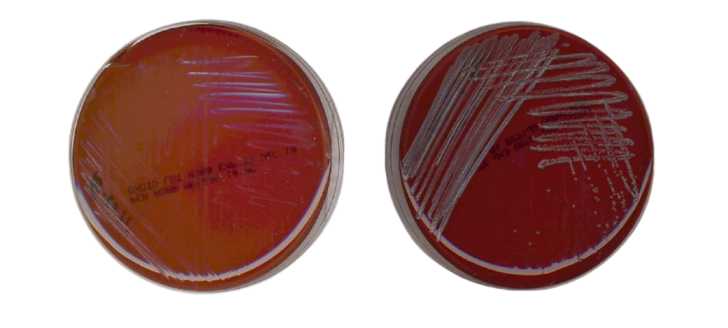 Figure: PEA agar plates with 5% sheep blood incubated at 48 hours at 35°C Left: Escherichia coli. Right: Staphylococcus aureus Image source: Cheeptham and Farday, ASM MicrobeLibrary
Growth Response
Growth response of some gram-positive and gram-negative bacteria on PEA agar
| Organism | Gram reaction | Growth response |
|---|---|---|
| Escherichia coli | Gram-negative | Inhibited |
| Enterobacter aerogenes | Gram-negative | Inhibited |
| Proteus mirabilis | Gram-negative | Markedly inhibited. Swarming inhibition. |
| Pseudomonas aeruginosa | Gram-negative | Partially inhibited |
| Salmonella enteritidis | Gram-negative | Inhibited |
| Bacillus sp. | Gram-positive | Good |
| Clostridium perfringens | Gram-positive | Partially inhibited |
| Enterococcus faecalis | Gram-positive | Good |
| Micrococcus luteus | Gram-positive | Good |
| Staphylococcus aureus | Gram-positive | Good |
| Streptococcus pneumoniae | Gram-positive | Good |
| Streptococcus pyogenes | Gram-positive | Good |
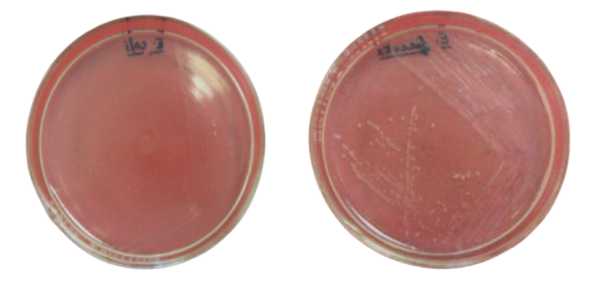 Figure: PEA agar plates without blood incubated at 48 hours at 35°C Left: Escherichia coli. Right: Enterococcus faecalis Image source: Cheeptham and Farday, ASM MicrobeLibrary
Uses
- PEA agar is used if the sample source contains a mixture of pathogens (e.g., gastrointestinal content or peritoneal fluid) or Gram stain indicates that the culture contains Gram-negative rods. Phenylethyl alcohol agar inhibits gram-negative bacteria, specifically Proteus species, in specimens containing mixed bacterial flora. It is used for the selective growth of Staphylococcus and Streptococcus inmixed cultures.
- PEA agar with 5% sheep blood is used to isolate most gram-positive and gram-negative anaerobes from enteric samples. It inhibits facultative gram-negative rods, preventing Enterobacteriaceae from overgrowing the anaerobes and inhibiting the swarming of Proteus and Clostridium septicum.
PEA vs Columbia CNA Agar — Which to Choose?
Both PEA and Columbia CNA select for gram-positive organisms, but they use different mechanisms and have different strengths:
| Feature | PEA Agar | Columbia CNA Agar |
|---|---|---|
| Selective agents | Phenylethyl alcohol (disrupts membrane) | Colistin + Nalidixic acid (antibiotic inhibition) |
| Mechanism | Membrane permeability disruption → K⁺ leakage → DNA synthesis failure | Colistin destroys outer membrane; nalidixic acid inhibits DNA gyrase |
| Pseudomonas growth? | Yes — P. aeruginosa is NOT inhibited by PEA | Generally no — colistin inhibits most Pseudomonas |
| Anaerobic use? | Yes — blood-supplemented PEA is standard for anaerobic gram-positive isolation | Limited — CNA primarily used aerobically |
| Anti-swarming (Proteus) | Yes — phenylethyl alcohol specifically inhibits Proteus swarming | Less effective for swarming inhibition |
| Primary use | Mixed anaerobic cultures; Proteus swarming specimens | Wound/genital specimens; aerobic gram-positive isolation |
Key rule: Use PEA for anaerobic cultures and specimens with swarming Proteus. Use Columbia CNA for aerobic gram-positive isolation from mixed aerobic specimens.
Limitations
- Some gram-positive cocci may be slightly inhibited by PEA and many require incubation up to 48 hours for sufficient growth to be visible.
- Pseudomonas aeruginosa (a gram-negative bacteria) is not inhibited on this medium. Other gram-negatives sometimes may give tiny observable colonies but they are often confined to the first quadrant on a streak plate.
Key Exam Facts in One Table
| Feature | Detail |
|---|---|
| Type | Selective medium |
| Selective agent | Phenylethyl alcohol (PEA) — disrupts gram-negative outer membrane |
| Organisms that grow | Gram-positive cocci and anaerobes |
| Pseudomonas aeruginosa | NOT inhibited — grows on PEA (key exception) |
| Proteus swarming | Specifically inhibited — important clinical use |
| Blood supplement | 5% sheep blood added for anaerobic version — enhances anaerobe growth |
| Primary clinical use | Anaerobic cultures from mixed specimens; Proteus-contaminated specimens |
| Incubation (aerobic) | 35°C, 24–48h |
| Incubation (anaerobic) | 35°C, 48–72h in anaerobic atmosphere |
| vs Columbia CNA | CNA preferred for aerobic gram-positive; PEA preferred for anaerobic and anti-swarming |
References and further readings
- Lal A, Cheeptham N. Phenylethyl alcohol agar protocol. American Society for Microbiology; 2011.
- Garcia LS. Clinical Microbiology Procedures Handbook. 4th ed. ASM Press; 2016.
- Forbes BA, Sahm DF, Weissfeld AS. Bailey & Scott's Diagnostic Microbiology. 14th ed. Elsevier; 2023.
- Murray PR, Rosenthal KS, Pfaller MA. Medical Microbiology. 9th ed. Elsevier; 2020.

Comments
No comments yet. Be the first to share your thoughts.
Leave a comment
All comments are reviewed before they appear.