
WHO Priority Pathogens List (BPPL 2024): Critical, High, and Medium
The WHO Bacterial Priority Pathogens List (BPPL) 2024 ranks 24 antibiotic-resistant bacteria into critical, high, and medium tiers. See the full current list, what changed from the 2017 list, and how to remember it.

On this page
Every few years, the World Health Organization asks a hard question: if we can only develop so many new antibiotics, which resistant bacteria should we target first? The answer is the Bacterial Priority Pathogens List, and in 2024 it was updated for the first time since 2017. Some pathogens climbed, one dropped out of the top tier, and new ones appeared, each move reflecting where resistance is now hurting people most. This article gives the current 2024 list in full, then shows exactly what changed and why.
The WHO Bacterial Priority Pathogens List (BPPL) is a ranked catalogue of the antibiotic-resistant bacteria that pose the greatest threat to human health. Its purpose is to steer research and development of new antibiotics toward the pathogens that need them most. WHO published the first list in 2017 and released a major update, the BPPL 2024, on 17 May 2024. The 2024 edition covers 24 pathogens across 15 bacterial families, sorted into three tiers by urgency: critical, high, and medium. The current (2024) list is given below, followed by what changed from 2017 and why.
The list highlights in particular the threat of gram-negative bacteria that are resistant to multiple antibiotics. These bacteria have built-in abilities to find new ways to resist treatment and can pass along genetic material that allows other bacteria to become drug-resistant as well.
The WHO list is divided into three categories according to the urgency of the need for new antibiotics: critical, high, and medium priority.
Updates of BPPL (Bacterial Priority Pathogens List), 2024
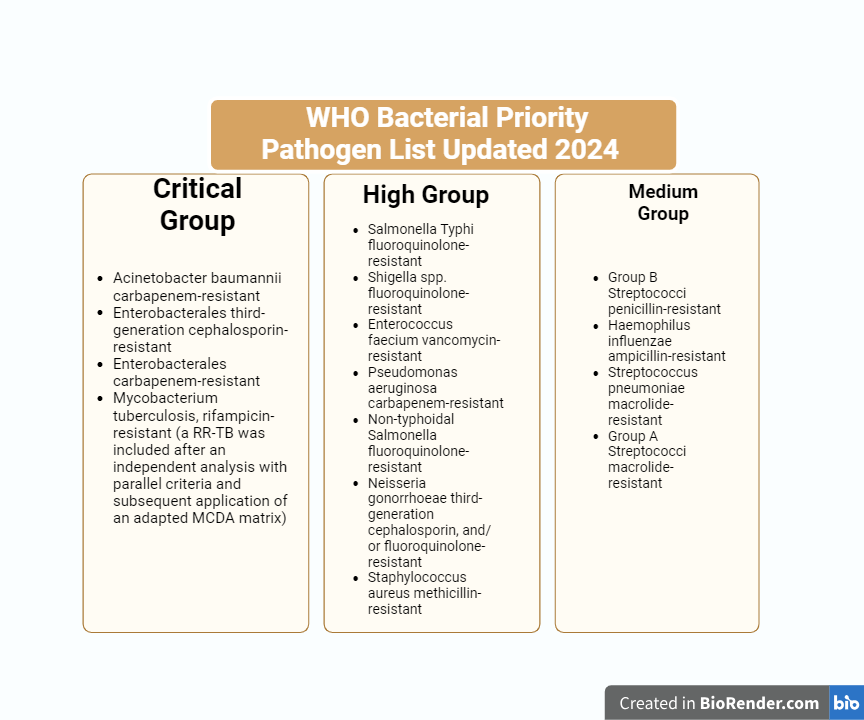 Figure: WHO new Updated list
According to Dr Yukiko Nakatani, WHO’s Assistant Director-General for Antimicrobial Resistance ad interim, the threat of antimicrobial resistance has increased significantly since the last list in 2017.
The most significant changes in 2024 are the separate listing of third-generation cephalosporin-resistant Enterobacterales in the critical group, and the addition of rifampicin-resistant Mycobacterium tuberculosis (RR-TB) to the critical group. Both reflect how few effective options remain for these infections. A notable reclassification is the move of carbapenem-resistant Pseudomonas aeruginosa from critical (2017) down to high (2024). This does not mean the threat has gone away; it reflects updated data showing the situation, while still serious, is somewhat less acute than in 2017.
The WHO BPPL 2024 includes the following bacteria:
Critical priority
- Acinetobacter baumannii, carbapenem-resistant;
- Enterobacterales, third-generation cephalosporin-resistant, and
- Enterobacterales, carbapenem-resistant;
- Mycobacterium tuberculosis is rifampicin-resistant (included after an independent analysis with parallel tailored criteria and subsequent application of an adapted multi-criteria decision analysis matrix).
High priority
- Salmonella Typhi, fluoroquinolone-resistant
- Shigella spp., fluoroquinolone-resistant
- Enterococcus faecium, vancomycin-resistant
- Pseudomonas aeruginosa, carbapenem-resistant
- Non-typhoidal Salmonella, fluoroquinolone-resistant
- Neisseria gonorrhoeae, third-generation cephalosporin- and/or fluoroquinolone-resistant
- Staphylococcus aureus, methicillin-resistant
Medium priority
- Group A streptococci, macrolide-resistant
- Streptococcus pneumoniae, macrolide-resistant
- Haemophilus influenzae, ampicillin-resistant
- Group B streptococci, penicillin-resistant
What changed from the 2017 list to 2024
The 2024 update was not a small refresh. Building on the 2017 list, it re-scored pathogens using new burden data and expert review. The changes worth knowing:
| Change | 2017 | 2024 | Why it matters |
|---|---|---|---|
| Carbapenem-resistant Pseudomonas aeruginosa | Critical | Downgraded to High | The single most-cited change. Updated data showed the threat, while serious, was less acute than in 2017. |
| Rifampicin-resistant Mycobacterium tuberculosis | Not tiered in the main list | Added to Critical | Reflects the difficulty and cost of treating drug-resistant TB; a major addition. |
| Third-generation cephalosporin-resistant Enterobacterales | Grouped with carbapenem-resistant | Listed separately in Critical | Highlights a distinct, growing threat needing its own R&D focus, especially in low- and middle-income countries. |
| Group A and Group B Streptococci | Not on the list | New, in Medium | Reflects a new emphasis on community-acquired infections, not just hospital pathogens. |
| Helicobacter pylori (clarithromycin-resistant) | High priority | Removed | Streamlined out as priorities were re-scored. |
| Campylobacter spp. (fluoroquinolone-resistant) | High priority | Removed | Removed in the re-prioritization. |
The overall pattern of the 2024 update: Gram-negative bacteria and rifampicin-resistant M. tuberculosis remain the top of the critical tier, while the list broadened toward community-acquired pathogens (such as Salmonella Typhi, Shigella, and the streptococci) that hit resource-limited settings hardest.
The original 2017 WHO priority pathogens list (for historical reference)
The 2017 list below is the original edition, now superseded by the BPPL 2024 above. It is kept here for reference and to show how prioritization has evolved.
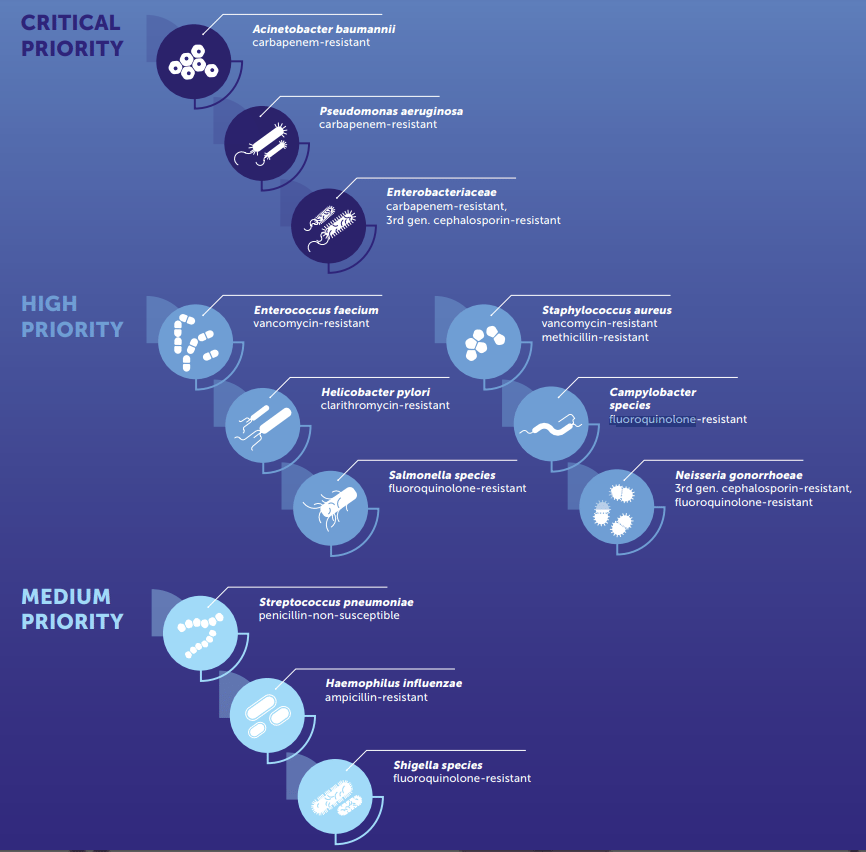 Figure: WHO Priority Pathogen List (2017)
Priority 1: CRITICAL
- Acinetobacter baumannii: Carbapenem-resistant
- Pseudomonas aeruginosa: Carbapenem-resistant
- Enterobacteriaceae: Carbapenem-resistant, 3rd gen cephalosporin-resistant
Priority 2: HIGH
- Enterococcus faecium, vancomycin-resistant
- Staphylococcus aureus, methicillin-resistant, vancomycin-intermediate and resistant
- Helicobacter pylori, clarithromycin-resistant
- Campylobacter spp., fluoroquinolone-resistant
- Salmonellae, fluoroquinolone-resistant
- Neisseria gonorrhoeae, cephalosporin-resistant, fluoroquinolone-resistant
Priority 3: MEDIUM
- Streptococcus pneumoniae, penicillin-non-susceptible
- Haemophilus influenzae, ampicillin-resistant
- Shigella spp., fluoroquinolone-resistant
The most critical group of all includes multidrug-resistant bacteria that pose a particular threat in hospitals, nursing homes, and among patients whose care requires devices such as ventilators and blood catheters. They include Acinetobacter, Pseudomonas, and various Enterobacteriaceae (including Klebsiella, E. coli, Serratia, and Proteus). They can cause severe and often deadly infections such as bloodstream infections and pneumonia.
These bacteria have become resistant to a large number of antibiotics, including carbapenems and third-generation cephalosporins, the best available antibiotics for treating multi-drug resistant bacteria.
The second and third tiers in the list, the high and medium priority categories – contain other increasingly drug-resistant bacteria that cause more common diseases such as gonorrhea and food poisoning caused by Salmonella.
According to WHO, the list was developed in collaboration with the Division of Infectious Diseases at the University of Tübingen, Germany, using a multi-criteria decision analysis technique vetted by a group of international experts. The criteria for selecting pathogens on the list were:
- how deadly the infections they cause are; whether their treatment requires long hospital stays;
- how frequently they are resistant to existing antibiotics when people in communities catch them;
- how easily they spread between animals, from animals to humans, and from person to person;
- whether they can be prevented (e.g. through good hygiene and vaccination);
- how many treatment options remain; and
- whether new antibiotics to treat them are already in the R&D pipeline.
How to Remember
ESKAPE covers most of the critical and high pathogens. The ESKAPE group (Enterococcus faecium, Staphylococcus aureus, Klebsiella pneumoniae, Acinetobacter baumannii, Pseudomonas aeruginosa, Enterobacter species) is the set of bacteria that most often "escape" the action of antibiotics, and it maps closely onto the WHO critical and high tiers. If you know ESKAPE, you already know most of the top of the list. Students search "ESKAPE pathogens" heavily, and this is the anchor.
Critical = Gram-negatives plus resistant TB. The 2024 critical tier is almost entirely carbapenem-resistant Gram-negative bacteria (Acinetobacter, Enterobacterales) plus rifampicin-resistant TB. If you remember "critical means the Gram-negatives we're running out of drugs for, plus drug-resistant TB," you can reconstruct the tier.
The one that moved down: Pseudomonas. The single most-tested change from 2017 to 2024 is carbapenem-resistant Pseudomonas aeruginosa dropping from critical to high. One organism, one direction, easy to remember.
Medium = community pathogens. The medium tier is the community-acquired, vaccine-relevant organisms: pneumococcus, Haemophilus influenzae, and the streptococci. "Medium means the ones you meet in the community" separates it from the hospital-heavy critical tier.
Key exam facts
| Point | Fact | Memory aid |
|---|---|---|
| Current list | BPPL 2024 (released 17 May 2024) | 2024 is current; 2017 is historical |
| Coverage | 24 pathogens, 15 bacterial families | 24 in 15 |
| Tiers | Critical, High, Medium | Three levels of urgency |
| Purpose | Guide R&D of new antibiotics (2024 also adds public health actions) | Where to aim new drugs |
| Critical tier | Carbapenem-resistant Acinetobacter baumannii; carbapenem-resistant and 3rd-gen-cephalosporin-resistant Enterobacterales; rifampicin-resistant M. tuberculosis | Gram-negatives + resistant TB |
| Biggest change | Carbapenem-resistant Pseudomonas aeruginosa: critical (2017) to high (2024) | Pseudomonas moved down |
| New additions | Rifampicin-resistant TB (critical); Group A and B strep (medium) | TB up, strep new |
| Removed from 2017 | Helicobacter pylori, Campylobacter (among others) | H. pylori and Campylobacter gone |
| Top-ranked pathogen | Carbapenem-resistant Klebsiella pneumoniae (highest score) | Klebsiella at the top |
| Method | Multi-criteria decision analysis (MCDA) | Scored, not guessed |
| Related mnemonic | ESKAPE group maps onto critical/high tiers | ESKAPE = escapes antibiotics |
Where Students Get Confused
"Is this the 2017 list or the 2024 list?" The current, valid list is BPPL 2024, released in May 2024. The 2017 list was the first edition and is now superseded. If a question or source refers simply to "the WHO priority pathogens list" today, it means the 2024 edition. Always check the year, because the tiers changed between them.
"Why did Pseudomonas aeruginosa move from critical to high?" Because the 2024 re-scoring, using newer burden and resistance data, found the threat from carbapenem-resistant P. aeruginosa, while still serious, was somewhat less acute than in 2017. It moved down one tier but remains a high-priority pathogen. The move reflects updated evidence, not that the problem is solved.
"Are third-generation cephalosporins the last-resort antibiotics?" No. For the critical Gram-negative pathogens, the last-resort agents are the carbapenems. Third-generation cephalosporins are important broad-spectrum agents, and resistance to them is a serious warning sign, but they are not the last line. Confusing the two is a common error.
"Enterobacteriaceae or Enterobacterales?" The 2024 list uses Enterobacterales, the order that includes E. coli, Klebsiella, Enterobacter, and others. Enterobacteriaceae is an older, narrower family name. For current work, use Enterobacterales.
"What is the difference between the WHO list and ESKAPE?" ESKAPE is a memory device for six bacteria that commonly escape antibiotic action; it predates and overlaps the WHO list but is not identical. The WHO BPPL is an official, scored, tiered priority list covering 24 pathogens. ESKAPE is a useful shorthand for the top of it, not a substitute for it.
"How many pathogens are on the 2024 list, 24 or 15?" Both numbers are correct for different things. The list covers 24 individual pathogen-antibiotic combinations, grouped into 15 bacterial families. "24 pathogens across 15 families" captures both.
Frequently Asked Questions
What is the WHO priority pathogens list?
What is the WHO priority pathogens list?
It is the WHO Bacterial Priority Pathogens List (BPPL), a ranked catalogue of antibiotic-resistant bacteria that pose the greatest threat to human health. It sorts pathogens into critical, high, and medium tiers to guide where new antibiotics and public health efforts are most urgently needed.
What is the latest WHO priority pathogens list?
What is the latest WHO priority pathogens list?
The current edition is the BPPL 2024, released on 17 May 2024. It covers 24 pathogens across 15 bacterial families and replaces the original 2017 list.
What are the critical priority pathogens in 2024?
What are the critical priority pathogens in 2024?
Carbapenem-resistant Acinetobacter baumannii, carbapenem-resistant Enterobacterales, third-generation cephalosporin-resistant Enterobacterales, and rifampicin-resistant Mycobacterium tuberculosis.
What changed between the 2017 and 2024 WHO lists?
What changed between the 2017 and 2024 WHO lists?
The biggest change is carbapenem-resistant Pseudomonas aeruginosa moving from critical to high. Rifampicin-resistant tuberculosis was added to the critical tier, Group A and B streptococci were newly added to the medium tier, and some 2017 pathogens (including Helicobacter pylori and Campylobacter) were removed.
What are the ESKAPE pathogens, and how do they relate to the WHO list?
What are the ESKAPE pathogens, and how do they relate to the WHO list?
ESKAPE stands for Enterococcus faecium, Staphylococcus aureus, Klebsiella pneumoniae, Acinetobacter baumannii, Pseudomonas aeruginosa, and Enterobacter species, the bacteria that most often escape antibiotic action. They overlap heavily with the WHO critical and high tiers, which makes ESKAPE a useful shorthand for the top of the list.
Why is Pseudomonas aeruginosa no longer a critical priority?
Why is Pseudomonas aeruginosa no longer a critical priority?
The 2024 re-scoring, based on newer data, found the threat from carbapenem-resistant P. aeruginosa, while still serious, was somewhat less acute than in 2017, so it was moved to the high tier. It remains an important priority pathogen.
References
- World Health Organization. WHO Bacterial Priority Pathogens List, 2024: bacterial pathogens of public health importance to guide research, development and strategies to prevent and control antimicrobial resistance. Geneva: World Health Organization; 2024. Licence: CC BY-NC-SA 3.0 IGO. Available from: https://www.who.int/publications/i/item/9789240093461
- World Health Organization. WHO updates list of drug-resistant bacteria most threatening to human health. 17 May 2024. Available from: https://www.who.int/news/item/17-05-2024-who-updates-list-of-drug-resistant-bacteria-most-threatening-to-human-health
- Sati H, et al. The WHO Bacterial Priority Pathogens List 2024: a prioritisation study to guide research, development, and public health strategies against antimicrobial resistance. Lancet Infect Dis. 2025. Available from: https://www.thelancet.com/journals/laninf/article/PIIS1473-3099(25)00118-5/fulltext
- Tacconelli E, et al. Discovery, research, and development of new antibiotics: the WHO priority list of antibiotic-resistant bacteria and tuberculosis. Lancet Infect Dis. 2018;18(3):318-327.

Tankeshwar Acharya, MSc (Medical Microbiology)
Tankeshwar Acharya is an Assistant Professor in the Department of Microbiology at Patan Academy of Health Sciences (PAHS), Nepal, where he has been teaching and practicing clinical microbiology for over 14 years. He is the founder of Microbe Online, one of the leading free microbiology education resources on the web, covering bacteriology, mycology, parasitology, immunology, and clinical laboratory diagnostics written from direct experience in both the classroom and the diagnostic laboratory.
Comments
No comments yet. Be the first to share your thoughts.
Leave a comment
All comments are reviewed before they appear.