
Laminar Airflow Cabinet: How It Works, and Why It Is Not a Biosafety Cabinet

On this page
A microbiologist in a pharmaceutical manufacturing facility is preparing a sterile intravenous medication. She sets up her work in a laminar airflow cabinet, confident that her workspace is protected. The cabinet maintains sterile conditions perfectly; no particles settle on the product, and no contamination reaches the vial.
What she does not notice, because there is nothing to see, is which way the air is moving. Filtered air enters from the HEPA filter behind the work surface and flows forward, across her hands and out through the front opening where she is sitting. That is exactly what keeps the vial sterile. It also means anything aerosolized at the work surface travels toward her face. If the vial held Mycobacterium tuberculosis instead of a pharmaceutical, the cabinet would be delivering it to her breathing zone.
A laminar airflow cabinet and a biosafety cabinet look similar. They sit on the bench. They have a work surface. They have airflow and filtration. But they are answering completely different questions. One asks, "How do I keep my product sterile?" The other asks, "How do I protect myself from a biohazard?" Confusing the two is not a minor mistake; it's how labs become transmission sites.
The microbiology laboratory handles many infectious and hazardous materials. The handling risks the contamination of the environment and increases the risk of infection in laboratory personnel. So, safety cabinets are preferred for safe and contamination-free handling of microbial cultures. These help in the containment of infectious aerosols. The types of safety cabinets commonly used are biological safety cabinets and laminar air flow cabinets.
A laminar airflow cabinet is a closed workstation that uses HEPA (high-efficiency particulate air) filters to provide a unidirectional flow of sterile air at a steady velocity. It offers an area for contamination-free handling of sterile, non-hazardous materials, protecting the work from airborne contamination. It is ideal for preparing sterile culture media, assembling sterile components into complete units, and other aseptic transfers. It is NOT for hazardous or infectious material (see the safety sections below).
Critical distinction from biosafety cabinets: A laminar airflow cabinet is designed to protect the product (maintain sterility and prevent contamination of the work). It does NOT protect the worker from biohazards. The filtered air flows from the back of the cabinet toward the front opening, where the worker sits. Any pathogenic organism aerosol generated during work will be pushed out of the cabinet toward the worker, not contained or filtered. Laminar airflow cabinets must never be used for work with biohazardous materials; they provide a false sense of safety that can be deadly.
Parts of Laminar Airflow Cabinet
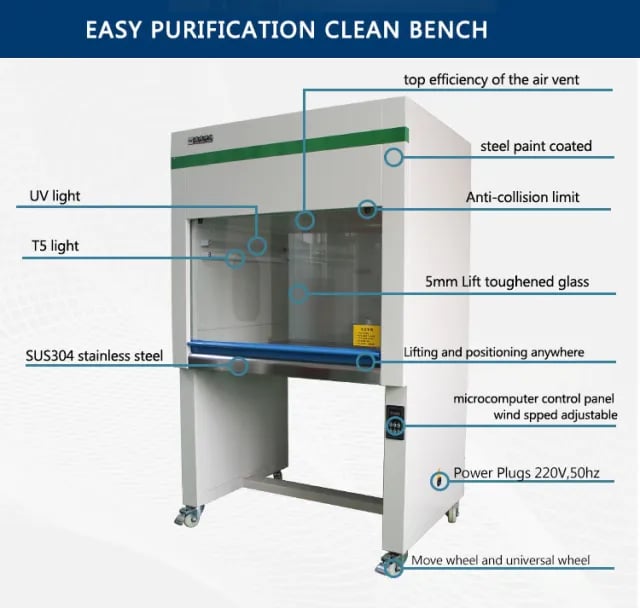 Figure: Parts of vertical laminar airflow chamber
The parts of the laminar airflow chamber are the cabinet, working platform, filter pad (pre-filter), blower/fan, HEPA filter, fluorescent lamp, and UV lamp.
- Cabinet: It is the outermost part of the hood. It is made up of stainless steel. The cabinet provides an enclosed system of insulated air throughout the working station. The front part of the cabinet consists of a sliding glass door. The sliding door should be closed completely when the hood is not in use because it shields the inner sterile condition from the outside environment.
- Working platform: It is the sterile space inside the cabinet. The platform is also made up of stainless steel and serves as an area for performing all the desired tasks.
- Filter pad: it is the primary filter for absorbing pollutants of air entering inside the cabinet.
- Blower/Fan: It draws the semi-filtered air from the filter pad and passes it into the HEPA filter.
- HEPA filter: the second, high-efficiency filter. A true HEPA filter traps at least 99.97% of particles at 0.3 µm, which is the most penetrating particle size (it captures both larger and smaller particles even more efficiently). The filtered, sterile air then passes across the chamber at uniform velocity.
- Fluorescent lamp: It is helpful for illumination inside the cabinet for performing tasks.
- UV lamp: Used for surface decontamination of the work area, glassware, and instruments between sessions. It acts only on surfaces the light reaches directly
Working Principle of Laminar Airflow Chamber
The operation of the laminar airflow chamber is based on the unidirectional flow of filtered sterile air with constant velocity. The prefilter/filter pad of the hood traps the outside non-sterile air; the air is slightly filtered by it. The prefilter air is then blown to the HEPA filter with the help of a fan/blower. The HEPA filter removes essentially all airborne particulates, and the filtered air then passes across the working area at uniform velocity. This way, the non-sterile air is trapped, filtered, and sterilized to pass through the working area.
Sometimes the objects used inside the hood might be non-sterile or exposed to the outside air. The exposure may risk the contamination of the hood, so using the UV lamp while using metals, glassware, and media before performing the task helps maintain sterility.
This positive-pressure, filtered-air-toward-the-worker design is the exact opposite of a biosafety cabinet, which draws air away from the worker. For how the BSC achieves worker protection, see Biological Safety Cabinet (BSC): Types, Working Mechanism.
Operating a Laminar Airflow Cabinet
The following steps are required for the operation of the laminar airflow cabinet:
- Firstly, turn on the hood’s main switch and ensure the manometer displays the normal/expected pressure reading before using it.
- Then turn on the airflow switch for circulating air in the hood.
- Place the required objects, media, glassware, and instruments inside the hood, close the sash fully, and switch on the UV lamp. UV must never be run with the sash open or with anyone exposed, since it causes eye and skin injury.
- Switch the UV lamp off after about 30 minutes, then switch on the fluorescent lamp and begin work. UV decontaminates only the surfaces it reaches directly, so it supplements wiping with 70% alcohol rather than replacing it.
Cleaning the Laminar Airflow Hood
- Turn the airflow and UV switch off for cleaning the working space.
- Use a clean dry cloth for cleaning the HEPA filter grill (protective grill). Do not wet the grill.
- Now clean the interior working area using a clean cloth and sterile water. Then, spray the 70% alcohol (isopropyl alcohol) and wipe with another clean cloth on the work surface.
- Finally, close the sash and switch on the UV lamp for surface decontamination.
Critical Safety Precaution
DO NOT use this laminar airflow cabinet for any work with biohazardous materials, pathogenic organisms, or any BSL1, BSL2, BSL3, or BSL4 work. Laminar airflow cabinets are NOT designed to protect the worker from biohazards. Using one for pathogenic work leaves the operator unprotected and is prohibited under standard laboratory biosafety guidance.
For aseptic pharmaceutical, tissue culture, or other non-biohazard work:
- Operators should wear personal protective equipment such as gloves and gowns. They should also avoid unnecessary movements and minimize talking and coughing near the hood.
- Eating, drinking, and smoking are strictly prohibited near the hood.
- Arrange work so that nothing non-sterile sits upstream of a sterile item in the airflow path.
- Maintenance of the filters and blowers should be carried out timely.
- Carrying out the aseptic procedures should be performed at least 15 cm (6 inches) inside the front edge and away from the sides of the hood.
- Operators must not wear jewelry on their hands and wrists.
- Replace the UV lamp according to the manufacturer's schedule, commonly every 8,000 to 9,000 hours or annually, since output falls well before the lamp stops emitting visible light
Types of Laminar Airflow Chamber
Based on the movement of air, the laminar airflow cabinet is of two types which are; horizontal and vertical airflow cabinets.
Horizontal Airflow Cabinet
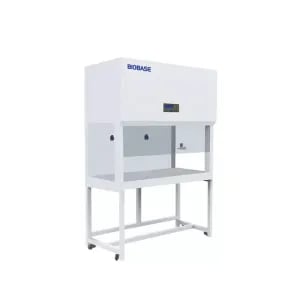 Figure: Horizontal airflow cabinet
The air movement in these cabinets is from the back to the front of the hood, meaning filtered air flows toward the worker's face and breathing zone. The electrical blower pulls air from the room, passes it through a pre-filter or filter pad, then through the HEPA filter (final filter). In a horizontal cabinet the HEPA filter is mounted on the back wall, so the filtered air is delivered horizontally across the work surface toward the front. Since the HEPA filter removes particles of 0.3 µm efficiently, it easily removes common airborne microorganisms of 0.5 µm or larger. For product sterility, nothing non-sterile should be placed behind a sterile object, because it would sit upstream in the airflow.
Critical safety note: Because air flows toward the worker's face and breathing zone, horizontal laminar airflow cabinets must NEVER be used for work with pathogenic organisms or biohazards. Any aerosol generated from infectious material will be directed at the worker instead of being contained.
Vertical Airflow Cabinet
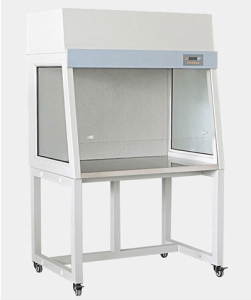 Figure: Vertical airflow cabinet
In vertical laminar airflow cabinets, the HEPA-filtered air moves downward from the top to the bottom of the hood. This downward flow of air provides excellent protection of the product and can prevent cross-contamination between samples. The operator is still exposed, however. Downward air strikes the work surface and deflects outward in all directions, including toward the front opening, and there is no inward face velocity to intercept it. Anything aerosolized at the work surface can reach the operator. Vertical laminar airflow cabinets are therefore NOT suitable for work with biohazardous materials or pathogenic organisms.
Uses of Laminar Airflow Cabinet
The laminar airflow cabinet is helpful in the following laboratory works:
- Preparing culture media for bacterial and fungal isolation and culture.
- Performing plant cell and tissue cultures.
- Conducting other tasks that require aseptic conditions, like the operation of particle-sensitive electronic devices.
- Preparing and quality testing of pharmacological products.
- Performing general laboratory tasks by adjusting settings as per need.
Advantages of Laminar Airflow Cabinet (for aseptic pharmaceutical and tissue culture work)
- Since heat or harsh chemicals are not used in laminar airflow cabinets, it prevents chemical irritation and heat-related damage to samples and reagents.
- The sterile working area is spacious, so larger containers can be used inside the cabinet compared to some other aseptic containment methods.
Important: Laminar airflow cabinets are not advantages over biosafety cabinets; they serve completely different purposes. Biosafety cabinets protect the worker from biohazards. Laminar airflow cabinets do not. These are not interchangeable choices.
Technical limitations:
- Changes in airflow velocity can create zones of turbulence within the cabinet. Turbulent air disrupts the smooth unidirectional flow and can draw contaminants into the sterile work zone, so a stable, uniform velocity is important.
- A cabinet that has been switched off needs a purge period, typically 15 to 30 minutes of airflow, before aseptic work can begin.
- If the filter pad and HEPA filter are not cleaned correctly and timely, the risk of contamination increases.
Laminar Airflow Cabinet vs. Biosafety Cabinet: Key Differences
| Feature | Laminar Airflow Cabinet | Biosafety Cabinet (Class II) |
|---|---|---|
| Primary Purpose | Protect the product from external contamination (aseptic work) | Protect the worker AND the product AND the environment from biohazards |
| Airflow Direction | Air flows from back to front (toward worker) | Air flows from front into cabinet (away from worker) |
| Worker Protection | None. Worker is exposed to aerosols | Yes. Inward airflow and HEPA filtration protect worker |
| Product Protection | Yes. It prevents contamination of the work | Yes. Inward airflow and HEPA filtration prevent contamination |
| Environmental Protection | No. Unfiltered air exhausts to room | Yes. All exhausted air is HEPA filtered |
| Appropriate for Biohazards? | No. Never use for pathogens or BSL work | Yes, required for aerosol-generating work at BSL2 and above |
| Typical Uses | Pharmaceutical preparation, tissue culture, cosmetics manufacturing, cleanroom work | Work with pathogenic organisms, BSL1/2/3 procedures, diagnostic testing |
| Regulatory Compliance for Biohazard Work | Not acceptable for biohazardous work | Required by regulation for BSL work |
Bottom line: These are fundamentally different tools answering completely different questions. Never assume one can substitute for the other.
How to Remember
- Laminar airflow pushes air toward you; biosafety cabinets pull air away from you. Laminar = positive pressure, worker-side exhaust. Biosafety = negative pressure, worker-side inflow. Opposite directions, opposite purposes.
- "Aseptic" vs. "containment," the one-word distinction: Laminar airflow is an aseptic tool (keeping the product clean). Biosafety cabinets are containment tools (keeping the organism contained). Same bench, different questions.
- If it says "pharmaceutical preparation" or "tissue culture," it's probably laminar flow. If it says "BSL2" or "pathogen," it's biosafety cabinet. Never mix these up.
- The visual test: If the cabinet manual doesn't mention worker protection from biohazards and explicitly states applications like "pharmaceutical" or "aseptic," it's not a biosafety cabinet, no matter how much it looks like one. Don't assume.
Key exam facts in one table
| Feature | Laminar Airflow Cabinet | Biosafety Cabinet (Class II) | Critical difference |
|---|---|---|---|
| Airflow direction | Toward the worker (filtered air blows across the work and out through the front opening) | Away from the worker (room air is drawn in at the front, away from the breathing zone) | The entire safety difference rests on this: LAF pushes air at you, BSC pulls it away |
| Primary protection target | The product/work (keeps it sterile) | The worker AND the product AND the environment | Laminar airflow compromises worker safety |
| Appropriate for biohazardous work | No. Dangerous, never use | Yes, it is designed specifically for this | This is not a minor difference; it's a safety-critical distinction |
| HEPA filtration | Yes, filters product-side air | Yes, filters both intake and exhaust | Both filter, but in opposite directions for opposite reasons |
| Use cases | Pharmaceutical prep, tissue culture, cleanroom work | BSL1/BSL2/BSL3/BSL4 work with pathogens | Completely different applications, not interchangeable |
| Regulatory compliance for BSL2 work | Not acceptable for biohazardous work | Required by regulation | Substituting a laminar airflow cabinet for a biosafety cabinet leaves the operator unprotected |
Where Students Get Confused
- The two cabinets look alike, but their airflow runs in opposite directions. A laminar airflow cabinet blows filtered air across the work surface and out toward the operator. A biosafety cabinet draws room air inward at the front opening, away from the operator's face. That single difference decides who is protected. The laminar cabinet protects the product; the biosafety cabinet protects the worker, the product, and the environment. Every other similarity, the stainless steel, the sash, the fan noise, is cosmetic.
- HEPA filtration tells you the air is clean, not that you are safe. Both cabinets use the same filter to the same specification. What matters is where that filtered air goes and what happens to the air leaving the work surface. In a laminar cabinet, air arrives clean and departs unfiltered into the room, carrying whatever was aerosolized at the bench, including past the operator. In a biosafety cabinet, air is filtered on the way in and again on the way out. Clean air moving in the wrong direction offers no protection against a pathogen.
References
- U.S. Department of Health and Human Services, CDC and NIH. Biosafety in Microbiological and Biomedical Laboratories (BMBL). 6th ed. Atlanta, GA: CDC; 2020.
- World Health Organization. Laboratory Biosafety Manual. 4th ed. Geneva: WHO; 2020.
- International Organization for Standardization. ISO 14644-1:2015, Cleanrooms and associated controlled environments, Part 1: Classification of air cleanliness by particle concentration.
- Whyte, W. (2010). Cleanroom Technology: Fundamentals of Design, Testing and Operation (2nd ed.). Wiley.
Frequently Asked Questions
What is the difference between a laminar airflow cabinet and a biosafety cabinet?
Can I use a laminar airflow cabinet for BSL2 work?
Why do laminar airflow cabinets push air toward the worker if that seems unsafe?
What should I use for work with infectious organisms if the lab only has a laminar airflow cabinet?
Are both laminar airflow and biosafety cabinets required to have HEPA filters?

Tankeshwar Acharya, MSc (Medical Microbiology)
Tankeshwar Acharya is an Assistant Professor in the Department of Microbiology at Patan Academy of Health Sciences (PAHS), Nepal, where he has been teaching and practicing clinical microbiology for over 14 years. He is the founder of Microbe Online, one of the leading free microbiology education resources on the web, covering bacteriology, mycology, parasitology, immunology, and clinical laboratory diagnostics written from direct experience in both the classroom and the diagnostic laboratory.
Comments
No comments yet. Be the first to share your thoughts.
Leave a comment
All comments are reviewed before they appear.