
Isotypes, Allotypes, and Idiotypes: Antibody Antigenic Determinants Explained
Isotype vs allotype vs idiotype made simple: the three kinds of antigenic determinant on an antibody, sorted by location (class, allele, and antigen-binding site), with examples and how each anti-antibody forms. For micro and health-science students.

On this page
Here is a strange idea: an antibody can itself become an antigen. Inject a human antibody into a mouse, and the mouse will make antibodies against it. But the mouse does not react to the whole molecule equally. It reacts to specific spots, and those spots fall into exactly three categories depending on where they sit on the antibody. Those three categories, isotype, allotype, and idiotype, are the subject of this article.
They sound abstract, but they answer a very practical question: when one antibody is used to detect another (which happens constantly in the lab and the clinic), what exactly is being recognized? The location on the antibody is the whole key, and once you see that, the three terms sort themselves out.
Human antibodies are Y-shaped, four-chain glycoproteins made by two heavy chains and two light chains that are bound together by disulfide bonds. Like any other proteins, antibodies can act as an antigen, if injected into different species or hosts. For example, if antibodies from humans are injected into mice, mice will recognize these antibodies are foreign proteins (antigens) and will form antibodies against human antibodies (i.e. anti-human antibodies).
It is observed that the entire immunoglobulin is not immunogenic but it contains antigenic determinants at specific sites. Based on the location of those antigenic determinants, immunoglobulins are divided into, isotypes, allotypes, and idiotypes.
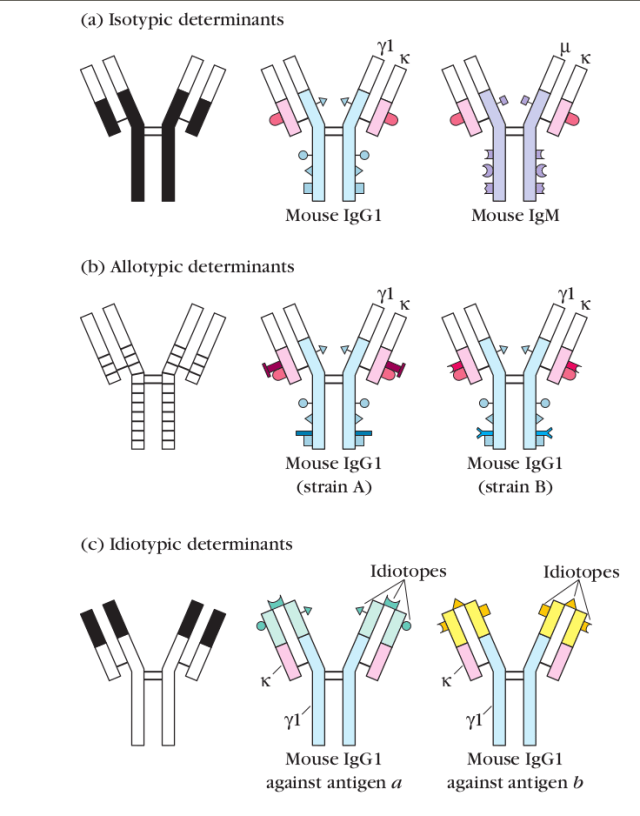 Figure: Isotypes, allotypes and idiotypes
The one rule: location decides the category
The three terms differ by one thing only: where on the antibody the antigenic determinant sits, and how widely it is shared. Get the location, and the category follows automatically.
Isotype: the determinant is in the constant region, and it is the same in every member of the species. It defines the class (IgG, IgA, and so on). Because everyone in the species has it, it is only seen as foreign by a different species.
Allotype: the determinant is also in the constant region, but it varies between individuals because it is encoded by different alleles. So it is shared by some members of the species but not others. It is seen as foreign by another individual of the same species who has a different allele.
Idiotype: the determinant is in the variable region, at the antigen-binding site, and it is unique to one antibody clone. So it is seen as foreign even by the same individual, if that exact clone is not their own.
Notice the pattern: as you move from isotype to allotype to idiotype, the determinant moves from the constant region to the variable region, and the sharing narrows from the whole species, to some individuals, to a single clone. That single progression is the entire topic.
| Location | Shared by | Seen as foreign by | |
|---|---|---|---|
| Isotype | Constant region | All members of the species | A different species |
| Allotype | Constant region (allelic) | Some individuals in the species | Another individual (different allele) |
| Idiotype | Variable region (binding site) |
Isotypes
Each antibody has only one type of (γ, or α, or μ, or ε, or δ) heavy chain and one type of (k or λ) light chain. The structural differences in the constant region of a heavy chain or light chain determine immunoglobulin (Ig) class and sub-class, types and subtypes within a species. These constant region determinants are called isotypic determinants or isotypes.
A simple way to see it: isotype is what makes an IgG an IgG and an IgA an IgA. It is the class-defining part, present in everyone, which is why anti-isotype antibodies are used in the lab to measure how much of each antibody class a patient has.
Formation of anti-isotypic antibody
All members of a species carry the same constant-region genes (including multiple alleles) so when an antibody from one species is injected into another species, the isotypic determinants will be recognized as foreign, forming anti-isotypic antibody.
Allotypes
Although all members of a species inherit the same set of isotype genes, multiple alleles exist for some of the genes. These alleles encode subtle amino acid differences. Products of allelic forms of the same gene will have slightly different amino acid sequences in the constant regions, which are known as allotypic determinants. The sum of the individual allotypic determinants displayed by an antibody determines its allotype.
Allotypes in human
Allotypes have been characterized for all four IgG subclasses, IgA2 subclass, and Kappa light chain. They are designated by the class and subclass followed by the allele number.
- Gamma-chain allotypes (also known as Gm markers):So far at least 25 different Gm allotypes have been identified e.g. G1m(1), G2m(23), G3m(11), G4m(4a).
- IgA2 subclass has 2 allotypes designated as A2m(1) and A2m(2).
- Kappa (κ) light chain has 3 allotypes, designated Km(1), Km(2), and Km(3).
Each of these allotypic determinants represents differences in one to four amino acids that are encoded by different alleles.
Formation of anti-allotypic antibodies
Antibody to allotypic determinants can be produced by injecting antibodies from one member of a species into another member of the same species who carries different allotypic determinants. Sometimes, a pregnant mother can produce antibodies to paternal allotypic determinants present on the fetal immunoglobulin. Anti-allotype antibodies may also be developed following blood transfusion.
Idiotype
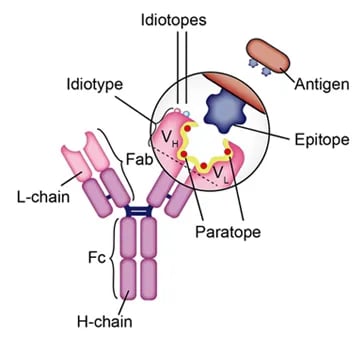 Figure: Idiotype
VH and VL domains of an antibody constitute an antigen-binding site. To recognize the vast array of antigens that a human can encounter in its lifetime, this variable region has different structural conformation owing to the presence of different amino acids. There are millions of such antibodies in the human body specific for each antigen.
These unique amino acid sequences present in the VH and VL domains of a given antibody also serves as a set of antigenic determinants. Each individual antigenic determinant of the variable region is referred to as an idiotope. Each antibody will present multiple idiotopes; the sum of the individual idiotopes is called the idiotype of the antibody.
A helpful distinction: an idiotope is one single determinant in the variable region; the idiotype is the whole collection of idiotopes on that antibody. The relationship is the same as one brick to a wall. Because the idiotype comes from the antigen-binding site, two antibodies against different antigens have different idiotypes, even if they are the same class and from the same person.
Formation of anti-idiotype antibodies
A single clone of plasma cells produces immunoglobulin molecules with identical variable-region sequences i.e., they all have the same idiotype. When antibodies having no or minimal variation in their isotypes and allotypes are injected into a genetically identical person, anti-idiotype antibodies will be formed.
Why isotypes, allotypes, and idiotypes matter
These are not just definitions. Each has real uses.
Isotypes are used to measure antibody classes. Anti-isotype antibodies (for example, anti-IgG or anti-IgM) are the reagents behind countless lab tests that quantify each class, diagnose immunodeficiencies, or detect which class of antibody a patient has made against an infection.
Allotypes are used in paternity and population studies. Because allotypes are inherited like other genetic markers, they were historically used in paternity testing, and their different frequencies across populations make them useful in anthropology. Allotype mismatches also matter in transfusion and pregnancy, where a person can make antibodies against allotypes they do not carry.
Idiotypes are used in understanding immune regulation and in therapy. The idiotype network theory proposed that the immune system regulates itself through anti-idiotype antibodies. Idiotypes are also important in monoclonal antibody therapy, where anti-idiotype antibodies can be raised against a therapeutic antibody, and in tracking specific B-cell clones, such as in some lymphomas.
How to remember
Location is everything: Constant-shared, Constant-allelic, Variable-unique. Isotype and allotype are both in the constant region; idiotype is in the variable region. That single split (constant vs variable) is the first thing to fix.
The sharing narrows: species → individuals → clone. Isotype is shared by the whole species, allotype by some individuals, idiotype by one clone only. Widest to narrowest.
Who sees it as foreign: another species, another person, even yourself. Isotype is foreign only across species; allotype is foreign to another person; idiotype can be foreign even within the same person.
The prefixes tell the story: Iso = same (same in all the species). Allo = other (varies between individuals, like alloantigens in transfusion). Idio = personal/unique (like "idiosyncratic," unique to one).
Idiotope vs idiotype: brick vs wall. One idiotope is a single determinant; the idiotype is all of them together.
Key exam facts in one table
| Fact | Detail |
|---|---|
| Isotype location | Constant region (heavy and light) |
| Isotype defines | Antibody class and subclass |
| Isotype shared by | All members of the species |
| Allotype location | Constant region, allelic variants |
| Allotype shared by | Some individuals (depends on alleles) |
| Human allotype examples | Gm (IgG heavy), Am (IgA2), Km (kappa) |
| Idiotype location | Variable region (antigen-binding site) |
| Idiotope | A single variable-region determinant |
| Idiotype | The sum of an antibody's idiotopes |
| Idiotype shared by | One antibody clone only |
| Anti-isotype used for | Measuring antibody classes |
| Anti-allotype used for | Paternity, population studies |
| Anti-idiotype used for | Immune regulation, mAb therapy |
Where students get confused
"Isotype and allotype are in different parts of the antibody." No. Both are in the constant region. The difference is that an isotype is the same across the whole species, while an allotype varies between individuals because of different alleles. Same location, different breadth of sharing.
"Idiotype and isotype are just two words for the antibody class." No. Isotype is the class (IgG, IgA). Idiotype is the unique fingerprint of one antibody's binding site. Two antibodies can share an isotype (both IgG) but have completely different idiotypes.
"An idiotope and an idiotype are the same thing." No. An idiotope is a single determinant in the variable region; the idiotype is the whole set of idiotopes on that antibody. One brick versus the wall.
"Only another species can react to your antibodies." No, that is only true for isotypes. Another individual of your species can react to your allotypes, and an anti-idiotype response can occur even within the same person against a specific clone.
"Allotypes are big differences between antibodies." No. Allotypic determinants often differ by just one to a few amino acids, encoded by different alleles. Small sequence differences, but enough to be recognized.
References and further readings
- Abbas AK, Lichtman AH, Pillai S. Cellular and Molecular Immunology. 10th ed. Elsevier; 2022.
- Punt J, Stranford SA, Jones PP, Owen JA. Kuby Immunology. 8th ed. W.H. Freeman; 2019.
- Delves PJ, Martin SJ, Burton DR, Roitt IM. Roitt's Essential Immunology. 13th ed. Wiley-Blackwell; 2017.
Frequently Asked Questions
What is the difference between isotype, allotype, and idiotype?
What is the difference between isotype, allotype, and idiotype?
They are three kinds of antigenic determinant on an antibody, defined by location. Isotype is in the constant region and defines the class (same in all the species). Allotype is also in the constant region but varies between individuals (allelic). Idiotype is in the variable region and is unique to one antibody clone.
What is an isotype?
What is an isotype?
An isotype is the constant-region determinant that defines an antibody's class, such as IgG or IgA. Every member of the species has the same isotypes, so isotypes are recognized as foreign only by a different species.
What is an allotype?
What is an allotype?
An allotype is a constant-region determinant that differs between individuals because it is encoded by different alleles. Human examples include the Gm markers on IgG and the Km markers on kappa light chains.
What is the difference between an idiotope and an idiotype?
What is the difference between an idiotope and an idiotype?
An idiotope is a single antigenic determinant in the variable region. The idiotype is the sum of all the idiotopes on that antibody. One idiotope is like a brick; the idiotype is the whole wall.
Why can an antibody act as an antigen?
Why can an antibody act as an antigen?
Because an antibody is a protein, and like any protein it carries antigenic determinants. Injected into a different species, individual, or against a specific clone, those determinants (isotypic, allotypic, or idiotypic) can be recognized as foreign and provoke anti-antibody responses.

Tankeshwar Acharya, MSc (Medical Microbiology)
Tankeshwar Acharya is an Assistant Professor in the Department of Microbiology at Patan Academy of Health Sciences (PAHS), Nepal, where he has been teaching and practicing clinical microbiology for over 14 years. He is the founder of Microbe Online, one of the leading free microbiology education resources on the web, covering bacteriology, mycology, parasitology, immunology, and clinical laboratory diagnostics written from direct experience in both the classroom and the diagnostic laboratory.
Comments
No comments yet. Be the first to share your thoughts.
Leave a comment
All comments are reviewed before they appear.