
How Do Probiotics Work? Mechanisms of Action Explained
How probiotics actually work: competitive exclusion, antimicrobial production, gut barrier reinforcement, and immune modulation, explained mechanism by mechanism.

On this page
Swallowing a capsule of live bacteria to improve your health sounds strange when you think about it. The gut already holds trillions of microbes; how could adding a few billion more make any difference, and how would they help rather than harm? The answer is that probiotics do not simply add to the crowd. They actively compete with harmful microbes, produce their own antimicrobial weapons, strengthen the gut wall, and signal to the immune system. This article walks through those four mechanisms, the "how" behind every probiotic benefit.
Probiotics are live microorganisms that, in adequate amounts, benefit the host (for the full definition and the organisms used, see the main article on probiotics and prebiotics). This article focuses on one question: once probiotics reach the gut, how do they actually work?
The idea is over a century old. Metchnikoff proposed in the early 1900s that helpful bacteria could be introduced to displace harmful ones. Modern research has since worked out the details, and the mechanisms fall into four main groups:
1. Competing with pathogens for space and food
2. Producing substances that inhibit or kill pathogens
3. Strengthening the gut's protective barrier
4. Modulating the host immune system
Importantly, these mechanisms are strain-specific: different probiotic strains use different combinations of them, which is why one strain's benefit does not automatically apply to another. The sections below explain each mechanism in turn.
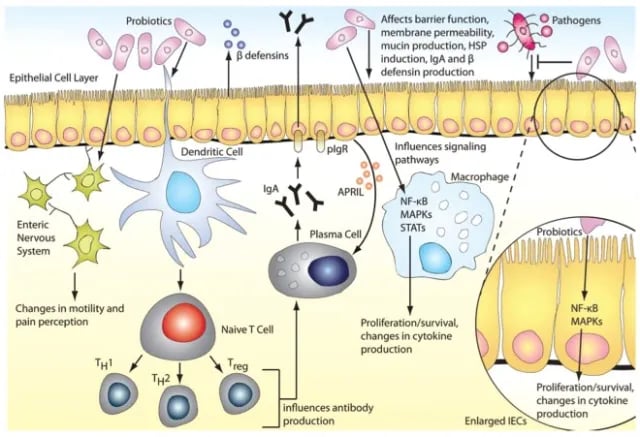 Figure: Probiotic mechanisms in the human gastrointestinal tract
The Four Main Mechanisms
1. Competitive exclusion: crowding out pathogens
Probiotics compete with harmful microbes for the two things every gut microbe needs: attachment sites and nutrients. The gut lining has a limited number of places bacteria can attach. If beneficial bacteria occupy those sites first, pathogens cannot get a foothold and are flushed out. For example, Lactobacillus casei and L. plantarum competitively block the attachment of enteropathogenic E. coli.
Probiotics also compete for nutrients and lower the local pH by producing acids, making the environment less hospitable to pathogens. Together, occupying space, using up food, and acidifying the surroundings is called competitive exclusion, and it is one of the most important ways probiotics protect the gut.
2. Production of antimicrobial substances
Probiotics actively make compounds that inhibit or kill pathogens. These include:
- Organic acids (mainly lactic and acetic acid), which lower pH and are directly toxic to many pathogens.
- Hydrogen peroxide, which damages microbial cells.
- Bacteriocins, small antimicrobial proteins that target specific bacteria. For example, some Lactobacillus strains produce bacteriocins active against both Gram-positive and Gram-negative gut bacteria.
By releasing these substances, probiotics suppress pathogen growth directly, acting somewhat like a natural, targeted antimicrobial.
3. Strengthening the gut barrier
The gut lining is a physical wall that keeps microbes and harmful substances out of the body. Probiotics reinforce this barrier in several ways:
- They stimulate goblet cells to produce more mucin, thickening the protective mucus layer over the gut lining.
- They enhance tight junctions, the seals between neighboring gut cells, reducing the gaps through which pathogens and antigens could leak.
- They prompt the gut to produce antimicrobial peptides such as defensins.
A stronger barrier means fewer pathogens and antigens cross into the body, which is one reason probiotics may help in conditions involving a "leaky" or inflamed gut.
4. Modulating the immune system
Probiotics communicate with the gut's immune system, tuning its responses rather than simply boosting them. Reported effects include:
- Increasing secretory IgA, the antibody that guards mucosal surfaces.
- Enhancing the activity of phagocytes (such as macrophages) and natural killer cells, which is notable in the elderly.
- Balancing cytokine signals, often reducing pro-inflammatory cytokines while supporting regulatory responses.
This immune modulation is why probiotics are studied for conditions ranging from allergies to inflammatory bowel disease. The effect is regulatory: probiotics help the immune system respond appropriately, not just more strongly.
A note on the anti-cancer idea
Some gut bacteria produce enzymes (such as β-glucuronidase, azoreductase, and nitroreductase) that can convert harmless precursors into carcinogens. Studies have found that taking L. acidophilus or L. casei lowers the levels of these enzymes in stool. This is a plausible route by which probiotics might reduce cancer risk, but it is not yet confirmed that they actually lower cancer incidence in people. It remains an area of research, not an established benefit.
How the mechanisms produce benefits
Each observed benefit traces back to one or more of the four mechanisms above. A few well-studied examples show the link:
- Diarrhea. Strains such as Lactobacillus rhamnosus GG and Bifidobacterium lactis BB-12 can shorten or prevent certain diarrheas, including rotavirus and antibiotic-associated diarrhea. The mechanisms at work are competitive blocking of the pathogen's attachment, immune enhancement, and production of substances that inactivate pathogens. This is the best-documented probiotic benefit.
- Allergy in children. In some studies, giving L. rhamnosus GG around birth reduced early atopic (allergic) disease. The proposed mechanism is barrier reinforcement and immune modulation, particularly a stronger gut IgA response and a better-regulated cytokine balance.
- Genitourinary infections. Lactobacillus normally dominates the healthy vagina and keeps it acidic. When these bacteria are depleted, the risk of urinary tract infection, bacterial vaginosis, and candidiasis rises. Probiotic lactobacilli are thought to help by competitive exclusion and by keeping the environment acidic and hostile to pathogens.
For a fuller summary of probiotic health benefits and the strength of evidence behind them, see the main article on probiotics and prebiotics.
A note on safety
Probiotics are generally safe for healthy people, and humans have consumed the microbes in fermented foods for millennia. The most common effect is mild, temporary gas or bloating. The important exception is people who are critically ill or immunocompromised, in whom probiotics can rarely cause serious infections (for example, Saccharomyces fungemia). Safety and who should be cautious are covered in more detail in the main article on probiotics and prebiotics.
How to Remember
The four mechanisms as a defended fort.
Competitive exclusion holds the ground (space and food). Antimicrobial production is the weaponry (acids, peroxide, bacteriocins). Barrier reinforcement is the wall (mucin, tight junctions). Immune modulation is calling in the guards (IgA, phagocytes). Four ways to defend the gut.
"Crowd, attack, wall, signal."
Crowd out pathogens (compete), attack them (antimicrobials), wall them off (barrier), signal the immune system (modulate).
Why probiotics don't just "boost" immunity.
They modulate, not simply boost. Probiotics often calm inflammation as much as they stimulate defense. The immune effect is about balance, which is why they're studied in allergy and IBD, conditions of immune overreaction.
The best-proven benefit maps to the first two mechanisms.
Diarrhea prevention, the strongest evidence, comes mainly from competitive exclusion and antimicrobial production: crowd the pathogen out and poison it. Start there when linking mechanism to benefit.
Key exam facts
| Point | High-yield fact |
|---|---|
| Four main mechanisms | Competitive exclusion, antimicrobial production, barrier reinforcement, immune modulation |
| Competitive exclusion | Occupying adhesion sites, using nutrients, lowering pH |
| Antimicrobial substances | Organic acids, hydrogen peroxide, bacteriocins |
| Bacteriocins | Small antimicrobial proteins targeting specific bacteria |
| Barrier reinforcement | More mucin, stronger tight junctions, defensins |
| Immune modulation | Increased secretory IgA, phagocyte and NK activity, cytokine balancing |
| Key qualifier | Mechanisms are strain-specific |
| Best-documented benefit | Prevention/treatment of certain diarrheas |
| Historical origin | Metchnikoff, early 1900s |
| Immune effect is | Regulatory (modulating), not simply "boosting" |
| Anti-cancer idea | Probiotics lower carcinogen-activating gut enzymes; cancer reduction not confirmed |
Where Students Get Confused
What is competitive exclusion?
It is the way probiotics crowd out pathogens by occupying the limited attachment sites on the gut lining, consuming available nutrients, and lowering the local pH. With no space, food, or friendly pH, pathogens cannot establish themselves and are cleared.
Do probiotics "boost" the immune system?
Not exactly. They modulate it, which can mean calming an overactive response as much as strengthening a weak one. This is why probiotics are studied in allergy and inflammatory conditions, where the problem is an immune system overreacting, not underperforming.
What are bacteriocins?
Bacteriocins are small antimicrobial proteins made by bacteria, including probiotics, that kill or inhibit other bacteria. They are one of the direct chemical weapons probiotics use against pathogens, alongside organic acids and hydrogen peroxide.
How do probiotics strengthen the gut barrier?
By thickening the mucus layer (stimulating mucin production), tightening the seals between gut cells (enhancing tight junctions), and prompting release of antimicrobial peptides. A stronger barrier lets fewer pathogens and antigens leak through.
Do probiotics permanently colonize the gut?
Usually not. Most probiotic strains only pass through and act transiently, which is why continued consumption is often needed for a sustained effect. Their benefits come from what they do while present, not from permanent residence.
References
- Senok AC, Ismaeel AY, Botta GA. Probiotics: facts and myths. Clin Microbiol Infect. 2005;11(12):958–966.
- Bermudez-Brito M, Plaza-Díaz J, Muñoz-Quezada S, Gómez-Llorente C, Gil A. Probiotic mechanisms of action. Ann Nutr Metab. 2012;61(2):160–174. https://doi.org/10.1159/000342079
- Liu Q, Yu Z, Tian F, et al. Molecular insights into probiotic mechanisms of action employed against intestinal pathogenic bacteria. Gut Microbes. 2020;12(1):1831339. https://doi.org/10.1080/19490976.2020.1831339
- Hemarajata P, Versalovic J. Effects of probiotics on gut microbiota: mechanisms of intestinal immunomodulation and neuromodulation. Therap Adv Gastroenterol. 2013;6(1):39–51. https://doi.org/10.1177/1756283X12459294
Frequently Asked Questions
How do probiotics work in the body?
How do probiotics work in the body?
Probiotics work through four main mechanisms: competing with pathogens for space and nutrients, producing antimicrobial substances like acids and bacteriocins, strengthening the gut's protective barrier, and modulating the immune system. Most strains use a combination of these.
What is competitive exclusion?
What is competitive exclusion?
It is when probiotic bacteria crowd out pathogens by occupying attachment sites on the gut lining, using up available nutrients, and lowering the pH. This leaves pathogens with nowhere to attach and no resources, so they cannot establish an infection.
Do probiotics kill harmful bacteria?
Do probiotics kill harmful bacteria?
They can inhibit and sometimes kill them, mainly by producing organic acids, hydrogen peroxide, and bacteriocins (antimicrobial proteins). They also suppress pathogens indirectly by outcompeting them and by strengthening the gut's defenses.
Do probiotics stay in the gut permanently?
Do probiotics stay in the gut permanently?
Usually not. Most probiotics pass through the gut and act only while they are present, which is why regular consumption is often needed. Their benefits come from their activity during transit rather than permanent colonization.
Do probiotics boost the immune system?
Do probiotics boost the immune system?
They modulate it rather than simply boosting it. Probiotics can increase protective antibodies like secretory IgA and activate immune cells, but they can also calm excessive inflammation. The effect is about balancing the immune response.
Why doesn't one probiotic work for everything?
Why doesn't one probiotic work for everything?
Because probiotic mechanisms are strain-specific. Different strains use different combinations of the four mechanisms, so a strain proven to help one condition may do nothing for another. The specific strain, not just the species, determines the effect.

Tankeshwar Acharya, MSc (Medical Microbiology)
Tankeshwar Acharya is an Assistant Professor in the Department of Microbiology at Patan Academy of Health Sciences (PAHS), Nepal, where he has been teaching and practicing clinical microbiology for over 14 years. He is the founder of Microbe Online, one of the leading free microbiology education resources on the web, covering bacteriology, mycology, parasitology, immunology, and clinical laboratory diagnostics written from direct experience in both the classroom and the diagnostic laboratory.
Comments
No comments yet. Be the first to share your thoughts.
Leave a comment
All comments are reviewed before they appear.