
Elek Test (Elek's Gel Precipitation Test): Principle, Procedure, and Results
The Elek test (Elek's gel precipitation test) is an immunodiffusion test that shows whether a Corynebacterium diphtheriae strain produces diphtheria toxin. Learn the principle, procedure, how to read the precipitin lines, and how it compares with PCR.

On this page
A throat swab grows Corynebacterium diphtheriae. That alone does not tell the team whether the patient has diphtheria, because only strains that actually produce diphtheria toxin cause the disease. A strain can even carry the toxin gene and still not make the toxin. The Elek test answers the question that decides treatment and public health action: is this strain making the toxin, or not? A single fine precipitin line on the plate is the answer.
The Elek test, also called Elek's gel precipitation test, is an in vitro immunoprecipitation (immunodiffusion) test that determines whether a strain of Corynebacterium diphtheriae produces diphtheria toxin. A strain that produces the toxin is called toxigenic. This matters because only toxigenic strains cause diphtheria. A strain of C. diphtheriae that does not produce the toxin does not cause the disease, so identifying toxin production, not just identifying the organism, is what guides treatment and public health action. The same test is used for Corynebacterium ulcerans, which can cause a diphtheria-like illness.
In the test, a strip of filter paper soaked in diphtheria antitoxin is placed on the agar, and the strains are streaked at right angles to it: the patient's isolate along with a known toxigenic (positive) control and a known non-toxigenic (negative) control.
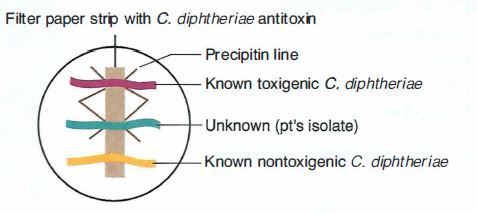 Fig 1: Elek Test
Principle
The test works by letting two substances diffuse toward each other through the agar and meet. The antitoxin diffuses outward from the filter paper strip. At the same time, any diphtheria toxin produced by a streaked strain diffuses outward from its line of growth. Where the toxin and the antitoxin meet at the right proportions, called the zone of equivalence, they bind and form a visible line of precipitate, the precipitin line. A strain that makes toxin produces these lines. A strain that makes no toxin produces none.
Procedure:
- Mix a tube of melted nutrient agar with 2 ml of sterile serum (horse or fetal calf serum is commonly used).
- Rotate the tube to mix the serum and agar. Do not shake the tube.
- Pour the mixture into a sterile petri dish.
- Using lightly flamed forceps, lay the strip of anti-toxin impregnated filter paper across the centre of the petri dish allowing it to sink beneath the agar surface.
- Allow the agar to set, then lift one corner of the lid and let the plate dry for 30-45 min in the incubator.
- When the surface is dry, streak the known toxigenic (positive) control in a single straight line across the plate at a right angle to the antitoxin strip.
- Streak the known non-toxigenic (negative) control and the patient's test strain in parallel lines, spaced about 1 cm apart, each at a right angle to the strip.
- Incubate the plate at 37°C and read at 24 hours, and again at 48 hours if needed, since some precipitin lines develop slowly.
A modified (optimized) Elek test is also used in reference laboratories. It adjusts the antitoxin concentration, the medium, and the spacing of strains to make faint lines easier to read and to reduce misinterpretation. The principle is the same.
Results and interpretation
Read the plate against transmitted light. Toxin production shows as fine precipitin lines that extend out from each streak at roughly a 45-degree angle, forming an arrowhead pattern between the strain and the antitoxin strip.
- Positive result: precipitin lines are present. The strain produces diphtheria toxin and is toxigenic.
- Negative result: no precipitin lines form along the strain's streak. The strain does not produce the toxin.
The line of identity is the key to reading the plate. The toxigenic control strain always produces precipitin lines. When a test strain is also toxigenic, its lines join smoothly with the control's lines, meeting to form a continuous arc. This joining is called a line of identity, and it confirms that the toxin made by the test strain is the same as true diphtheria toxin. If the test strain's lines cross or do not connect with the control's lines, the reaction is not a line of identity and should not be read as a true positive.
How to read the four streaks on a typical plate:
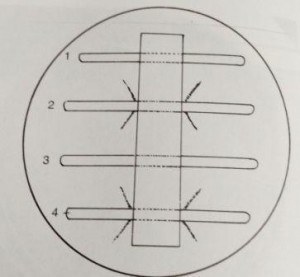 1. The negative control shows no precipitin lines.
2. The positive control shows clear precipitin lines.
3. A non-toxigenic test strain shows no lines, and its streak stays clear where it meets the control's lines.
4. A toxigenic test strain shows lines that join the positive control's lines in a continuous arc, a line of identity.
1. The negative control shows no precipitin lines.
2. The positive control shows clear precipitin lines.
3. A non-toxigenic test strain shows no lines, and its streak stays clear where it meets the control's lines.
4. A toxigenic test strain shows lines that join the positive control's lines in a continuous arc, a line of identity.
A common error is reading a nonspecific precipitin line as positive. Only lines that form a true line of identity with the toxigenic control should be interpreted as a positive result. This is why the known controls are streaked on every plate.
Elek test and PCR, why both are used
Modern laboratories can detect the diphtheria toxin gene, called tox, directly by PCR. PCR is fast and sensitive, so it is often used first to screen isolates or clinical samples. However, PCR and the Elek test answer different questions, and this difference is important.
PCR detects whether the toxin gene is present. The Elek test detects whether the toxin is actually produced. These are not always the same. Some strains carry the tox gene but do not express it, so they are PCR-positive but Elek-negative. These are called non-toxigenic toxin gene-bearing (NTTB) strains. Because they do not produce the toxin, they do not cause classical diphtheria, but they carry a theoretical risk if the gene were to become active.
This is why the Elek test remains the reference method for confirming toxigenicity. A tox-positive PCR result is confirmed by the Elek test to determine whether the strain truly produces toxin. In short, PCR asks "is the gene there?" and the Elek test asks "is the toxin being made?" The treatment and public health response depend on the second question.
The toxin gene itself is carried by a bacteriophage that infects the bacterium, a process called lysogenic conversion. A strain becomes toxigenic only when it carries this phage, which is why toxin production, not just the species, must be confirmed.
How to Remember
The test asks "is the toxin made," not "is the gene there." PCR finds the gene. Elek finds the toxin. Only the toxin causes disease.
Arrowheads mean toxin. Fine precipitin lines fanning out at an angle from the streak are the sign of toxin meeting antitoxin.
Line of identity confirms a true positive. A test strain is truly toxigenic when its lines join the positive control's lines in a smooth continuous arc. Crossing or unconnected lines are not a true positive.
Only toxigenic strains cause diphtheria. Finding C. diphtheriae is not enough. The strain must make the toxin.
Key exam facts
| Item | Fact |
|---|---|
| Type of test | In vitro immunoprecipitation (immunodiffusion) |
| Detects | Diphtheria toxin production (toxigenicity) |
| Organism | Corynebacterium diphtheriae (also Corynebacterium ulcerans) |
| Reagent on strip | Diphtheria antitoxin |
| Positive result | Precipitin lines forming a line of identity with the toxigenic control |
| Negative result | No precipitin lines along the strain's streak |
| Controls | Known toxigenic (positive) and non-toxigenic (negative) strains on every plate |
| Incubation | 37°C, read at 24 hours (and 48 hours if needed) |
| Toxin gene | tox, carried by a bacteriophage (lysogenic conversion) |
| PCR relationship | PCR detects the gene; Elek confirms the toxin is produced |
| NTTB strains | tox gene-positive by PCR but Elek-negative (no toxin made) |
| Clinical importance | Only toxigenic strains cause diphtheria |
Where Students Get Confused
"The Elek test identifies Corynebacterium diphtheriae." No. It does not identify the organism. It tests whether an already-identified strain produces diphtheria toxin. Identification of the species is done separately.
"A positive PCR for the tox gene means the strain is toxigenic." Not necessarily. Some strains carry the gene but do not produce the toxin (NTTB strains). PCR shows the gene is present; the Elek test confirms whether the toxin is actually made.
"Any precipitin line means a positive result." No. Only a line that forms a true line of identity with the toxigenic control counts as positive. Nonspecific lines that cross or do not connect are a common cause of misreading.
"Finding C. diphtheriae in a throat swab means the patient has diphtheria." Not by itself. Only toxigenic strains cause diphtheria. A non-toxigenic strain can be present without causing the disease, which is exactly why the Elek test is done.
"The test detects the antitoxin." No. The antitoxin is the known reagent on the strip. The test detects the toxin produced by the strain, which meets the antitoxin to form the precipitin line.
Resumen en español
La prueba de Elek (también llamada prueba de precipitación en gel de Elek) es una prueba de inmunodifusión que determina si una cepa de Corynebacterium diphtheriae produce la toxina diftérica. Esto es importante porque solo las cepas que producen la toxina (cepas toxigénicas) causan difteria. En la prueba, una tira de papel de filtro con antitoxina diftérica se coloca sobre el agar, y las cepas se siembran en líneas perpendiculares a la tira, junto con un control positivo y un control negativo.
Donde la toxina y la antitoxina se encuentran en proporciones equivalentes, se forma una línea de precipitación. Un resultado positivo muestra líneas de precipitación que se unen con las del control positivo, formando una línea de identidad. Un resultado negativo no muestra líneas. La PCR puede detectar el gen de la toxina (tox), pero no todas las cepas con el gen producen la toxina, por lo que la prueba de Elek sigue siendo el método de referencia para confirmar la producción real de la toxina.
References
- Procop, G. W., et al. (2017). Koneman's Color Atlas and Textbook of Diagnostic Microbiology (7th ed.). Wolters Kluwer.
- Tille, P. M. (2022). Bailey and Scott's Diagnostic Microbiology (15th ed.). Elsevier.
- Melnikov, V. G., Berger, A., and Sing, A. (2022). Detection of diphtheria toxin production by toxigenic corynebacteria using an optimized Elek test. Infection, 50(6), 1591–1595.
Frequently Asked Questions
What is the Elek test used for?
What is the Elek test used for?
It determines whether a strain of Corynebacterium diphtheriae produces diphtheria toxin. Only toxin-producing (toxigenic) strains cause diphtheria, so the test guides treatment and public health decisions.
What is a positive Elek test?
What is a positive Elek test?
The strain produces precipitin lines that join the toxigenic control's lines in a continuous arc, called a line of identity. This confirms the strain makes diphtheria toxin.
What is a negative Elek test?
What is a negative Elek test?
No precipitin lines form along the strain's streak. The strain does not produce the toxin.
Why is it called the gel precipitation test?
Why is it called the gel precipitation test?
Because the toxin and the antitoxin diffuse through the agar gel and form a visible precipitate where they meet. It is a gel-based immunoprecipitation (immunodiffusion) test.
What is a line of identity?
What is a line of identity?
It is the smooth, continuous line formed when a test strain's precipitin line joins the positive control's line. It confirms that the toxin the strain produces is the same as true diphtheria toxin.
How is the Elek test different from PCR?
How is the Elek test different from PCR?
PCR detects the toxin gene (tox). The Elek test detects whether the toxin is actually produced. Some strains carry the gene but do not make the toxin, so the Elek test is used to confirm true toxin production.
What are NTTB strains?
What are NTTB strains?
Non-toxigenic toxin gene-bearing strains carry the tox gene and are PCR-positive, but they do not produce the toxin and are Elek-negative. They do not cause classical diphtheria.
Does finding C. diphtheriae mean the patient has diphtheria?
Does finding C. diphtheriae mean the patient has diphtheria?
Not on its own. Only toxigenic strains cause diphtheria. The Elek test confirms whether the strain that was isolated actually produces the toxin.

Tankeshwar Acharya, MSc (Medical Microbiology)
Tankeshwar Acharya is an Assistant Professor in the Department of Microbiology at Patan Academy of Health Sciences (PAHS), Nepal, where he has been teaching and practicing clinical microbiology for over 14 years. He is the founder of Microbe Online, one of the leading free microbiology education resources on the web, covering bacteriology, mycology, parasitology, immunology, and clinical laboratory diagnostics written from direct experience in both the classroom and the diagnostic laboratory.
Comments
No comments yet. Be the first to share your thoughts.
Leave a comment
All comments are reviewed before they appear.