

Two soldiers from the same training camp are sent to fight the same enemy, but they fight in completely different ways. One can spot the enemy anywhere, in the open, at a distance, and attacks directly. The other is effectively blind to the enemy in the open and can only strike once a scout holds up a captured piece of the enemy for it to see. This is the strange truth about B cells and T cells.
They come from the same place, the bone marrow, and they serve the same adaptive immune system. But a B cell can see antigen directly and free, while a T cell can only see antigen after it has been processed and presented on a special molecule called MHC. That single difference, free versus presented, is the key that unlocks almost every other difference between them.
T cells and B cells are white blood cells that are important cells for adaptive immunity. Like all blood cells, they are made in the bone marrow. While B-cells mature in the bone marrow, T-cells travel through the bloodstream to the thymus (a small organ between the lungs and behind the sternum) and mature there. Broadly speaking T cells can be divided into two different types, ‘killer T-cells’ and ‘helper T-cells’.
Regulatory T cells (Tregs) are a third type of T cell. Their job is to regulate and suppress other immune cells, which keeps the immune response from overreacting or attacking the body's own tissues.
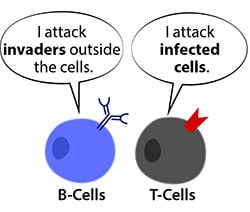 T cells come in two main functional types. Cytotoxic T cells (also called killer T cells) carry the CD8 marker and kill cells that are infected with viruses or that have turned cancerous, using toxic mediators such as perforin and granzymes. Helper T cells carry the CD4 marker and help other cells, including helping B cells make antibody. The reason CD8 cells partner with one class of MHC and CD4 cells with another (CD8 with MHC class I, CD4 with MHC class II) is explained in the article on MHC class I and class II.
B cells are the central cells of humoral (antibody-mediated) immunity. Their plasma cell offspring produce the antibodies that circulate and neutralize antigens.
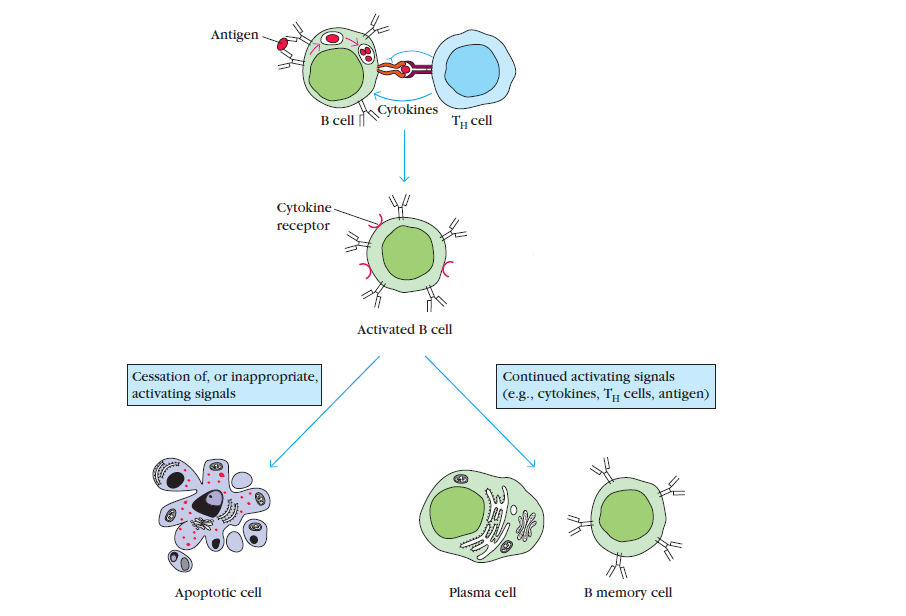 Figure: Helper T cells and B Cell Interactions (Source: Kuby Immunology)
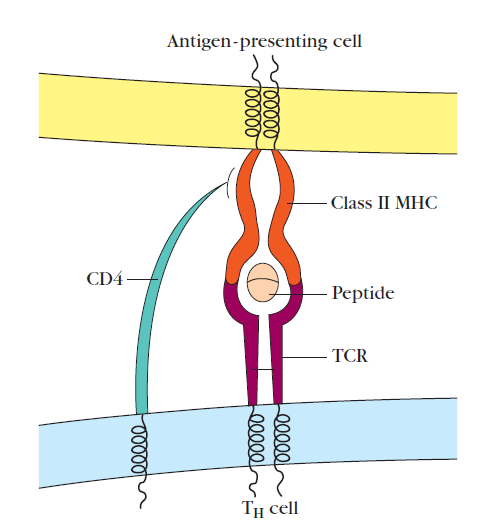 Helper T cells act largely by releasing cytokines, and they come in subsets with different jobs. Two classic subsets are Th1 and Th2. Th1 cells produce interferon-gamma and drive cell-mediated immunity, the response against intracellular microbes. Th2 cells produce interleukin-4 and support antibody responses by helping B cells. Other helper subsets exist (such as Th17 and follicular helper T cells), but Th1 and Th2 are the two most students are expected to know.
Once activated by its matching antigen, a B cell multiplies and gives rise to plasma cells, which secrete antibody, and memory B cells. The full sequence of B cell activation, from first antigen encounter to plasma and memory cell, is covered in the article on B cell development and activation.
The one difference that explains all the others
B cells and T cells are both lymphocytes, both made in the bone marrow, both part of adaptive immunity. To keep them straight, do not memorize a list of contrasts. Anchor everything to one difference: how each one sees antigen.
A B cell sees antigen directly. Its receptor is a membrane-bound antibody, and it can bind a whole, free, unprocessed antigen floating in the blood or tissue fluid, whether that antigen is a protein, a sugar, or a lipid. The B cell needs no help to recognize its target.
A T cell cannot do this. Its receptor cannot bind free antigen at all. A T cell only recognizes antigen when it has been chopped into a short peptide and displayed on an MHC molecule on the surface of another cell. No MHC, no recognition. And because MHC presents peptides, T cells mostly see protein antigens, not sugars or lipids.
Now watch how that one difference generates the rest of the table. It explains why B cells recognize many kinds of molecules but T cells mostly recognize proteins. It explains why the B cell interaction is a simple two-part binding (antibody plus antigen) while the T cell interaction is a three-part binding (T cell receptor plus antigen plus MHC). It explains why T cells depend on antigen-presenting cells and B cells do not. One difference, cascading through the whole comparison.
So as you read each row below, ask: is this a consequence of the B cell seeing antigen free, and the T cell only seeing it presented? Almost always, it is.
Some of the major differences between B Cells and T Cells are tabulated below:
Features | B Cells | T Cells |
Maturation | Bone Marrow (Bursal equivalent) | Thymus |
Involvement of MHC molecules | None required | Required to display processed antigen |
Recognition of Antigen | B Cells can recognize and bind to soluble antigens. | T-cell receptor (TCR) does not recognize the free antigens. T cells can recognize an antigen only when it is associated with self MHC molecule on the surface of a self-cell (either an antigen-presenting cell or altered self cell or on a virus-infected cell and graft). |
Chemical nature of antigen |
|
|
Interaction with antigen | Involves binary complex of membrane Immunoglobulin and Antigen | Involves ternary complex of the T-cell receptor, antigen, and MHC molecule |
Epitope properties | Accessible, hydrophilic, mobile peptides containing sequential or nonsequential amino acids |
|
Antigen Specificity | Antigen specificity of each B cell is determined by the membrane-bound antigen-binding receptor (antibody) expressed by the cell. | Antigenic specificity of T Cells is determined by antigen-binding T-cell receptor (TCR) on T Cells. TCR genes are capable of generating on the order of 10^9 unique antigenic specificities. |
Main effector function | Make antibody (humoral immunity). Plasma cells secrete antibody; B cells also present antigen. | Direct action (cell-mediated immunity). Cytotoxic T cells kill infected cells; helper T cells coordinate other cells. |
Proportion of blood lymphocytes | About 10 to 15 percent | About 70 to 80 percent |
Antigen recognition receptors | Membrane-bound immunoglobulin (IgM or IgD complexed with Igα /Igβ) molecules serve as receptors for antigens. | T cell receptors (TCR) complexed with CD3 (signal-transduction element of the T-cell receptor) |
CD markers | Defining pan-B-cell markers are CD19 and CD20. Others include CD21 (complement receptor CR2, also the EBV receptor), CD40 (signal for T cell help), and surface immunoglobulin as the antigen receptor. | Defining markers are CD3 (part of the T cell receptor complex), plus CD4 (on helper T cells, binds MHC class II) or CD8 (on cytotoxic T cells, binds MHC class I). Others include CD28 (receptor for the co-stimulatory B7 signal) and CD45. |
How to remember B cells vs T cells
B sees it free, T needs it fed. The one difference that generates the whole table. A B cell binds free antigen directly. A T cell can only see antigen when it is processed and presented (fed to it) on MHC. Free versus fed.
B is for Bone marrow and antiBody. T is for Thymus. The letters do the work. B cells mature in the Bone marrow and make antiBody. T cells mature in the Thymus. The names tell you the two most testable facts.
CD4 for helper, CD8 for killer. 4 x 2 = 8. Helper T cells carry CD4 and pair with MHC class II. Cytotoxic (killer) T cells carry CD8 and pair with MHC class I. The multiplication trick, 4 times 2 (the MHC class) equals 8, keeps the pairings straight: CD4 x MHC-II, CD8 x MHC-I.
Binary for B, ternary for T. The B cell interaction has two parts: antibody plus antigen. The T cell interaction has three parts: T cell receptor plus antigen plus MHC. B for binary, T for ternary, and the count is a direct consequence of "B sees it free, T needs it presented."
Where students get confused
"Both B and T cells mature in the bone marrow because both start there." Both originate in the bone marrow, but only B cells mature there. T cells leave and travel to the thymus to mature. The T in T cell stands for thymus, which is the memory hook.
"T cells can bind free antigen like B cells do." They cannot. This is the single most important difference. A T cell receptor cannot recognize free antigen at all. It only recognizes a peptide displayed on an MHC molecule on another cell's surface. B cells bind free antigen directly.
"B cells only recognize proteins." The opposite is closer to true. B cells recognize a wide range of molecules, including proteins, sugars, and lipids, because they bind antigen directly. It is T cells that are largely restricted to protein peptides, because MHC presents peptides.
"CD4 goes with MHC class I." No, and this reverses a high-yield fact. CD4 (helper T cells) pairs with MHC class II. CD8 (cytotoxic T cells) pairs with MHC class I. The trick is 4 times 2 equals 8: CD4 with class II, CD8 with class I.
"Helper T cells kill infected cells." Helper T cells do not kill. They coordinate, mainly by releasing cytokines that help B cells and activate other cells. It is cytotoxic (CD8) T cells that kill infected cells directly.
"B cells and T cells work independently." They cooperate closely. Most antibody responses need helper T cells to fully activate the B cell. This is why the two are often described as partners within adaptive immunity, not separate tracks.
References and further reading:
- Abbas AK, Lichtman AH, Pillai S. Cellular and Molecular Immunology. 10th ed. Philadelphia: Elsevier; 2022.
- Punt J, Stranford SA, Jones PP, Owen JA. Kuby Immunology. 8th ed. New York: W. H. Freeman; 2019.
- Delves PJ, Martin SJ, Burton DR, Roitt IM. Roitt's Essential Immunology. 13th ed. Chichester: Wiley-Blackwell; 2017.

Comments
No comments yet. Be the first to share your thoughts.
Leave a comment
All comments are reviewed before they appear.