
Clostridioides difficile: Antibiotic-Associated Colitis, Toxins, and Diagnosis
How Clostridioides difficile (formerly Clostridium difficile) causes antibiotic-associated diarrhea and pseudomembranous colitis, how its toxins A and B damage the gut, and how the GDH and toxin tests are interpreted.

On this page
An elderly hospital patient, a week into antibiotics for a chest infection, develops frequent watery diarrhea and abdominal pain. Colonoscopy shows raised yellow patches stuck to the inflamed lining, like a membrane laid over the bowel wall. This is pseudomembranous colitis, and the cause is a spore-forming bacterium that the antibiotics themselves let loose: Clostridioides difficile.
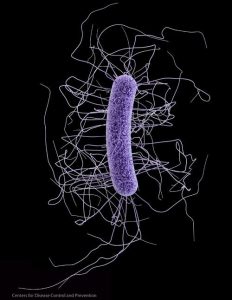 C. difficile is one of the most important causes of hospital-acquired diarrhea. What makes it distinctive is that antibiotics, meant to treat infection, are what trigger it, by clearing away the normal gut bacteria that usually keep it in check. This page is about how it causes disease, why its spores make it so hard to control in hospitals, and how the laboratory diagnoses it.
Introduction
Clostridioides difficile (formerly Clostridium difficile, and often shortened to "C. diff") is a Gram-positive, anaerobic, spore-forming rod. It is a leading cause of hospital-associated diarrhea and the main cause of antibiotic-associated colitis. Infection (called CDI, C. difficile infection) occurs mostly in people with recent hospital care, recent antibiotics, or recent chemotherapy.
What makes C. difficile hard to control
Two features explain why C. difficile is such a problem in hospitals.
It forms spores. The spores are tough, dormant forms that survive on surfaces, floors, bed rails, call buttons, doorknobs, thermometers, for long periods, and resist many ordinary disinfectants and alcohol hand rubs. This is why C. difficile spreads so readily in hospitals and why controlling it needs soap-and-water handwashing (which physically removes spores) and bleach-based cleaning, not just alcohol gel.
It spreads by the fecal-oral route in hospitals. Spores pass from patient to patient on the hands of staff, on shared equipment such as rectal thermometers, and on high-touch surfaces in patient bathrooms. A patient swallows the spores, which then germinate in the gut.
Newer, more virulent strains (such as the ribotype 027 strain), which produce more toxin and are often fluoroquinolone-resistant, have caused severe hospital outbreaks and are a particular concern.
Virulence factors and how C. difficile causes disease
C. difficile causes disease through two toxins, but only after antibiotics have set the stage. Each part of the story matters.
The trigger: antibiotics clear the normal flora. In a healthy gut, the hundreds of species of normal bacteria crowd out C. difficile and keep it from establishing. When a person takes antibiotics, especially broad-spectrum ones, much of this normal flora is killed. That removes the competition, and any C. difficile spores present can germinate and multiply unchecked. This is why the infection is "antibiotic-associated": the antibiotic does not introduce the organism, it removes the defense against it. Almost any antibiotic can do this; the classic culprits are clindamycin, cephalosporins, fluoroquinolones, and broad-spectrum penicillins such as amoxicillin and ampicillin.
The damage: toxins A and B. Once established, toxigenic strains produce two toxins:
- Toxin A (an enterotoxin): damages the lining of the gut and draws fluid into the bowel, causing diarrhea. It also attracts inflammatory cells (neutrophils).
- Toxin B (a cytotoxin): is directly toxic to the gut lining cells, killing them. Toxin B is the more potent of the two.
Together the toxins destroy patches of the colon lining. The dead cells, inflammatory cells, mucus, and fibrin pile up into the raised yellow plaques called pseudomembranes, which is why severe disease is called pseudomembranous colitis. Strains that do not make these toxins do not cause disease, which is why laboratory testing looks for the toxins, not just the organism.
Putting it together
The sequence explains the whole illness. A patient in hospital swallows spores from a contaminated surface or hands. Antibiotics clear the normal gut flora, removing the competition. The spores germinate and multiply, and toxigenic strains release toxins A and B, which damage the colon lining and produce watery diarrhea. In severe cases the damage builds into pseudomembranes (pseudomembranous colitis), and the illness can progress to a dangerously dilated colon (toxic megacolon) and become life-threatening. This is why stopping the triggering antibiotic is the first step in treatment: it lets the normal flora recover.
Pseudomembranous colitis
Pseudomembranous colitis is the severe form of the disease: an inflammation of the large bowel with the characteristic yellow pseudomembranes on the mucosa. It is caused mainly by C. difficile toxins, and rarely by other organisms. Almost any antibiotic, and several cancer chemotherapy agents, can trigger it by disrupting the normal flora.
The range of disease
CDI ranges from mild to life-threatening:
- Antibiotic-associated diarrhea: mild to moderate watery diarrhea, the most common form.
- Colitis: more marked inflammation with cramping, fever, and more severe diarrhea.
- Pseudomembranous colitis: the severe form, with pseudomembranes.
- Fulminant colitis and toxic megacolon: the colon dilates and can perforate; this is a surgical emergency and can be fatal.
The highest-risk patients are the elderly, those on or recently on antibiotics, those with prolonged hospital stays, and the immunocompromised. Recurrence is a major problem: a significant proportion of patients relapse after treatment, because spores persist and the flora is slow to recover.
Laboratory diagnosis
Test only the right patients. C. difficile is diagnosed only in patients with genuine diarrhea (unformed stool that takes the shape of the container). Testing formed stool is wrong, because many healthy people, and especially hospitalized patients, carry C. difficile without disease. A positive test on someone without diarrhea reflects harmless carriage, not infection. So the specimen is fresh liquid stool, and it should be refrigerated (2 to 8°C) until tested.
The problem the testing algorithm solves. No single quick test is both sensitive and specific enough on its own, so laboratories use a two-step approach that separates "is the organism there?" from "is it making toxin?"
- GDH antigen test. Glutamate dehydrogenase (GDH) is an enzyme made by all C. difficile, toxigenic or not. The GDH test is very sensitive, so it is an excellent screen: a negative GDH effectively rules the organism out. But a positive GDH only tells you the organism is present, not whether it is the harmful, toxin-producing kind.
- Toxin A/B test. This detects the actual toxins. It is more specific: a positive toxin test means a toxigenic strain is present and actively producing toxin, which is what causes disease.
Using them together, GDH to screen and toxin to confirm, gives a reliable answer. When the two disagree, a NAAT (nucleic acid amplification test, such as PCR) for the toxin gene resolves it. NAAT detects the toxin gene (the potential to make toxin) and has largely replaced the older cell cytotoxicity assay as the reference method, because it is faster and widely available.
Interpreting the GDH and toxin results
| GDH | Toxin | Interpretation | Action |
|---|---|---|---|
| Negative | Negative | No C. difficile | Rules it out. Do not repeat testing. |
| Positive | Positive | Toxigenic C. difficile present | Treat and use contact precautions. |
| Positive | Negative | Organism present, but toxin not detected: either a non-toxigenic strain or a false-negative toxin test | Confirm with a NAAT for the toxin gene, and interpret from that. |
| Negative | Positive | Discordant/indeterminate | Repeat the test once. |
Note: the exact algorithm varies by hospital protocol.
A key point for interpretation: because carriage is common, always read the result against the clinical picture. A positive test in a patient without diarrhea does not mean CDI.
Treatment
Treatment of CDI has features that make it distinctive.
Stop the triggering antibiotic if possible. The first step is to stop the antibiotic that set off the infection, when it is safe to do so, because that lets the normal gut flora begin to recover.
Specific antibiotics against C. difficile. Unlike most gut infections, CDI is treated with antibiotics aimed at C. difficile itself. The first-line agents are oral vancomycin or fidaxomicin. Metronidazole is now reserved for milder cases or where the first-line drugs are unavailable. Notably, the vancomycin here is given orally specifically so it stays in the gut lumen where the organism is, a rare situation where an oral, poorly-absorbed antibiotic is the point.
Recurrence and fecal microbiota transplant. Because relapse is common, recurrent CDI may be treated by restoring the normal flora directly, through fecal microbiota transplantation (FMT), transferring stool from a healthy donor to re-establish a protective gut community. FMT is one of the clearest demonstrations that the disease is fundamentally about a disrupted microbiome.
Avoid antimotility drugs in active CDI, as slowing the gut can worsen the illness and increase the risk of toxic megacolon.
Specific doses and durations are clinical decisions and are not covered here. Surgery may be needed for fulminant colitis or toxic megacolon.
Prevention and infection control
Preventing spread depends on the biology of the spore:
- Handwashing with soap and water, which physically removes spores. Alcohol hand rubs do not reliably kill spores, so soap and water is preferred when caring for a patient with CDI.
- Contact precautions (gloves, gowns) and isolating affected patients.
- Cleaning with a sporicidal agent such as a bleach-based disinfectant; ordinary cleaning may leave spores behind.
- Antibiotic stewardship, using antibiotics only when needed and choosing narrower agents, which reduces the disruption of normal flora that lets C. difficile take hold. This is the single most important preventive measure at the hospital level.
How to remember
Antibiotics cause it, and stopping them starts the cure. The counterintuitive core: an infection triggered by antibiotics. They do not bring the organism, they clear the normal flora that keeps it down. So the first treatment step is stopping the offending antibiotic.
Two toxins: A attracts and adds fluid, B is the bigger killer. Toxin A is the enterotoxin that draws in fluid and inflammatory cells; toxin B is the more potent cytotoxin that kills the lining cells. Only toxin-producing strains cause disease, which is why the lab tests for toxin, not just the organism.
GDH asks "is it there," toxin asks "is it dangerous." GDH is made by all C. difficile, so it is the sensitive screen. The toxin test tells you whether the strain is the harmful kind. Screen with GDH, confirm with toxin.
Spores beat the alcohol gel. C. difficile spores survive alcohol hand rub and ordinary cleaning. That is why you wash with soap and water and clean with bleach. Picture the spore shrugging off the hand gel.
Yellow plaques on the colon: pseudomembranes. The raised yellow patches on the bowel lining in severe disease are pseudomembranes, dead cells, inflammatory cells, and fibrin. Pseudomembranous colitis is the severe C. difficile picture.
Key exam facts in one table
| Fact | Detail |
|---|---|
| Organism | Clostridioides difficile (formerly Clostridium difficile), Gram-positive anaerobic spore-forming rod |
| Main disease | Antibiotic-associated diarrhea and pseudomembranous colitis |
| Trigger | Antibiotics clear normal flora, letting C. difficile overgrow |
| Classic culprit antibiotics | Clindamycin, cephalosporins, fluoroquinolones, broad-spectrum penicillins |
| Toxins | Toxin A (enterotoxin), Toxin B (cytotoxin, more potent) |
| Severe form | Pseudomembranous colitis (yellow pseudomembranes); can progress to toxic megacolon |
| Virulent strain | Ribotype 027 (hypertoxin, fluoroquinolone-resistant) |
| Screening test | GDH antigen (made by all strains; sensitive) |
| Confirmatory test | Toxin A/B assay; NAAT for toxin gene resolves discordant results |
| Specimen | Fresh liquid stool only (not formed stool; carriage is common) |
| First-line treatment | Oral vancomycin or fidaxomicin; stop the triggering antibiotic |
| Recurrent disease | Fecal microbiota transplantation (FMT) |
| Infection control | Soap-and-water handwashing (not alcohol gel), bleach cleaning, contact precautions, antibiotic stewardship |
| Related colitis | Antibiotic-associated colitis that is C. difficile-negative: consider Klebsiella oxytoca |
Where students get confused
Antibiotics cause it, antibiotics treat it. It seems contradictory. Broad-spectrum antibiotics trigger CDI by clearing normal flora; specific antibiotics (oral vancomycin, fidaxomicin) then treat it. The first step is stopping the broad-spectrum drug that caused it.
Testing without diarrhea. Many people carry C. difficile harmlessly, so testing formed stool, or testing a patient without diarrhea, produces misleading positives. Test only unformed (liquid) stool in a patient with genuine diarrhea.
GDH positive does not mean disease. GDH is made by every C. difficile, including harmless non-toxigenic strains. A positive GDH alone does not confirm infection; you need evidence of toxin.
Alcohol gel is not enough. For most organisms alcohol hand rub is fine, but C. difficile spores survive it. Soap-and-water handwashing and bleach-based cleaning are needed. Students used to "alcohol gel for everything" get this wrong.
Oral vancomycin for a gut infection. Vancomycin is usually thought of as an IV drug for serious Gram-positive infection. In CDI it is given by mouth on purpose, so it stays in the gut where C. difficile is. IV vancomycin does not treat CDI because it does not reach the gut lumen well.
C. difficile is not the only antibiotic-associated colitis. It is the most common and important, but a C. difficile-negative antibiotic-associated colitis (especially with bloody diarrhea) can be caused by Klebsiella oxytoca.
References
- Tille, P. M. (2022). Bailey & Scott's Diagnostic Microbiology (15th ed.). Elsevier.
- Procop, G. W., et al. (2017). Koneman's Color Atlas and Textbook of Diagnostic Microbiology (7th ed.). Wolters Kluwer.
- Centers for Disease Control and Prevention. Clostridioides difficile Infection. https://www.cdc.gov/cdiff/
- McDonald, L. C., Gerding, D. N., Johnson, S., et al. (2018). Clinical practice guidelines for Clostridium difficile infection in adults and children: 2017 update by IDSA and SHEA. Clinical Infectious Diseases, 66(7), e1–e48. https://doi.org/10.1093/cid/cix1085
Frequently Asked Questions
Why do antibiotics cause Clostridioides difficile infection?
Why do antibiotics cause Clostridioides difficile infection?
Antibiotics kill much of the normal gut bacteria that normally keep C. difficile in check. With the competition gone, C. difficile spores germinate and multiply, and toxigenic strains release toxins that damage the colon. The antibiotic does not introduce the organism; it removes the defense against it.
What are toxin A and toxin B?
What are toxin A and toxin B?
They are the two toxins that cause the disease. Toxin A is an enterotoxin that draws fluid into the gut and attracts inflammatory cells; toxin B is a more potent cytotoxin that kills the cells lining the colon. Only toxin-producing strains cause disease.
What is the difference between the GDH test and the toxin test?
What is the difference between the GDH test and the toxin test?
GDH (glutamate dehydrogenase) is made by all C. difficile, so the GDH test is a sensitive screen that tells you the organism is present. The toxin test detects the actual toxins and tells you whether the strain is the harmful, disease-causing kind. Laboratories use them together.
Why is only liquid stool tested for C. difficile?
Why is only liquid stool tested for C. difficile?
Because many people carry C. difficile without being ill. Testing formed stool, or a patient without diarrhea, gives misleading positive results that reflect harmless carriage rather than infection. Only unformed (liquid) stool from a patient with diarrhea should be tested.
Why is soap and water better than alcohol gel for C. difficile?
Why is soap and water better than alcohol gel for C. difficile?
Because C. difficile forms spores that survive alcohol hand rub. Washing with soap and water physically removes the spores, and cleaning surfaces needs a bleach-based (sporicidal) disinfectant.
How is C. difficile infection treated?
How is C. difficile infection treated?
The first step is to stop the triggering antibiotic when possible. Specific treatment is with oral vancomycin or fidaxomicin. For repeated relapses, fecal microbiota transplantation can restore the normal gut bacteria. Antimotility drugs are avoided.
What is pseudomembranous colitis?
What is pseudomembranous colitis?
It is the severe form of C. difficile disease, in which the toxins damage the colon so much that raised yellow patches (pseudomembranes) of dead cells and inflammatory material form on the bowel lining. It can progress to a dangerously dilated colon.
What else can cause antibiotic-associated colitis besides C. difficile?
What else can cause antibiotic-associated colitis besides C. difficile?
C. difficile is by far the most common cause, but a C. difficile-negative antibiotic-associated colitis, especially with bloody diarrhea, can be caused by Klebsiella oxytoca.

Tankeshwar Acharya, MSc (Medical Microbiology)
Tankeshwar Acharya is an Assistant Professor in the Department of Microbiology at Patan Academy of Health Sciences (PAHS), Nepal, where he has been teaching and practicing clinical microbiology for over 14 years. He is the founder of Microbe Online, one of the leading free microbiology education resources on the web, covering bacteriology, mycology, parasitology, immunology, and clinical laboratory diagnostics written from direct experience in both the classroom and the diagnostic laboratory.
Comments
No comments yet. Be the first to share your thoughts.
Leave a comment
All comments are reviewed before they appear.