
Butyrate Disk Test: Principle, Procedure, Results, Uses
Butyrate Disk Test: Principle, Procedure, Results, Uses
The butyrate disk test is a rapid test detecting the enzyme butyrate esterase. When used in conjunction with characteristic morphology on a blood agar plate, typical Gram stain, and a positive oxidase test, the butyrate test is helpful for definitively identifying Moraxella catarrhalis.
Butyrate Test Overview
| Method | Butyrate Disk Test (Catarrhalis Test) |
|---|---|
| Detection of | Enzyme butyrate esterase |
| Use | Identification of Moraxella catarrhalis |
| Time Required | 5-7 minutes |
| Expected result | Development of blue color |
| Limitations | False positive reactions if incubation is longer than 5 minutes. |
Principle
Suspected bacterial colonies are applied on the filter paper disk impregnated with bromo-chloro-indolyl butyrate (butyrate esterase substrate) and are examined for the presence of a blue color.
Hydrolysis of bromo-chloro-indolyl butyrate impregnated in the disks by the enzyme butyrate esterase releases indoxyl. In the presence of oxygen, indoxyl spontaneously forms indigo, a chromogenic compound that appears blue to blue-violet. If the filter paper disk is blue, the organism is identified as M. catarrhalis. If the disk is colorless (white), the butyrate esterase reaction is recorded as negative.
4-methylumbelliferyl butyrate (MUB) can also be used as a substrate. Hydrolysis of the MUB produces a fluorescent compound visible under UV light.
Test Organism
Gram-negative, oxidase-positive diplococci growing on blood agar as white colonies that remain together when lifted with a loop or wire.
Quality control
- Discard disks if they do not appear white with no visible color.
- Perform quality control on each new lot and shipment of disks or MUB reagents before using them.
- Organism:
Moraxella catarrhalis ATCC 25240: butyrate positive Neisseria gonorrhoeae ATCC 43069: butyrate negative
Use
- Butyrate disk test helps to identify Moraxella catarrhalis.
- Butyrate disk test helps to differentiate Neisseria gonorrhoeae (negative) and Moraxella catarrhalis (positive), both are oxidase-positive, Gram-negative diplococci.
Procedure of Butyrate Disk Test
- Remove a disk from the vial and place it on a glass microscope slide
- Add 1 drop of reagent-grade water. This should leave a slight excess of water on the disk.
- Using a wooden applicator stick, rub a small amount of several colonies of oxidase-positive, Gram-negative diplococci from an 18 to 24-hour pure culture onto the disk.
- Incubate at room temperature for up to 5 minutes.
Expected results
- Positive: Development of blue color or fluorescence (if MUB is used as a substrate) during 5 minute incubation period.
- Negative: No color change
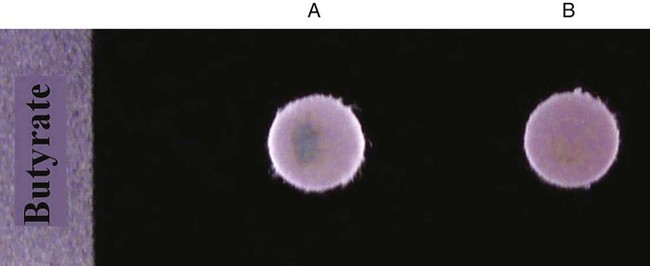 Figure: Butyrate disk test A, Positive test. B. Negative test
Limitations
- The false-positive reaction is seen if the incubation period is longer than 5 minutes.
- False-negative reactions may occur if the inoculum is too small. If suspected organisms give negative test results, repeat with a larger inoculum and follow up with additional methods.
References and further readings
- Clinical Microbiology Procedures Handbook, Fourth Edition. (2016). American Society of Microbiology. https://doi.org/10.1128/9781555818814
- Michael A Noble, Bailey and Scott’s Diagnostic Microbiology, Fourteenth Edition (2017). Betty Forbes, Daniel F. Sahm, and Alice S. Weissfeld. St. Louis, MO: Mosby.

Tankeshwar Acharya, MSc (Medical Microbiology)
Tankeshwar Acharya is an Assistant Professor in the Department of Microbiology at Patan Academy of Health Sciences (PAHS), Nepal, where he has been teaching and practicing clinical microbiology for over 14 years. He is the founder of Microbe Online, one of the leading free microbiology education resources on the web, covering bacteriology, mycology, parasitology, immunology, and clinical laboratory diagnostics written from direct experience in both the classroom and the diagnostic laboratory.