
Biopesticides: Classification, Advantages, Disadvantages
Biopesticides explained: the three EPA categories (microbial, biochemical, plant-incorporated), how Bt works, and the advantages and disadvantages versus chemical pesticides.
On this page
A caterpillar eats a cotton leaf and dies within days, but the bird that eats the caterpillar is unharmed, and so is the farmer who sprayed the field. That selectivity is the promise of biopesticides: pest control that targets the pest and spares almost everything else.
A biopesticide is a pest-control product made from a living organism or a natural substance, rather than from a synthetic chemical. The living or natural agent can be a microbe (bacterium, fungus, virus, or protozoan), a plant-derived compound, or a gene engineered into the crop itself. Biopesticides control pests through targeted, mostly non-toxic mechanisms, which makes them central to integrated pest management (IPM) and to organic farming.
The idea is old. In 1835, Agostino Bassi showed that the fungus Beauveria bassiana caused a fatal disease in silkworms, the first demonstration that a microbe could be used against an insect. That work opened the field of microbial pest control that this article covers.
Classification of Biopesticides
The United States Environmental Protection Agency (EPA) divides biopesticides into three categories, based on what the active ingredient is: microbial pesticides, biochemical pesticides, and plant-incorporated protectants. These three categories are the standard framework, and the sections below cover each in turn.
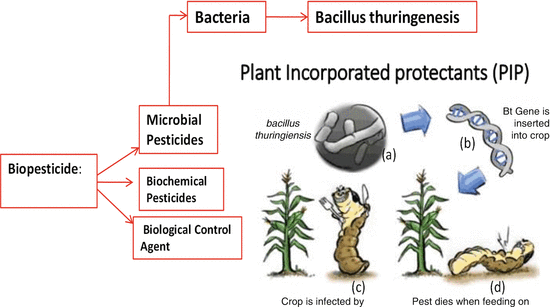 Figure: Classification of biopesticides. Source: SpringerLink
Microbial biopesticides
Microbial biopesticides use a whole living microorganism as the active agent. They are environment-friendly, host-specific, and in some cases self-replicating, which lets them persist in the field after application. They fall into four groups by the type of microbe.
| Type | Examples | Main targets |
|---|---|---|
| Bacteria | Bacillus thuringiensis (Bt), Bacillus popilliae, Serratia entomophila, Saccharopolyspora spinosa (source of spinosad) | Insect larvae (Lepidoptera, Coleoptera, Diptera) |
| Fungi | Beauveria bassiana, Metarhizium anisopliae, Trichoderma viride, Verticillium lecanii | Insects, and (for Trichoderma) plant-pathogenic fungi |
| Viruses | Baculoviruses (nucleopolyhedroviruses, granuloviruses) | Specific caterpillar pests |
| Protozoa/others | Nosema species | Grasshoppers, locusts |
The most important of these is Bacillus thuringiensis (Bt), a spore-forming bacterium that produces an insecticidal crystal protein during sporulation. Bt is the world's most widely used microbial biopesticide, and its mechanism is worth understanding in detail.
Mode of action of B thuringiensis
As a microbial biopesticide, Bt is sprayed onto crops as a mix of spores and crystal proteins. The insect must eat it for the toxin to work. (When the Bt gene is instead built into the plant, that is a plant-incorporated protectant, covered below, not the spray described here.)

The steps are:
- The insect eats Bt spores and crystals on the leaf. Each crystal is made of Cry protein, a δ-endotoxin the bacterium produces during sporulation.
- The alkaline midgut of the insect (pH 9–12) dissolves the crystal and releases the Cry protein. Insect gut enzymes then cut it into its active toxic form.
- The activated protein binds to the specific receptor present in the gut wall of insects, causing pore formation.
- The pore formation leads to an osmotic imbalance between intracellular and extracellular environments, and cell lysis occurs.
- As a result, the microvilli are destroyed, the insect ceases feeding, and it eventually dies.
The toxin is selective because it only activates at high gut pH and only binds receptors found in specific insect guts. Humans and other mammals have acidic stomachs and lack those receptors, so the same Cry protein is harmless to us. This is why Bt can kill a caterpillar and spare the farmer.
Biochemical Pesticides
Biochemical pesticides are naturally occurring substances that control pests by non-toxic mechanisms, meaning they interfere with the pest's behavior or growth rather than poisoning it outright. This is what separates them from conventional insecticides, which are synthetic chemicals that kill the pest directly. The EPA recognizes several groups:
- Pheromones, especially insect sex pheromones. These do not kill the insect; they disrupt mating by confusing males or luring pests into traps. Pheromones are the classic example of a non-toxic biochemical pesticide, and they are not plant-derived.
- Plant extracts and essential oils that repel pests, deter feeding (antifeedants), or attract them to traps.
- Insect growth regulators, which block the insect's development (for example, preventing it from molting into an adult).
Because the mechanisms are subtle (disrupting mating, feeding, or development) rather than lethal, biochemical pesticides are considered low-risk. Deciding whether a substance qualifies as a biochemical pesticide is not always obvious, so the EPA convenes a special committee to make that call.
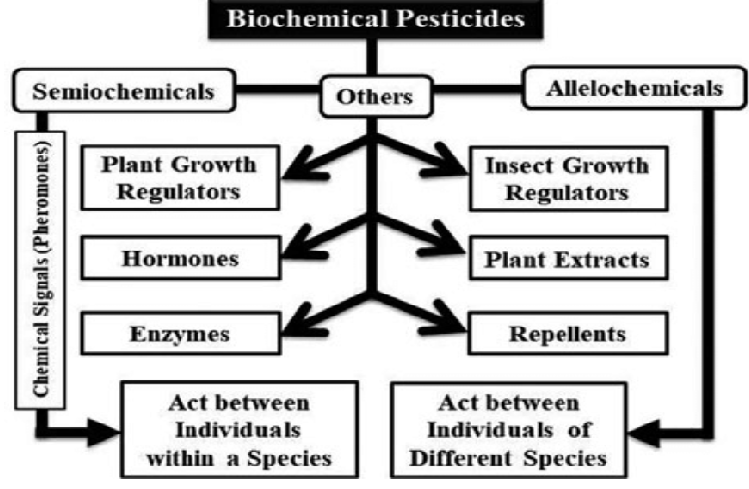 Figure: Bio-chemical pesticides. Source: ResearchGate
Plant-Incorporated Protectants
- Plant-incorporated protectants, genetically modified plants, or manipulated plants have the toxin-producing genes to combat the pest. For instance, the Bt gene is transferred in the cotton plant. This is the same Bt toxin described earlier, but delivered differently: instead of spraying the bacterium onto the crop, the toxin gene is built into the plant so the plant makes the toxin in its own tissues. Bt cotton and Bt corn are the best-known examples.
- The target gene is transferred into transgenic plants using Agrobacterium-mediated transfer, gene guns, or ballistic techniques. The above methods were applied to rice, corn, wheat, and maize.
- Plant-incorporated protectants also carry concerns: possible effects on non-target organisms (such as beneficial insects), the spread of the introduced gene to wild or neighboring plants, and the emergence of resistant pests over time. These risks are why PIP crops are regulated as pesticides, not just as crops.
Biopesticide Formulation
- Biopesticide formulations are similar to those of synthetic pesticides. Active ingredients and inert or inactive substances are combined in biopesticide formulations.
- The formulation intended to manage the target pest contains one or more active ingredients (such as ethylene or B. thuringiensis), as well as inert additives (such as kerosene, beeswax, and propane) serve to improve the application and efficacy of the active ingredients.
- Based on their formulations, biopesticides are divided into dry and liquid.
- Dry materials include dust powders, granules, seed dressings, wettable powders, and wettable-dispersible powders, whereas emulsions, suspensions, emulsifiable concentrates, and ultra-low volume liquids are all examples of liquids.
Biopesticides versus Chemical Pesticides
The clearest way to understand biopesticides is to compare them directly with the synthetic chemical pesticides they aim to replace.
| Feature | Biopesticides | Chemical pesticides |
|---|---|---|
| Source | Living organisms or natural substances | Synthetic chemicals |
| Target range | Narrow, often one pest group | Broad, kills many species |
| Effect on non-target species | Low | Often high (bees, birds, fish) |
| Speed of action | Slow (days) | Fast (hours) |
| Residue in food and water | Low, breaks down quickly | Can persist |
| Resistance development in pests | Slower | Faster |
| Shelf life and stability | Shorter, sensitive to heat and light | Longer, more stable |
| Cost and ease of use | Sometimes higher, more specialized | Usually cheaper, simpler |
The trade-off is speed and convenience versus safety and selectivity. Chemical pesticides act fast and store well but harm non-target species and drive resistance. Biopesticides are safer and more selective but act slowly and need more careful handling. This is exactly why they are used together in integrated pest management, rather than one fully replacing the other.
Advantages of Biopesticides
Biopesticide holds some pros over synthetic pesticides:
- Biopesticides are less harmful than synthetic pesticides since they are made from natural components, thereby being gentler for the environment.
- Compared to synthetic pesticides, biopesticides are frequently more targeted in their effects and are more unlikely to harm non-target species.
- Biopesticides can aid in reducing the emergence of resistance to pesticides in pests, increasing the durability of pest control measures.
- In contrast to synthetic pesticides, biopesticides frequently leave less residue, lowering the risk of food and water pollution.
- Biopesticides are compatible with organic farming and can protect crops without jeopardizing the organic certification.
- Biopesticides are safer for the people who apply them. Because they are low-toxicity to mammals, they reduce the risk of poisoning for farm workers.
- Many act through mechanisms (such as gut-specific toxins or mating disruption) that pests find very hard to overcome, so resistance builds slowly.
- They fit integrated pest management, where they are combined with other methods to reduce total chemical use.
Disadvantages of Biopesticides
Biopesticide has a few cons, which are as follows:
- Many biopesticides break down in sunlight (ultraviolet light) and heat, so they lose potency quickly in the field and often must be reapplied. Some are applied in the evening or early morning to limit UV exposure.
- Only a specific species or group of insects are poisoned by microbial insecticides; the others may still exist and inflict damage.
- Some of the fungal pesticides are expensive.
- Possibly having a shorter life span than synthetic pesticides, biopesticides are less practical to store and utilize.
- Biopesticides may need specialized tools or application methods, making them more challenging to apply.
- They act slowly. A farmer facing a fast-moving pest outbreak may not have the days a biopesticide needs to take effect.
- They are highly specific, which is a strength for safety but a weakness in a mixed-pest field, where one biopesticide controls only one pest and others survive.
- Effectiveness depends heavily on conditions. Temperature, humidity, and timing all affect whether a living biopesticide works, so results are less predictable than with chemicals.
- Shorter shelf life and special storage (often refrigeration) make them harder to stock and distribute, which matters most in exactly the warm, low-resource settings where they are most needed.
How to Remember
The three EPA categories: Microbe, Molecule, Made-in-plant. Microbial (a whole living microbe), Biochemical (a natural molecule like a pheromone), and Plant-incorporated (the toxin gene made inside the plant). Microbe, molecule, made-in-plant.
The Bt sequence: Eat, Dissolve, Cut, Punch, Leak, Die. The insect Eats the crystal; the high-pH gut Dissolves it; enzymes Cut the Cry protein to its active form; the toxin Punches pores in the gut wall; the cells Leak and burst; the insect stops feeding and Dies.
Why Bt is safe for us: no high pH, no receptor. The toxin needs an alkaline gut to dissolve and a specific gut receptor to bind. Our stomachs are acidic and we lack the receptor, so it does nothing to us.
Bt spray versus Bt plant. Same toxin, two delivery routes. Sprayed on the crop = microbial biopesticide. Built into the crop's genes = plant-incorporated protectant. If the plant makes the toxin itself, it is a PIP.
Biopesticide trade-off in three words: safe but slow. That single phrase captures both the main advantage and the main disadvantage.
Key exam facts
| Fact | Answer to remember |
|---|---|
| The three EPA categories | Microbial, biochemical, plant-incorporated protectants |
| Most widely used microbial biopesticide | Bacillus thuringiensis (Bt) |
| Bt's active toxin | Cry protein (a δ-endotoxin), made during sporulation |
| Why Bt is selective | Needs high gut pH plus a specific insect gut receptor |
| First microbial pest-control demonstration | Agostino Bassi, Beauveria bassiana in silkworms, 1835 |
| Classic biochemical pesticide | Insect sex pheromones (disrupt mating, not toxic) |
| Example of a plant-incorporated protectant | Bt cotton, Bt corn |
| Main fungal biopesticides | Beauveria bassiana, Metarhizium anisopliae |
| Viral biopesticides | Baculoviruses |
| Main advantage over chemical pesticides | Selective and low-toxicity to non-target species |
| Main disadvantage | Slow-acting and short-lived (breaks down in sunlight) |
| Where biopesticides fit | Integrated pest management (IPM) and organic farming |
Where Students Get Confused
Bt spray and Bt crops are different categories. Bt sprayed on a plant is a microbial biopesticide. The Bt gene engineered into a plant is a plant-incorporated protectant. Same toxin, two EPA categories.
Biopesticides are not always instant or plant-derived. They act slowly, not on contact like many chemicals. And they are not all from plants: microbial and pheromone biopesticides are not plant products.
"Non-toxic mechanism" does not mean harmless to the pest. Biochemical pesticides control pests without directly poisoning them (for example, by disrupting mating), but the pest population still collapses. Non-toxic describes the mechanism, not the outcome.
The Cry protein is a δ-endotoxin, not the LPS endotoxin. In Bt, "endotoxin" means the crystal Cry protein. Do not confuse it with the lipopolysaccharide endotoxin of Gram-negative bacteria. Different molecule, same word.
Selective is a strength and a weakness. Specificity makes biopesticides safe for non-target species, but it also means one product usually controls only one pest, so a field with several pests needs several products or other methods.
Biopesticides do not replace chemical pesticides outright. In practice they are combined with other methods in IPM. The goal is to reduce chemical use, not always to eliminate it.
Frequently Asked Questions
What is a biopesticide?
What is a biopesticide?
A biopesticide is a pest-control product made from a living organism or a natural substance, rather than a synthetic chemical. It controls pests through targeted, mostly non-toxic mechanisms and is widely used in integrated pest management and organic farming.
What are the three categories of biopesticides?
What are the three categories of biopesticides?
The EPA divides them into microbial pesticides (a whole microbe, such as Bacillus thuringiensis), biochemical pesticides (natural substances such as pheromones), and plant-incorporated protectants (a pest-killing gene engineered into the plant).
How does Bacillus thuringiensis (Bt) work?
How does Bacillus thuringiensis (Bt) work?
The insect eats Bt spores and crystals. The high-pH gut dissolves the crystal and releases the Cry protein, which is activated by gut enzymes, binds receptors in the gut wall, and punches pores in it. The gut cells burst, the insect stops feeding, and it dies. It is harmless to mammals because our stomachs are acidic and we lack the receptor.
What are the advantages of biopesticides?
What are the advantages of biopesticides?
They are selective (sparing non-target species), low-toxicity to humans and wildlife, leave little residue, slow the development of resistance, and are compatible with organic farming
What are the disadvantages of biopesticides?
What are the disadvantages of biopesticides?
They act slowly, break down quickly in sunlight and heat, are often effective against only one pest, depend heavily on conditions, and usually have a shorter shelf life than chemical pesticides.
What is the difference between biopesticides and chemical pesticides?
What is the difference between biopesticides and chemical pesticides?
Biopesticides come from living organisms or natural substances and are selective, safe, but slow. Chemical pesticides are synthetic, broad-spectrum, fast, and stable, but they harm non-target species and drive resistance. The two are often used together in integrated pest management.
What is the difference between Bt spray and Bt crops?
What is the difference between Bt spray and Bt crops?
Bt spray applies the bacterium to the crop surface and is a microbial biopesticide. Bt crops have the Bt toxin gene built into the plant, making them a plant-incorporated protectant. Same toxin, different delivery, different regulatory category.
References
- Bharti, V. and Ibrahim, S. (2020). Biopesticides: production, formulation and application systems. International Journal of Current Microbiology and Applied Sciences, 9(10), 3931–3946. https://doi.org/10.20546/ijcmas.2020.910.453
- Rajamani, M. and Negi, A. (2021). Biopesticides for pest management. In V. Venkatramanan, S. Shah, and R. Prasad (Eds.), Sustainable Bioeconomy (pp. 239–266). Springer Singapore. https://doi.org/10.1007/978-981-15-7321-7_11
- Schünemann, R., Knaak, N. and Fiuza, L.M. (2014). Mode of action and specificity of Bacillus thuringiensis toxins in the control of caterpillars and stink bugs in soybean culture. ISRN Microbiology, 2014, 135675. https://doi.org/10.1155/2014/135675
- United States Environmental Protection Agency. What are biopesticides? Retrieved from https://www.epa.gov/ingredients-used-pesticide-products/what-are-biopesticides
- Madigan, M.T., Bender, K.S., Buckley, D.H., et al. (2021). Brock Biology of Microorganisms, 16th ed. Pearson. (Microbial biotechnology and Bacillus thuringiensis sections.)

Tankeshwar Acharya, MSc (Medical Microbiology)
Tankeshwar Acharya is an Assistant Professor in the Department of Microbiology at Patan Academy of Health Sciences (PAHS), Nepal, where he has been teaching and practicing clinical microbiology for over 14 years. He is the founder of Microbe Online, one of the leading free microbiology education resources on the web, covering bacteriology, mycology, parasitology, immunology, and clinical laboratory diagnostics written from direct experience in both the classroom and the diagnostic laboratory.
Comments
No comments yet. Be the first to share your thoughts.
Leave a comment
All comments are reviewed before they appear.