
Beta-Lactam Antibiotics: Mechanism of Action and Resistance
How beta-lactam antibiotics work, how they are classified (penicillins, cephalosporins, carbapenems, monobactams), and the three ways bacteria resist them, with the one distinction that changes treatment.

On this page
A four-year-old is admitted with a spreading skin infection and started on amoxicillin. Two days later the child is worse, not better. The culture returns Staphylococcus aureus, methicillin-resistant. The drug never had a chance. Not because the dose was wrong, but because this organism had changed the very lock that every beta-lactam is built to jam.
Beta-lactams are the most prescribed antibiotics on earth. Understanding why they work so well, and why they sometimes fail completely, starts with a single four-membered ring. By the end of this article, you will be able to explain not just how this child's amoxicillin was supposed to work, but exactly why nothing in the beta-lactam class could have saved the day, and what has to change instead.
The beta-lactam ring (structure)
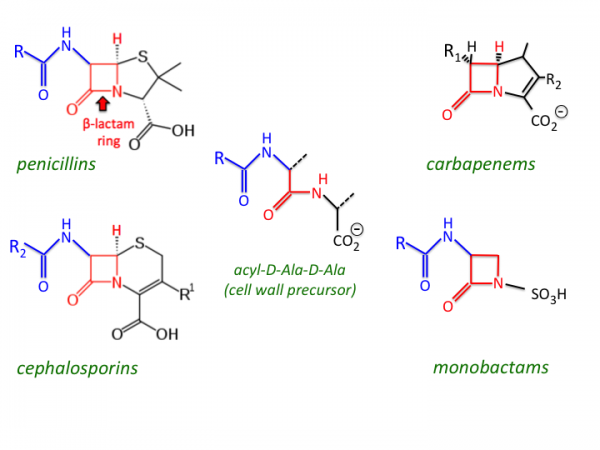 Figure 1: Molecular structure of common beta-lactam antibiotics
The beta-lactam ring is a four-membered ring made of three carbon atoms and one nitrogen atom, with a carbonyl group that makes it chemically strained and reactive. The name comes from lactam (a cyclic amide), and "beta" refers to the position of the amino group two carbons from the carbonyl. That strain is the point: the ring is primed to snap open and react with its target.
In a real drug, the beta-lactam ring is fused to a second ring, and that partner ring is what separates the classes:
- Penicillins: beta-lactam ring fused to a five-membered thiazolidine ring.
- Cephalosporins: fused to a six-membered dihydrothiazine ring. As a class, cephalosporins tend to be more stable to many staphylococcal and gram-negative beta-lactamases than the natural penicillins, though this depends far more on the side chains and the specific enzyme than on the fused ring alone.
- Carbapenems: a modified five-membered ring with a carbon replacing the sulfur, giving the broadest spectrum and the most stability to beta-lactamases.
- Monobactams: the beta-lactam ring stands alone, with no fused second ring.
Two events happen at this ring, and they are the whole story of the class. A penicillin-binding protein mistakes the ring for its natural substrate and gets locked onto it (the mechanism of action). A bacterial beta-lactamase cleaves the ring open before it can act (the main mechanism of resistance). Break the ring, and the drug is dead.
Classification of Beta-Lactam Antibiotics
Beta-lactam antibiotics fall into four structural subgroups. Read the tables for what each group is, but the payoff is the pattern underneath them: spectrum is bought and sold as you move across the classes, and knowing the pattern tells you which drug reaches which infection.
| Subgroup | Examples | Key point |
|---|---|---|
| Penicillins | penicillin G, amoxicillin, cloxacillin, piperacillin | The original class; ranges from narrow to broad depending on subtype |
| Cephalosporins | cefazolin through ceftaroline | Spectrum broadens by generation (see below); the 5th generation reaches MRSA |
| Carbapenems | meropenem, imipenem, ertapenem, doripenem | Broadest spectrum; reserved for serious or resistant infections |
| Monobactams | aztreonam | Gram-negative only; a useful option in penicillin allergy (minimal cross-reactivity with other beta-lactams except ceftazidime, which shares a side chain) |
Penicillins are themselves divided by spectrum:
| Penicillin subtype | Examples | Note |
|---|---|---|
| Natural | penicillin G, penicillin V | Narrow, mainly gram-positive |
| Aminopenicillins | amoxicillin, ampicillin | Extended to some gram-negatives |
| Antistaphylococcal | cloxacillin, flucloxacillin | Beta-lactamase stable, used against staphylococci |
| Antipseudomonal | piperacillin, ticarcillin | Broad spectrum, active against Pseudomonas |
Cephalosporins are grouped by generation, with the spectrum widening toward gram-negatives at each step:
| Generation | Examples | Spectrum note |
|---|---|---|
| 1st | cefazolin, cephalexin | Mainly gram-positive (skin and soft tissue) |
| 2nd | cefuroxime, cefoxitin | Adds gram-negative cover and some anaerobes |
| 3rd | ceftriaxone, cefotaxime, ceftazidime | Broad gram-negative; ceftriaxone crosses into the CNS |
| 4th | cefepime | Broad, including Pseudomonas |
| 5th | ceftaroline | Reaches MRSA |
These four subgroups are frequently paired with a beta-lactamase inhibitor (clavulanate, sulbactam, tazobactam, or avibactam) to protect them from destruction, as in amoxicillin-clavulanate and piperacillin-tazobactam. That is a combination strategy, covered in the resistance section below, not a fifth structural class.
Why this matters
This is the mechanistic root of nearly everything in antimicrobial susceptibility testing. The reason Kirby-Bauer, MIC determination, and the carbapenemase tests on this site exist at all is that resistance mechanisms do not behave predictably from species identity alone. Two E. coli isolates from the same hospital ward can carry completely different resistance profiles. That unpredictability is exactly what susceptibility testing exists to resolve, and the three mechanisms in the resistance section below are what it is actually testing for.
Hold onto the question from the top of this article: why did nothing in the beta-lactam class save that child? The answer is not in the mechanism of action. It is in one of the three resistance pathways, and the distinction between them is what changes the entire treatment strategy, not just the dose.
Mechanism of Action of Beta-Lactam Antibiotics
The beta-lactam ring is the key to how these drugs work. They target and inhibit cell wall synthesis by binding the enzymes involved in building the wall. These enzymes are anchored in the cell membrane and, as a group, are referred to as penicillin-binding proteins (PBPs). A bacterial species may contain between 4 and 6 different types of PBPs. The PBPs involved in cell wall cross-linking (that is, the transpeptidases) are often the most critical for survival.
The four-membered ring of beta-lactam antibiotics gives these compounds a three-dimensional shape that mimics the D-Ala-D-Ala peptide terminus, the natural substrate for transpeptidase activity during cell wall peptidoglycan synthesis. Tight binding of the beta-lactam drug to the transpeptidase active site inhibits cell wall synthesis.
Death results from osmotic instability caused by faulty cell wall synthesis, or the binding of the beta-lactam to a PBP may trigger a series of events that lead to autolysis and death of the cell.
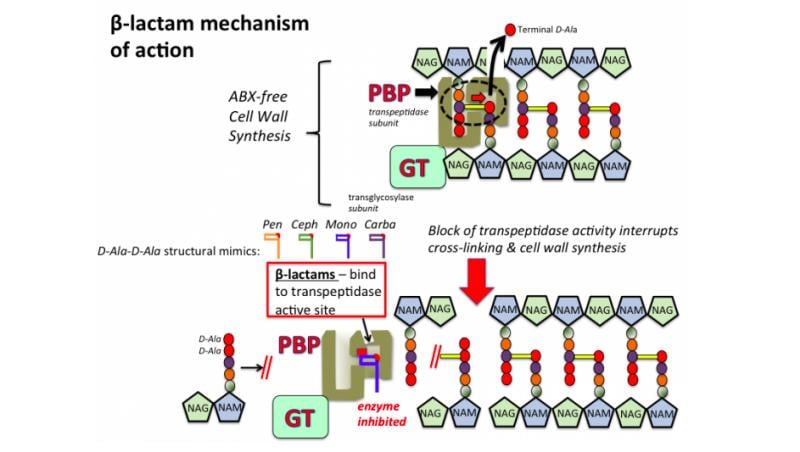 Figure 2: Mechanism of action of beta-lactam antibiotics
Beta-lactam agents are active against both gram-positive and gram-negative bacteria, but effectiveness varies because of structural differences in the cell wall (for example, the outer membrane present in gram-negative but not gram-positive bacteria) and PBP content.
Resistance Mechanisms Against Beta-Lactam Antibiotics
Three pathways confer resistance to beta-lactams: enzymatic destruction of the antibiotic, altered antibiotic targets, or decreased uptake of the drug.
Summary
| Resistance pathway | Specific mechanism | Examples |
|---|---|---|
| Enzymatic destruction of antibiotics | Beta-lactamase enzymes destroy the beta-lactam ring, so the antibiotic can no longer bind penicillin-binding protein (PBP) or interfere with cell wall synthesis | Staphylococcal resistance to penicillin. Resistance of Enterobacteriaceae and Pseudomonas aeruginosa to several penicillins, cephalosporins, and aztreonam. |
| Altered target | Mutational changes in the original PBPs, or acquisition of different PBPs that do not bind beta-lactams sufficiently to inhibit cell wall synthesis | Staphylococcal resistance to methicillin and all other available beta-lactams. Penicillin and cephalosporin resistance in Streptococcus pneumoniae and viridans streptococci. |
| Decreased uptake | Porin channels (through which beta-lactams cross the outer membrane to reach the PBPs of gram-negative bacteria) change in number or character, so beta-lactam uptake is substantially reduced | Pseudomonas aeruginosa resistance to imipenem. |
Enzymatic destruction of the antibiotic
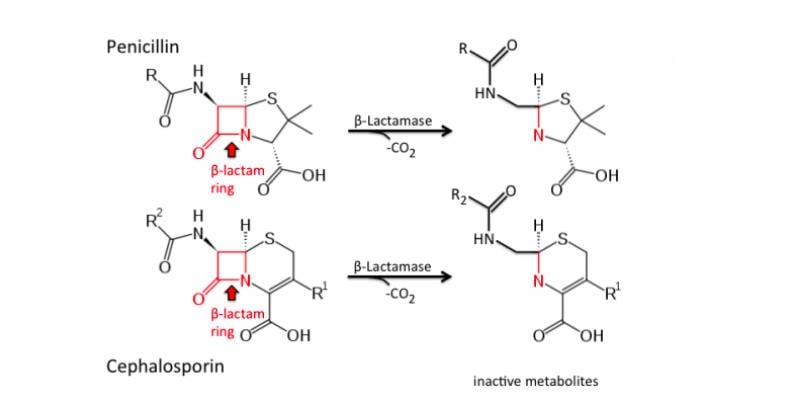 Figure 3: Hydrolysis of penicillins and cephalosporins by beta-lactamase
Destruction of beta-lactams by beta-lactamase enzyme-producing bacteria is by far the most important method of resistance. Beta-lactamases open the beta-lactam ring, and the altered drug can no longer bind PBPs or inhibit cell wall synthesis. But not every beta-lactam is susceptible to hydrolysis by every beta-lactamase. For example, staphylococcal beta-lactamase readily hydrolyzes penicillin and its close derivatives, but fails to hydrolyze many cephalosporins and imipenem.
Do you know? Both gram-positive and gram-negative bacteria produce beta-lactamase. The beta-lactamase produced by gram-positive bacteria is secreted into the surrounding environment, whereas that of gram-negative bacteria remains in the periplasmic space.
You may like to explore the lab methods for detecting these enzymes: Modified Hodge Test and Carba NP Test,.
Altered antibiotic targets
The organism changes, or acquires a gene coding for, altered PBPs. Beta-lactams lack sufficient affinity for the altered PBP and cannot block its function, so cell wall synthesis continues even in the presence of the antibiotic. This is exactly what happened to the child in the opening case. Methicillin-resistant Staphylococcus aureus (MRSA) carries an altered PBP called PBP2a, encoded by the mecA gene. PBP2a simply will not bind beta-lactams, at any dose, with any inhibitor. No amount of clavulanate fixes a lock the key was never shaped for. This is why a beta-lactamase inhibitor combination such as amoxicillin-clavulanate can rescue an ordinary penicillinase-producing staphylococcus, but is powerless against MRSA. The inhibitor disables an enzyme; it cannot reshape a target.
This is the crux of the case: an inhibitor can neutralize an enzyme that destroys the drug, but it cannot help when the target itself has changed. Treatment for MRSA therefore has to leave the beta-lactam class almost entirely (the 5th-generation cephalosporin ceftaroline is the notable exception) and move to an agent with a different mechanism, such as vancomycin.
Read more: D-Test.
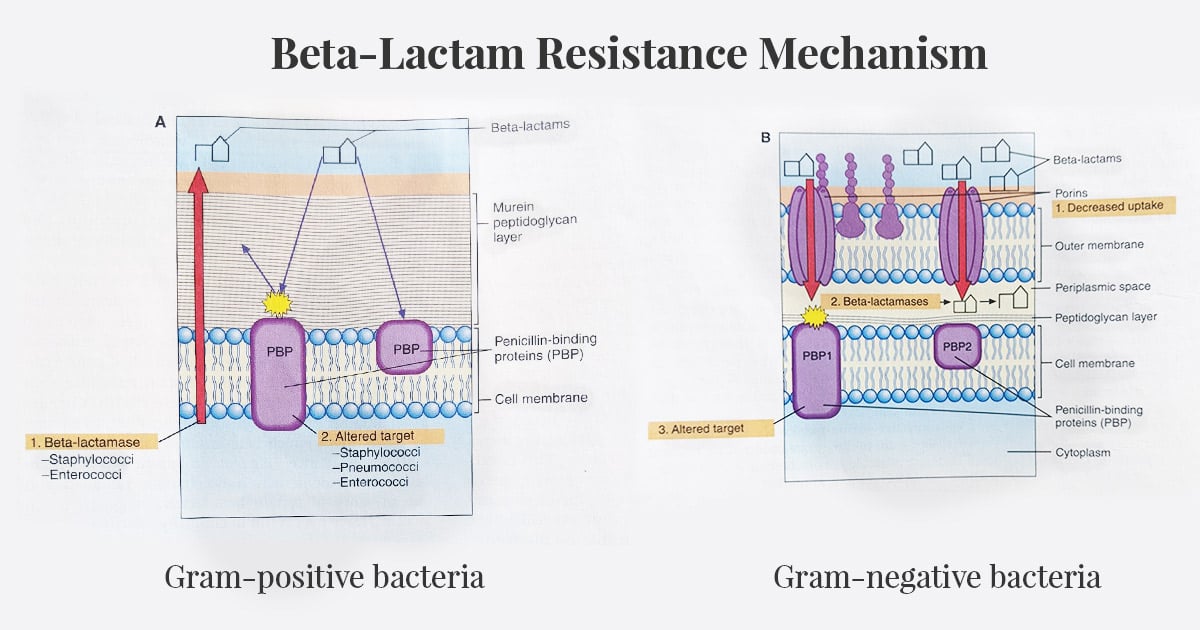 Figure 4: Beta-lactam resistance mechanisms of gram-positive and gram-negative bacteria. Image source: Bailey & Scott's Diagnostic Microbiology.
Decreased uptake of the drug
Decreased uptake contributes significantly to beta-lactam resistance in gram-negative bacteria. It happens when the number or character of the outer membrane porins changes (these porins are how beta-lactams reach the inner peptidoglycan layer of gram-negative bacteria). For example, Pseudomonas aeruginosa resistance to imipenem.
Tackling resistance to beta-lactam antibiotics
- Protect the beta-lactam ring from beta-lactamases by molecular alteration of the ring. For example, methicillin and oxacillin, close molecular derivatives of penicillin, resist staphylococcal beta-lactamase.
- Combine a beta-lactamase inhibitor with an active beta-lactam. The combination pairs a beta-lactam with antimicrobial activity (for example ampicillin, amoxicillin, or piperacillin) with a beta-lactam that has little antimicrobial activity of its own but binds and inhibits beta-lactamases (for example sulbactam, clavulanate, or tazobactam). The inhibitor binds the beta-lactamase avidly and irreversibly, rendering the enzyme incapable of hydrolysis and allowing the partner beta-lactam to act. Examples include ampicillin-sulbactam, amoxicillin-clavulanate, and piperacillin-tazobactam. These combinations only work against organisms whose beta-lactamase is bound by the inhibitor. They do little against resistance mediated by altered PBPs.
- Switch to an antimicrobial with a different mechanism of action. For example, vancomycin (a non-beta-lactam agent) for MRSA.
How to Remember
The one sentence that captures the whole article: Only enzymatic resistance can be chemically outmaneuvered with an inhibitor combination. Altered targets and decreased uptake have to be solved by switching drug classes entirely, which is why correctly identifying the resistance mechanism changes the whole treatment strategy, not just the dose.
The ring is both the target and the weakness. Picture the beta-lactam ring as a key shaped to fit the bacterium's wall-building lock (the PBP). The same shape that lets the key fit also makes it fragile: a beta-lactamase is the bolt-cutter that snaps the key before it can turn. Two ways to beat the drug follow directly from the picture. Snap the key (beta-lactamase, enzymatic destruction) or change the lock (altered PBP). An inhibitor can jam the bolt-cutter, but it cannot re-carve a lock.
Cephalosporin generations, the classic pain point: "1 for skin, 3 for the brain." First-generation cephalosporins are workhorses for gram-positive skin and soft-tissue infections. Third-generation agents like ceftriaxone cross into the CNS and treat meningitis. Each higher generation trades some gram-positive cover for more gram-negative reach, until the 5th generation swings back to cover MRSA.
Key exam facts
| Question | Answer |
|---|---|
| What natural substrate does the beta-lactam ring structurally mimic? | The terminal D-Ala-D-Ala peptide sequence used by transpeptidases |
| What are PBPs? | Penicillin-binding proteins, the cell membrane enzymes that beta-lactams target to block cell wall synthesis |
| Name the three resistance pathways | Enzymatic destruction, altered target, decreased uptake |
| Which pathway is most clinically important overall? | Enzymatic destruction by beta-lactamase |
| Where do gram-positive vs. gram-negative bacteria keep their beta-lactamase? | Gram-positive: secreted into the surrounding environment. Gram-negative: retained in the periplasmic space |
| Which resistance mechanism does MRSA use? | Altered PBP (PBP2a, encoded by mecA), not enzymatic destruction |
| Name a real example of decreased-uptake resistance | Pseudomonas aeruginosa resistance to imipenem via porin changes |
| Which resistance mechanism can a beta-lactamase inhibitor combination rescue? | Enzymatic destruction only, not altered target or decreased uptake |
| Name three clinically used beta-lactam/inhibitor combinations | Ampicillin-sulbactam, amoxicillin-clavulanate, piperacillin-tazobactam |
Where students actually get confused
- The beta-lactam ring is not the whole drug. It is the shared reactive core. The fused second ring and the side chains are what make a penicillin different from a cephalosporin.
- "Generations" of cephalosporins describe spectrum, not potency. A later generation is not simply stronger. It covers a different (usually broader gram-negative) range.
- Why MRSA resists every beta-lactam at once: it alters the target itself (PBP2a), so no beta-lactam binds well, no matter how the ring is protected. This is different from a beta-lactamase, which destroys the drug rather than changing the target. See the resistance section above and the MRSA article.
- ESBL, AmpC, and carbapenemase are all beta-lactamases, but they differ in what they destroy and what stops them. Clavulanate rescues against many ESBLs but not against AmpC. See the resistance section and the beta-lactamase classification article.
- Penicillin allergy and cephalosporins: cross-reactivity exists, but is far lower than once taught, and is driven by shared side chains, not by the shared beta-lactam ring.
References
- Procop GW, Church DL, Hall GS, Janda WM. Koneman's Color Atlas and Textbook of Diagnostic Microbiology. 7th ed. Wolters Kluwer; 2017.
- Tille PM. Bailey & Scott's Diagnostic Microbiology. 15th ed. Elsevier; 2022.
- Bush K, Bradford PA. Beta-lactams and beta-lactamase inhibitors: an overview. Cold Spring Harbor Perspectives in Medicine. 2016;6(8):a025247.
- Pandey N, Cascella M. Beta-lactam antibiotics. StatPearls. StatPearls Publishing; updated regularly.
- Katzung BG, editor. Basic and Clinical Pharmacology. 15th ed. McGraw Hill; 2021.
Frequently Asked Questions
What are the three mechanisms of beta-lactam resistance?
Why does a beta-lactamase inhibitor combination work against some resistant organisms but not MRSA?
Where do gram-positive and gram-negative bacteria keep their beta-lactamase enzymes?
What natural structure does the beta-lactam ring mimic?
Can all beta-lactamase enzymes hydrolyze all beta-lactam antibiotics?
Why is decreased drug uptake a resistance mechanism mainly seen in gram-negative bacteria?

Tankeshwar Acharya, MSc (Medical Microbiology)
Tankeshwar Acharya is an Assistant Professor in the Department of Microbiology at Patan Academy of Health Sciences (PAHS), Nepal, where he has been teaching and practicing clinical microbiology for over 14 years. He is the founder of Microbe Online, one of the leading free microbiology education resources on the web, covering bacteriology, mycology, parasitology, immunology, and clinical laboratory diagnostics written from direct experience in both the classroom and the diagnostic laboratory.
Comments
No comments yet. Be the first to share your thoughts.
Leave a comment
All comments are reviewed before they appear.