

The infection that dies before the culture even starts
A patient at a genitourinary clinic has a urethral swab taken for suspected gonorrhea. Neisseria gonorrhoeae is notoriously fragile outside the body, sensitive to drying, temperature swings, and delay. If that swab sits on a counter for even a few hours without proper transport conditions, the organism can die before it ever reaches the lab. The culture comes back negative, not because the infection wasn't there, but because it never survived the trip. The patient, still infected, may go untreated, and any contact-tracing that depended on a positive result never happens.
This is exactly the problem Amies transport medium exists to solve: keeping a fragile organism alive and stable between collection and processing, without letting it multiply, dry out, or die in the meantime. Getting this medium's design and its handling rules right isn't a formality. It's the difference between a true infection reaching the lab intact and a true infection quietly disappearing en route.
Amies transport medium is a widely used, effective semisolid medium for transporting swab specimens to the microbiology laboratory. Placing a swab in a moist transport medium prevents drying and death of the organism during transit.
Amies is a modification of Stuart’s medium in which glycerophosphate is replaced by an inorganic phosphate buffer and charcoal is added. This modification prolongs the viability and thus increases the isolation of anaerobes, delicate bacterial pathogens like Neisseria gonorrhoeae, Haemophilus influenzae, Neisseria meningitidis, and Haemophilus ducreyi. For delays as long as 24 hours, Amies medium with charcoal can be used.
Principle
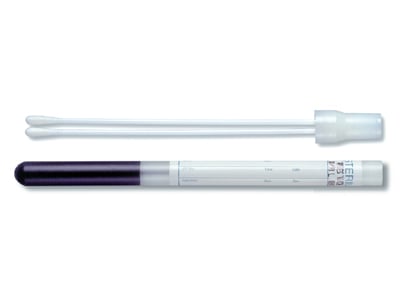 Figure: Amies transport medium
The presence of sodium thioglycollate and a small amount of agar creates a reduced environment which favors the growth of a wide variety of pathogens. The use of charcoal in transport media neutralizes toxic materials in the specimen or on the swab and facilitates the growth of sensitive bacterial pathogens such as Neisseria gonorrhoeae.
Calcium, magnesium, potassium, and sodium salts help the survival of pathogens and also control the permeability of bacterial cells. Phosphate buffer maintains the pH of the medium.
Why Amies Replaced Stuart's Medium
Amies is a modification of the older Stuart's transport medium, and the change wasn't cosmetic. Stuart's medium used glycerophosphate as a buffering component, but glycerophosphate can also serve as a carbon source, meaning some organisms could actually use it to keep multiplying during transport. That's the opposite of what a transport medium is supposed to do: a transport medium's job is to pause the situation, not let it keep writing itself. Uncontrolled multiplication during transport can distort what the lab eventually recovers, overrepresenting fast growers and underrepresenting the organism that actually matters.
Amies replaced glycerophosphate with an inorganic phosphate buffer, removing that accidental carbon source, and added charcoal. The result: organisms are held in a stable, non-multiplying, non-dying state for far longer than plain saline or a dry swab would allow.
GUIDE TO REMEMBER: Anchor for the Stuart's-to-Amies fix: "take away the snack." Stuart's medium accidentally gave some organisms a carbon source (glycerophosphate) they could use to keep multiplying. Amies took that snack away, which is the entire reason it replaced Stuart's medium rather than just being a minor variant of it.
With Charcoal vs. Without Charcoal
This distinction matters and is easy to get backwards:
- Amies with charcoal is the standard choice for most specimens. Charcoal absorbs toxic fatty acids and other bacterial metabolic byproducts that would otherwise damage sensitive organisms during transport, extending viability for delicate pathogens like N. gonorrhoeae, Haemophilus influenzae, N. meningitidis, and H. ducreyi.
- Amies without charcoal is preferred specifically for Mycoplasma* and *Ureaplasma recovery. The same charcoal that protects most fastidious organisms actually interferes with recovery of these two, so the charcoal-free version is used whenever they're a specific concern.
GUIDE TO REMEMBER: Anchor for charcoal vs. charcoal-free: "charcoal is a sponge for troublemakers, but Mycoplasma doesn't like the couch." Charcoal soaks up toxic byproducts that would otherwise hurt most fastidious organisms, but it also happens to inhibit Mycoplasma and Ureaplasma recovery specifically, which is exactly why the charcoal-free version exists for those two.
Handling Rules, and Why They Matter
Transport specimens to the laboratory as soon as possible, ideally within 6 hours, and no later than 24 hours, maintaining a cold chain. Do not freeze. Freezing causes ice crystals to form inside bacterial cells, rupturing them; this is a direct cause of specimen death, not a precaution taken "just in case." Refrigeration slows metabolism without destroying the cells; freezing kills them outright.
Composition of Amies transport medium
Final pH (at 25°C) 7.2±0.2
| Ingredients | Gms/liter |
|---|---|
| Sodium chloride | 3.0 |
| Potassium chloride | 0.2 |
| Calcium chloride | 0.1 |
| Magnesium chloride | 0.1 |
| Monopotassium phosphate | 0.2 |
| Disodium phosphate | 1.150 |
| Sodium thioglycollate | 1.0 |
| Charcoal | 10.0 |
| Agar | 4.0 |
Preparation of Amies Transport medium
Amies transport medium is best prepared from ready to use dehydrated powder, available from most suppliers of culture media.
pH of medium: This should be within the range of pH 7.0-7.4 at room temperature.
Shelf-life: Up to 9 months providing there is no change in the volume or appearance of the medium to suggest contamination or an alteration of its pH.
Inoculation of the Medium
Clinics and ward staff should be advised to check the expiry date before using the medium. Specimen collected on a sterile cotton wool swab should be immersed into the medium, cutting off the swab stick to allow the bottle top to be replaced tightly.
- Insert the swab (with cotton tip downwards) into the medium to one-third of the medium depth.
- Cut off or break the swab stick if longer than the tube.
- Screw the cap firmly in a way that the swab is forced to the bottom of the medium.
- Transport to the laboratory as soon as possible or preferably within 6 hours (maximum up to 24 hours) maintaining a cold chain (do not freeze).
Uses of Amies Transport Medium
Amies transport medium is used for the collection, transport, and preservation of microbiological specimens, especially throat, vaginal, and wound swab samples. It is routinely used for the transport of specimens from collection centers (or health centers) to the microbiology laboratory.
- Sputum: Transfer a purulent part of the sputum to a cotton-wool swab, and insert it in a container of Amies transport medium. Amies medium ensures the survival of pathogens such as S. pneumoniae and H. influenzae and also avoids the overgrowth of fast-multiplying commensals.
- Pus: Collect the pus specimen using a sterile cotton-wool swab. When pus is not discharged, use a sterile cotton swab to collect a sample from the infected site. Insert it in a container of Amies transport medium, breaking off the swab stick to allow the bottle top to be replaced tightly.
- Nasopharyngeal specimen: To identify carriers of N. meningitidis, a nasopharyngeal swab specimen is collected and transported to the laboratory in Amies or Stuart’s medium or plated directly onto medium and transported in a CO2 containing the system. Amies medium is also used in suspected Bordetella pertussis and Corynebacterium diphtheriae cases.
- Urogenital swab: Amies medium is the most efficient medium for transporting urethral, cervical, and vaginal swabs. It ensures the survival of Haemophilus ducreyi (which causes soft chancre) and delicate organisms like Neisseria gonorrhoeae.
Key exam facts
| Fact | Detail |
|---|---|
| Type of medium | Semisolid transport medium (not a growth medium) |
| Modified from | Stuart's transport medium |
| Key change from Stuart's | Glycerophosphate (a potential carbon source) replaced with an inorganic phosphate buffer |
| Role of charcoal | Absorbs toxic fatty acids/metabolic byproducts, extending viability of fastidious organisms |
| Amies with charcoal | Standard choice; used for N. gonorrhoeae, H. influenzae, N. meningitidis, H. ducreyi, and most routine swabs |
| Amies without charcoal | Preferred for Mycoplasma and Ureaplasma, since charcoal inhibits their recovery |
| Transport time | As soon as possible, ideally within 6 hours, maximum 24 hours |
| Temperature rule | Maintain a cold chain; refrigerate, never freeze |
| Why not freeze | Ice crystal formation ruptures bacterial cells, killing the organism outright |
Where Students Get Confused
- Treating Amies as just "a slightly different version" of Stuart's medium. The specific change, removing glycerophosphate as an accidental carbon source, is the whole point; without it, the same overgrowth problem Stuart's medium had would return.
- Assuming charcoal is always the better choice. It's better for most fastidious organisms, but it specifically works against recovery of Mycoplasma and Ureaplasma, the one case where charcoal-free is the correct choice.
- Assuming colder is always safer for transport. Refrigeration is correct; freezing kills the organism via ice crystal formation, the opposite of the intended effect.
- Treating a transport medium as if it were a growth medium. Its job is to keep organisms alive without letting them multiply, not to support active growth the way a culture medium does.
References
- MacFaddin J.F., 1985, Media For Isolation-Cultivation-Identification-Maintenance of Medical Bacteria, Vol. 1, Williams and Wilkins, Baltimore. Revision: 04/ 2018
- Jorgensen,J.H., Pfaller , M.A., Carroll, K.C., Funke, G., Landry, M.L., Richter, S.S and Warnock., D.W. (2015) Manual of Clinical Microbiology, 11th Edition. Vol. 1
- Monica Cheesbrough District laboratory Practice in Tropical countries (Part II)
- Koneman, E. W. et al. Color Atlas and Textbook of Diagnostic Microbiology (5th ed.).
- World Health Organization guidance on specimen collection and transport for STI diagnosis.

Comments
No comments yet. Be the first to share your thoughts.
Leave a comment
All comments are reviewed before they appear.