
Rickettsial Disease MCQs With Answers and Explanations
Ten rickettsial disease MCQs with answers and explanations: epidemic and endemic typhus, Rocky Mountain spotted fever, scrub typhus, Q fever, Brill-Zinsser disease, and their arthropod vectors.

On this page
Ten multiple choice questions with answers and explanations on the rickettsial diseases: typhus, spotted fevers, scrub typhus, and Q fever, their causative organisms, and their arthropod vectors. Write down your answers first, then check them against the key at the end.
For a full explainer on what these organisms are and the diseases they cause, see the overview of the rickettsiae.
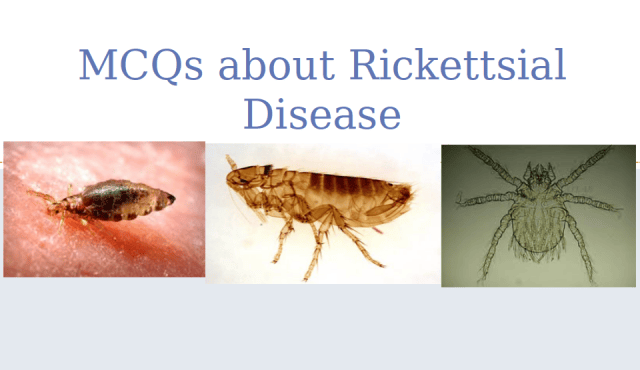 1. Which of the following organisms causes epidemic typhus?
a. Rickettsia prowazekii
b. Rickettsia typhi
c. Orientia tsutsugamushi (formerly Rickettsia tsutsugamushi)
d. Rickettsia akari
2. Rocky Mountain spotted fever is caused by:
a. Rickettsia prowazekii
b. Coxiella burnetii
c. Rickettsia rickettsii
d. Rickettsia typhi
3. Which of the following organisms is transmitted by the aerosol route?
a. Rickettsia rickettsii
b. Rickettsia typhi
c. Coxiella burnetii
d. Rickettsia prowazekii
4. Which rickettsial disease is flea-borne?
a. Rocky Mountain spotted fever
b. Epidemic typhus
c. Endemic typhus
d. Scrub typhus
5. All of the following rickettsial diseases are zoonoses except:
a. Rocky Mountain spotted fever
b. Endemic typhus
c. Scrub typhus
d. Epidemic typhus
6. Brill-Zinsser disease is caused by:
a. Rickettsia typhi
b. Orientia tsutsugamushi
c. Rickettsia prowazekii
d. Rickettsia rickettsii
7. Which of the following statements about the rickettsiae is not correct?
a. Rickettsiae are obligate intracellular bacteria
b. The Weil-Felix test can be used in the diagnosis of rickettsial disease
c. All rickettsial diseases are zoonoses
d. Rickettsiae are gram-negative but stain poorly with the standard Gram stain
8. Which rickettsial disease is transmitted from person to person by the human body louse (Pediculus)?
a. Epidemic typhus
b. Endemic typhus
c. Scrub typhus
d. Rocky Mountain spotted fever
9. Ticks are the arthropod vector responsible for the transmission of which of the following organisms?
a. Rickettsia prowazekii
b. Rickettsia typhi
c. Orientia tsutsugamushi
d. Rickettsia rickettsii
10. Which of the following rickettsial diseases is not transmitted to humans by the bite of an arthropod vector?
a. Rickettsialpox
b. Q fever
c. Rocky Mountain spotted fever
d. Epidemic typhus
Answer key
- a. Rickettsia prowazekii
- c. Rickettsia rickettsii
- c. Coxiella burnetii
- c. Endemic typhus
- d. Epidemic typhus
- c. Rickettsia prowazekii
- c. All rickettsial diseases are zoonoses
- a. Epidemic typhus
- d. Rickettsia rickettsii
- b. Q fever
Why these are the answers
1. Rickettsia prowazekii. Epidemic typhus, also called louse-borne typhus, is caused by Rickettsia prowazekii and spreads through the human body louse. The distractors cause different diseases: R. typhi causes endemic (murine) typhus, Orientia tsutsugamushi (reclassified in 1995 from Rickettsia tsutsugamushi) causes scrub typhus, and R. akari causes rickettsialpox.
2. Rickettsia rickettsii. Rocky Mountain spotted fever, the most severe spotted fever, is caused by Rickettsia rickettsii and transmitted by ticks. Despite its name, it occurs across much of the Americas, not only the Rocky Mountains. Coxiella burnetii (Q fever) and the typhus-group rickettsiae are the wrong answers here.
3. Coxiella burnetii. Q fever is the exception among these organisms because it spreads by inhaling contaminated aerosols (from the birth fluids, urine, or feces of infected livestock), not by an arthropod bite. Coxiella burnetii is also extremely hardy in the environment and needs a very low infectious dose. Note that Coxiella is now placed in a separate genus from the true rickettsiae, though it is traditionally taught alongside them.
4. Endemic typhus. Endemic typhus (also called murine or flea-borne typhus), caused by Rickettsia typhi, is transmitted by the rat flea, with rats as the reservoir. Contrast this with epidemic typhus (louse-borne), Rocky Mountain spotted fever (tick-borne), and scrub typhus (mite/chigger-borne). Matching each disease to its vector is the core of this topic.
5. Epidemic typhus. The question asks which is not a zoonosis. A zoonosis is maintained in an animal reservoir; Rocky Mountain spotted fever, endemic typhus, and scrub typhus all have animal reservoirs. Epidemic typhus is the exception: humans are the main reservoir, and it passes person to person through the body louse, so it is not a true zoonosis. (Under stress, such as war or famine, this human-louse-human cycle can cause explosive epidemics, hence the name.) Read more about Typhus fever in this article.
6. Rickettsia prowazekii. Brill-Zinsser disease is a delayed relapse of epidemic typhus: R. prowazekii can persist silently in a person for years after the initial illness, then reactivate (typically when immunity wanes) to cause a milder recurrent typhus. Because it is recrudescent epidemic typhus, the organism is the same as in question 1, R. prowazekii.
7. All rickettsial diseases are zoonoses. This is the false statement, so it is the answer, and it follows directly from question 5: epidemic typhus is not a zoonosis, so "all" is incorrect (most are, but not all). The other statements are true: rickettsiae are obligate intracellular bacteria, the Weil-Felix test (based on cross-reacting Proteus antigens) has historically been used in diagnosis, and rickettsiae are gram-negative but stain poorly by Gram stain, so other stains (such as Giemsa) are preferred.
8. Epidemic typhus. Only epidemic typhus is transmitted from person to person by the human body louse (Pediculus humanus). The louse feeds on an infected person, and the bacteria are then spread when louse feces are scratched into the skin. This human-to-human louse cycle is exactly why epidemic typhus, unlike the others, is not a zoonosis.
9. Rickettsia rickettsii. Among these organisms, Rickettsia rickettsii (Rocky Mountain spotted fever) is the tick-borne one. The others use different vectors: R. prowazekii the louse, R. typhi the flea, and Orientia tsutsugamushi the mite (chigger). Ticks also transmit the other spotted-fever-group rickettsiae.
10. Q fever. The question asks which disease is not spread by an arthropod bite. Rickettsialpox (mite), Rocky Mountain spotted fever (tick), and epidemic typhus (louse) are all arthropod-borne. Q fever (Coxiella burnetii) is the exception: it is acquired by inhaling contaminated aerosols, not through a bite. This is the same key fact as question 3.

Tankeshwar Acharya, MSc (Medical Microbiology)
Tankeshwar Acharya is an Assistant Professor in the Department of Microbiology at Patan Academy of Health Sciences (PAHS), Nepal, where he has been teaching and practicing clinical microbiology for over 14 years. He is the founder of Microbe Online, one of the leading free microbiology education resources on the web, covering bacteriology, mycology, parasitology, immunology, and clinical laboratory diagnostics written from direct experience in both the classroom and the diagnostic laboratory.
Comments
No comments yet. Be the first to share your thoughts.
Leave a comment
All comments are reviewed before they appear.