

Plant cells and animal cells look different under a microscope, but they have far more in common than most students expect. Both are eukaryotic cells, which means both keep their DNA inside a true nucleus and both are packed with the same membrane-bound machinery. That shared design is not a coincidence: plants and animals descend from a common eukaryotic ancestor, so they inherited the same basic cellular toolkit. The differences came later, as plants evolved to make their own food and stand upright, and animals evolved to move.
This article covers what the two cell types share, how they differ, and, just as usefully for revision, why the similarities and differences exist. Because both are eukaryotic, the similarities are the larger and more important part of the story, so we start there.
Similarities Between Plant and Animal Cells
Both plant and animal cells are eukaryotic, so they share the entire eukaryotic cell plan. The main similarities are:
- A true nucleus. Both keep their genetic material (DNA) inside a membrane-bound nucleus. This is the defining feature of a eukaryotic cell and the thing prokaryotes (bacteria) lack.
- A plasma (cell) membrane. Both are enclosed by a phospholipid membrane that controls what enters and leaves the cell.
- Cytoplasm. Both are filled with cytoplasm, the gel-like fluid in which the organelles sit and most chemical reactions happen.
- Mitochondria. Both have mitochondria, the organelles that release energy (ATP) from food. (Plant cells have these as well as chloroplasts, not instead of them.)
- Ribosomes. Both build their proteins on ribosomes. Ribosomes have no membrane, and both cell types have them free in the cytoplasm and attached to the endoplasmic reticulum.
- Endoplasmic reticulum (rough and smooth). Both have this network for making and transporting proteins and lipids.
- Golgi apparatus. Both have a Golgi system that packages and sorts molecules for delivery or secretion.
- Lysosomes and other vesicles. Both use membrane-bound sacs to move and break down materials. (Lysosomes are prominent in animal cells; plant cells carry out similar digestion largely in the vacuole.)
- The same genetic code. Both store information in DNA and read it using the same genetic code, so the basic processes of copying DNA and making protein are the same in a plant cell and an animal cell.
- A cytoskeleton. Both have an internal protein scaffold of microtubules and microfilaments that gives shape, moves organelles, and drives cell division.
The single simplest way to state the overlap: if you are asked for one feature present in both a plant and an animal cell, the safest answers are the nucleus or the cell membrane, because both are defining eukaryotic features neither cell can do without.
Why are they so similar?
Because both are eukaryotic cells, and eukaryotes share a common ancestor. Every eukaryotic cell, whether in an oak tree or in your own body, was built from the same inherited plan: DNA in a nucleus, energy from mitochondria, proteins from ribosomes, transport through the endoplasmic reticulum and Golgi. The differences below are modifications added on top of this shared foundation, not a different design. Keeping that in mind makes the whole topic easier: start from "both are eukaryotic, so they share everything eukaryotic," then learn the short list of things that differ.
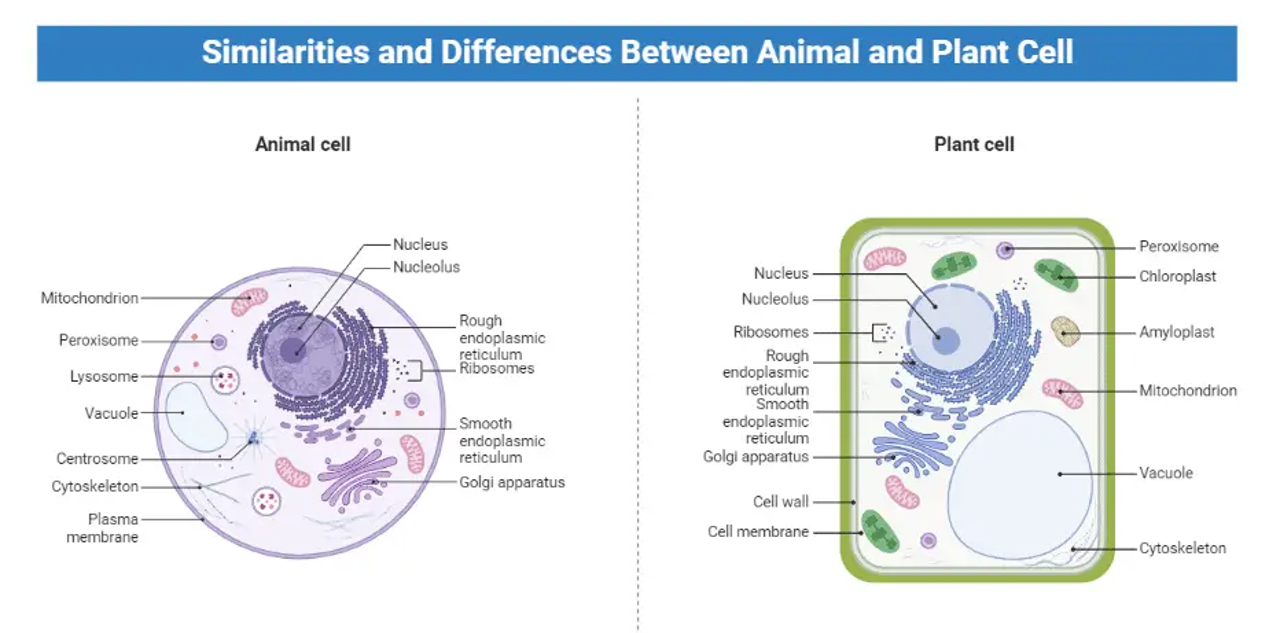 Figure: Diagram comparing a plant cell and an animal cell, showing the shared organelles and the plant-only cell wall, chloroplasts, and central vacuole.
Differences Between Plant and Animal Cells
The differences come from the different jobs plant and animal cells evolved to do. A short table first, then the detail.
| Feature | Plant cell | Animal cell |
|---|---|---|
| Cell wall | Present (cellulose), outside the membrane | Absent; membrane is the outer layer |
| Shape | Fixed, more regular, held by the wall | Varied, often rounded or irregular |
| Chloroplasts / plastids | Present (make food by photosynthesis) | Absent |
| Vacuole | One large, central vacuole | Small and several, or absent |
| Centrioles | Absent in higher plants | Present |
| Golgi | Many small units (dictyosomes) | Usually one prominent Golgi complex |
| Size | Often larger (10 to 100 μm) | Often smaller (about 10 to 30 μm) |
| Food storage | As starch | As glycogen |
Cell wall. The biggest structural difference. Plant cells have a rigid cell wall of cellulose outside the membrane, which gives the cell strength and a fixed shape and lets plants stand upright without a skeleton. Animal cells have no wall; their outer boundary is the plasma membrane, which is why animal cells can take on many shapes and move more freely. For a full tour of the animal cell and each of its organelles, see the animal cell and its parts.
Chloroplasts and plastids. Plant cells contain plastids, most importantly chloroplasts, which hold the green pigment chlorophyll and carry out photosynthesis, making food from sunlight, water, and carbon dioxide. Animal cells have no plastids and cannot make their own food; they must consume it. This single difference, the ability to photosynthesize, is the root of most of the others. A closer look at the wall, chloroplasts, vacuole, and every other plant structure is in the plant cell and its parts.
Vacuoles. A mature plant cell usually has one large central vacuole that can fill most of the cell, storing water and maintaining the internal pressure (turgor) that keeps the plant firm. Animal cells may have several small vacuoles or none; animal cells do have vacuoles, they are simply small and not the dominant feature they are in plants.
Shape. Because the wall holds them in place, plant cells keep a fixed, fairly regular shape. It is often drawn as rectangular, but that is a simplification, many plant cells are not rectangular. Animal cells, with no wall, are more varied and often rounded.
Centrioles. Higher plants lack centrioles and organize cell division using other microtubule-organizing centers instead. Animal cells have a pair of centrioles (in the centrosome) that help organize the spindle during division. Note that centrioles are not membrane-bound; they are small cylinders built from microtubules. (Some lower plants and algae do have centrioles, in the basal bodies of their swimming sperm, so "plants lack centrioles" is a rule for higher plants, not all plants.)
Golgi apparatus. Plant cells have many small Golgi units scattered through the cytoplasm, called dictyosomes. Animal cells usually have a single, larger, more prominent Golgi complex.
Food storage. Plants store surplus energy as starch; animals store it as glycogen.
How to Remember
Same toolkit, different add-ons. Both cells are eukaryotic, so they share everything eukaryotic: nucleus, membrane, mitochondria, ribosomes, ER, Golgi, cytoskeleton. Learn the shared toolkit once, then just add the plant extras. You spend far less effort remembering the four or five differences than re-learning the whole cell twice.
Plants have the extras a food-maker needs. Wall, chloroplasts, and a big central vacuole are all things a stationary, self-feeding, upright organism needs: a wall to stand, chloroplasts to make food, a vacuole to hold water and stay firm. Tie each plant-only feature to "it makes its own food and cannot move," and you can reason out the differences instead of memorizing them.
Starch for plants, glycogen for animals. Both store spare energy as a glucose polymer; plants pick starch, animals pick glycogen. "Plant = starch" (both begin with a soft sound), animal = glycogen.
One feature in both? Say nucleus. A very common exam question asks for a single shared feature. The nucleus (or the cell membrane) is always a safe answer, because both are core eukaryotic features.
Key exam facts
| Point | Plant cell | Animal cell |
|---|---|---|
| Cell type | Eukaryotic | Eukaryotic |
| Nucleus | Present | Present |
| Cell membrane | Present | Present |
| Mitochondria | Present | Present |
| Ribosomes, ER, Golgi | Present | Present |
| Cytoskeleton | Present | Present |
| Cell wall | Present (cellulose) | Absent |
| Chloroplasts | Present | Absent |
| Central vacuole | One large | Small or several |
| Centrioles | Absent (higher plants) | Present |
| Shape | Fixed, more regular | Varied, often rounded |
| Energy store | Starch | Glycogen |
Where Students Get Confused
Plant and animal cells are mostly different. They are mostly the same. Both are eukaryotic and share the nucleus, membrane, mitochondria, ribosomes, ER, Golgi, and cytoskeleton. The differences are a short list added on top of a large shared base.
Animal cells have no vacuoles. They do. Animal cells have small vacuoles; they simply lack the single large central vacuole that dominates a plant cell. The difference is size and number, not presence or absence.
Plant cells have chloroplasts instead of mitochondria. No. Plant cells have both. They use chloroplasts to make food by photosynthesis and mitochondria to release energy from it, just as animal cells do.
All plant cells are rectangular and lack centrioles. "Rectangular" is a textbook simplification; many plant cells are other shapes. And it is higher plants that lack centrioles; lower plants and many algae have them for their swimming sperm.
Only plant cells have a cell wall, so bacteria and fungi are like plants. Cell walls appear in several groups, but they are made of different materials: cellulose in plants, chitin in fungi, peptidoglycan in bacteria. A wall alone does not make a cell plant-like.
References
- Iwasa J, Marshall W. Karp's Cell and Molecular Biology. 8th ed. Hoboken: Wiley; 2016.
- Alberts B, Heald R, Johnson A, et al. Molecular Biology of the Cell. 7th ed. New York: W. W. Norton; 2022.
- Reece JB, Urry LA, Cain ML, et al. Campbell Biology. 12th ed. New York: Pearson; 2021.

Comments
No comments yet. Be the first to share your thoughts.
Leave a comment
All comments are reviewed before they appear.