
Oxygen Requirements for Pathogenic Bacteria: Classification, Examples, and Laboratory Implications
Bacteria are classified by oxygen requirements into aerobes, anaerobes, facultative anaerobes, microaerophiles, capnophiles, and aerotolerant anaerobes. Learn each category's characteristics, clinical examples, lab incubation conditions, and why oxygen kills obligate anaerobes.
A surgical patient develops a deep wound infection five days after abdominal surgery. A swab is taken and plated onto blood agar — incubated in the standard aerobic incubator at 37°C. Forty-eight hours later, the plate shows no growth. The clinician concludes the culture is negative and continues empirical antibiotics. The patient continues to deteriorate.
The problem: the causative organism was Bacteroides fragilis — an obligate anaerobe. Exposure to the oxygen in the aerobic incubator killed it before a single colony could form. The culture was not negative; it was incorrectly incubated.
Understanding oxygen requirements is not abstract classification for its own sake. It determines which incubation environment every clinical culture needs, which media battery is appropriate for each specimen type, and whether a pathogen will be recovered or missed entirely. A microbiologist who cannot match an organism's oxygen requirement to the correct lab conditions cannot reliably culture it.
Classification
Microorganisms can be characterized by their requirements for oxygen. The oxygen requirements of bacteria reflect the mechanism used to satisfy their energy needs.
Depending on the oxygen requirements, microorganisms can be classified as aerobic (requires O₂), facultative (can grow in the presence or absence of O₂), anaerobic (growth in the absence of O₂), capnophilic (CO₂ stimulates growth), and microaerophilic (require slightly decreased O₂ tension).
Aerobes
Aerobes grow in ambient air, which contains 21% oxygen and a small amount of (0.03%) carbon dioxide. Aerobes obtain some of their energy from glycolysis but they get most of the energy through aerobic respiration. Aerobes require molecular oxygen as a terminal electron acceptor, so they cannot grow in its absence. For example, Micrococcus luteus and Pseudomonas aeruginosa.
Among the aerobes, cultures of rapidly dividing cells require more oxygen than do cultures of slowly dividing cells.
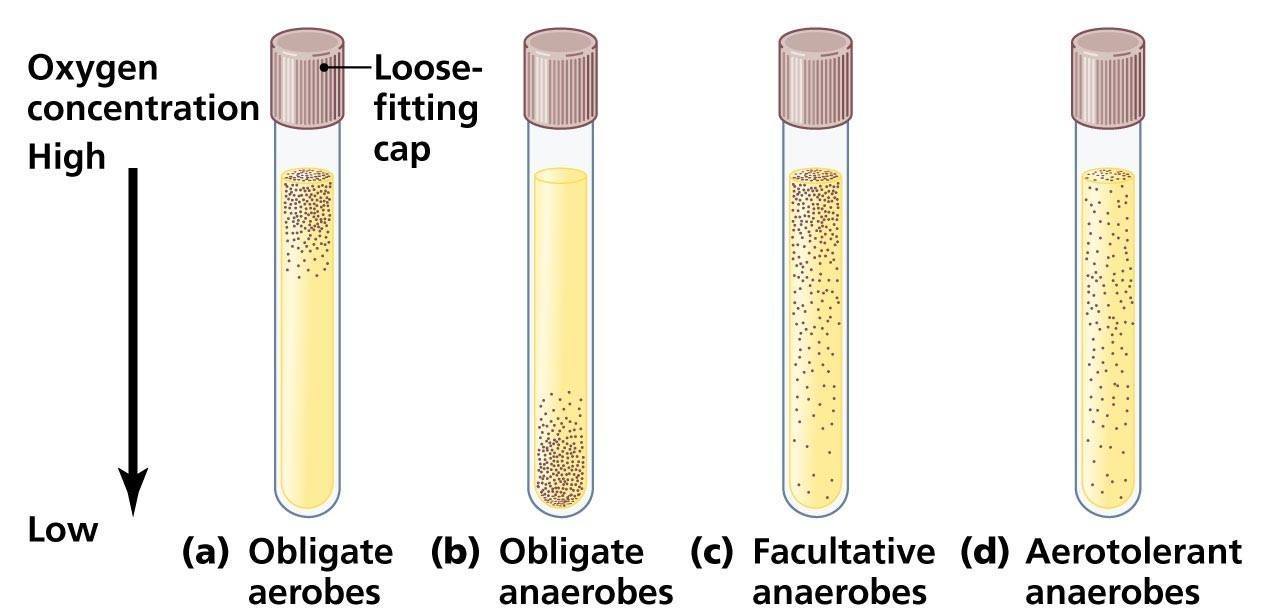 Figure: In a culture tube containing nutrient broth, obligate aerobes grow near the surface; where atmospheric oxygen diffuses into the medium; obligate anaerobes grow near the bottom of the tube, where little or no free oxygen reaches them.
Obligate aerobes
They have an absolute requirement of free oxygen to grow. For Examples, Pseudomonas aeruginosa, Mycobacterium tuberculosis. Most obligate aerobes obtain sufficient oxygen from nutrient broth or on the surface of solidified agar medium, but some need more; in such cases, oxygen gas is bubbled through the medium or into the incubation environment.
Anaerobes
Anaerobes can not grow in the presence of oxygen, oxygen is toxic to them. Anaerobes do not use free O₂ as their final electron acceptor. Instead, they use inorganic oxygen-containing molecules such as nitrate (NO3-), nitrite (NO2−), and sulfate (SO₄²-), in a process called anaerobic respiration. As anaerobes use fewer metabolic pathways, they produce fewer ATP molecules than aerobic organisms.
Their metabolism frequently is a fermentative type in which they reduce available organic compounds to various end products such as organic acids and alcohols.
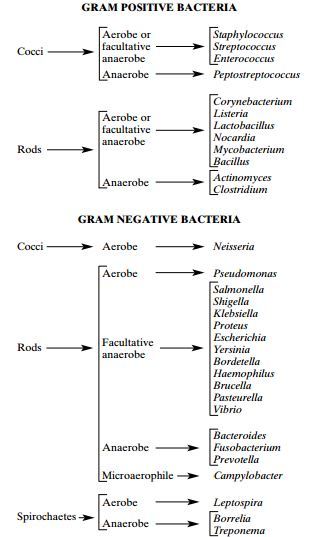 Figure: Basic classification of Medically Important Bacteria
Obligate anaerobes
Obligate anaerobes are killed by free oxygen. These bacteria grow only under the condition of high reducing intensity. Clostridium perfringens, Clostridium botulinum etc.
Obligate anaerobes are killed not by gaseous oxygen but by a highly reactive and toxic forms of oxygen called superoxide and hydrogen peroxide. Obligate anaerobes lack superoxide dismutase and catalase enzymes to neutralize oxygen free radicals thus, they succumb to the toxic effects of superoxide and hydrogen peroxide.
You can find detailed mechanisms about ‘how oxygen kills‘ at the end of this blog post.
Facultative anaerobes
Facultative anaerobes are versatile organisms capable of growth under aerobic and anaerobic conditions. They use oxygen if it is available but can function without it. When oxygen is present, they preferentially use oxygen as a terminal electron acceptor and carry on aerobic metabolism, but they shift to anaerobic metabolism when oxygen is absent. e.g., Enterobacteriaceae family, Staphylococcus aureus, etc.
Aerotolerant anaerobes
They are anaerobic bacteria that are not killed by exposure to oxygen. Aerotolerant anaerobes can survive in the presence of oxygen but not use it in their metabolism. Lactobacillus, for example, always captures energy by fermentation, regardless of whether the environment contains oxygen.
Capnophiles
Capnophilic bacteria require elevated CO₂ concentrations (5–10%) for optimal growth. CO₂ stimulates their growth, but capnophily is distinct from microaerophily — capnophiles do not necessarily require reduced oxygen. Neisseria gonorrhoeae and Haemophilus influenzae, for example, grow at normal atmospheric oxygen levels (21%) but require elevated CO₂.
The required CO₂ environment can be achieved by:
- CO₂ incubator — most reliable; maintains 5–10% CO₂ precisely
- Candle jar — a sealed container with a lit candle; the candle burns until O₂ is depleted, generating approximately 3% CO₂; acceptable alternative in resource-limited settings but less precise
- CO₂ generating sachets (e.g., CampyGen CO₂) — convenient for transport containers
Capnophile vs microaerophile distinction: Some organisms are both capnophilic AND microaerophilic — Campylobacter jejuni requires both elevated CO₂ (5–10%) AND reduced O₂ (5% O₂). These are two independent properties. An organism can be capnophilic without being microaerophilic (e.g., N. gonorrhoeae) or microaerophilic without being strongly capnophilic.
Microaerophiles
Microaerophiles are bacteria that grow best under reduced oxygen (5% to 10%) and increased carbon dioxide (5% to 10%) concentrations. Higher oxygen tensions may be inhibitory to them.
In a nutrient broth, they grow below the surface of the medium in a culture tube at the level where oxygen availability matches their needs. This environment can be obtained in specially designed jars or bags. Microaerophiles such as Campylobacter are also capnophiles. They thrive under conditions of low oxygen and high carbon dioxide concentration. Examples of microaerophiles are Campylobacter jejuni, Helicobacter pylori, etc.
Summary: Classification, Characteristics, Examples, and Laboratory Requirements
| Classification | O₂ requirement | CO₂ | Key enzymes | Clinical examples | Lab incubation environment |
|---|---|---|---|---|---|
| Obligate aerobe | Required (21%) | Normal (0.03%) | Superoxide dismutase + catalase | Mycobacterium tuberculosis, Pseudomonas aeruginosa, Bacillus spp. | Ambient air incubator (37°C) |
| Capnophile | Normal or variable | Elevated (5–10%) | Superoxide dismutase + catalase | Neisseria gonorrhoeae, Haemophilus influenzae, Brucella spp. | CO2 incubator or candle jar |
| Microaerophile | Reduced (5–10%) | Elevated (5–10%) | Superoxide dismutase; variable catalase | Campylobacter jejuni, Helicobacter pylori | Microaerobic jar or bag (CampyPak/CampyGen); water bath at 42°C for Campylobacter |
| Facultative anaerobe | Can use or survive without | Normal | Superoxide dismutase + catalase | Enterobacteriaceae (E. coli, Klebsiella), Staphylococcus aureus | Ambient air incubator — grows in all conditions |
| Aerotolerant anaerobe | Tolerates but does not use | Normal | Superoxide dismutase; no catalase (uses peroxidase) | Lactobacillus spp., Streptococcus pyogenes | Ambient air or anaerobic conditions — survives in both |
| Obligate anaerobe | Toxic — must be absent | Normal | Neither SOD nor catalase | Bacteroides fragilis, Clostridium perfringens, Clostridium botulinum, Actinomyces, Fusobacterium | Anaerobic chamber, anaerobic jar (GasPak), or anaerobic bag — all O2 must be excluded |
Key exam point — enzyme pattern:
- SOD + catalase = survives oxygen (aerobe or facultative)
- SOD only = tolerates oxygen but does not thrive (aerotolerant or some facultative)
- Neither = killed by oxygen (obligate anaerobe)
Why Oxygen Requirements Matter in the Laboratory
1. Specimen handling and transport Obligate anaerobes begin dying from the moment they are exposed to air. Wound swabs, abscess aspirates, and tissue from suspected anaerobic infections must be transported in anaerobic transport tubes (e.g., Port-A-Cul), processed within 30 minutes, and inoculated directly onto anaerobic media. A swab transported in a standard Amies tube left at room temperature for two hours will likely fail to grow Bacteroides or Clostridium even if they were present at collection.
2. Media battery selection Different incubation environments require different plates:
- Aerobic workup: blood agar + MacConkey (routine)
- Suspected anaerobes: blood agar + anaerobic blood agar + kanamycin-vancomycin blood agar (KVBA) incubated in anaerobic jar
- Suspected Campylobacter: Campylobacter blood agar (CAMPY-BAP) incubated microaerobically at 42°C
- Suspected Neisseria or Haemophilus: chocolate agar incubated in CO₂
3. Incubation environment options in resource-limited settings Access to CO₂ incubators and anaerobic chambers varies widely between laboratories:
| Environment needed | High-resource option | Resource-limited alternative |
|---|---|---|
| Aerobic (21% O₂) | Standard incubator | Any sealed box at 37°C |
| Capnophilic (5% CO₂) | CO₂ incubator | Candle jar (~3% CO₂) |
| Microaerobic (5% O₂, 10% CO₂) | Automated microaerobic jar | CampyGen sachet in sealed jar |
| Anaerobic (<0.1% O₂) | Anaerobic chamber | GasPak jar or AnaeroGen sachet in sealed jar |
Most laboratories in Developing Nations including Nepal, have standard aerobic incubators but limited access to CO₂ incubators and anaerobic jars. This means capnophilic and obligate anaerobic organisms are routinely under-detected in resource-limited settings — not because they are absent, but because the correct incubation conditions are unavailable. Recognising this gap is the first step toward addressing it.
4. Why "no growth" does not always mean "sterile" A culture plate showing no growth after 48 hours of aerobic incubation can mean:
- The specimen was sterile (true negative)
- The organism was an obligate anaerobe killed by aerobic incubation
- The organism was a microaerophile that could not grow at full O₂ tension
- The organism was a capnophile that needed CO₂
- The organism was a slow grower (e.g., M. tuberculosis) not yet visible at 48 hours
Clinical interpretation of "no growth" always requires considering what incubation conditions were used.
Why oxygen is toxic to some bacteria and how do bacteria detoxify toxic oxygen metabolites?
Several studies indicate that aerobes can only survive in the presence of oxygen through an elaborate system of defenses. Without these defenses, key enzyme systems in the organisms fail to function, and the organisms die.
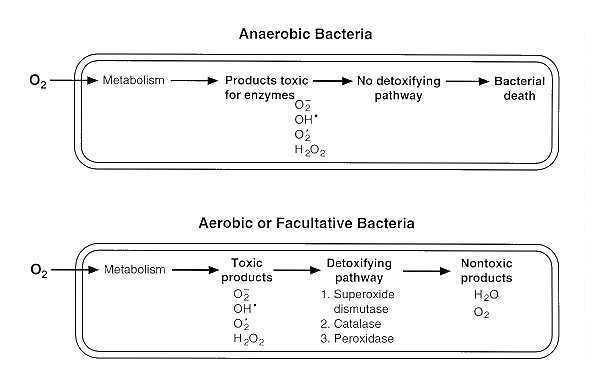 Obligate anaerobes, which live only in the absence of oxygen, do not possess the defenses that make aerobic life possible and, therefore, can not survive in air.
Figure: effects of oxygen on aerobic, anaerobic and facultative anaerobic bacteria
The tolerance to oxygen is related to the ability of the bacterium to detoxify superoxide and hydrogen peroxide, produced as a byproduct of aerobic respiration.
The assimilation of glucose in aerobic conditions results in the terminal generation of free radical superoxide (O2–). The enzyme superoxide dismutase reduces the superoxide to oxygen gas and hydrogen peroxide (H₂O₂). Subsequently, the toxic hydrogen peroxide generated in this reaction is converted to water and oxygen by the enzyme catalase, which is found in aerobic and facultative bacteria, or by various peroxidases found in several aerotolerant anaerobes.
- Obligate aerobes and most facultative anaerobes have both superoxide dismutase and catalase.
- Some facultative and aerotolerant anaerobes have superoxide dismutase but lack catalase.
- Most obligate anaerobes lack both enzymes.
How to Remember
The test tube diagram as a memory anchor:
The classic teaching image for oxygen requirements is a sealed nutrient broth tube inoculated with each group — where does each grow?
Surface (high O2)       ──────── Obligate aerobes: band at the top only
                        ──────── Facultative anaerobes: throughout, densest at top
                        ──────── Microaerophiles: a band just below the surface
                        ──────── Aerotolerant anaerobes: evenly throughout
Bottom (low O2)         ──────── Obligate anaerobes: bottom only
This single image encodes the entire classification: position in the tube reflects the organism's oxygen preference. Obligate aerobes crowd the surface; obligate anaerobes sink to the bottom. The two that grow throughout are told apart by density: facultative anaerobes are heaviest near the top because they use oxygen when it is available, while aerotolerant anaerobes are spread evenly because oxygen makes no difference to them.
The enzyme ladder: SOD and catalase
Think of oxygen defense as a two-step ladder:
- Step 1 (SOD): O₂⁻ (superoxide) → H₂O₂ + O₂ [superoxide dismutase]
- Step 2 (catalase): H₂O₂ → H₂O + O₂ [catalase]
- Aerobic organisms: climb both steps → survive oxygen
- Aerotolerant anaerobes: climb step 1 only → tolerate but don't thrive in O₂
- Obligate anaerobes: cannot climb either step → killed by oxygen
Three pairs that students always confuse:
| Confusion pair | Distinction |
|---|---|
| Aerotolerant anaerobe vs facultative anaerobe | Aerotolerant: cannot USE O₂, just tolerates it. Facultative: actively switches between aerobic and anaerobic metabolism — PREFERS O₂ when available |
| Capnophile vs microaerophile | Capnophile: needs more CO₂ (O₂ can be normal). Microaerophile: needs less O₂ (CO₂ may also be elevated). Campylobacter is both |
| Obligate anaerobe vs aerotolerant anaerobe | Both use fermentation. Key difference: SOD. Obligate anaerobes lack SOD and are killed by O₂; aerotolerant have SOD and survive O₂ |
Clinical memory anchors for each category:
- Obligate aerobe: M. tuberculosis — grows only at the well-oxygenated apex of the lung
- Capnophile: N. gonorrhoeae — always culture on CO₂ (candle jar or CO₂ incubator)
- Microaerophile: Campylobacter — microaerobic jar at 42°C; the most commonly missed diarrheal pathogen due to incorrect incubation
- Facultative: E. coli — grows everywhere; the most versatile; the default organism for lab teaching
- Aerotolerant: Lactobacillus — gut commensal; ferments regardless of O₂; probiotic significance
- Obligate anaerobe: Bacteroides fragilis — most common anaerobic pathogen in clinical infections; dies on contact with air
References and further readings
- Tille, P. M. (2022). Bailey and Scott's Diagnostic Microbiology (15th ed.). St. Louis: Elsevier.
- Madigan, M. T., Bender, K. S., Buckley, D. H., Sattley, W. M., & Stahl, D. A. (2021). Brock Biology of Microorganisms (16th ed.). Pearson.
- Mahon, C. R., Lehman, D. C., & Manuselis, G. (2018). Textbook of Diagnostic Microbiology (6th ed.). Elsevier.
- Cheesbrough, M. (2006). District Laboratory Practice in Tropical Countries, Part 2 (2nd ed.). Cambridge University Press.

Tankeshwar Acharya, MSc (Medical Microbiology)
Tankeshwar Acharya is an Assistant Professor in the Department of Microbiology at Patan Academy of Health Sciences (PAHS), Nepal, where he has been teaching and practicing clinical microbiology for over 14 years. He is the founder of Microbe Online, one of the leading free microbiology education resources on the web, covering bacteriology, mycology, parasitology, immunology, and clinical laboratory diagnostics written from direct experience in both the classroom and the diagnostic laboratory.