
OF Test: Fermenter or Non-Fermenter? The Two-Tube Test That Identifies Pseudomonas
When the oxidase test flags an oxidase-positive Gram-negative rod, the next question is whether it ferments glucose or only oxidizes it. The OF test answers that with two tubes, one sealed from air. Oxidative plus oxidase-positive points to Pseudomonas. Here is the low-peptone mechanism, the paired-tube reading logic, and why weak oxidative acid needs a special medium to detect.
Why It Matters
A wound swab from an ICU patient grows a Gram-negative rod on blood agar. The first branch-point test, oxidase, comes back positive within ten seconds. That single result has already done something important: it has removed the organism from the Enterobacteriaceae, because every member of that family is oxidase-negative. This is not E. coli or Klebsiella.
So what is it? The oxidase-positive Gram-negative rods split into two camps, and the next question sorts them: does this organism ferment glucose, or does it only oxidize it?
That is the exact question the oxidative-fermentative test answers. And the answer is diagnostic. An oxidase-positive Gram-negative rod that is oxidative (uses glucose only when air is present) and not fermentative is a non-fermenter, and the non-fermenters are a small, clinically heavy group: Pseudomonas aeruginosa, Acinetobacter, Burkholderia cepacia, Stenotrophomonas maltophilia. In an ICU wound, oxidase-positive plus oxidative plus a blue-green pigment and a grape-like odor is presumptive Pseudomonas aeruginosa before any other test returns.
Fermenters, by contrast, produce acid whether or not air is present. That is what E. coli and the rest of the Enterobacteriaceae do.
The OF test is how you tell those two metabolisms apart, and it needs a special trick to do it, because the acid a non-fermenter makes is so weak that an ordinary sugar tube cannot detect it at all. This article is about that trick, and about reading the two tubes the test depends on.
Hugh and Leifson developed the oxidative-fermentative (OF) test in 1953. They developed OF media to differentiate between oxidative bacteria (that produces acid from carbohydrates under aerobic condition only) and fermentative bacteria (that produces acid both under aerobic and anaerobic conditions).
Saccharolytic microorganisms degrade glucose either fermentatively or oxidatively. The end products of fermentation are relatively strong mixed acids detected in a conventional fermentation test medium. However, the acids formed in oxidative degradation of glucose are extremely weak and less, and the more sensitive oxidation fermentation medium of Hugh and Leifson’s is required for the detection. The medium was made by increasing the amount of glucose above that found in the medium used to detect fermentation and decreasing the amount of peptone.
The OF medium of Hugh and Leifson differs carbohydrate fermentation media as follows:
- The agar concentration is decreased to 2% from 3%, making it semisolid (This assists in determining the motility of organisms).
- The concentration of peptone is greatly reduced. Conventional carbohydrate fermentation media contain roughly 1% peptone; Hugh and Leifson's OF medium drops this to about 0.2% (2 g/L). Less peptone means fewer alkaline amines from protein breakdown, so the weak acid a non-fermenter produces is not neutralized before it can be detected.
- The carbohydrate concentration is raised to about 1% (from roughly 0.5% in conventional media). More glucose means more of the weak oxidative acid, pushing it above the threshold the bromothymol blue indicator can detect.
Principle: why the medium has almost no peptone
Here is the problem the OF test was invented to solve. A non-fermenter like Pseudomonas does use glucose, but only oxidatively, and oxidative metabolism produces only a tiny amount of weak acid, far less than fermentation produces. In an ordinary sugar tube, that trace of acid never shows up. Why not?
Because the same organism is also breaking down the peptone (protein) in the medium, and protein breakdown releases alkaline amines. In a normal, peptone-rich medium, those alkaline amines swamp the trace of weak acid, the pH never drops, and the indicator never changes. The organism looks like it did nothing to the sugar, when in fact it oxidized it.
Hugh and Leifson's fix was elegant: starve the medium of peptone and flood it with glucose.
- Low peptone (about 0.2%) means far fewer alkaline amines, so there is nothing to neutralize the weak acid.
- High glucose (about 1%) means more weak acid is produced in the first place.
- A dipotassium phosphate buffer stabilizes the reading and helps the small pH shift register.
- Low agar (semisolid) lets the acid diffuse and, as a bonus, lets you read motility from the same stab.
The result is a medium sensitive enough to catch the faint acid of oxidative metabolism, which an ordinary fermentation tube would miss entirely. That sensitivity is the entire reason OF medium exists as a separate test rather than just using a sugar fermentation tube.
Fermenters, of course, produce strong acid in bulk, so they turn the indicator yellow easily, in both tubes. The low-peptone trick does not change their result. It exists specifically to rescue the weak signal of the oxidizers.
Where the OF test sits in the workflow
The OF test rarely stands alone. It runs immediately after the oxidase test on a Gram-negative rod, and the two together are the backbone of non-fermenter identification.
- Oxidase negative + fermentative → Enterobacteriaceae (E. coli, Klebsiella, and the rest). Confirm with TSI, IMViC, and the enteric battery.
- Oxidase positive + fermentative → a fermenter outside the Enterobacteriaceae, such as Vibrio or Aeromonas.
- Oxidase positive + oxidative → a non-fermenter: Pseudomonas, Burkholderia, Alcaligenes, and relatives.
- Oxidase negative + oxidative or nonsaccharolytic → Acinetobacter, Stenotrophomonas (the oxidase-negative non-fermenters, the exceptions worth memorizing).
So the OF result only becomes an identification when paired with the oxidase result. A positive oxidase and an oxidative OF, on a Gram-negative rod, is the presumptive doorway to Pseudomonas aeruginosa, which you then confirm with pigment, odor, growth at 42°C, and cetrimide agar.
Uses
OF test is used to determine if gram-negative bacteria metabolize carbohydrates oxidatively, by fermentation, or are nonsaccharolytic (cannot use the carbohydrate in the media).
Media
Hugh and Leifson’s OF basal medium; constituents are as follows:
- Sodium chloride: 5.0 g
- Di-potassium phosphate: 0.3 g
- Peptone: 2.0 g
- Bromthymol blue: 0.03 g
- Agar: 3.0 g
- Glucose: 10 g
- Water: 1000 ml
The pH should be adjusted to 7.1 before autoclaving. After the medium is autoclaved at 121°C for 15 minutes, a filter-sterilized solution of 10% solution of carbohydrate is aseptically added to the medium to a final concentration of 1%.
Procedure
- Inoculate two tubes of OF test medium with the test organism using a straight wire by stabbing “halfway to the bottom” of the tube.
- Cover one tube of each pair with a 1 cm layer of sterile mineral oil or liquid paraffin (it creates an anaerobic condition in the tube by preventing diffusion of oxygen), leaving the other tube open to the air.
- Incubate both tubes at 35°C for 48 hours (slow-growing bacteria may take 3 to 4 days before results can be observed)
Reading the two tubes together
The whole test rests on comparing two tubes of the same medium inoculated with the same organism: one open to air (aerobic), one sealed under mineral oil (anaerobic). Neither tube means anything alone. The pattern across both is the result.
| Open (aerobic) tube | Sealed (oil) tube | Interpretation | What the organism did |
|---|---|---|---|
| Yellow (acid) | Yellow (acid) | Fermentative | Made acid with or without air; ferments glucose. e.g. E. coli |
| Yellow (acid) | Green (no change) | Oxidative | Made acid only when air was present; oxidizes glucose. e.g. Pseudomonas aeruginosa |
| Green, or blue at top (alkaline) | Green (no change) | Nonsaccharolytic | Did not use glucose at all; may turn the open tube blue from peptone breakdown. e.g. Alcaligenes faecalis |
The logic in one line: the sealed tube can only make acid by fermentation, because there is no oxygen. So acid in the sealed tube proves fermentation. The open tube tells you whether the organism can make acid at all. Read the sealed tube first to answer "fermenter?", then the open tube to distinguish oxidizer from nonsaccharolytic.
Read the open tube from the top down. In an oxidative organism, the yellow appears first at the surface, where oxygen is, and spreads downward. A band of yellow at the top of the open tube with green below is a classic early oxidative reading.
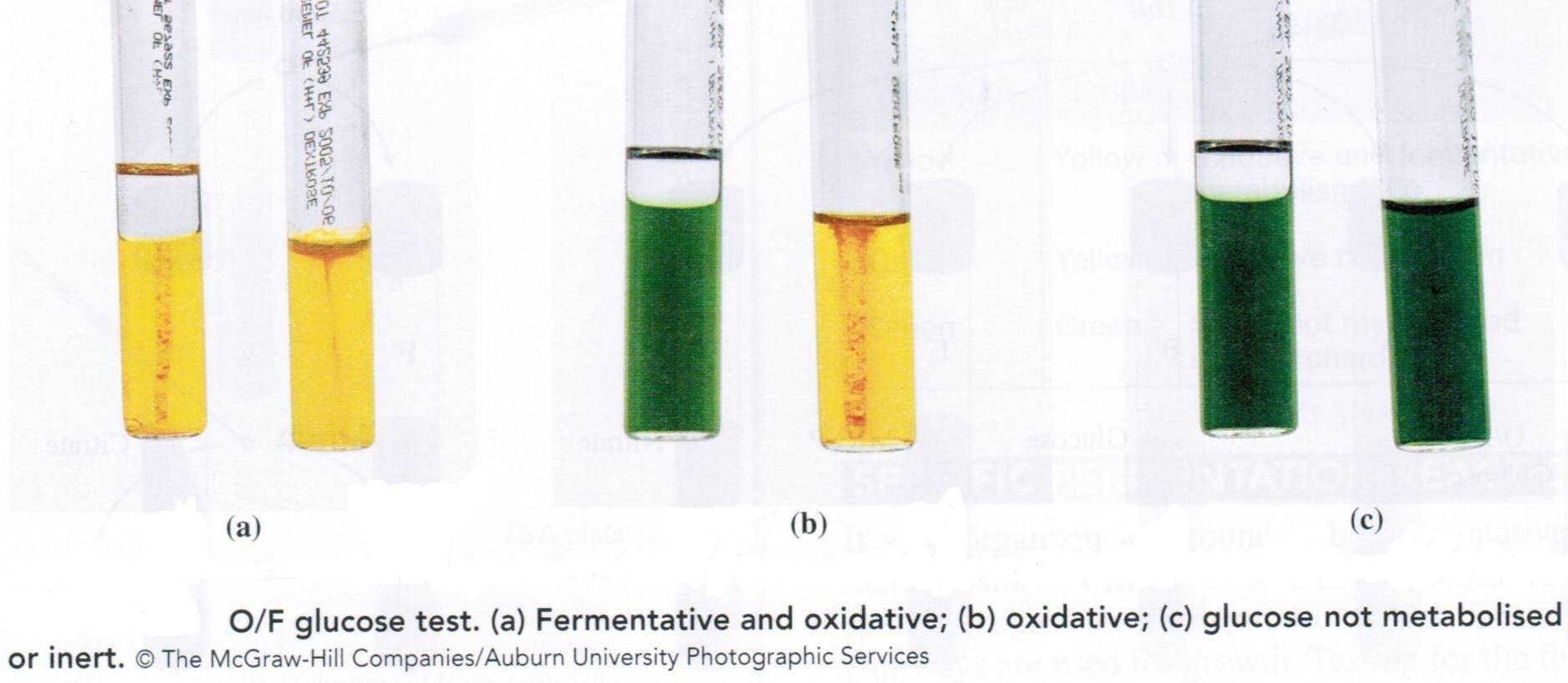 Figure: Oxidative Fermentative Test
Quality Control
- Glucose Fermenter: Escherichia coli
- Glucose oxidizer: Pseudomonas aeruginosa
- Nonsaccharolytic: Moraxella species
OF reactions by organism
| Organism | OF reaction | Note |
|---|---|---|
| Escherichia coli | Fermentative | Prototype fermenter; acid in both tubes |
| Klebsiella, Enterobacter | Fermentative | Enterobacteriaceae |
| Vibrio cholerae | Fermentative | Oxidase-positive fermenter |
| Pseudomonas aeruginosa | Oxidative | The classic non-fermenter; oxidase-positive |
| Burkholderia cepacia | Oxidative | Non-fermenter; cystic fibrosis pathogen |
| Alcaligenes faecalis | Nonsaccharolytic | Does not use glucose; open tube may turn blue |
| Acinetobacter baumannii | Oxidative or nonsaccharolytic | Oxidase-negative non-fermenter (the exception) |
| Stenotrophomonas maltophilia | Oxidative | Oxidase-negative non-fermenter (the exception) |
| Moraxella | Nonsaccharolytic | QC nonsaccharolytic control |
The two exceptions to hold onto: Acinetobacter and Stenotrophomonas are non-fermenters that are oxidase-negative, so they break the "oxidase-positive = non-fermenter" shortcut. Oxidase separates them from Pseudomonas; O-F confirms they are non-fermenters.
How to remember
Sealed tube = fermentation detector. The oil-sealed tube has no oxygen, so the only way it turns yellow is fermentation. Acid in the sealed tube means fermenter, full stop. If only the open tube goes yellow, the organism needs air to make acid, that is oxidative. If neither goes yellow, the organism ignored the sugar, that is nonsaccharolytic. Read the sealed tube first and half the answer is done.
Oxidase-positive + oxidative = Pseudomonas. This is the pairing that matters. O-F rarely travels without oxidase. An oxidase-positive Gram-negative rod that oxidizes but does not ferment is a non-fermenter, and the flagship non-fermenter is Pseudomonas aeruginosa. Add blue-green pigment and a grape smell and you barely need another test.
Low peptone is the whole trick. Oxidizers make so little acid that ordinary media miss it, because alkaline amines from peptone breakdown neutralize it. Starve the peptone, flood the glucose, and the faint acid finally shows. If you understand why the medium is peptone-poor, you understand the test.
Two exceptions: Acinetobacter and Stenotrophomonas. Both are non-fermenters but oxidase-negative, so they break the oxidase-positive shortcut. They are the same two exceptions that break the oxidase rule, worth learning once as a pair.
Key exam facts in one table
| Question | Answer | The reason behind it |
|---|---|---|
| What does the OF test determine? | Whether an organism ferments, oxidizes, or cannot use glucose | Distinguishes fermenters, oxidizers (non-fermenters), and nonsaccharolytic |
| Who developed it? | Hugh and Leifson, 1953 | To detect the weak acid of oxidative metabolism |
| Indicator | Bromothymol blue (green → yellow with acid) | Detects the pH drop |
| Why low peptone (~0.2%)? | Fewer alkaline amines to neutralize weak acid | The central design trick |
| Why high glucose (~1%)? | More weak acid produced | Pushes acid above the detection threshold |
| Why two tubes? | One open (aerobic), one sealed under oil (anaerobic) | The pattern across both is the result |
| What does the sealed tube prove? | Acid in the sealed tube = fermentation | No oxygen, so only fermentation can make acid there |
| Fermentative result | Yellow in both tubes | Acid made with or without air |
| Oxidative result | Yellow open tube, green sealed tube | Acid only with air |
| Nonsaccharolytic result | Green/blue open, green sealed | Glucose not used; peptone breakdown may alkalinize the open tube |
| Fermenter example | E. coli | Enterobacteriaceae |
| Oxidizer example | Pseudomonas aeruginosa | The classic non-fermenter |
| Nonsaccharolytic example | Alcaligenes faecalis | Does not use glucose |
| Paired test | Oxidase | Oxidase-positive + oxidative = Pseudomonas |
| Two oxidase-negative non-fermenters | Acinetobacter, Stenotrophomonas | Break the oxidase-positive shortcut |
| Why semisolid agar? | Allows acid diffusion and motility reading | Low agar (2%) |
| Incubation | 35°C, 48 hours (up to 3-4 days for slow growers) | Non-fermenters can be slow |
| QC fermenter / oxidizer / nonsaccharolytic | E. coli / P. aeruginosa / Moraxella | Standard controls |
Where students get confused
Reading one tube instead of the pair. The single defining error. Neither tube means anything alone. A yellow open tube could be oxidative or fermentative, you only know which by checking the sealed tube. Always read both tubes together, and read the sealed tube first to settle "fermenter or not."
Expecting an oxidizer to turn the sealed tube yellow. It cannot. Oxidative metabolism needs oxygen, and the sealed tube has none. If the sealed tube is yellow, the organism fermented, by definition. An oxidizer leaves the sealed tube green.
Wondering why you can't just use a normal sugar tube. Because a normal, peptone-rich tube would miss the weak oxidative acid entirely, neutralized by alkaline amines from peptone breakdown. The low-peptone OF medium exists precisely to make that faint acid visible. Using an ordinary fermentation tube on a Pseudomonas would wrongly suggest it does not use glucose.
Misreading a nonsaccharolytic open tube as negative-and-done. A nonsaccharolytic organism may turn the open tube blue (more alkaline than the starting green), because it is breaking down peptone and releasing amines. That blue is not a sugar reaction; it is protein metabolism. Both tubes lacking yellow is the nonsaccharolytic result.
Forgetting the oxidase pairing. An OF result is not an identification by itself. Oxidative alone does not name Pseudomonas; oxidative plus oxidase-positive does. And the two oxidase-negative non-fermenters, Acinetobacter and Stenotrophomonas, will read oxidative or nonsaccharolytic while being oxidase-negative, so O-F and oxidase must be read together.
Reading too early. Non-fermenters can be slow. A tube that is still green at 24 hours may be positive by 48 hours or later. Hold slow growers 3 to 4 days before calling nonsaccharolytic.
Sealing the tube poorly. If the mineral oil layer is too thin or broken, oxygen reaches the "anaerobic" tube and an oxidizer can produce acid there, mimicking fermentation. Use a full 1 cm oil layer.
Further resources:
- Hugh R, Leifson E. The taxonomic significance of fermentative versus oxidative metabolism of carbohydrates by various Gram-negative bacteria. J Bacteriol. 1953;66(1):24-26. doi:10.1128/jb.66.1.24-26.1953
- Shields P, Cathcart L. Oxidative-fermentative test protocol. American Society for Microbiology, 2013.
- Tille PM. Bailey and Scott's Diagnostic Microbiology. 15th ed. St. Louis: Elsevier; 2022.
- Procop GW, Church DL, Hall GS, Janda WM, Koneman EW, Schreckenberger PC, Woods GL. Koneman's Color Atlas and Textbook of Diagnostic Microbiology. 7th ed. Philadelphia: Wolters Kluwer; 2017.
- MacFaddin JF. Biochemical Tests for Identification of Medical Bacteria. 3rd ed. Philadelphia: Lippincott Williams & Wilkins; 2000.
Frequently Asked Questions
What is the difference between oxidative and fermentative metabolism in the OF test?
Why does OF medium contain so little peptone?
Why are two tubes used in the OF test?
How does the OF test help identify Pseudomonas aeruginosa?
What does a nonsaccharolytic result look like?
Which non-fermenters are oxidase-negative?

Tankeshwar Acharya, MSc (Medical Microbiology)
Tankeshwar Acharya is an Assistant Professor in the Department of Microbiology at Patan Academy of Health Sciences (PAHS), Nepal, where he has been teaching and practicing clinical microbiology for over 14 years. He is the founder of Microbe Online, one of the leading free microbiology education resources on the web, covering bacteriology, mycology, parasitology, immunology, and clinical laboratory diagnostics written from direct experience in both the classroom and the diagnostic laboratory.