
Nitrate Reduction Test: Why Red Means Positive, Unless It Means Negative

On this page
A microbiology student runs a nitrate broth on an unknown Gram-negative rod. After incubation she adds the two reagents, sulfanilic acid and alpha-naphthylamine, and watches for red. Nothing. The broth stays pale. She writes "nitrate negative" and moves on. She has just made the most common error in this entire test, and she has probably misidentified her organism.
No red does not mean the organism failed to reduce nitrate. It can mean the exact opposite: that the organism was so good at it that it pushed the reaction past nitrite, all the way to nitrogen gas, leaving no nitrite for the reagents to detect. A powerful nitrate reducer and a complete non-reducer give the same blank result at this stage. The test cannot tell them apart yet.
That is what the pinch of zinc is for. Zinc chemically reduces any nitrate still sitting in the broth down to nitrite. So if you add zinc and the tube turns red now, there was unreduced nitrate all along, which means the organism never touched it. Red after zinc is a negative result.
And if you add zinc and nothing happens? Then there was no nitrate left for the zinc to work on, because the organism had already reduced all of it and carried it away as gas. No red after zinc is a positive result.
One reagent color, three different meanings, depending entirely on when it shows up. This is the only test in the biochemical panel built like that, and it is why more students get nitrate wrong than almost any other reaction. This article is about reading it correctly, every time.
The nitrate reduction test detects whether an organism can use nitrate (NO₃⁻) as a terminal electron acceptor, reducing it to nitrite (NO₂⁻) and often further, to nitric oxide, nitrous oxide, ammonia, or nitrogen gas. The enzyme responsible is nitrate reductase, and the word that matters is reduction, not breakdown: the organism is adding electrons to nitrate, not cleaving it with water.
This is not a digestive test. It is a respiration test. Nearly all Enterobacteriaceae are nitrate positive, so the test is most useful not within that family but for separating organisms outside it, identifying Mycobacterium and Corynebacterium species, and distinguishing Neisseria species from look-alikes.
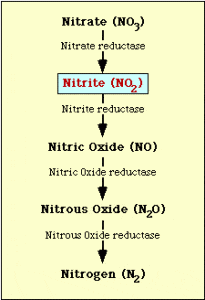 Figure: Nitrate Reduction Pathway
Principle: nitrate reduction is anaerobic respiration
Most students meet nitrate reduction as a color reaction and never learn what the organism is actually doing. It is worth thirty seconds, because it explains every result the test can give.
When oxygen runs out, some bacteria keep respiring by using something other than oxygen as the final electron acceptor at the end of their electron transport chain. Nitrate is one of the best substitutes. An organism with nitrate reductase can dump its electrons onto nitrate instead of oxygen, keep its chain running, and keep making energy in an anaerobic environment. This is called anaerobic respiration, and it is different from fermentation.
The reduction can stop at different points depending on the organism's enzyme set:
- Nitrate → nitrite. This is as far as most Enterobacteriaceae go. E. coli stops here. Nitrite accumulates in the broth, and the reagents detect it. Red.
- Nitrate → nitrite → nitrogen gas (N₂). Organisms with the full denitrification pathway, such as Pseudomonas aeruginosa, carry the reduction all the way to nitrogen gas, which bubbles off. No nitrite is left behind. No red at the reagent stage, even though the organism is an extremely active reducer.
- No reduction at all. The organism lacks nitrate reductase. Nitrate sits untouched in the broth. Also no red at the reagent stage.
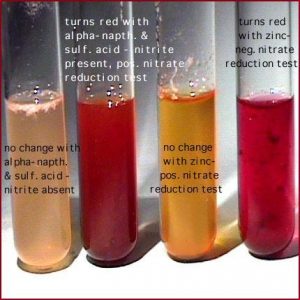 Figure: Nitrate reduction test experiments
Notice the problem this creates. The full denitrifier and the complete non-reducer both give a colorless broth after the first reagents. The test cannot distinguish "reduced it all the way past nitrite" from "never reduced it" using color alone. Resolving that ambiguity is the entire reason zinc exists in this procedure.
Requirements
- Media: Nitrate broth with inverted Durham tube
- Reagents: Sulfalinic acid reagent, alpha-naphthylamine reagent, zinc dust
- Others: Inoculating loop, Bunsen burner, dropper
Procedure
- Inoculate nitrate broth with a heavy growth of test organism using an aseptic technique.
- Incubate at an appropriate temperature for 24 to 48 hours
- Add one dropper full of sulfanilic acid and one dropper full of an alpha-naphthylamine to each broth. At this point, a color change to RED indicates a POSITIVE nitrate reduction test. If you get a red color, then you can stop at this point. No color change indicates the absence of nitrite. This can happen either because nitrate was not reduced or because nitrate was reduced to nitrite, then nitrite was further reduced to some other molecule. If you DO NOT get a red color, then you must proceed to the next step.
- Add a small amount of zinc (a toothpick full) to each broth. Zinc catalyzes the reduction of nitrate to nitrite. At this point, a color change to RED indicates a NEGATIVE nitrate reduction test because this means that nitrate must have been present and must have been reduced to form nitrite. No color change means that no nitrate was present. Thus no color change at this point is a POSITIVE result.
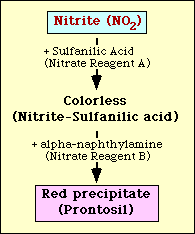 Figure: Fig. Diagrammatic representation of the detection of nitrite in medium
Result and Interpretation
- Nitrate Reduction Positive: (Red after sulfanilic acid + alpha-naphthylamine; no color after zinc)
- Nitrate Reduction Negative: (No color after sulfanilic acid + alpha-naphthylamine followed by Red after zinc)
Reading the Durham tube. If the nitrate broth contains an inverted Durham tube, check it before adding any reagents. Gas trapped in the Durham tube is direct evidence that the organism reduced nitrate all the way to nitrogen gas. A tube with gas is already telling you this is a complete denitrifier, which you will then confirm as "no red before zinc, no red after zinc." Note that some organisms also produce gas from carbohydrate fermentation, so gas in the Durham tube supports denitrification only in a nitrate broth with no fermentable sugar.
Why red means positive, unless it means negative
Read the test in two stages. Never skip stage two on a colorless tube.
Stage 1: add sulfanilic acid, then alpha-naphthylamine.
If nitrite is present in the broth, it forms nitrous acid, which reacts with sulfanilic acid to make a diazonium salt, which then couples with alpha-naphthylamine to form a red azo dye.
- Red now → POSITIVE. The organism reduced nitrate to nitrite. Stop. You are done.
- No red → you are not finished. Go to stage 2. A colorless tube here is ambiguous: it means either no reduction or reduction pushed all the way past nitrite to gas.
Stage 2: add a pinch of zinc dust.
Zinc is a chemical reducing agent. It reduces any unreduced nitrate still in the broth down to nitrite. So zinc is a probe for leftover nitrate.
- Red after zinc → NEGATIVE. There was unreduced nitrate for the zinc to act on, which means the organism never reduced it. The zinc did the job the organism failed to do.
- No red after zinc → POSITIVE (complete reduction). There was no nitrate left for the zinc to find, because the organism had already reduced all of it and carried it off as nitrogen gas. This is sometimes called a "positive complete" or denitrification result.
| What you see | Nitrite present? | Nitrate left? | Result | What the organism did |
|---|---|---|---|---|
| Red after reagents | Yes | — | Positive | Reduced nitrate to nitrite |
| No red, then red after zinc | No | Yes | Negative | Did not reduce nitrate at all |
| No red, then still no red after zinc | No | No | Positive (complete) | Reduced nitrate past nitrite to gas |
The single rule to carry out of here: red is only good news if it appears before the zinc. After the zinc, red is bad news.
Quality Control
| Organism | What it does | Stage 1 (reagents) | Stage 2 (zinc) | Interpretation |
|---|---|---|---|---|
| Escherichia coli ATCC 25922 | Reduces nitrate to nitrite | Red | — (stop at stage 1) | Positive |
| Pseudomonas aeruginosa ATCC 27853 | Denitrifies nitrate to N₂ gas | No red | No red | Positive (complete) |
| Acinetobacter baumannii | No nitrate reductase | No red | Red | Negative |
Running all three, rather than the usual two, is worth the extra tube here specifically because it puts one example of each outcome in front of the student. The Pseudomonas and Acinetobacter tubes both look identical at stage 1 and diverge only after zinc, which is exactly the distinction the test exists to make.
Nitrate reduction by organism
Positive (reduce nitrate to nitrite):
- Nearly all Enterobacteriaceae: E. coli, Klebsiella, Proteus, Salmonella, Shigella, Enterobacter, Serratia, Citrobacter. This near-uniformity is itself useful: a Gram-negative rod that is nitrate negative is unlikely to be a member of this family.
- Neisseria gonorrhoeae reduces nitrite but not nitrate; N. meningitidis reduces nitrate. This is a standard Neisseria speciation point.
- Most Mycobacterium tuberculosis strains are nitrate positive, which helps separate them from many nitrate-negative non-tuberculous mycobacteria such as M. avium complex.
- Corynebacterium diphtheriae is nitrate positive, separating it from C. ulcerans variants and other coryneforms.
Positive by complete denitrification (nitrate to gas, red only absent after zinc):
- Pseudomonas aeruginosa, the classic denitrifier.
- Some Bacillus species.
Negative (no nitrate reductase):
- Acinetobacter baumannii is characteristically nitrate negative, one feature separating it from nitrate-positive Enterobacteriaceae.
- Moraxella catarrhalis reduces nitrite but is nitrate negative; contrast with nitrate-positive Neisseria.
- Enterococcus and most streptococci.
How to remember
Red before zinc is good. Red after zinc is bad.
This is the whole test in seven words. Zinc is the villain's reveal: if the tube only blushes once zinc shows up, the organism was guilty of doing nothing. Say it out loud before every nitrate reading and you will not invert the result.
Zinc does the organism's homework.
Picture zinc as the student who copies the answer at the last second. If the tube turns red because zinc reduced the nitrate, that only proves the nitrate was still sitting there untouched, the assignment was never done, and the organism gets a negative. If zinc adds nitrate and still nothing happens, there was no homework left to copy because the organism already finished it and threw it away as gas. Positive.
The blank tube is a fork, not an answer.
Ask yourself before adding zinc: a colorless tube could be the best reducer in the rack or the worst. Which one am I about to find out? Holding that question in mind is what stops you writing "negative" on a denitrifier, which is the error the whole test is designed to prevent.
Enterobacteriaceae are almost all positive. So flip it: a nitrate-negative Gram-negative rod is probably not an enteric. That single contrapositive is most of the test's day-to-day diagnostic value.
Key exam facts
| Question | Answer | The reason behind it |
|---|---|---|
| What does the test detect? | The ability to reduce nitrate (NO₃⁻), using it as a terminal electron acceptor | It is a test of anaerobic respiration, not digestion |
| What enzyme? | Nitrate reductase | Adds electrons to nitrate; does not hydrolyze it |
| Stage 1 reagents | Sulfanilic acid, then alpha-naphthylamine | They detect nitrite by forming a red azo dye |
| Red after reagents | Positive | Nitrate was reduced to nitrite; nitrite is present |
| No red after reagents | Ambiguous, proceed to zinc | Could be no reduction, or reduction all the way to gas |
| Stage 2 reagent | Zinc dust | Chemically reduces any leftover nitrate to nitrite |
| Red after zinc | Negative | Unreduced nitrate was present; the organism never touched it |
| No red after zinc | Positive (complete / denitrification) | No nitrate was left; organism reduced it all to gas |
| The one-line rule | Red before zinc is positive; red after zinc is negative | The same color means opposite things by timing |
| What does the Durham tube show? | Nitrogen gas from complete denitrification | Direct evidence of a positive-complete result |
| Which family is nearly all positive? | Enterobacteriaceae | A nitrate-negative Gram-negative rod is probably not an enteric |
| Classic denitrifier | Pseudomonas aeruginosa | Full pathway to N₂; red only absent after zinc |
| Nitrate-negative Gram-negative | Acinetobacter baumannii, Moraxella catarrhalis | Separates them from nitrate-positive enterics and Neisseria |
| Neisseria point | N. meningitidis reduces nitrate; N. gonorrhoeae does not | Standard speciation distinction |
| Mycobacterium point | M. tuberculosis positive; many NTM negative | Helps separate TB from M. avium complex |
| Why incubate anaerobically-favoring? | Nitrate reduction is anaerobic respiration; O₂ competes as electron acceptor | High O₂ can suppress the reaction |
| QC positive (to nitrite) | E. coli ATCC 25922 | Stops at nitrite; red at stage 1 |
| QC positive (complete) | P. aeruginosa ATCC 27853 | Denitrifies; no red at either stage |
| QC negative | Acinetobacter baumannii | Red only after zinc |
Where students get confused
Calling a colorless stage-1 tube "negative." The single most common error, and the reason the hook exists. No red after the reagents is not a result. It is a fork. Add zinc before you write anything down. A complete denitrifier like Pseudomonas aeruginosa gives a colorless stage-1 tube and is strongly positive.
Getting the zinc logic backwards. Red after zinc feels like a positive because red felt like a positive a moment ago. It is not. Zinc reducing the nitrate proves the organism did not. Red after zinc is negative. Rehearse the one-liner: red before zinc good, red after zinc bad.
Not understanding what the zinc actually does. This is a real reader question from this article's own comment history. Zinc is a chemical reducing agent. It does to nitrate exactly what the organism's nitrate reductase would have done: turns it into nitrite. So a red color after zinc means there was leftover nitrate for the zinc to convert, which means the organism left it alone. Zinc is a probe for unreduced nitrate.
Ignoring the Durham tube. Gas in the Durham tube of a sugar-free nitrate broth is a complete-denitrification result you can read before touching a reagent. Students trained only on the color reaction walk past the most direct evidence in the tube.
Reproducibility failures from mixed or aged cultures. Another real reader question: "my repeat tests disagreed." Nitrate results must be reproducible for a pure isolate. When they are not, the usual causes are a mixed culture picked from confluent growth rather than a well-isolated colony, or reading past the recommended window. Always subculture to a single colony first.
Reading too much nitrate reduction into Enterobacteriaceae identification. Because nearly all enterics are positive, a positive result barely narrows anything within the family. The test earns its keep at the edges: separating Neisseria from Moraxella, identifying Mycobacterium and Corynebacterium, and flagging the rare nitrate-negative Gram-negative rod as probably-not-an-enteric.
Assuming red intensity means anything. A faint red and a strong red at stage 1 are both simply positive. The test is qualitative. Do not grade the color.
References
- Conn HJ, Breed RS. The use of the nitrate-reduction test in characterizing bacteria. J Bacteriol. 1919;4(3):267-290. doi:10.1128/jb.4.3.267-290.1919
- Fleming WH, Fierer J. Nitrate reduction: new method for testing the antibiotic susceptibility of Haemophilus influenzae. Antimicrob Agents Chemother. 1978;13(5):791-795. doi:10.1128/aac.13.5.791
- Leber AL, editor. Clinical Microbiology Procedures Handbook. 4th ed. Washington, DC: ASM Press; 2016. doi:10.1128/9781555818814
- Tille PM. Bailey and Scott's Diagnostic Microbiology. 15th ed. St. Louis: Elsevier; 2022.
- MacFaddin JF. Biochemical Tests for Identification of Medical Bacteria. 3rd ed. Philadelphia: Lippincott Williams & Wilkins; 2000.
Frequently Asked Questions
Why does red mean positive before zinc but negative after zinc?
How does zinc interact with unreduced nitrate to produce red?
My nitrate broth stayed colorless after adding the reagents. Is that negative?
What does no color change after adding zinc mean?
Why do my repeat nitrate tests give different results for the same isolate?
Is there a shortcut for which organisms are nitrate positive?
The most useful rule is that nearly all Enterobacteriaceae are nitrate positive, so a nitrate-negative Gram-negative rod is probably not a member of that family.
Beyond that, Pseudomonas aeruginosa is positive by complete denitrification, most Mycobacterium tuberculosis strains are positive, and characteristic negatives include Acinetobacter baumannii and Moraxella catarrhalis. Among Neisseria, N. meningitidis reduces nitrate while N. gonorrhoeae does not.
What is the inverted Durham tube for in the nitrate broth?
Why is the nitrate reduction test described as anaerobic respiration?

Tankeshwar Acharya, MSc (Medical Microbiology)
Tankeshwar Acharya is an Assistant Professor in the Department of Microbiology at Patan Academy of Health Sciences (PAHS), Nepal, where he has been teaching and practicing clinical microbiology for over 14 years. He is the founder of Microbe Online, one of the leading free microbiology education resources on the web, covering bacteriology, mycology, parasitology, immunology, and clinical laboratory diagnostics written from direct experience in both the classroom and the diagnostic laboratory.
Comments
No comments yet. Be the first to share your thoughts.
Leave a comment
All comments are reviewed before they appear.